Why You Must Read the Textbook (If You Want High Grades)
The short answer: Yes — O/L and A/L papers are set from the official syllabus and the government books: the Educational Publications Department textbooks for O/L, the NIE resource books for A/L — never from tuition handouts. Read the official book first for every topic, and let tuition notes, videos and guides reinforce it afterwards.
A chapter of the free book Learn to Learn
Published 2026-08-31 · updated 2026-08-31
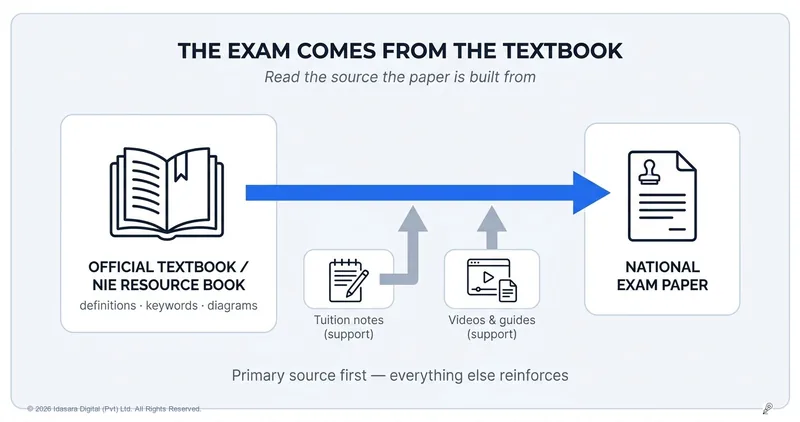
National exam papers in Sri Lanka are set from the official syllabus and the government textbooks — not from tuition handouts or internet summaries. This chapter of Learn to Learn explains where exam questions actually come from, why borrowed summaries quietly cost you marks, and how to make the textbook your primary source.
Here is a question worth sitting with for a moment: who writes your exam paper?
Not your tuition sir. Not a YouTube teacher. Not the author of the glossy revision guide from the bookshop. Your O/L and A/L papers are set by examiners working from one master reference — the official national syllabus, and the government textbooks and resource books written to teach it.
Now look at your own study desk. For many students, the tuition notes are worn soft from use, and the government textbook — the one document the paper is actually built from — sits in the bag, almost untouched.
Does that make sense?
The open secret
Think of it this way. Before every exam, the "question bank" is published openly, in your own language, and handed to you for free: it is the textbook. Every definition the marking scheme rewards, every diagram label the examiner checks, every worked method the paper expects — the official book is where they live.
- For O/L (Grades 6–11): your nine subjects rest on the textbooks of the Educational Publications Department — the government's own books, distributed free.
- For A/L: whatever your stream, the master reference is the official NIE resource books, published by the National Institute of Education — the same institute whose syllabus the paper must follow.
In simple terms: the examiner and the textbook answer to the same syllabus. The tuition handout does not have to.
What do borrowed summaries quietly cost you?
Are tuition notes and revision guides useless, then? No — and this book will never tell you to abandon a teacher who helps you. But when a summary becomes your first and only source, three quiet losses begin:
1. The steps go missing. A summary is, by definition, someone else's shortened version. It keeps the conclusion and drops the build-up — but essay questions award marks for the build-up. The full derivation, the intermediate step, the "show your working" — those live in the full text.
2. The words drift. Marking schemes reward precise syllabus terminology. A handout that says it "in easier words" may teach you a phrasing the scheme doesn't recognise. You knew the idea; you wrote the wrong words; the mark went elsewhere.
3. The labels vanish. Diagrams in informal guides are often redrawn and simplified — and the label the examiner is instructed to look for is exactly the one that got simplified away.
None of these losses announce themselves while you study. They surface on results day, as the mysterious gap between "I knew everything" and the grade on the slip.
The aha: read the source, then use everything else
So here is the order that changes outcomes: textbook first, everything else after.
Read the official chapter as your first encounter with a topic. Then let the tuition class deepen it, the video explain it another way, the guide drill it. Used in that order, every other resource becomes a helper. Used in the reverse order, they become a filter — and you sit the exam having only ever seen the syllabus through someone else's shortcut.
And there is a hidden bonus. National papers are written in the careful, formal language of the official books. A student who reads the textbook all year walks into the hall already fluent in the language the questions are asked in. That fluency is worth marks in every subject — and it is built silently, chapter by chapter.
Do this tonight
- Take the topic your class covered most recently.
- Find it in the official textbook or resource book — not the handout — and read the full section, start to finish.
- As you read, tick anything your class notes already cover, and mark anything the book has that your notes don't: a definition's exact wording, a labelled diagram, a worked example.
- That marked material is your evidence. Those details were always going to be on the exam paper — now they're in your notes too.
If you don't have a copy, you are not stuck: the Educational Publications Department and the Ministry of Education's e-thaksalawa portal publish the official books online, free.
At a glance
- Exam papers are set from the official syllabus and government textbooks/NIE resource books — not from tuition handouts.
- O/L: Educational Publications Department textbooks. A/L: official NIE resource books.
- Summaries lose three things that carry marks: intermediate steps, precise terminology, diagram labels.
- The winning order: textbook first, then tuition, videos and guides as reinforcement.
- Reading the official book all year also teaches you the exam's own language.
One step further with Idasara Academy
The textbook tells you everything — but not when. Idasara Academy's curriculum browser — free — maps every official topic for your grade across Term 1, Term 2 and Term 3, so you always know which chapter to read next and whether you're on pace. And when a chapter fights back, the Lesson Notes packs (a one-time purchase per subject) give you a grounded, syllabus-faithful walkthrough of the same topic to read beside the textbook — never instead of it.
Start Free — Create Your Account →
FAQ
Are tuition notes a waste of money? No. A good teacher's notes are excellent reinforcement — explanation, shortcuts, exam technique. The problem is only when they replace the primary source instead of supporting it.
The textbook is hard to read. What if I don't understand it? That's normal, and it is not a reason to retreat to summaries. Keep reading to the end of the section — textbooks often clarify themselves through the worked examples that follow. A later chapter of this book, on reading even when you don't understand, covers exactly this.
Where do I get the official books if mine are lost or damaged? The Educational Publications Department publishes O/L textbooks online, and the Ministry of Education's e-thaksalawa portal carries official learning materials — both free. NIE publishes the A/L syllabi and resource materials.
Does this apply to subjects like English and Mathematics too? Yes — and doubly for the subjects your marks swing on. Wherever a marking scheme exists, it was written beside the official text, not beside a private handout.
Further reading
This chapter is the first move of a larger system. The full write-up — primary sources, handwritten notes, and the 7-move learning loop — is in the Idasara Method: Part 1 — The Human Foundation & Active Recall.
Sources
- Educational Publications Department, Sri Lanka (official school textbooks, free download): edupub.gov.lk
- National Institute of Education, Sri Lanka (A/L syllabi & resource materials): nie.ac.lk
- Ministry of Education — e-thaksalawa learning portal: e-thaksalawa.moe.gov.lk
- The Idasara Method: Part 1 — The Human Foundation & Active Recall