Why Highlighting Doesn't Work (and What Your Brain Needs Instead)
The short answer: No — highlighting marks the page without making your brain produce anything, so it builds familiarity rather than memory, and research reviews rank it among the least effective study techniques. What works is the reverse: read with the pen down, close the book, and write what you remember on a blank page.
A chapter of the free book Learn to Learn
Published 2026-08-31 · updated 2026-08-31
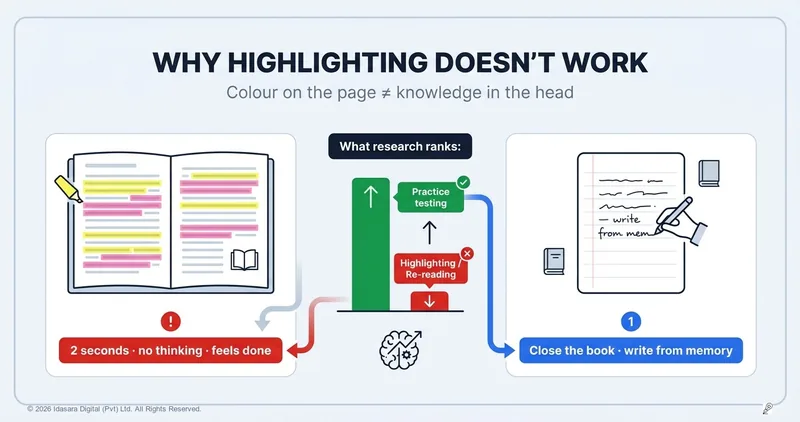
Highlighting feels like studying, but research reviews rank it among the least effective study techniques — because it marks text without making your brain retrieve anything. This chapter of Learn to Learn explains why the rainbow textbook fails, the one honest use a highlighter still has, and what to do instead.
Open the textbook of a hard-working student and what do you see?
Yellow. Pink. Green. Whole paragraphs glowing like a festival. Every colour is a promise: this is important — I will remember this.
Now ask that same student, three weeks later, to write down what the yellow paragraph said. Silence. The colour stayed on the page. The knowledge did not stay in the head.
Why does a tool every student owns, and almost every student trusts, work so poorly?
What does highlighting actually do?
Think about the moment you highlight. Your eyes find a sentence that looks important. Your hand drags the pen across it. Total time: two seconds. Total thinking: almost none.
You have not explained the sentence to yourself. You have not connected it to anything. You have not tried to remember it. You have simply marked it — the way you might fold the corner of a page. In simple terms: highlighting is a note to your future self saying "learn this later." It is not the learning.
The trouble is that it feels like learning. Ink went down. The page changed. Something visible happened. That feeling of progress is exactly what makes highlighting so popular — and so dangerous.
This is not just an opinion. A major research review by John Dunlosky and colleagues examined ten common study techniques across hundreds of studies and rated highlighting and re-reading among the least effective techniques of all — while practice testing, the simple act of making your brain produce answers, sat at the very top.
Why does your brain fall for it?
Your brain has two very different abilities that feel the same from the inside.
One is recognition — seeing something and sensing "I've seen this before." The other is recall — producing something from memory onto a blank page, with no text in front of you.
Highlighting, and re-reading your highlights, trains recognition. Each time you look at the glowing paragraph, it feels more familiar, and familiarity whispers: you know this. But the exam hall never tests recognition. It hands you a blank sheet and demands recall — and recall was never practised.
That gap between familiar and known has a name: the illusion of competence. It is the single most expensive illusion in a student's life, and the highlighter is its favourite tool.
There is a second problem: time. Even if a highlight leaves a faint trace, most of what you passively read is gone within a day or two — the forgetting curve, which has its own chapter in this book. Colour does not slow the forgetting. Retrieval does.
What should you do instead?
The fix is almost embarrassingly simple. Wherever you feel the urge to highlight, make your brain produce instead of mark.
- Read the section with your pen down. No colouring. Just understand.
- Close the book and write. From memory, in your own words — the ideas, the formula, the diagram. This is the short-note method, and it is the exact opposite of highlighting: hard while you do it, permanent afterwards. (The chapter How to Take a Good Short Note walks you through it.)
- Test yourself, don't re-read yourself. At the end of the week, do not re-read the chapter — attempt the end-of-chapter questions with the book closed. Every question you answer from memory is worth more than an hour of re-reading, and the research review above rated practice testing among the most broadly effective techniques it measured.
Notice what these three moves have in common. In each one, the knowledge travels out of you — onto a blank page, into an answer. Highlighting only ever travels along the page.
The one honest use of a highlighter
Should you throw the highlighter away? Not quite. It has one job it does well — after the real work is done.
When you have written your short note from memory and you compare it against the book, mark only what you missed — the forgotten unit, the mislabelled diagram, the condition you dropped. Red pen or highlighter, the principle is the same: colour becomes a map of your weak spots, not decoration for the whole chapter.
A page fully highlighted says nothing. A page with three marks says: these three things — this is where my memory failed. Start here next time. That is a highlighter earning its place.
Do this tonight
Take the chapter you most recently studied. Close the book. On a blank page, write everything you remember — five minutes, no peeking. Then open the book and compare.
The gap you see between the glowing paragraphs and your blank page is not a reason to feel bad. It is the most useful piece of information you have collected all term — because now you know what studying has to feel like: not smooth and colourful, but effortful and blank-page-first. Every student who makes that switch discovers the same thing: the marks were never about talent. They were about what the hours actually did.
At a glance
- Highlighting marks text; it does not make your brain retrieve anything — so it builds familiarity, not memory.
- Research reviews rate highlighting and re-reading among the least effective study techniques; practice testing ranks top.
- The exam tests recall (blank page), but highlighting trains recognition (familiar page).
- Replace it: read pen-down → close the book → write from memory → self-test weekly.
- Keep one honest use: after self-checking, colour only what you missed — a map of weak spots, not a costume.
One step further with Idasara Academy
The strongest replacement for re-reading is being asked questions — again and again, on exactly the topics you studied. That's what Idasara Academy's micro-quizzes are for, and they're free to start: open the topic you just highlighted, take its quiz with the book closed, and watch what the colour never told you. Every slip is remembered by the system, so the same weak spot comes back until it is closed. Practice testing, made automatic.
Start Free — Create Your Account →
FAQ
Is highlighting completely useless? As a way of learning, essentially yes. As a way of flagging — marking what you missed after a memory check, or tagging a confusing line to ask about later — it is genuinely useful. The difference is whether your brain worked before the ink went down.
My teacher tells us to highlight key points. Should I stop? No — but change what it means. Let the teacher's highlight tell you what matters; then close the book and prove you can write that point from memory. The highlight is the question list, not the studying.
Is re-reading the chapter before the exam also a waste? Mostly, if it's your main method — it produces the same false familiarity. Far stronger: attempt questions or rewrite your short note from memory, then look back at the text to patch exactly what failed.
Why does highlighting feel so productive if it does so little? Because something visible happens, and your brain rewards visible progress. Real learning often feels the opposite — slow, effortful, full of blanks. In studying, the discomfort is usually the signal that it's working.
Further reading
This chapter is part of the foundation of a larger system. The full write-up — active recall, the illusion of competence, and the 7-move learning loop — is in the Idasara Method: Part 1 — The Human Foundation & Active Recall.
Sources
- Dunlosky, J. et al. (2013). Improving Students' Learning With Effective Learning Techniques, Psychological Science in the Public Interest — overview at the Association for Psychological Science
- Murre, J. & Dros, J. (2015). Replication and Analysis of Ebbinghaus' Forgetting Curve, PLOS ONE
- The Learning Scientists: Learn How to Study Using… Retrieval Practice
- The Idasara Method: Part 1 — The Human Foundation & Active Recall