How to Take a Good Short Note (the 3-Pass Method)
The short answer: Read one textbook section with no pen, then close the book and write the main ideas, formulas, and diagrams from memory in your own words, then compress the lot into two or three dense pages. Check against the book and correct in red — the struggle to remember is the studying.
A chapter of the free book Learn to Learn
Published 2026-08-31 · updated 2026-08-31
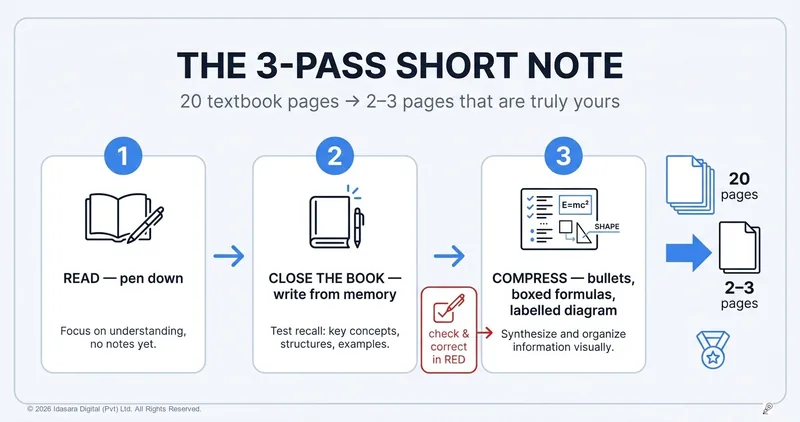
A short note is two or three handwritten pages that hold a whole textbook chapter — written from memory, in your own words, after you read. This chapter of Learn to Learn shows you the 3-pass method: read without a pen, write with the book closed, then make it dense. It works for any subject, from Grade 8 to A/L.
Have you ever borrowed a friend's short notes the night before a paper?
They looked perfect. Neat headings, boxed formulas, everything underlined in two colours. You read them three times. And the next morning, in the exam hall, you stared at the question — and the page in your mind was blank.
Why does that happen?
Why doesn't copying count as studying?
Here is the uncomfortable truth: most of what students call "short notes" are not short notes at all. They are copies. Copied from the textbook, copied from the tuition board, copied from a friend.
Copying feels like studying. Your hand is moving, the page is filling, the evening feels productive. But your brain is doing almost nothing. It is recognising words, not retrieving them — and an exam never asks you to recognise. It hands you a blank page and asks you to produce.
In simple terms: reading and copying build a feeling of "I know this." Only pulling something out of your own memory builds the ability to write it when it matters.
And memory fades fast: most of what we read is gone within a day or two unless we actively bring it back to mind — the forgetting curve, which has its own chapter in this book. Not because you are lazy. Not because you are weak at studying. Because that is how every human brain works.
So the real question is not "How do I make my notes look good?" It is "How do I make my brain do the work?"
The aha: the note is not the treasure
Here is the reframe that changes everything.
A good short note is not a product you make so you can study later. The making of the note is the studying. The struggle to remember — book closed, pen in hand, brain searching — is the exact moment learning happens. The two or three pages you end up with are almost a by-product. A valuable one, yes. But the treasure was the effort.
Once you see it this way, the method becomes obvious.
The 3-pass method
Pass 1 — Read, with no pen. Take one section of your textbook — two or three pages, not the whole chapter. Put the pen down. Read to understand: What is this section really saying? What is the main idea, what are the parts, what connects them? If something confuses you, keep reading to the end of the section anyway — later paragraphs and worked examples often clear it up.
Pass 2 — Close the book. Write from memory. Now shut the textbook. In your own notebook, write down the main ideas, the definitions, the formulas, the rough diagram — from memory, in your own words. This will feel harder than copying. It should. That difficulty is your brain building the connection. Only open the book if you are completely stuck, check the one thing you need, and close it again.
Pass 3 — Make it dense. A 20-page chapter should become two or three pages. Use short bullet points, not sentences from the book. Box the formulas. Draw the diagram and label it. Give every section a clear heading. If your note is ten pages, you have written a summary, not a short note — squeeze it again.
Then check yourself. Open the book (or a trusted digital summary) one more time and compare. Did you miss a unit? A condition? A label on the diagram? Add the corrections in red ink. Weeks later, when you revise, your eyes will jump straight to the red — the exact places your memory was weak.
Why by hand?
Because handwriting is slow — and that slowness is a gift. You cannot write everything, so your brain is forced to choose what matters and say it in your own words. A well-known study of note-taking found exactly this: students who typed captured more words but understood less, because typing invites copying while handwriting forces thinking.
There is a practical reason too. Your O/L or A/L paper is three hours of continuous handwriting. Every evening of handwritten notes is quietly training the speed and stamina your hand will need on the day it counts.
Do this tonight
- Pick one section of one subject — just two or three pages.
- Read it once, pen down.
- Close the book. Write half a page from memory: ideas, formula, diagram.
- Compare with the book. Correct in red.
- Look at what you wrote. That half page is worth more than an hour of highlighting — because it came out of you.
Small, yes. But a student who does this for one section every day walks toward exam season owning their syllabus — and owning a skill no exam can take away.
At a glance
- A short note = 2–3 handwritten pages per chapter, written from memory, in your own words.
- The making of the note is the studying; the pages are the by-product.
- Pass 1: read a section with no pen. Pass 2: book closed, write from memory. Pass 3: compress — bullets, boxed formulas, labelled diagrams.
- Check against the book afterwards; correct in red ink.
- Handwriting beats typing for understanding, and trains exam stamina.
One step further with Idasara Academy
The hardest part of the method is the self-check: how do you know your note isn't confidently wrong? Idasara Academy's short notes — free to start — hold a curriculum-checked summary of every topic in your grade: put your handwritten note beside the screen, compare line by line, and mark what you missed in red. Your note stays yours; the tool is the mirror. (And micro-quizzes on the same topic tell you, cold, whether the note went in.)
Start Free — Create Your Account →
FAQ
Can I type my short notes instead? You can, but you lose twice: typing invites word-for-word copying (less thinking), and it gives your hand zero practice for a three-hour handwritten paper. Type only things like vocabulary lists you want to search later.
How long should a short note be? Roughly one page of notes for every seven to ten pages of textbook. If it's much longer, you are copying, not compressing.
Can I just use my friend's — or my tuition class's — short notes? Read them, by all means. But they cannot replace yours, because their value was created in the writing, and someone else did that writing. Their brain got the exercise; yours got a photocopy.
When should I make short notes — before or after the lesson is taught in class? Ideally before. Walking into class already holding your own rough note turns the lesson into a checking-and-deepening session instead of a first encounter.
Do mind maps count as short notes? Yes — a mind map drawn from memory is a short note in a different shape, and it works especially well for topics with many connected parts. A later chapter of this book covers exactly how.
Further reading
This chapter is one move of a larger system. The full write-up — including the question log, the self-comparison protocol, and the rest of the 7-move learning loop — is in the Idasara Method: Part 1 — The Human Foundation & Active Recall.
Sources
- Mueller, P. & Oppenheimer, D. (2014). The Pen Is Mightier Than the Keyboard — summarised by the Association for Psychological Science: Take Notes by Hand for Better Long-Term Comprehension
- Murre, J. & Dros, J. (2015). Replication and Analysis of Ebbinghaus' Forgetting Curve, PLOS ONE
- The Learning Scientists: Learn How to Study Using… Retrieval Practice
- The Idasara Method: Part 1 — The Human Foundation & Active Recall