No App Can Learn For You (Including Ours)
The short answer: No app — including ours — can learn for you, because learning happens only in the effortful moment knowledge comes out of your own memory, onto paper. The best study tool is whichever one structures, checks, and schedules that effort, and there is a one-question test for any of them: after ten minutes, has anything come out of you?
A chapter of the free book Learn to Learn
Published 2026-08-31 · updated 2026-08-31
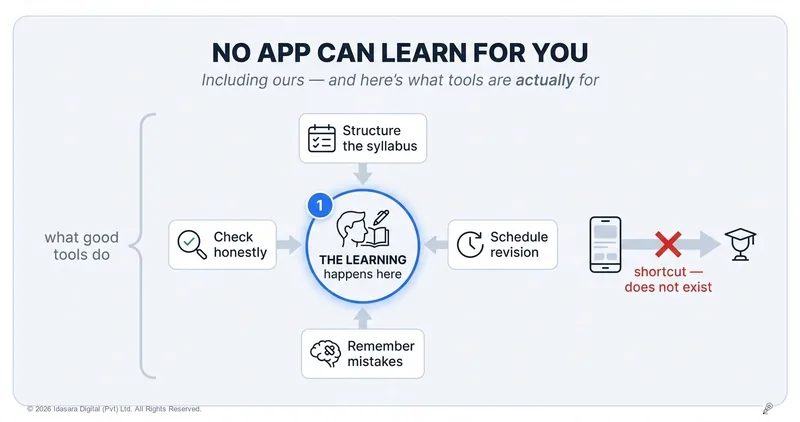
Every year, students download study apps, subscribe to video channels, and ask AI for answers — and marks still don't move, because learning happens only through the learner's own effort. This chapter of Learn to Learn is an honesty statement: what technology genuinely can do for a student, what it never will, and how to tell the difference before you spend hope on it.
This book is written by the people who built a learning app. So the sentence that follows may surprise you — but it shouldn't, because everything else in this book depends on it being said plainly:
No app will get you an A. Not any app on your phone. Not ours.
If that sounds like strange marketing, good — it isn't marketing. It is the foundation this whole book is built on, and any student who doesn't hear it eventually pays for the silence. So let's spend one honest chapter on it.
The comfortable illusion of the downloaded solution
You have seen this cycle — in a classmate, or in the mirror.
A student is struggling. They download the famous app. For a week, there's a glow of progress — streaks, badges, videos watched, percentages climbing. It feels like the problem is being handled. Then the term test arrives, the marks are unchanged, and the app joins its predecessors in a folder on the third screen of the phone.
What went wrong? Nothing went wrong — something was misunderstood. Watching, tapping, and collecting streaks are all knowledge flowing in — the same comfortable direction as re-reading and highlighting, wearing a nicer interface. But as this book's opening chapters showed, learning is manufactured in one place only: the effortful moment when knowledge is pulled out of your own memory — onto paper, into an answer, through your pen. No screen can have that moment for you. It happens between your mind, your pen, and your textbook, or it does not happen.
The newest version of the illusion is the most seductive: asking an AI for the answer and copy-pasting it into homework. The answer appears — polished, instant, correct. And precisely nothing has entered the student, as they discover in the exam hall, where the AI is not permitted to sit. A perfect answer you didn't produce is someone else's rung on the ladder — the grade ladder, climbed action by action.
In simple terms: technology can carry information to your door. Only effort carries it into your mind.
What do good tools genuinely do?
Now the other half of the honesty — because the answer is not to throw the phone in the river. Used correctly, good tools do things for a student that are real, and hard to get any other way. They just all share one shape: a good tool structures, checks, and schedules your effort. It never replaces it.
- Structure: a term map of the official syllabus that tells you what deserves tonight's effort, so your energy isn't spent on choosing.
- Honest checking: your handwritten attempt marked against real standards, today — instead of a misconception sitting uncorrected until exam week. Feedback is where technology genuinely shines; a machine can check your fiftieth answer with the same patience as your first.
- Scheduling memory: the forgetting curve managed for you — each topic returning as questions at the right interval, so the remembering happens on schedule.
- A memory of your mistakes: the list every A-student keeps, maintained automatically, so your practice aims at your actual weaknesses.
Read that list again and notice what every item has in common: each one ends with you doing effortful work — reading, writing, answering, correcting. The tool aims the effort and verifies the result. The effort is still, unavoidably, yours.
That gives you a permanent test for any study tool, ours included, and it fits in one question: after ten minutes with this tool, has anything come out of me — or have I only been watching things go in? If a session with an app never involves your pen moving on paper, your memory being tested, or your mistakes being confronted, then whatever it's building, it isn't your grade.
Why are we telling you this?
Because the alternative — letting students believe the download is the solution — costs them a year they don't have. And because this book's whole promise depends on you aiming your hope at the right target.
Your effort is the engine. The method — short notes from memory, question logs, honest marking, spaced revision, the ladder — is the design that stops the engine leaking. A good tool is the housing that keeps the engine running daily without heroic willpower. In that order. Always in that order. A student with method and no app will beat a student with every app and no method, every single time — and the best possible student is the one who knows the app is the third ingredient, not the first.
Idasara Academy was built as exactly that third ingredient: every feature in it exists to trigger, check, or schedule work that happens in your notebook, in your handwriting, in your head. If you ever find yourself using it — or anything — in a way where nothing comes out of you, close it and pick up your pen. That is not disloyalty to the app. That is the method the app was built to serve.
And since a chapter this honest shouldn't go silent at the obvious question: it's free to start, a paid plan costs from Rs 3,000 a month for all subjects together — about one tuition class — the full engine with the honest checking above starts at Rs 4,500 (Rs 9,000 at A/L), and every new account gets 42 days of it free. It works fully in Sinhala, Tamil and English. Now you know, and we can go back to the important part: the method is yours either way.
Do this tonight
- Open the study apps and channels you currently use. For each, ask the one-question test: does a session make knowledge come out of me, or only flow in?
- Keep what makes you produce, check, and correct. Be honest about what is entertainment dressed as education — you don't have to delete it, just stop counting it as studying.
- Then do twenty minutes of the oldest technology in this book: textbook open, then closed, and a page of your own retrieval. Let every tool you keep prove it serves that.
At a glance
- No app produces learning — learning happens only in the effortful moment knowledge is pulled out of your memory, and no screen can have that moment for you.
- Watching, tapping, streaks, and copy-pasted AI answers are inflow — comfortable, and unpaid by any exam.
- Good tools do four real things: structure the syllabus, check your work honestly, schedule your revision, and remember your mistakes — all of which end in your effort, never replace it.
- The one-question test for any tool: after ten minutes, has anything come out of me?
- Order matters: effort → method → tool. A student with method and no app beats the reverse, always.
FAQ
So why use a study app at all? For the four real functions: aiming your effort, checking it honestly, scheduling your memory, and tracking your weaknesses. Doing those manually is possible — this book teaches the manual versions — but doing them daily, across nine subjects, for a year, is where most willpower breaks. Automation of the system is valuable; automation of the learning is impossible.
Is asking AI questions cheating, then? Asking a precise question about your own confusion and writing the understanding back in your own words — that's the question log working, and it's excellent studying. Submitting AI's words as your own work — that's renting knowledge until exam day, when the lease expires. Same tool; opposite directions of flow.
My child spends hours on educational apps. Is that studying? (for parents) Apply the test together, kindly: after a session, can they produce something on paper — an explanation, a solved problem — with the screen off? If yes, the hours are real. If no, you've found the leak, and it isn't laziness; it's misdirected sincerity.
Isn't it strange for Idasara to publish this? Only if a tool needs students to misunderstand learning in order to be used. We'd rather be the third ingredient in a student who succeeds than the first ingredient in a student who doesn't.
Further reading
The manifesto behind this chapter — technology amplifies human effort, never replaces it — opens the Idasara Method: Part 1 — The Human Foundation & Active Recall.
Sources
- Dunlosky, J. et al. (2013). Improving Students' Learning With Effective Learning Techniques — overview at the Association for Psychological Science
- UCLA Bjork Learning and Forgetting Lab — research overview on generation and effortful learning
- The Idasara Method: Part 1 — The Human Foundation & Active Recall