The Exam Hall Has No Wi-Fi: Why Rented Knowledge Fails on Paper
The short answer: The risk is rented knowledge: when AI completes your homework, the results are real but the knowledge lives in the chat log — and Sri Lankan national exams are handwritten, offline, and unassisted, so the rental expires at the exam-hall door. Protect yourself with one nightly question: could I reproduce this tomorrow, on paper, with everything switched off?
A chapter of the free book Learn to Learn
Published 2026-08-31 · updated 2026-08-31
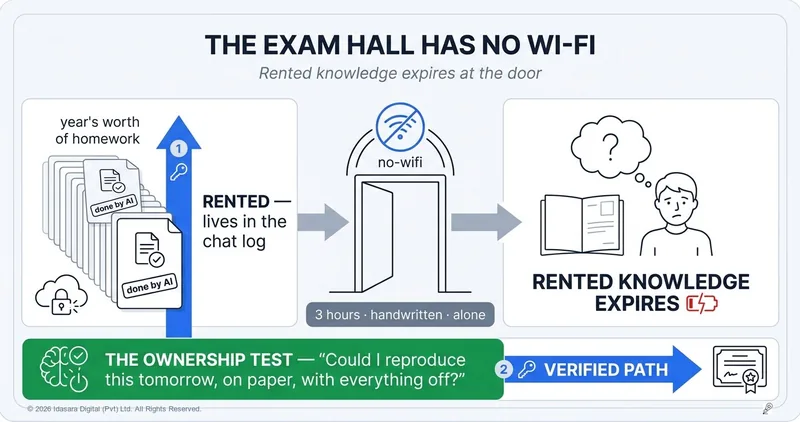
Sri Lankan national exams are handwritten, unassisted, and offline — while more and more of students' daily "knowing" quietly runs through AI. This chapter of Learn to Learn is about that collision: what the exam actually audits, the rented-knowledge trap, and the one question that tells you whether you own what you think you know.
Spend a moment inside the room where your next two years are heading.
Rows of desks. A question paper. A blank answer script. A pen. A clock. And you — exactly and only what's inside you. No phone. No search. No chat window. For three hours, the most connected generation in history is completely, deliberately offline.
That room hasn't changed in fifty years. What has changed — massively, in just the last few — is how students arrive at it. Between now and that morning stand hundreds of evenings in which every piece of homework, every essay, every hard question can be quietly completed by AI. The room is the same. The road to it is unrecognisable.
Which creates the defining trap of your student generation, and it deserves its own chapter.
What's wrong with letting AI do your homework?
When AI produces your homework answer, something real is delivered: the homework gets done, the exercise book fills, the teacher's tick arrives. It feels like progress, because a result exists.
But look at where the knowledge lives. It lives in the chat log. It made a brief stop in your eyes on its way to your exercise book — long enough to copy, not long enough to keep. This book has a word for what you hold afterwards: rented knowledge. It works beautifully while the connection is open. It was never yours.
Renting feels like owning all year — that's the trap's engine. The homework record says you can do integration by parts; the essay file says you can structure an argument in formal English; every visible artifact of your education says competent. Then you walk into the offline room, the rental agreement expires at the door, and the audit begins: three hours of pure ownership-testing. Not "was your homework correct?" but "can you, alone, produce?"
And here is the detail that makes the collision truly expensive: the exam doesn't just audit content ownership. It audits production capacity — retrieving under pressure, composing in formal language at speed, writing legibly for three hours. Every one of those is a capacity built only by repetition — repetitions that AI-completed homework silently cancelled, one evening at a time, all year. The copy-paste student didn't just skip learning the chemistry; they skipped a year of training in the act the exam consists of.
The nightly ledger
It helps to see the year as a ledger, because every evening posts an entry whether you notice or not.
A homework problem faced with your own pen — struggled through, checked, corrected — posts to owned: content plus one more rep of production. The same problem completed by AI posts to rented: a visible result, zero deposit. Neither entry announces itself; both compound. Two students with identical tick-filled exercise books can arrive at the hall carrying utterly different balances — and the paper, in its blunt offline way, prints the balance for each.
This, finally, is the honest answer to "why does it matter, if the homework's done?" The homework was never the asset. It was the record of that night's real work — or the cover for its absence.
None of this, note carefully, is an argument against AI. The previous chapter drew the line that matters: AI-as-tutor posts to owned — a resolved confusion is a deposit, and a good tutor accelerates depositing. It's specifically the vending-machine mode that posts to rented. Same tool; opposite ledger entries. The exam hall is simply where the ledger becomes public.
How do you know what you actually own?
You don't need to wait for the hall to learn your balance. One question, applicable any evening, tells you which column tonight's work landed in:
"Could I reproduce this tomorrow, on paper, with everything switched off?"
Not "did I finish it" — finishing is compatible with renting. Not "did I understand it when I read it" — you know from the illusion-of-competence chapter what that feeling is worth. Reproduce, alone, on paper. If yes, you own it. If you're not sure — the test costs one blank page and five minutes, and this book has taught you to run it.
Students who adopt this single question report a strange effect: it changes their behaviour before they run it. Knowing the test exists makes copy-pasting feel like what it is — deferring a debt to your future self, with the exam as collector.
Do this tonight
- Pick one piece of recent work an AI helped with (any mode — honest audit, no guilt).
- Run the ownership test: blank page, everything off, reproduce it — the solution, the essay's argument, the explanation.
- Whatever won't reproduce, do tonight with your own pen: attempt, struggle, check. Post one real deposit — then notice the difference in how it feels. That difference is your new detector.
At a glance
- The national exam room is offline by design: three hours of unassisted, handwritten production — an ownership audit.
- AI-completed work creates rented knowledge: real results, living in the chat log, expiring at the exam door.
- The audit covers more than content: production capacity (retrieval under pressure, formal composition, writing stamina) — built only by the reps that copy-pasting cancels.
- Every evening posts to the ledger: pen-first work → owned; vending-machine AI → rented. Tutor-mode AI posts to owned — the mode, not the tool, decides.
- The ownership test: could I reproduce this tomorrow, on paper, with everything off?
One step further with Idasara Academy
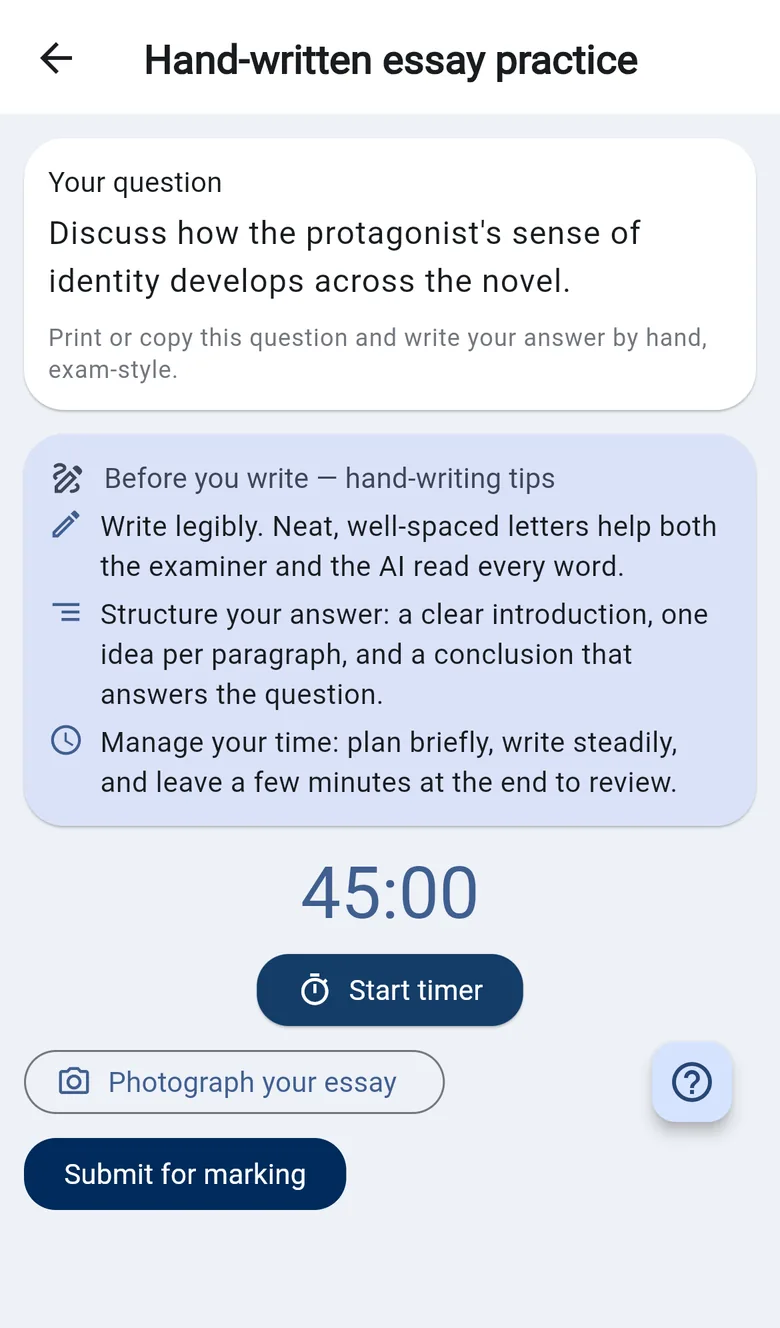
The exam's format — handwritten, unassisted, marked against an official scheme — is trainable all year, and that's precisely what Idasara Academy's Exam Paper Marking (paid tiers) exists for: you answer on paper, alone, by hand; photograph the page; and get it marked against the real standard. This is also the one job in this chapter no chat window can do for you — chatbots read typing, not your three pages of handwritten working. Every upload is one rehearsal of the exact act the offline room will demand, with the feedback loop the room never gives.
Start Free — Create Your Account →
FAQ
Won't exams eventually allow AI anyway? Perhaps, someday, in some forms — but your O/L and A/L are set, dated, and paper-based, and they gate your next decade. Prepare for the exam that exists. (And the deeper capacities it audits — retrieval, composition, clear writing — are exactly what the AI-rich workplace pays for too; a later chapter takes this up.)
I use AI for everything and my school marks are fine. Doesn't that prove it's working? It proves the rental economy works during term time — school marks partly measure completed work, which renting produces. The national exam measures only ownership. The gap between the two is invisible until it's printed on a results slip; the ownership test lets you see it now, for free.
Is using AI to check my finished work also renting? No — that's one of the best mode-two uses there is: you produced first, alone, and the AI audits. Production yours, feedback theirs. That's the same shape as every honest feedback loop in this book.
How do I break a year-long copy-paste habit with exams approaching? Start where the marks are: past-paper questions, pen first, under time, marked honestly. It will feel dramatically harder than your homework ever did — that's the deferred debt presenting its bill early, while there's still time to pay it down. Every unassisted rep from today is a real deposit.
Further reading
Why the method insists on handwritten, unassisted practice all year — and how the paper-marking loop trains the exam's exact format — is written up in the Idasara Method: Part 3 — The Grade Progression Ladder & Paper Marking.
Sources
- UNESCO — Artificial intelligence in education: a human-centred approach
- Dunlosky, J. et al. (2013). Improving Students' Learning With Effective Learning Techniques — overview at the Association for Psychological Science (practice testing and production)
- The Idasara Method: Part 3 — The Grade Progression Ladder & Paper Marking