10. Conclusion, the 5 Golden Rules, and the Path Forward
Published 2026-09-14
Core Theme: GPT-4 was like a single consultant; GPT-5 became a team of consultants; GPT-6 has become an intellectual companion sitting right beside you. Today, a team of PhDs has arrived at your very home. The problem is not that the models are becoming powerful; it is whether we are prepared to ask those powerful models the right question and put them to work.
How far have these models moved in eighteen months?
When the first session of this training series was delivered at the Presidential Secretariat in April 2025, the world's leading model was ChatGPT-4, and the ordinary administrative world had barely heard of Claude or DeepSeek.
The distance travelled since then is easier to grasp through an analogy than through benchmark scores, because what changed was not raw capability alone but the kind of colleague the technology resembles.
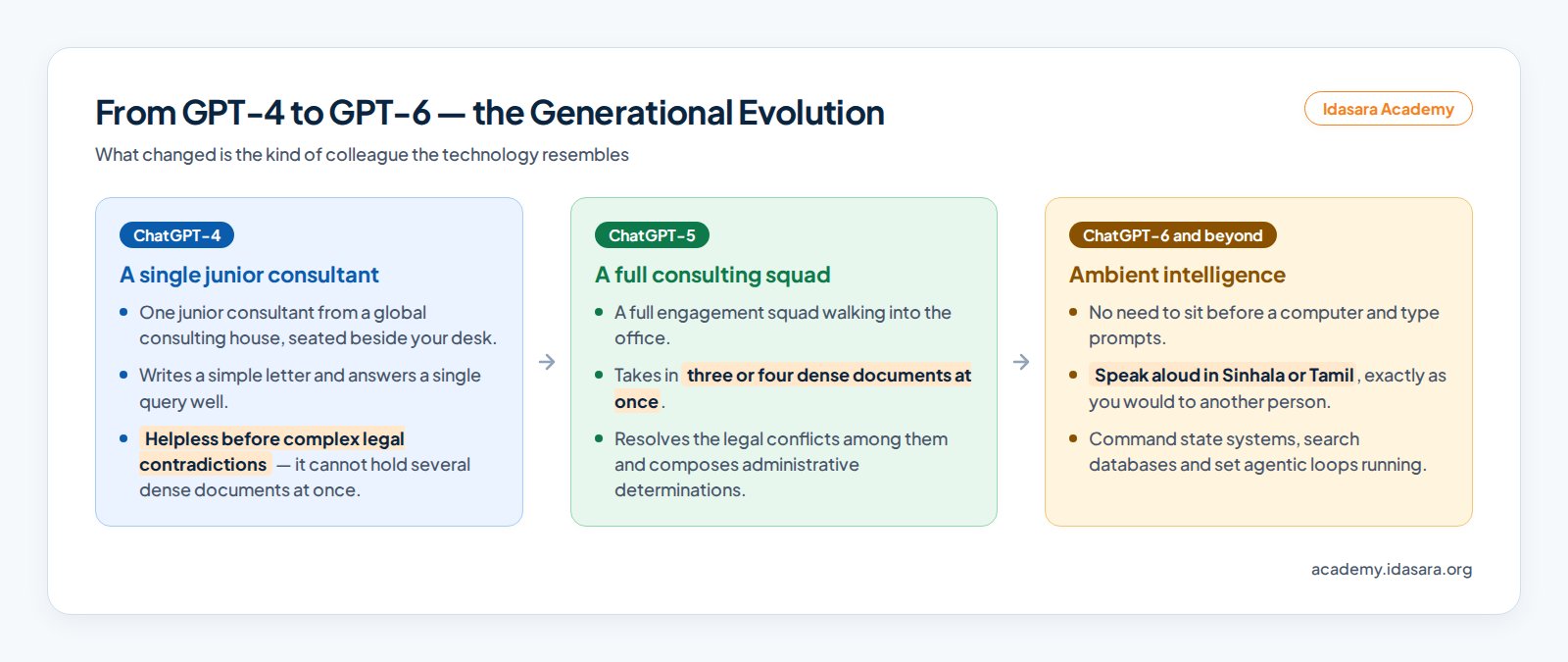
The ChatGPT-4 era: a single junior consultant
ChatGPT-4 was like seating one junior consultant from a global consulting house — a McKinsey or a BCG — beside your desk. Capable of writing a simple letter and answering a single query well. Helpless in the face of complex legal contradictions, because holding several dense documents in mind at once was beyond it.
The ChatGPT-5 era: a full consulting squad
ChatGPT-5 was described, fairly, as a full McKinsey engagement squad walking into the office. It could take in three or four dense documents at once — the Land Development Ordinance, the State Lands Ordinance, and the latest gazette — resolve the intricate legal conflicts among them, and compose error-free administrative determinations.
That is the leap that matters most for administrative work, and it is worth being precise about why. The difficulty in public administration is rarely one rule; it is several rules from different decades that amend one another and do not quite agree. A model that can hold all of them simultaneously is doing the specific thing the work requires.
ChatGPT-6 and beyond: ambient intelligence
Today the era is one of ambient intelligence. There is no longer a requirement to sit before a computer and type prompts at a keyboard. Sitting in your living room, speaking aloud in Sinhala or Tamil exactly as you would to another person, you can command complex state systems, search databases, and set agentic loops running.
Note where this arrives, because it closes a circle opened in Chapter 04. The grandmother at the ATM was defeated by an interface that demanded she become literate in English, in menus, and in machines. Ambient intelligence removes that demand entirely. The technology has finally met the citizen where she already stood.
The PhD team that has arrived at your home
Acquiring deep knowledge once meant combing through great libraries, buying expensive foreign books, or finding a professor willing to explain.
What has changed is best stated plainly: a team of PhD graduates, carrying the knowledge of the world, now sits at your desk — on your phone. The marginal cost of acquiring knowledge has fallen to approximately zero.
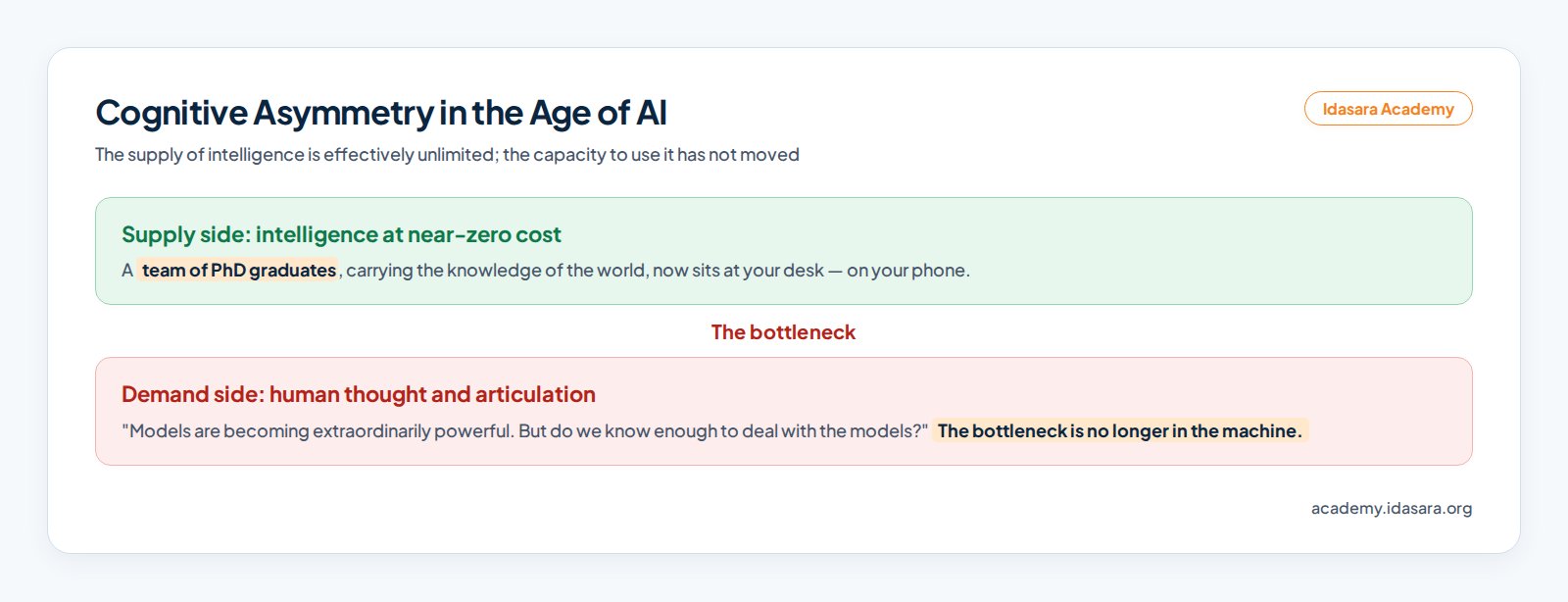
The figure names the asymmetry that results, and it is the central problem of this decade. The supply of intelligence has become effectively unlimited. The capacity to use it has not moved at all.
Important
But this is the fundamental existential question:
"Models are becoming extraordinarily powerful. But do we know enough to deal with the models?"
(The models grow ever more intelligent. But is our own thinking prepared enough to ask them the right question, impose strict constraints, and get real work done?)
However brilliant a model may be, if the person asking lacks deep reading, curiosity and discipline, what comes back is "Thinkslop" — a hollow answer full of verbal acrobatics, delivered in excellent prose.
This is the conclusion the whole book has been building toward, and it is worth stating without qualification. The bottleneck is no longer in the machine. It is in human thought and articulation. Every chapter here has been about one side or the other of that single fact: Chapter 04 on reading and listening, Chapter 05 on precise expression, Chapter 06 on structured reasoning, Chapter 08 on verification. None of them was about the technology. All of them were about the officer.
The five golden rules for the public officer
For any officer working with these tools in 2026 and beyond, five rules carry the weight of everything above. They belong somewhere visible.
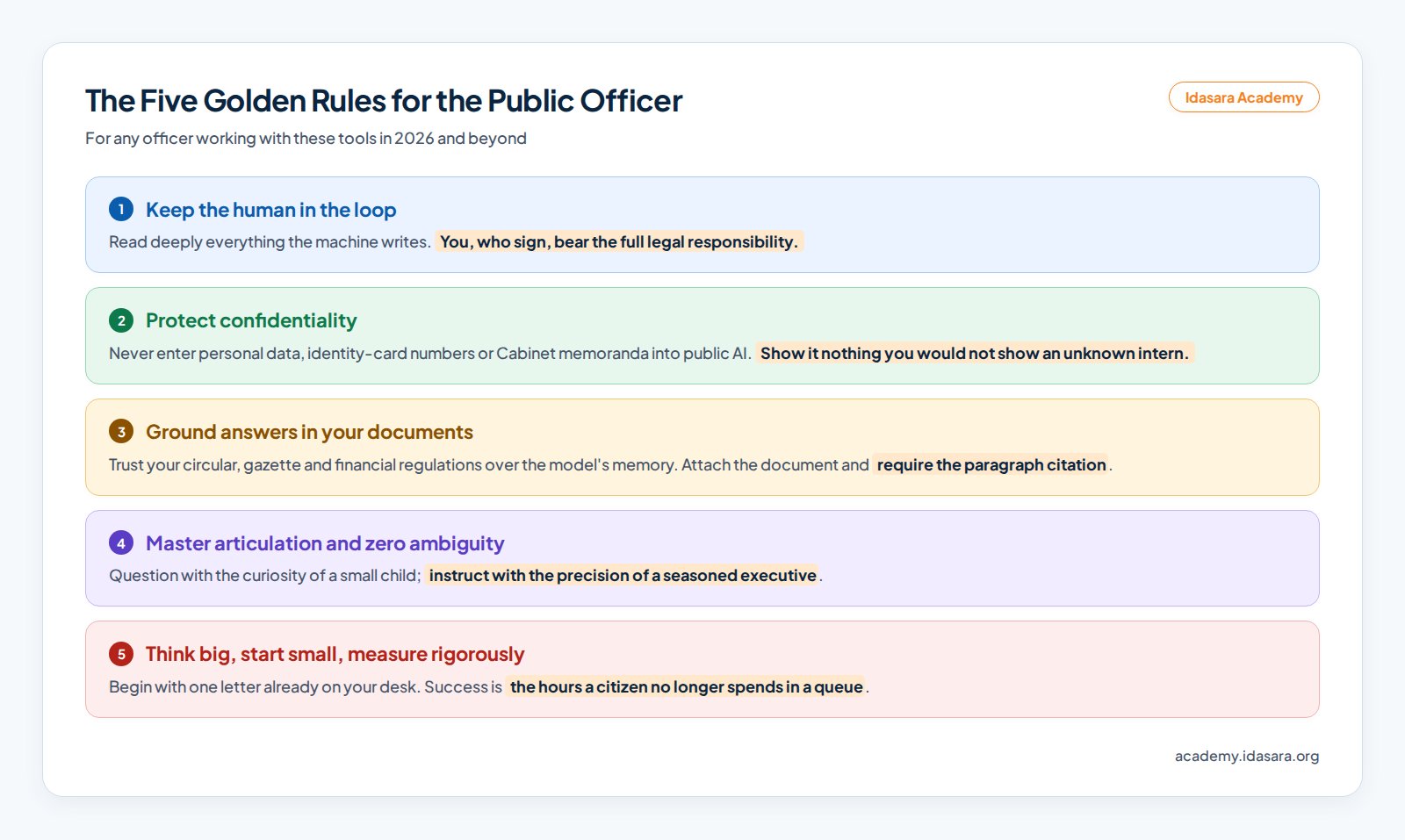
Keep the human in the loop
Read deeply everything the machine writes. Reading is the only intellectual shield against being caught by the machine's errors, and Chapter 08 showed what it costs an organisation to skip it. You, who sign the final document, bear the full legal responsibility — and that responsibility has never been delegable to a supplier, a system, or a model.
Protect confidentiality
Never enter personal data, identity-card numbers or Cabinet memoranda into public, open AI. The working test is simple enough to apply in the moment: show the AI no confidential document you would not show an unknown intern. If handing the page to a stranger would be unacceptable, pasting it into an open tool is the same act with more copies.
Ground answers in your documents
Trust your official circular, gazette and financial regulations over the model's general internet memory. Attach the document; draw answers from it alone; require the paragraph citation.
This single habit eliminates the largest category of error in official use, because it replaces an averaged recollection of the world with the authoritative text in front of you — and it gives you something citable, which the model's memory can never provide.
Master articulation and zero ambiguity
Eliminate vagueness from your instructions. Question with the curiosity of a small child; instruct with the precision of a seasoned executive, imposing explicit constraints.
Those two halves are not in tension. Curiosity finds the right question; precision gets it answered properly. The half entirely within your control is the second.
Think big, start small, measure rigorously
Before any grand pilot project, begin by summarising or drafting one letter already on your desk.
And measure the right thing. Success is not tokens consumed or officers trained; it is the hours a citizen no longer spends in a queue. State the result in the units the citizen lives in — visits saved, days saved, bus fares not paid — and the case for going further makes itself.
Where to go from here
Artificial intelligence is not something finished in a one-day seminar or a weekend course. It is a daily curiosity and discipline sustained over a lifetime — a habit, not a course. The models named in this book will be superseded; the underlying skills will not.
 Figure 10.1: The Idasara Digital Public Sector AI Resource Gateway — scan the QR code above or visit the official Google Drive repository to download, free of charge, all of this course's prompt templates, presentation slide decks, and public policy guides.
What the repository holds
Production prompt libraries — tested and verified system prompts and chain-of-thought templates for Divisional Secretariats, Grama Niladhari services, audit examinations and ministry reports. These are the starting points that save an officer from beginning at a blank box.
Complete slide decks and schemas — the high-resolution lecture slides from every executive session held at the Presidential Secretariat and the ministries.
Policy documents and guides — the ten-line institutional AI policy from Chapter 09, the PDPA data-classification checklist, and the practical model-routing plan that keeps costs proportionate.
The Idasara ecosystem
Four continuing tracks build on this book, through Idasara Digital and Idasara Academy.
The Gen AI Evolutionary Journey: 2017 to 2035 traces the path from the 2017 Transformer paper to the agentic economy and embodied intelligence of 2035 — including the DeepSeek cost collapse, and the central argument that human judgment becomes priceless precisely as the technology becomes cheap.
Learn to Learn and meta-learning builds the capacity to absorb new knowledge unaided in a changing world, rather than depending on examination certificates — the skill that matters most when what is worth knowing keeps changing.
The English Learn Ladder dispels the fear of language and opens the gateway into the international technical world, step by step, from wherever you stand today.
Employability and the product mindset raises creative product engineers and public leaders who identify problems and drive systemic solutions — as the age of the coder and the clerk closes.
The Final Message: A Nation's Transformation Begins at Your Desk
My friends in the public service,
Whether we welcome it or not, the artificial intelligence revolution is under way. It is remaking global politics, economics, and human labour entirely.
But the future of the public service is not a desolate world of machines without people. It is a golden age of public officers — empowered by the speed and precision of machines, freed from the weight of files: more humane, more compassionate, truly listening to the citizen.
Like Baranastha of Avukana, hand the monotonous chisel and mallet to the machine. Keep your mind, your heart, and your thinking awake for the citizen.
I have reminded you many times; let me say it one final time:
Read!
Write!
Think!
Listen!
Prompt!
Lead the Sri Lankan public service to victory!
Thank you!
Samisa Abeysinghe
Founder & Chief Executive Engineer — Idasara Digital (Pvt) Ltd
academy.idasara.org | idasara.org