05. Clear Articulation, Curiosity, and the Art of Prompting
Core Theme: AI does not reward cleverness; it rewards clarity. If you cannot question what you need with the unquenchable curiosity of a small child — and then translate it into unambiguous words — even the most powerful supercomputer in the world cannot give you the result you want.
1. The Hidden Secret of Prompting: The Toddler's Curiosity
Many people come to me and ask: "Sir, how do I become a good prompt engineer? What kind of coding do I need to learn for that?"
My answer astonishes them: "To become a good prompter, what you must do is not learn computer code; it is to become a three-year-old child again!"
If there is a three- or four-year-old in your home, or in a relative's home, you have lived this. That child does nothing all day but ask questions. There is not a single moment without a question: * "Amma, why is the sun round? Why is the moon round?" * "Why is there no sun at night? Why doesn't the moon come out in the daytime?" * "If I climb to the top of Sigiriya and drop my smartphone, will it float away? Will it break when it falls? Will it hit the rock on the way down and shatter? Will the wind carry it off? If I jump after it, can I catch it mid-air? Will I float too? What will happen to me?"
 Figure 5.1: The Childlike Curiosity — the unquenchable curiosity with which a small child looks at the world is the origin of prompt engineering.
Why does this child ask questions without ceasing? For one reason only: curiosity.
Unfortunately, our traditional education system and our society grind that curiosity down as we grow older. We are trained to stop asking questions and to accept, in silence, whatever we are handed.
To win in the presence of artificial intelligence, you must reawaken the curiosity you buried! Prompting is nothing other than this: looking at a problem with curiosity, tracing it to its root, and asking a connected chain of logical questions, one after another. The person who questions out of curiosity is, by nature, already an excellent prompter.
 Figure 5.2: Art of Inquiry — questioning continuously to find the root causes of a problem.
 Figure 5.3: Stay Curious — keeping the flame of constant curiosity from going out.
 Figure 5.4: Question Everything — the discipline of questioning everything to find the true root of a problem.
2. Clear Articulation: Jordan Peterson's Philosophy (Jordan Peterson on Articulation)
Curiosity is the fuel. But to steer that curiosity toward the right target, you need the rudder called articulation — the clear expression of ideas.
The view of the Canadian psychology professor Dr. Jordan B. Peterson on articulation should be a foundational compass for the public officer of the AI age:
 Figure 5.5: Jordan B Peterson on Articulation — how human expressive power is sharpened by choosing words with care, speaking what one believes to be true, and deep reading and writing.
"A person becomes more articulate by choosing their words with great care, by practicing saying what they believe to be true, by reading and writing deeply about their own thoughts, and by treating the word with immense respect. The clearer your ideas, the more powerful your thinking; and the more powerful your thinking, the more you become a victor before the world."
The most powerful person of the AI age is not the one who memorized computer code. It is the person with the articulate power to tell the machine exactly what they need — in precise words, with zero ambiguity.
3. The 5 Essential Human Skills Powering the Prompt
To obtain a flawless official document from an AI model, there are five fundamental human skills that must reside not in the machine, but in the officer (Figure 5.6):
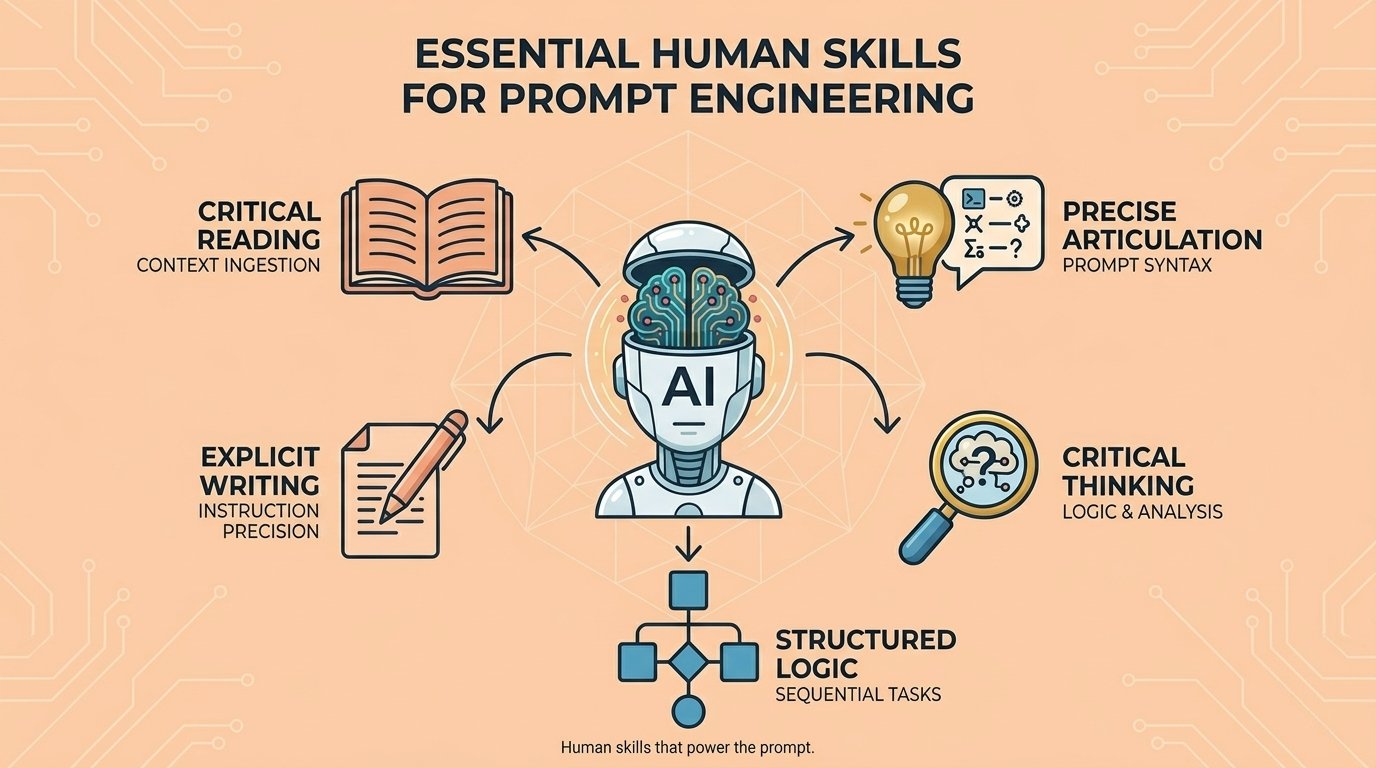 Figure 5.6: The 5 Essential Human Skills of Prompt Engineering — critical reading, explicit writing, structured logic, critical thinking, and precise articulation.
A Deep Reading of the 5 Human Skills in Figure 5.6:
- Critical Reading — Context Ingestion: Reading the problem, the complaint, or the draft bill deeply, without laziness. Asking an AI for solutions to something you have not read is like one blind man asking another for directions.
- Explicit Writing — Instruction Precision: Stripping away unnecessary words and translating the exact goal into direct, clear, imperative instructions.
- Structured Logic — Sequential Tasks: Not demanding a complex administrative task all at once, but decomposing it into a logical sequence of sub-routines: review → eligibility verification → calculation → recommendation.
- Critical Thinking — Logic & Analysis: Examining the AI's answer vigilantly for logical gaps, conceptual contradictions, or false inferences.
- Precise Articulation — Prompt Syntax: Laying out the role, the context, the constraints, and the format so cleanly that the machine cannot misunderstand you.
4. The Four Pillars of Precise Articulation (Precise Articulation Framework)
In the public service, a single ambiguous word in a letter can cost a citizen their land title or their pension — or open the road to a High Court case. Figure 5.7 shows the four principles we must follow when constructing a prompt:
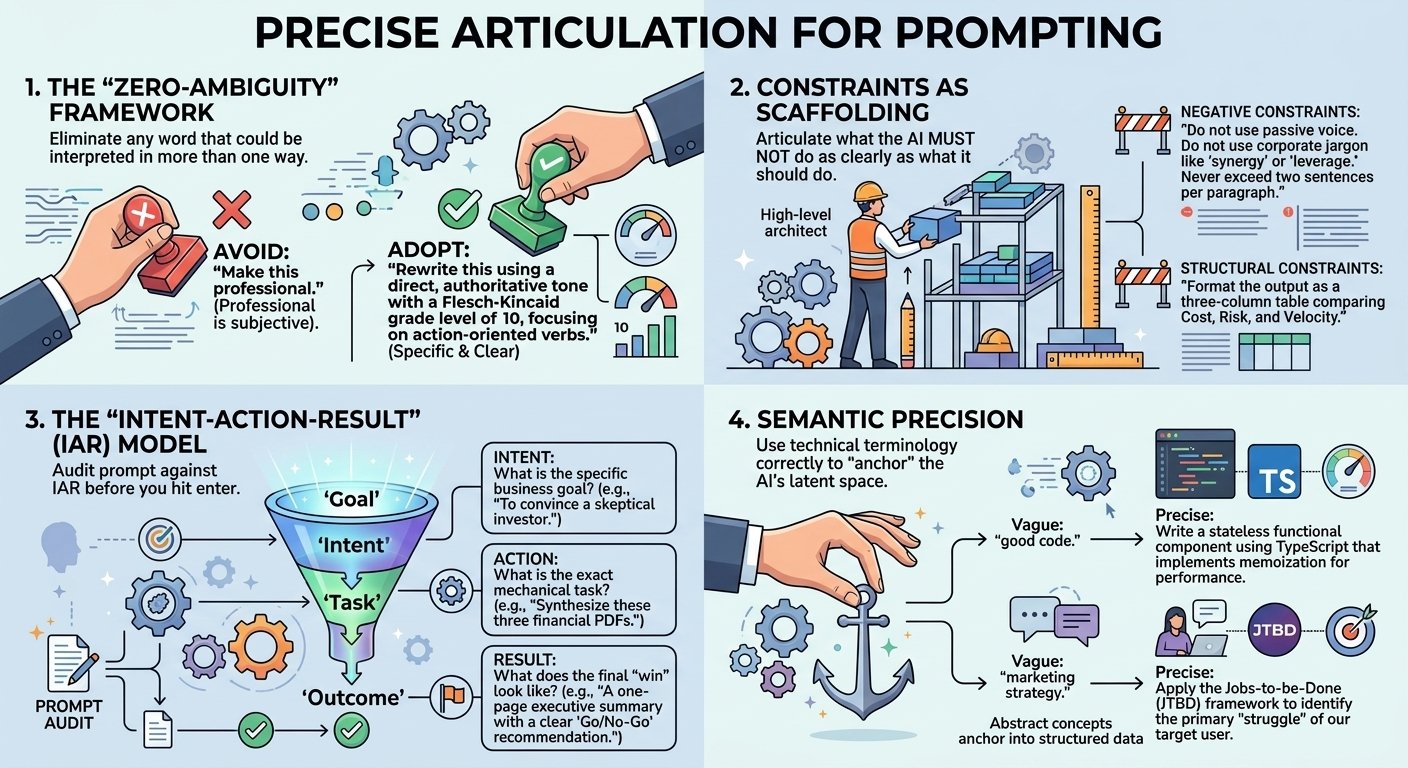 Figure 5.7: The Four Pillars of Precise Articulation in Prompt Engineering — Zero-Ambiguity, Negative Constraints, the Intent-Action-Result (IAR) audit model, and Semantic Precision.
A Deep Reading of the 4 Principles in Figure 5.7:
- Pillar 1: The "Zero-Ambiguity" Framework: * Remove from the prompt any subjective word that could carry more than one meaning. * Avoid: "Write this in a very professional manner." ("Professional" is a vague word that means different things to different people.) * Adopt: "Write this in a direct, authoritative tone, leading with action-oriented verbs, in simple sentences a person with an ordinary school education can understand."
- Pillar 2: Constraints as Scaffolding: * Just as you tell an AI model what it must do, it is even more decisive to state clearly what it MUST NOT do. * Negative constraints: "Do not use passive voice. Do not use empty corporate buzzwords such as 'synergy' or 'optimization'. Do not write more than two sentences per paragraph." * Structural constraints: "Format the output as a 3-column table (Cost, Risk, Velocity)."
- Pillar 3: The "Intent-Action-Result" (IAR) Model:
* Before you press
Enter, audit your own prompt against the three IAR criteria:- Intent — Goal: What is the institutional purpose of this task? (E.g., "To persuade the Ministry of Finance to approve the budget allocation.")
- Action — Task: What is the specific mechanical task assigned to the model? (E.g., "Compare the attached expenditure reports of 3 Divisional Secretariats.")
- Result — Outcome: What form must the final winning document take? (E.g., "A one-page executive summary ending in a clear 'can approve / cannot approve' recommendation.")
- Pillar 4: Semantic Precision — Anchoring Latent Space: * Using the precise technical or legal terminology of the domain, instead of ordinary language, anchors the model's neural attention to the relevant expert field. * Vague: "Write some good software code" → Precise: "Write a stateless functional component in TypeScript, using memoization for efficiency." * Vague: "Make a good promotional plan for farmers" → Precise: "Using the Jobs-to-be-Done (JTBD) framework, identify the core struggle of the rural farmer applying for the fertilizer subsidy, and design a communication strategy that speaks to it."
5. Prompt Architecture: The 5 Components of a Complete Blueprint (Universal Prompt Architecture)
A prompt built for analyzing the public service's complex files and gazettes is not a sentence or two; it is a carefully designed work of architecture (Prompt Architecture):
 Figure 5.8: Prompt Architecture (Full Architecture) — Role, Context, Task, Constraints, and Output Format.
A Deep Reading of the 5 Layers in Figure 5.8:
- Layer 1: Role and Persona (
<role>): The expert identity you assign to the model. E.g.: "Act as an Additional Secretary with 20 years of experience in the Sri Lanka Administrative Service, an expert in the Establishments Code and government financial regulations." - Layer 2: Context and Background (
<context>): The background information, the relevant circular numbers, and the parties involved. E.g.: "A dispute has arisen between the local council and the traders' association over the removal of unauthorized shops in the Divisional Secretariat division. Under Circular No. 12 of 2024..." - Layer 3: The Specific Task (
<task>): The direct operation to be performed. E.g.: "Draft a 5-step mediation action plan to bring the two parties to a settlement." - Layer 4: Constraints and Rules (
<constraints>): What must not be done, the legal limits, and the word count. E.g.: "Propose nothing that exceeds the powers granted by the Local Government Act. Do not include assumed laws. Limit the response to 300 words." - Layer 5: Output Format (
<output_format>): The shape in which the answer must be delivered. E.g.: "Present with headings, numbered steps, and a closing Markdown table of [Risk | Responsible Officer | Remedy]."
6. Idasara Academy and the Skill of Articulation (Cross-linking to Learn to Learn)
This power of articulation is exactly what we emphasize, without pause, at Idasara Academy (Meta-Learning Superpower).
A student does not fail an examination — and a graduate does not fail a job interview — because they do not know the facts. They fail because they cannot articulate what they know clearly and in an organized form (Certificates vs Capability).
As a public officer, practicing this articulate skill — in your file work and in commanding AI tools — will make you an administrator without equal.
In the next chapter, we build on these principles to study, hands-on, the advanced prompting methods used in the public service and the Divisional Secretariat "Promptathon" model.