04. The Natural Language Revolution, the Humanities Renaissance, and AI Literacy
Core Theme: The moment computers learned to understand human language instead of demanding code, the world turned 180 degrees. Reading, writing, conversation, and the humanities — long pushed into the shadow of technical disciplines — have returned as the most powerful superpower in human society.
1. Creating with Natural Language (Prompting with Natural Language)
In the past, getting a computer to perform a complex task meant writing precise commands, specialized software syntax, or programming code.
Today, in the presence of Generative AI, something remarkable has happened: you instruct the machine in ordinary human words (Natural Language) — exactly as you would speak to a friend, an office assistant, or a senior advisor.
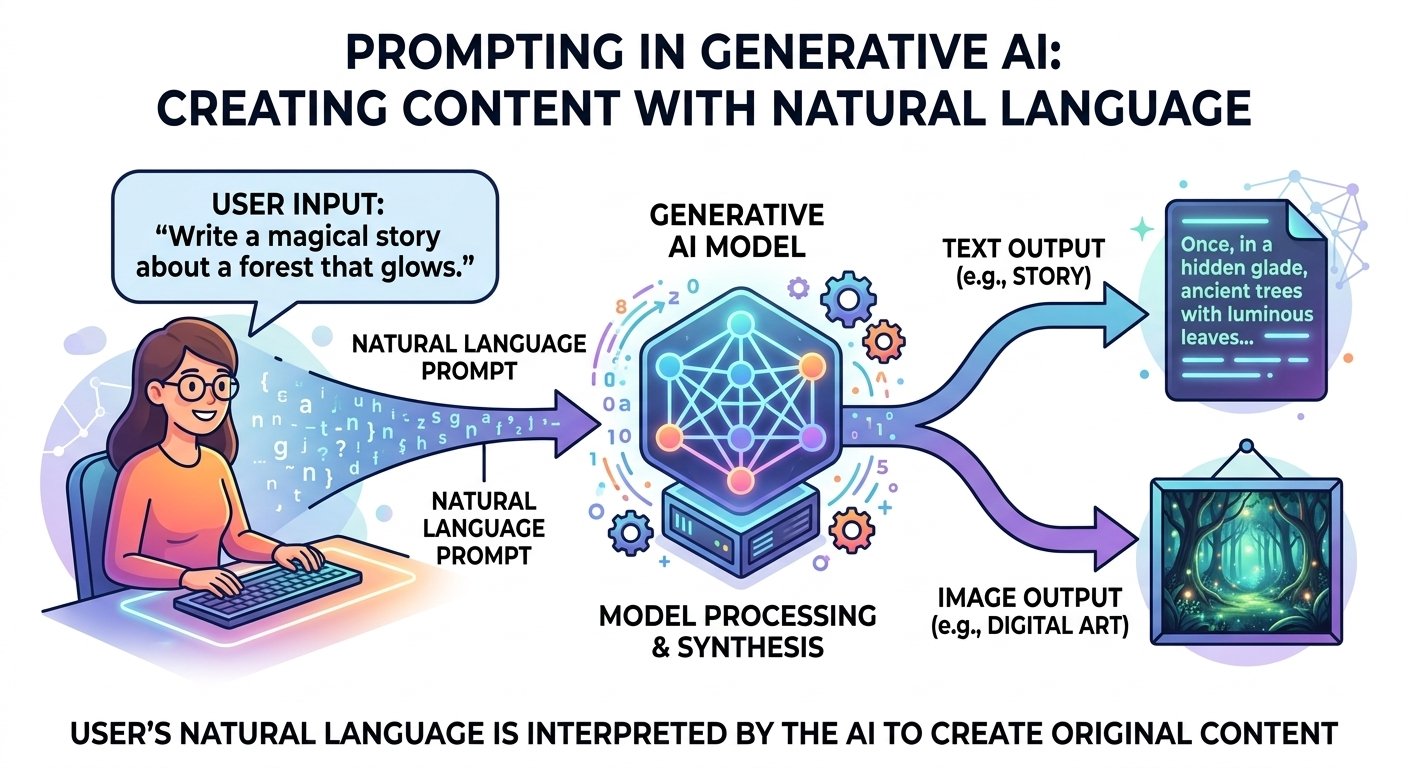 Figure 4.1: Prompting in Generative AI — issuing instructions in plain natural language to instantly generate complex letters, reports, and analyses.
This process of giving instructions is what we call prompting. Any question, command, context, or requirement you give an AI model is called a prompt.
2. The Language-Processing Trinity: NLP, NLU, and NLG in Practice
How does artificial intelligence understand our natural language and respond to it? Three principal technical layers operate behind the scenes:
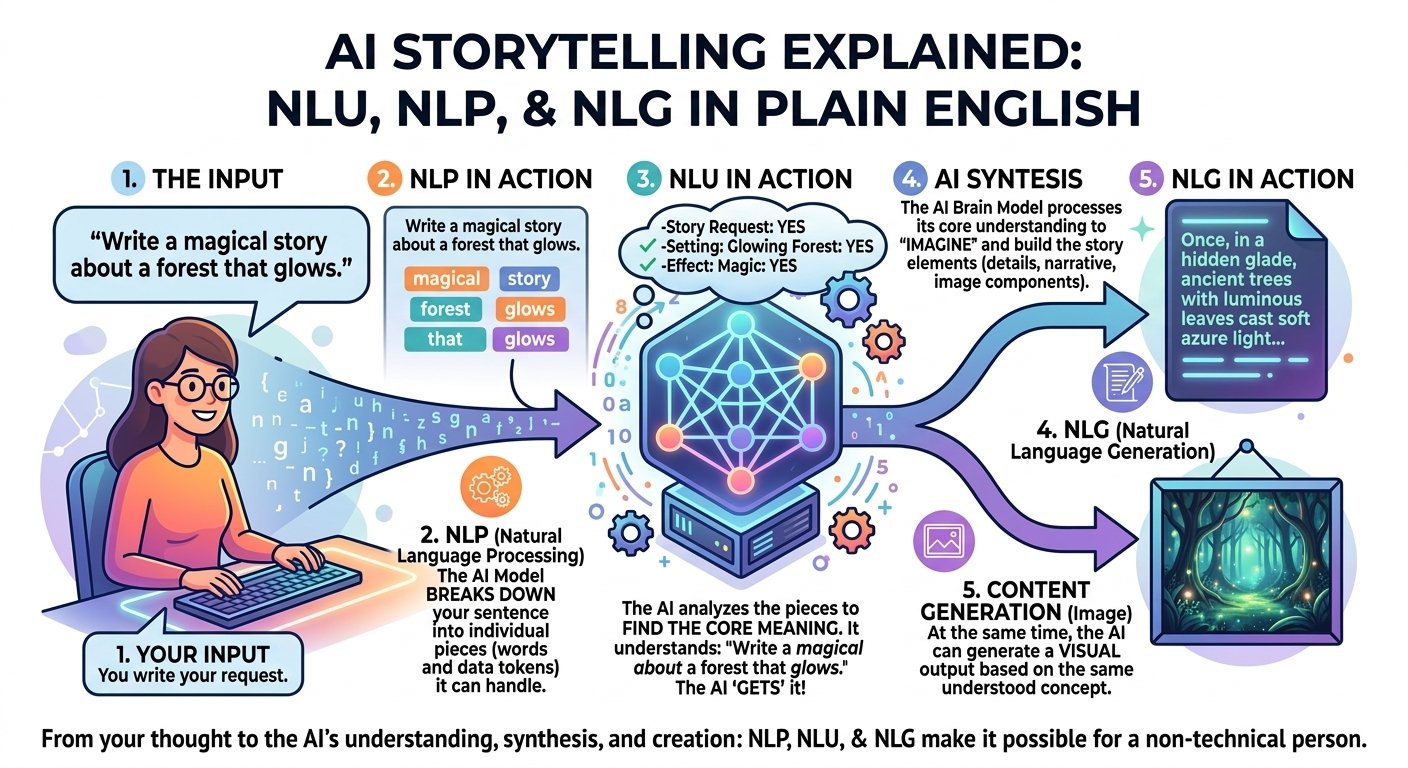 Figure 4.2: The AI Cognitive Pipeline — how Natural Language Processing (NLP), Natural Language Understanding (NLU), Synthesis, and Natural Language Generation (NLG) operate step by step.
A Deep Reading of the 5 Cognitive Steps in Figure 4.2:
- Step 1: Your Input:
The user states their need in plain language.
Example:
"Write a magical story about a forest that glows." - Step 2: NLP in Action — Decomposing the Sentence:
The model breaks the sentence into individual units and tokens:
[Write],[magical],[story],[forest],[glows]. Grammatical parts of speech — verbs, adjectives, nouns — are identified here. - Step 3: NLU in Action — Grasping True Meaning and Intent:
Going beyond mere word recognition, the model captures the user's underlying semantic intent:
* Story Request:
YES* Setting — Glowing Forest:YES* Effect — Magic:YESThe model correctly understands what the user actually wants ("The AI GETS it!"). - Step 4: AI Synthesis — Imagination: Scanning the data patterns held in its trained memory, the model internally constructs the story's characters, the colors of its setting (azure blue light), and its sequence of events.
- Step 5: NLG & Visual Content Generation: * NLG (text generation): The story is composed in smooth, elegant prose ("Once, in a hidden glade, ancient trees with luminous leaves cast soft azure light..."). * Image generation: Using that very same understanding, the system can simultaneously generate a matching digital painting.
A public service example: When a Grama Niladhari (village officer — the government's front-line administrative officer for a village division) logs a citizen complaint: * NLP recognizes the letters and words in the document. * NLU understands that this is a boundary dispute and that a report from the Land Surveyor is required. * NLG drafts, within seconds, the formal investigation report to be forwarded to the Divisional Secretary.
3. "A Mouth That Has Never Recited the Sakaskada Is a Hollow Anthill": The Humanities Renaissance
For the past four or five decades, our society leaned hard toward technical and white-collar technical careers. While computer science and engineering reigned at the top of the social ladder, the humanities — literature, art history, language, philosophy — were relegated to second class. Even musicians and writers felt compelled to learn computer code and to think in the machine's language.
But now that the computer can speak the human language fluently, it is we who must turn 180 degrees back!
There is a well-known saying in our old society: "සකස්කඩ නොකියූ කට උගේ කට හුඹස් කට" — "a mouth that has never recited the Sakaskada is a hollow anthill." (The Sakaskada is a classical Sinhala recitation text; the proverb holds that the mouth of a person without reading, language, and a literary foundation is as empty as an abandoned anthill.)
In the age of AI, this proverb is proving true with startling force: * Only the person who has read can write. * Only the person who can write can lay out the contents of their mind with clarity. * Only the person who can lay out their thoughts can think deeply. * A person who cannot read, write, or think has no question — and no prompt — to ask of an AI!
However powerful the computer becomes, the "thought" (the intent) that drives it must come from the human being. A person without reading and deep understanding will stand mute before the machine.
4. Steve Jobs's "Connecting the Dots" and the Four Human Pillars (Write, Read, Listen, Think)
In his historic 2005 Stanford Commencement Address, Apple co-founder Steve Jobs offered a beautiful insight about creativity:
"Creativity is just connecting dots. When you connect the varied experiences you have gathered — the books you have read, the people you have met, the things you have lived through — you create something the future has never seen."
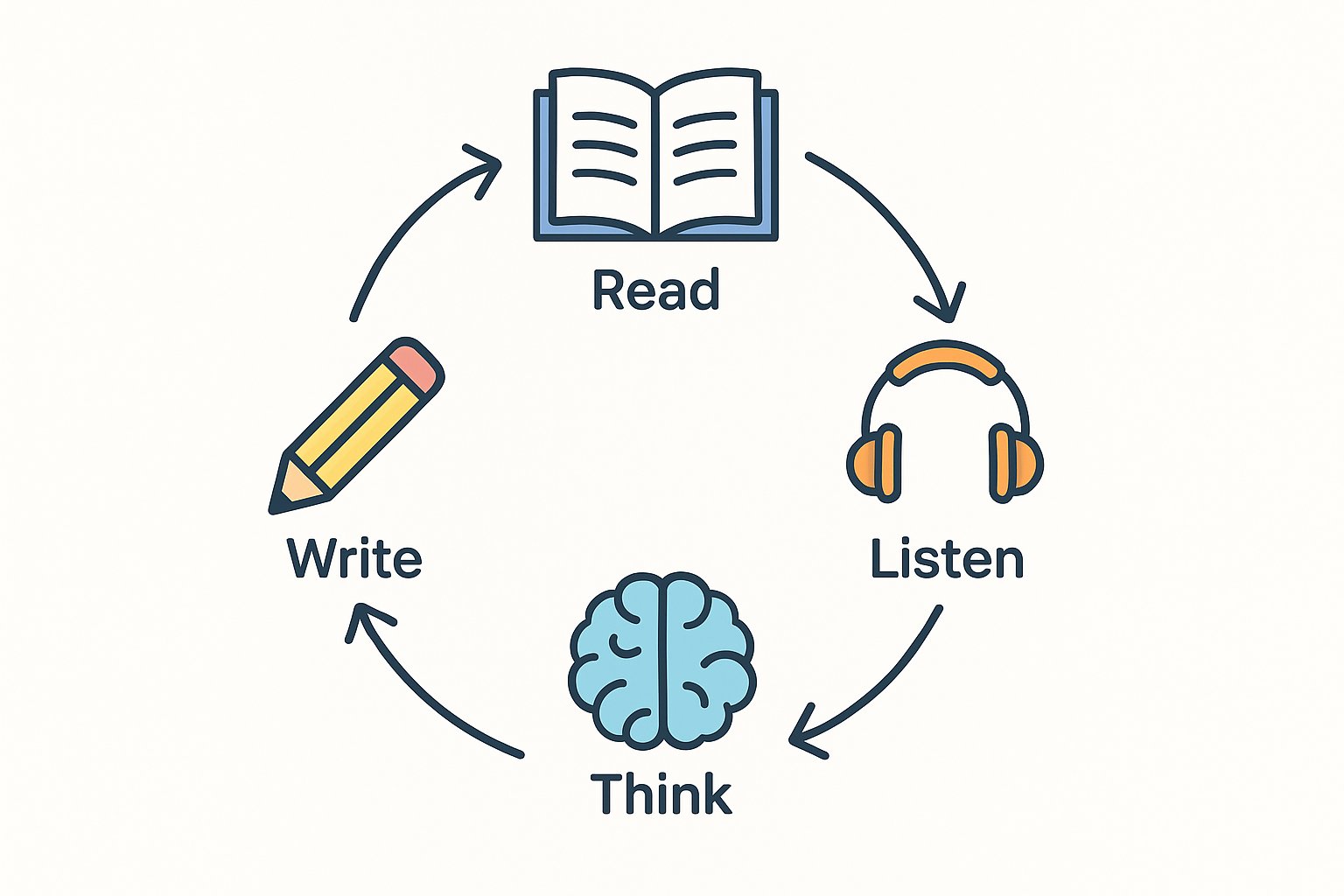 Figure 4.3: Connecting the Dots — the four foundational human skills of the AI age: Write, Read, Listen, and Think.
The Four Human Pillars in Figure 4.3:
- Think — identifying the problem: No successful prompt can be built without clear, logical thinking. The way you think determines the command you give.
- Write — expressing ideas: The ability to turn a complex need in your mind into words; to set down the right constraints, the background, and the task in writing.
- Read — the critical audit: An AI can produce a document in three seconds; but only an officer who can read it with fine-grained attention can verify its legal accuracy and separate truth from fabrication.
- Listen — citizen empathy: The foundation stone of public service is listening to the pain and the problems of the public. A machine cannot feel; only you can listen with empathy and carry what you hear into the system.
If you are to connect the dots, you must first collect the dots!
How do you collect dots in the presence of artificial intelligence? There is only one way: read widely, listen to people with empathy, and look at the world with an open mind. When you hold dots of knowledge from many fields, you will be able to use the AI tool to connect them — and to create administrative solutions no one has seen before.
5. Closing the Digital Divide: The Village ATM and the Grandmother's Experience
There is a real social example I often present to explain why Generative AI and the natural language revolution matter so much to the public service and to ordinary citizens.
When we speak of cybersecurity and the NIST digital identity guidelines (NIST SP 800-63B Authentication Guidelines), three fundamental factors are used to verify a person's identity (the Three Factors of Authentication): 1. Something you know: a password or a secret number (PIN). 2. Something you have: a bank card (ATM card) or the national identity card. 3. Something you are: a fingerprint, your face (facial recognition), or the retina of your eye. This is what Sri Lanka's national digital identity (SLUDI) is being built upon today.
A bank secures cash withdrawal at an ATM through two-factor authentication (2FA): the card you hold (something you have) and the secret number you know (something you know).
But go and stand for a moment beside an ATM in a rural area. What happens when an elderly grandmother or grandfather comes to withdraw money? They do not have the digital literacy to make sense of the English words on the screen, the buttons, or the layered menus.
And what does that elder finally do? They hand over both their ATM card and their PIN to an unknown young man standing nearby, or to the security guard, and plead: "Son, please take out four thousand rupees for me from this."
Caution
The failure of the system: The bank may spend millions of dollars building a secure system, yet the language and literacy barrier at the interface between the human and the computer collapses the entire security wall. The ordinary citizen is left unprotected.
This historic failure is precisely what natural-language AI solves!
At the ATM of the future — or at the information counter of a Divisional Secretariat — the citizen will not need to press buttons or fill in complex forms. She will simply speak, in her own ordinary voice: "Son, check whether my pension has come in, and give me four thousand rupees."
The machine will recognize her voice, her language, and her fingerprint (biometrics), and deliver the service instantly — with no intermediary. It is through this natural language revolution that the poor, the elderly, and the ordinary citizen shut out of the digital world will be truly empowered.
🎬 Watch the animated story (1½ min): The ATM That Learned Our Language — Banking in the Gen AI Era
6. The New AI Literacy the Public Officer Needs, and the Human-AI Partnership
In this revolutionary age, the real AI literacy a public officer must possess is not mere typing skill. Figure 4.4 shows the five essential competency pillars, centered on the human-machine partnership:
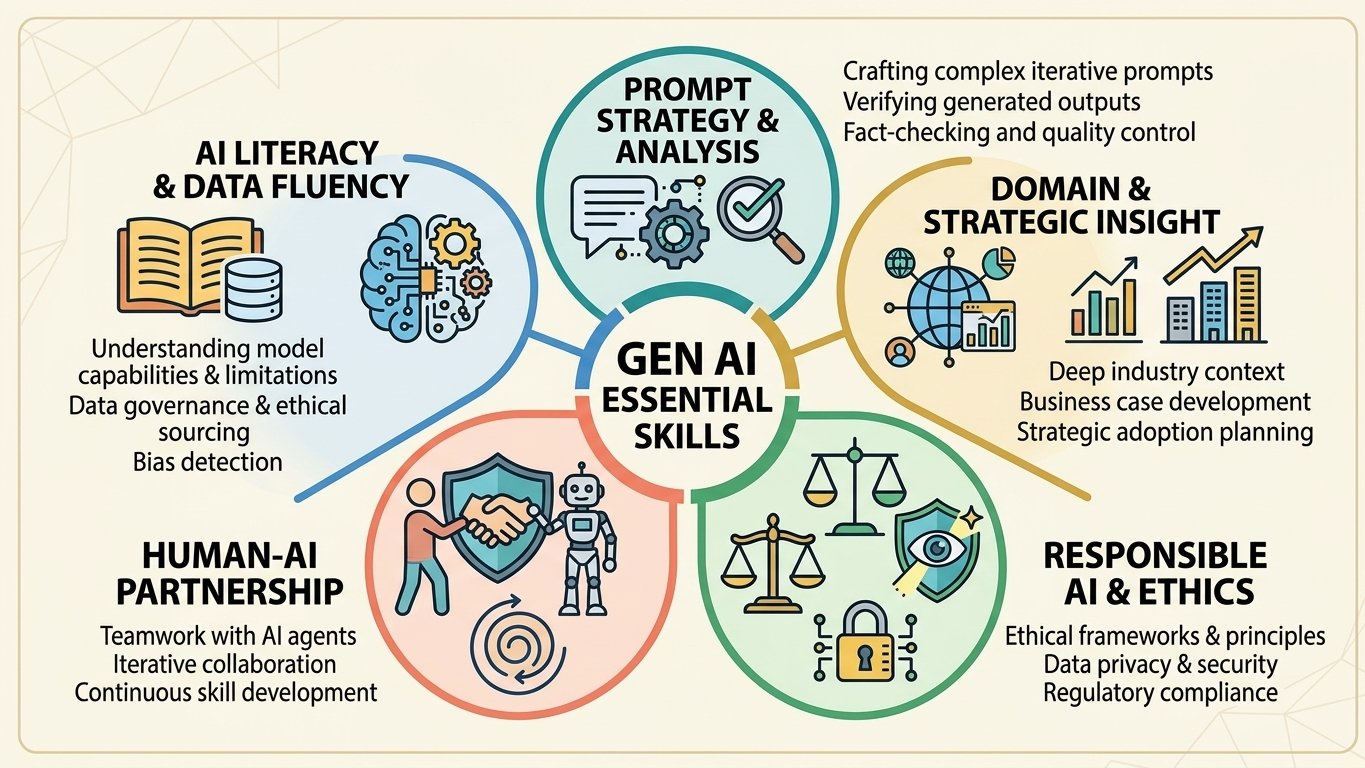 Figure 4.4: The Essential Skills Model of the Generative AI Era (Gen AI Essential Skills) — AI literacy, prompt strategy, domain expertise, ethical accountability, and the human-AI partnership.
A Deep Reading of the 5 Competency Pillars in Figure 4.4:
- AI Literacy & Data Fluency: * Recognizing what models can and cannot do (Model Capabilities & Limitations). * Data governance and ethical sourcing. * Detecting the biases embedded in training data (Bias Detection).
- Prompt Strategy & Analysis: * Crafting complex, step-by-step, iterative prompts. * Verifying the accuracy of generated outputs. * Fact-checking and quality control.
- Domain & Strategic Insight: * Deep administrative and legal context of the public service. * Identifying the use cases that bring genuine value to the institution (Business Case Development). * Planning the strategic adoption of AI within the organization.
- Responsible AI & Ethics: * Ethical frameworks and transparency. * Citizen data privacy and system security. * Compliance with national data protection laws and regulations (Regulatory Compliance).
- Human-AI Partnership — the Center: * Working with AI agents as a team (Teamwork with AI Agents). * Continuous collaboration and iterative workflows. * Ongoing skills development (the continuous-learning method of Idasara Academy).
In the next chapter, we take up the most important human skill for getting the most accurate result from an AI — clear articulation — together with the curiosity of a small child, and study the art of prompting in practice.