06. Advanced Prompting Methods and the Divisional Secretariat "Promptathon" Model
Core Theme: A prompt is not a simple question begged of a computer. It is a powerful architectural blueprint — one that builds reasoning step by step, assigns distinct administrative roles, and re-engineers institutional processes (BPR) themselves.
1. The Prompt Taxonomy: The 9 Core Methods in Depth (The Complete 9 Prompt Types Guide)
When most people begin using AI, they ask a simple question, look at the first answer, say "that's good," and stop there. But for the public service's complex files, gazettes, and policy analysis, we need nine formal prompt engineering methods (Figure 6.1):
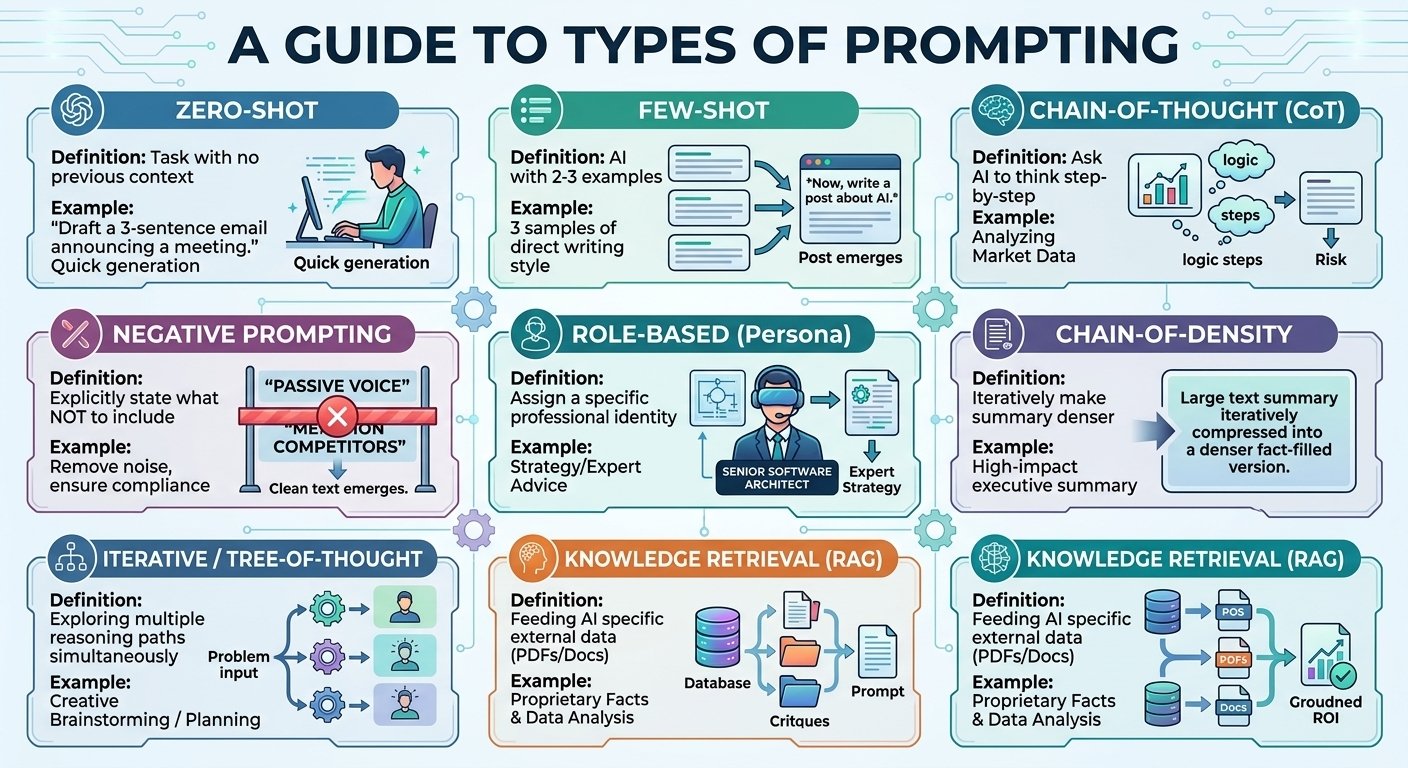 Figure 6.1: A Guide to Types of Prompting — the Zero-Shot, Few-Shot, Chain-of-Thought, Negative, Role-Based, Chain-of-Density, Tree-of-Thought, and Retrieval-Augmented (RAG) variants.
A Deep Reading of the 9 Prompting Methods in Figure 6.1:
- Zero-Shot Prompting: * Definition: Commanding the model to perform the task directly, with no prior examples given. * When to use: Simple, low-risk, general creative or summarization tasks. * Example: "Write a short official email informing the member officers about the District Agriculture Committee meeting to be held tomorrow."
- Few-Shot Prompting: * Definition: Showing the model 2 or 3 correct samples that carry the format, the register, and the legal pattern we expect — then asking for a solution to a new problem in exactly that pattern. * When to use: The formal official language of state documents, letters conforming to the Establishments Code (the public service's HR rulebook), and exact JSON data structures. * Example: Provide 2 successfully resolved pension appeal letters, then: "Following the language pattern of the above formats exactly, prepare the draft for the 3rd appeal."
- Chain-of-Thought (CoT) Prompting: * Definition: Forcing the model not to answer at once, but to build the answer through intermediate reasoning steps ("Think step-by-step"). * When to use: Complex pension arrears calculations, comparison of multiple circulars, and legal-consistency checks.
- Negative Prompting: * Definition: Explicitly fencing off what the AI must NOT do. * When to use: Preventing fabricated circular citations (hallucinations), banning passive voice, and stripping out empty institutional buzzwords. * Example: "Under no circumstances write a guessed circular number. If you are not certain of the number, leave [insert circular number]. Do not exceed 200 words."
- Role-Based / Persona Prompting: * Definition: Assigning the model a specific professional identity, domain expertise, and institutional standpoint. * When to use: Having a document critiqued from the perspective of a senior auditor of the Auditor General's Department, a District Land Registrar, or a procurement specialist.
- Chain-of-Density (CoD) Prompting: * Definition: Iterative compression — redrafting again and again within the same word limit, folding new essential facts and figures into each pass, increasing the summary's density. * When to use: Turning a 100-page Presidential Commission report or a Cabinet memorandum into a 300-word, ultra-dense executive summary.
- Tree-of-Thought (ToT) / Iterative Exploration: * Definition: Considering several solution paths to a problem at once, weighing the pros and cons of each logically, and selecting the best path. * When to use: Drafting disaster-management contingency plans, or balancing the economic and social trade-offs inside a policy decision.
- Knowledge Retrieval — Unstructured Text (RAG: Unstructured Text): * Definition: Feeding an external official document (a PDF gazette, a circular, or an audit report) directly to the model, and ordering it to answer based solely on the contents of that document. * When to use: Determining leave entitlement based on the latest amendments to the Establishments Code.
- Knowledge Retrieval — Structured Data and SQL (RAG: Structured Data & Relational Bases): * Definition: Connecting the model to structured spreadsheets (Excel), SQL databases, or national registry data to execute direct calculations and queries. * When to use: Comparing the income thresholds of Aswesuma welfare beneficiaries (Sri Lanka's national welfare benefit scheme) in the Divisional Secretariat division and automatically filtering ineligible applicants.
2. Chain-of-Thought (CoT) Prompting: Turning the Divisional Secretariat into a 'Single Window'
The most powerful method for solving a complex public service problem is CoT prompting. Figure 6.2 shows CoT being used to re-engineer a Divisional Secretariat's traditional counter bureaucracy into a digital Single Window Platform:
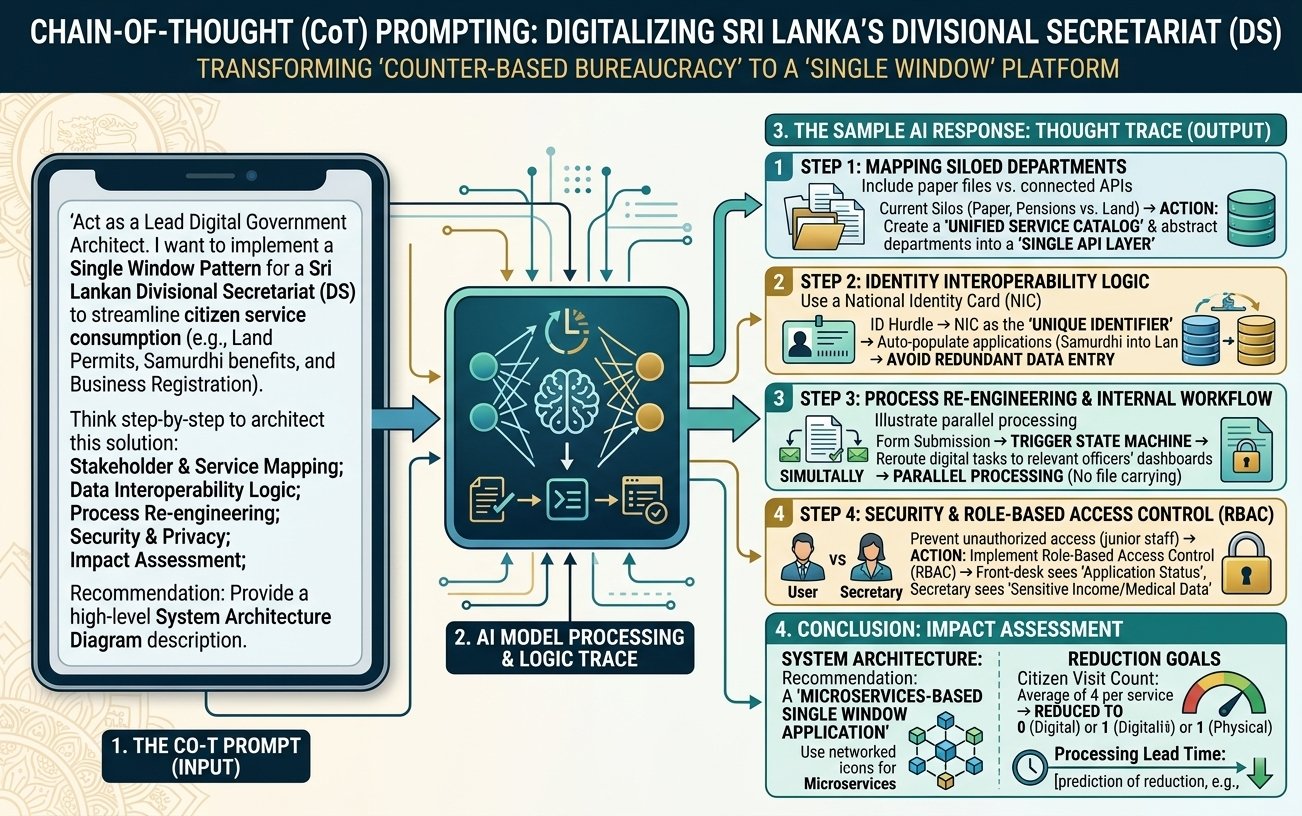 Figure 6.2: Chain-of-Thought (CoT) Prompting — re-engineering the Divisional Secretariat from 'counter-based bureaucracy' to a 'Single Window Platform'.
The CoT Input, Reasoning Trace, and System Outcome in Figure 6.2:
- The Input Prompt: * "Act as the Lead Digital Government Architect of the Government of Sri Lanka. You must design a Single Window Pattern to streamline citizen services at a Divisional Secretariat (land permits, Aswesuma welfare, and business registration). Think step-by-step through the following: (1) stakeholder and service mapping, (2) data interoperability, (3) process re-engineering, (4) security and role-based control, (5) impact assessment."
- The AI's Step-by-Step Thought Trace: * Step 1: Mapping Siloed Departments: Reality: Paper files sit isolated between the pensions and land divisions. Action: Create a 'Unified Service Catalog' and abstract every department behind a Single API Layer. * Step 2: Identity Interoperability Logic: Reality: The citizen brings photocopies of their identity card again and again, for every service. Action: Use the National Identity Card number (NIC / SLUDI) as the primary key, auto-populating data captured by one service into the next, eliminating duplication. * Step 3: Process Re-engineering and Internal Workflow: Reality: The file is carried from desk to desk by hand. Action: The moment an application is registered, a State Machine fires and routes tasks simultaneously to every relevant officer's digital dashboard (Parallel Processing). * Step 4: Security & RBAC: Reality: The risk of unauthorized officers viewing confidential information. Action: Role-Based Access Control: the front counter officer sees only the application's progress status; private medical and income records are visible only to the Divisional Secretary.
- System Outcome and Measurable Impact (Impact Assessment): * Number of citizen visits to the office: falls from an average of 4 visits per service to zero (0 — digital) or at most 1 (physical). * Architectural solution: A microservices-based Single Window Application.
3. Role-Based / Persona Prompts: The 4 Real Pillars of Administration
When building a Single Window platform for a Divisional Secretariat, the perspectives of its different officers can be activated through AI along the four key roles shown in Figure 6.3:
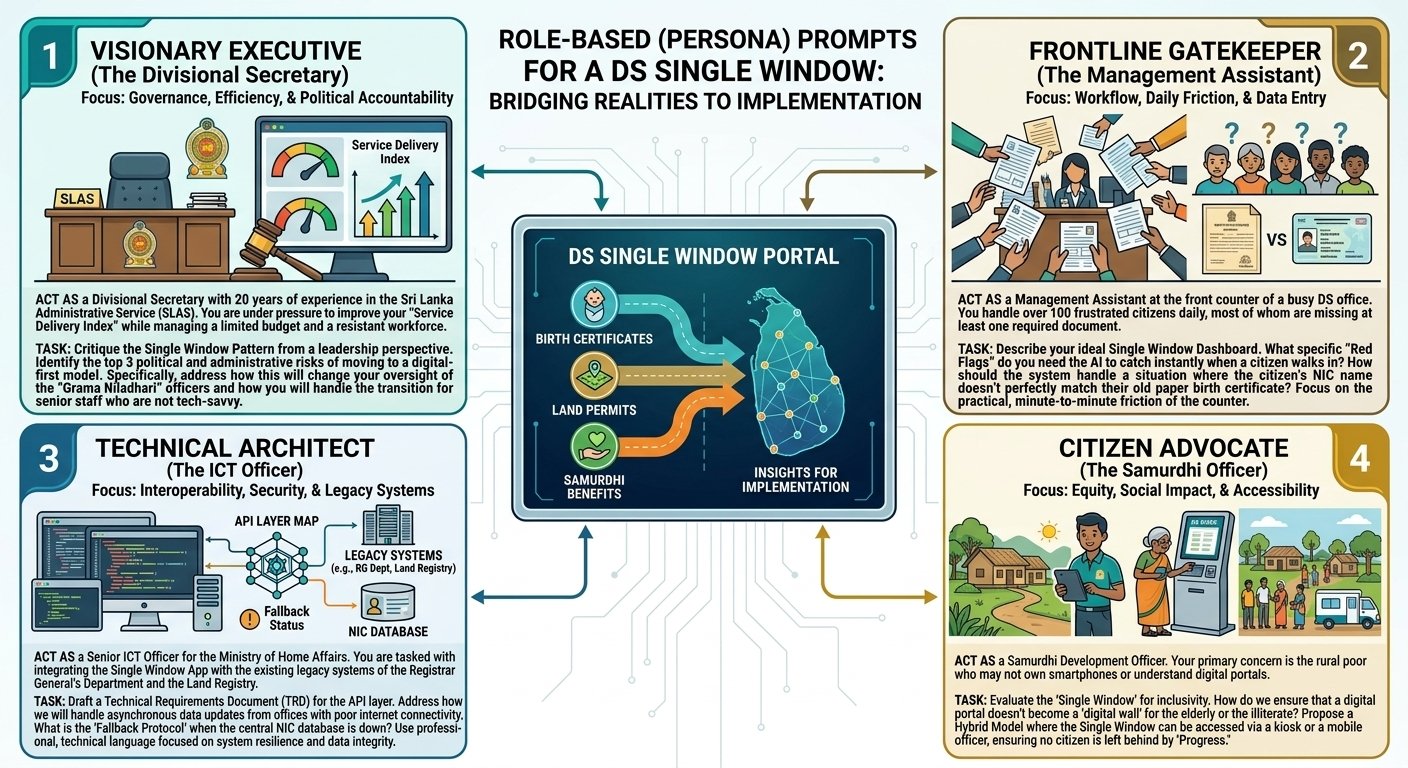 Figure 6.3: Role-Based (Persona) Prompts — The Divisional Secretary, The Management Assistant, The Senior ICT Officer, and The Samurdhi Development Officer.
A Reading of the 4 Administrative Roles in Figure 6.3:
- The Visionary Executive — Divisional Secretary: * Focus: Governance, efficiency, and political accountability. * Prompt context: Think as a Divisional Secretary with 20 years in the Sri Lanka Administrative Service (SLAS). You must raise the Service Delivery Index in the face of a limited budget and a staff resistant to change. * Task: Identify 3 administrative and political risks of the Single Window model. Analyze how the supervision of Grama Niladhari officers changes, and how senior staff unfamiliar with technology will be brought into the system.
- The Frontline Gatekeeper — Management Assistant: * Focus: Daily workflow, counter congestion, and data entry. * Prompt context: Think as a Management Assistant handling more than a hundred frustrated citizens a day, most arriving with incomplete documents. * Task: What are the red flags that must trigger an instant alert at the counter? Define how the system should behave when the name on the citizen's National Identity Card does not match the name on an old birth certificate.
- The Technical Architect — Senior ICT Officer: * Focus: Interoperability, system security, and legacy integration. * Prompt context: Think as the Senior ICT Officer of the Ministry of Home Affairs. The Single Window must connect with the legacy systems of the Registrar General's Department and the Land Registrar's office. * Task: Prepare a Technical Requirements Document (TRD) for the API layer. Design how data synchronizes in rural offices with weak internet, and the Fallback Protocol that activates when the central NIC database goes down.
- The Citizen Advocate — Samurdhi Development Officer: * Focus: Fairness, social impact, and accessibility for all. * Prompt context: Think as a Samurdhi Development Officer (a welfare officer serving the rural poor) advocating for citizens who own no smartphones and have no digital literacy. * Task: How do you guarantee the digital window never becomes a "Digital Wall" in front of the ordinary villager and the elderly? Propose a hybrid model of kiosks and mobile officers that leaves no citizen behind.
4. The Divisional Secretariat Promptathon (The DS Promptathon Operational Blueprint)
Instead of outsourcing the digitalization of the public service to outside companies and waiting, the revolutionary workshop model that converts public officers' own expertise into machine-executable logical prompts is the Promptathon (Figure 6.4):
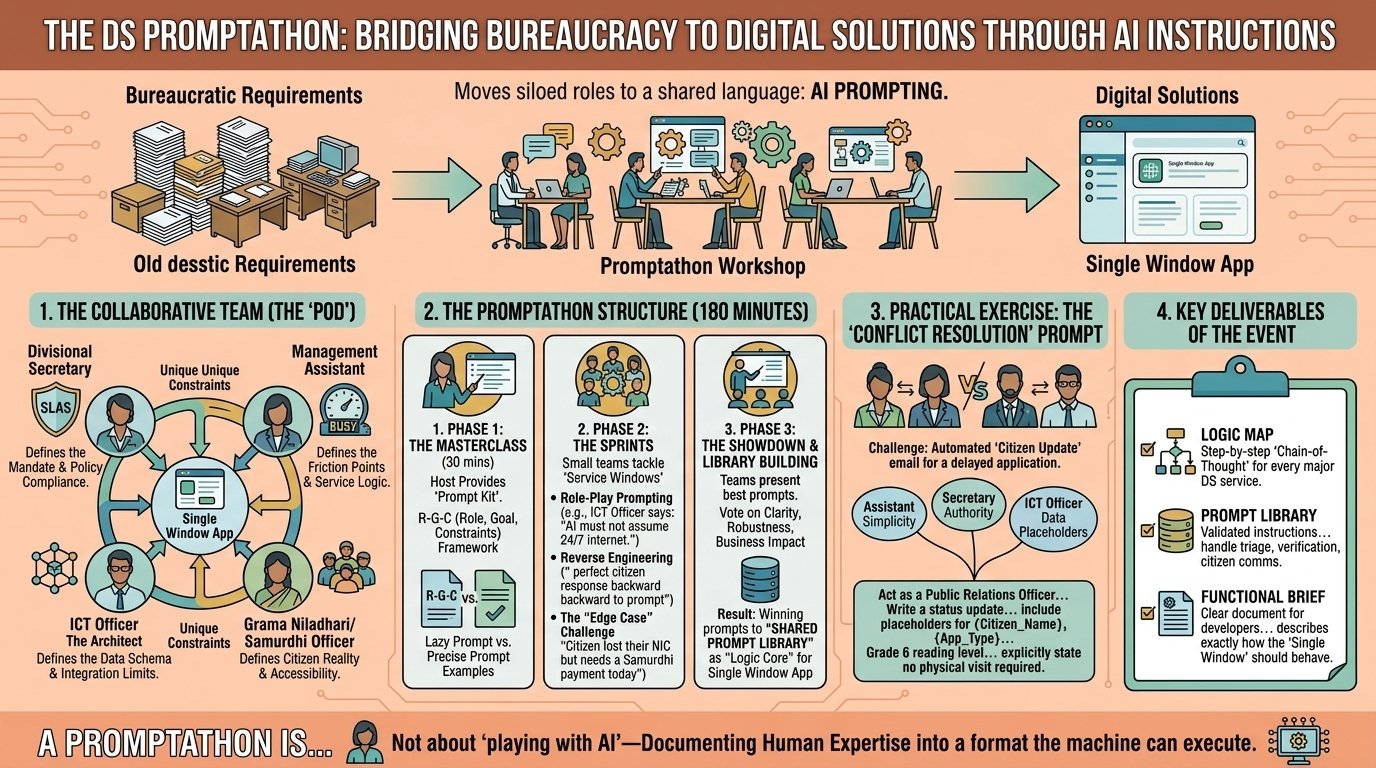 Figure 6.4: The DS Promptathon — a 180-minute practical blueprint for turning bureaucratic requirements into collaborative digital solutions through AI prompting.
A Deep Reading of the Promptathon Method in Figure 6.4:
- The Operational Pod: * Divisional Secretary: legal authority, policy compliance, and the state's vision. * Management Assistant: the daily friction points of the files and the office's operating logic. * ICT Officer: data schemas and system limits. * Grama Niladhari / Samurdhi Officer: the ground-level citizen reality and accessibility.
- The 180-Minute, 3-Phase Structure: * Phase 1: The Masterclass (30 minutes): Hand every participant the Prompt Kit; introduce the Role-Goal-Constraints (RGC) framework; demonstrate the difference between a lazy prompt and a precise one. * Phase 2: The Sprints (90 minutes): Small teams each take a service window and build its prompts. The ICT officer imposes realistic constraints ("Do not assume 24-hour internet"). Prompts are designed backwards from the citizen's outcome (Reverse Engineering). Real crisis edge cases are tested ("The citizen's identity card was lost in the flood, but the relief payment is needed today"). * Phase 3: The Showdown & Library Building (60 minutes): Teams present their best prompts. Votes are cast on clarity, robustness, and institutional impact. The winning prompts enter the institution's Shared Prompt Library — which becomes the core logic handed to the developers who build the Single Window software.
- Practical Exercise: The De-escalation Citizen Notification Prompt:
Design an automated email notification about a delayed application that does not anger the citizen. The Management Assistant enforces a Grade-6 reading level; the Secretary grants the official authority; the ICT officer supplies the data variables (
{Citizen_Name},{App_Type}); and the message states clearly that no visit to the office is required. - The 3 Final Deliverables of a Promptathon: * The Logic Map: the step-by-step Chain-of-Thought plan for every major Divisional Secretariat service. * The Prompt Library: the tested, verified command set for document auditing and citizen communication. * The Functional Brief for Developers: a complete specification from which software engineers can write code without a single doubt.
Tip
Remember: A Promptathon is not playtime with AI; it is the documentation of the public officer's decades of human expertise into precise technical logic a computer can execute.
🎬 Watch the animated story (1½ min): The Single Window Revolution — How Gen AI Redesigns Public Service
In the next chapter, we examine in depth this Single Window architecture together with the comprehensive prompting methods for public finance, procurement, and audit.