07. Single Window Government Architecture, RAG, and Public Finance Auditing
Core Theme: In public finance and auditing, what matters is not conjecture but the hard Financial Regulations (FR), the procurement guidelines, and unbreakable audit trails. How do you guarantee accuracy through RAG — the technology that connects your own government documents to AI?
1. From the World Trade Organization (WTO) to the Divisional Secretariat: The Origin of the Single Window Concept
The principal architectural model I propose for reorganizing a Divisional Secretariat is the Single Window Platform.
What few people know is that the Single Window concept was born in customs and international trade. The World Trade Organization (WTO) adopted the "Single Window" model under Article 10.4 of the Trade Facilitation Agreement to dissolve the immense bureaucratic barrier faced by international traders. Instead of presenting separate paperwork to customs, the port authority, the health inspectorate, the standards institute, and the import-export controller every time a shipment landed, the WTO Single Window let a trader submit every document through one single digital window.
What we do at the Divisional Secretariat is transplant this proven global architectural pattern into our own public administration!
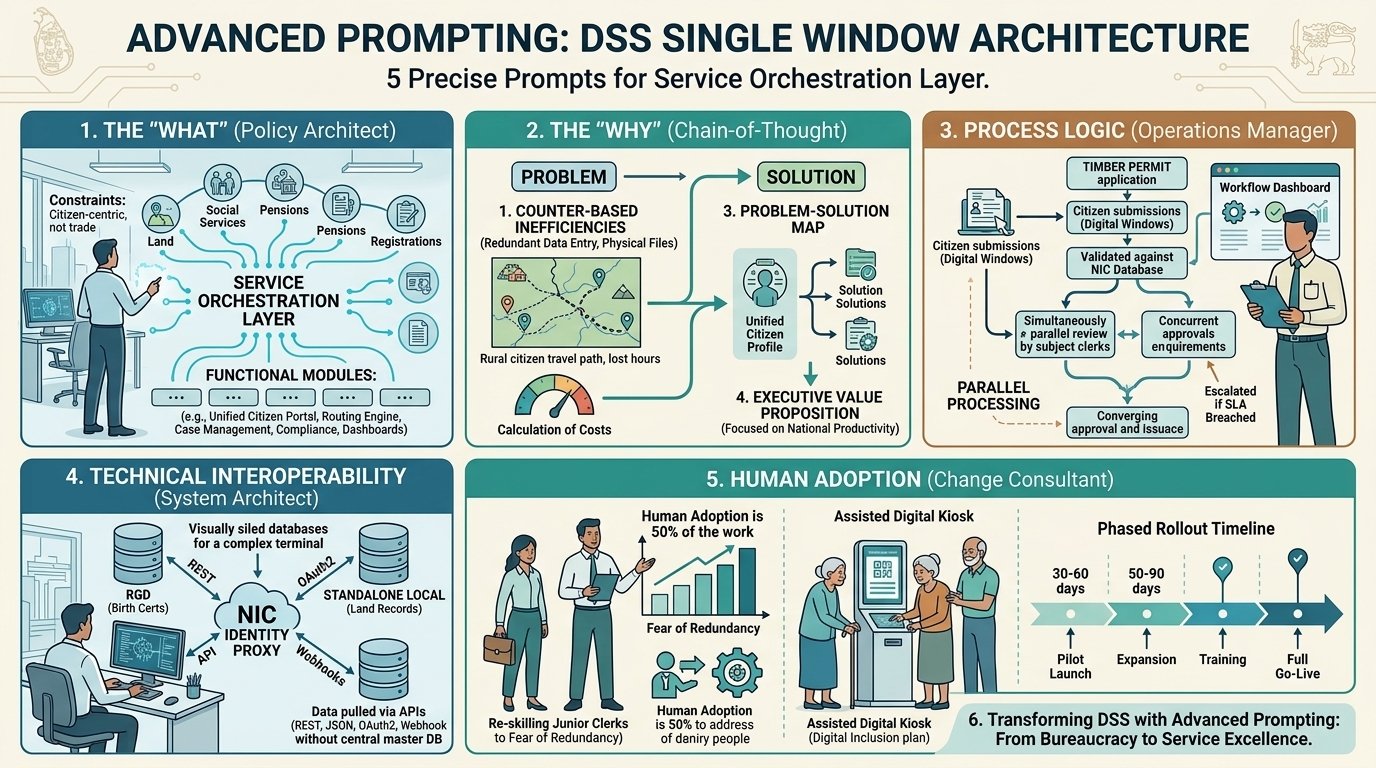 Figure 7.1: The DSS Single Window Architecture — the 5 precision prompt vectors for building the Service Orchestration Layer.
A Deep Reading of the 5 Precision Prompt Vectors in Figure 7.1:
- Vector 1: The "WHAT" — Policy Architect Prompt (Functional Scope): * Goal: Unify the siloed divisions — Pensions, Land Registrations, and Social Services — behind a single Service Orchestration Layer. * Core modules: a Unified Citizen Portal, an intelligent task Routing Engine, a state-law Compliance Module, and Executive Dashboards. * Hard constraints: The system must be no trade counter; it must be 100% citizen-centric, built around the citizen's life needs.
- Vector 2: The "WHY" — Chain-of-Thought Prompt (Economic and Productivity Justification): * Goal: Calculate the waste of the traditional counter-based file system and demonstrate the national productivity return (National ROI). * Reasoning chain: Count the number of times a rural villager must ride a bus 30 kilometers because of duplicate data entry and hand-carried files; compute the lost daily wages and hours → then establish the direct value to the provincial economy of cutting office visits by 70%.
- Vector 3: Process Logic — Operations Manager Prompt (Automated Workflow): * Goal: Convert the sequential, step-after-step file system into a parallel process (a Parallel State Machine) — the worked example being the timber felling and transport permit (Timber Permit). * How it runs: The citizen applies digitally → the application is verified against the National Identity Card (NIC) database and a Unified Citizen Profile is created → digital review is dispatched simultaneously to the Grama Niladhari, the Range Forest Officer, and the land clerk (Parallel Processing) → the instant all approvals land, the digital permit is issued by SMS → and if any officer delays beyond 48 hours, an alert automatically escalates to the Divisional Secretary (SLA Escalation).
- Vector 4: Technical Interoperability — System Architect Prompt: * Goal: Exchange data between distributed systems — without piling all government data into one monolithic master database and creating a single point of insecurity. * Technical protocols: REST APIs, JSON data formats, OAuth 2.0 security credentials, and Webhooks; maintaining live connections between the Registrar General's Department (births), local government bodies (permits/taxes), the Land Registry, and the NIC Identity Proxy.
- Vector 5: Human Adoption — Change Consultant Prompt (Change Management): * Goal: "Fifty percent of the success of any digital transformation rests not on the technology but on human adoption!" * Dissolving staff fear: Address the junior clerks' fear of redundancy by re-skilling them as digital auditors and citizen guides. * Assisted Digital Kiosks: assisted counters placed in post offices and Agrarian Service Centres for elders without smartphones. * Phased rollout: pilot project (days 1–30), staff training and regional expansion (days 30–60), full national launch (days 60–90).
2. RAG (Retrieval-Augmented Generation): Feeding Government Circulars to AI, Correctly
Ask a plain ChatGPT about a government procurement, and it may well answer with the rules of some other country mixed in. But what the public officer needs is a precise answer grounded in Sri Lanka's specific Government Procurement Guidelines and Financial Regulations (FR).
Here we use the advanced technique the world's AI researchers introduced as RAG (Retrieval-Augmented Generation) (Lewis et al., NeurIPS 2020: Retrieval-Augmented Generation for Knowledge-Intensive NLP Tasks).
A Practical Example: Two Conflicting Procurement Circulars
In a government procurement, several circulars issued at different times may govern the same procedure: * one circular sets the procurement thresholds, while * an amendment circular issued two years later has changed the tender board approval limits.
An ordinary officer would spend a full day cross-comparing the two documents. Inside a RAG workflow, instead: 1. You attach both official procurement circular PDFs to the AI chat window. 2. You then issue a constrained prompt of the following form:
Role: You are a senior procurement and financial audit specialist of the
Government of Sri Lanka.
Context: Base your answer ONLY on the attached Government Procurement
Guideline (Document A) and the Financial Amendment Circular No. 02 of 2024
(Document B).

Task: Our Divisional Secretariat plans to purchase computer equipment
worth Rs. 3.5 million.
1. Which tender procedure must be called for this (Shopping, or National
   Competitive Bidding)?
2. What is the required composition of the Procurement Committee (DPC),
   and who is the approving authority?
3. Answer citing the exact paragraph numbers of the attached documents.
   Include no general knowledge from outside the documents.
This slams the door on the model's room to fabricate (hallucinate), and yields a precise audit recommendation grounded solely in the real law of the state.
3. Protecting Government Data: The Difference Between Free and Paid Tiers
There is one ethical and security rule I press upon officers in every session:
Caution
Never enter confidential government documents or citizens' personal files into free AI windows!
- Free tiers: When you use ChatGPT or any other tool without paying, its Terms of Service grant the company permission to use every prompt and document you enter to train its next generation of AI models (Model Training). The moment you paste a government letter into a free tool, that is a state data leak.
- Paid / Enterprise tiers: With a paid tier costing US$15–20 a month (roughly Rs. 5,000–7,000) (OpenAI Enterprise Privacy Commitments and the Anthropic Trust Center): 1. You receive a legal guarantee that your data is not used to train their models (Data Privacy Guarantee). 2. You gain access to the most powerful and current reasoning models (GPT-4o/o1, Claude 3.5 Sonnet, Gemini 1.5 Pro). 3. You receive far higher capacity for analyzing large files (PDFs, Excel spreadsheets).
If a government institution is to use AI, the head of the institution or the ministry should issue official paid accounts — securing both data protection and superior productivity in one stroke.
4. The National Digital Economy Blueprint and Digital Public Infrastructure (DPI)
The transformation happening on the Divisional Secretariat's desk is bound tightly to Sri Lanka's overall national Digital Economy Blueprint. Figure 7.2 shows the six layers of the digital economy, running from physical infrastructure all the way to the ordinary citizen:
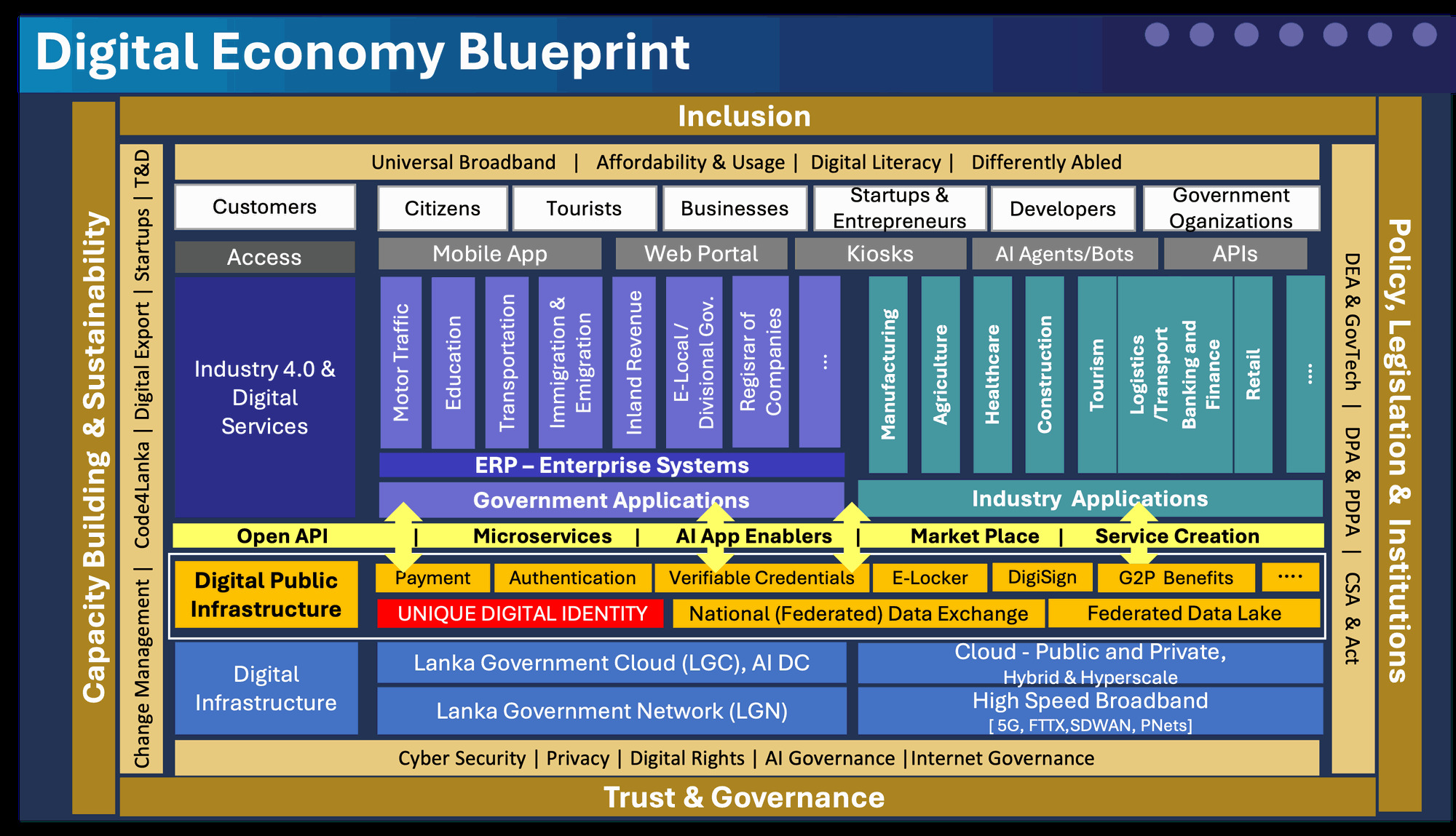 Figure 7.2: The Sri Lanka National Digital Economy Blueprint — physical infrastructure, Digital Public Infrastructure (DPI), open APIs, vertical applications, multi-channel access windows, and the governance-and-trust framework.
A Deep Reading of the 6 National Digital Economy Layers in Figure 7.2:
- Layer 1: Physical Digital Infrastructure — The Bedrock: * High-speed broadband networks: 5G, FTTx optical fiber, SD-WAN, and private government networks (PNets). * The Lanka Government Network (LGN): the high-speed secure network stitching together every ministry and Divisional Secretariat on the island. * Cloud and AI centers: the Lanka Government Cloud (LGC), national AI data centers (AI DC), and sovereign hybrid cloud environments.
- Layer 2: Digital Public Infrastructure (DPI): * The national digital identity (SLUDI / MOSIP): the biometric digital ID that establishes citizen identity. * Verifiable Credentials & E-Locker: the citizen vault where birth certificates, examination results, and land deeds are digitally signed and stored. * The digital signature (DigiSign): the legally valid digital signing scheme under the Electronic Transactions Act. * The National Federated Data Exchange (NDX): the secure digital highway along which government institutions exchange data. * The G2P Benefits Rail: crediting welfare benefits such as Aswesuma directly to the citizen's bank account, with no intermediaries.
- Layer 3: Open APIs & the Industry 4.0 Platform: * Government ERP systems, microservices, AI App Enablers, and the unified government payment system (GovPay / LankaPay). * The open API standards through which the private sector and software builders connect securely to government services.
- Layer 4: Vertical Sector Applications: * Government services: motor traffic (DMT), education, transport, immigration and emigration, Inland Revenue (IRD), local government and Divisional Secretariat services (E-Local / Divisional Gov), the company registrar (e-RoC). * Industry services: manufacturing, agriculture (smart harvest planning), health (digital patient records — EHR), construction, tourism, ports and logistics, banking and finance.
- Layer 5: Access Channels and Multi-Party Service Delivery: * Citizens, tourists, businesses, startup entrepreneurs, developers, and autonomous AI agents (AI Agents/Bots). * Access media: mobile apps, government web portals, self-service kiosks, and APIs.
- The Cross-Cutting Pillars: Trust, Governance & Inclusion: * The legal and governance framework: the Personal Data Protection Act (PDPA / DPA), the Cyber Security Act (CSA), the Digital Economy Authority (DEA), and AI ethics governance frameworks. * Social inclusion and capacity building: affordable broadband for all, accessibility for differently-abled citizens, the Code4Lanka program, and the island-wide AI literacy training delivered by Idasara Academy.
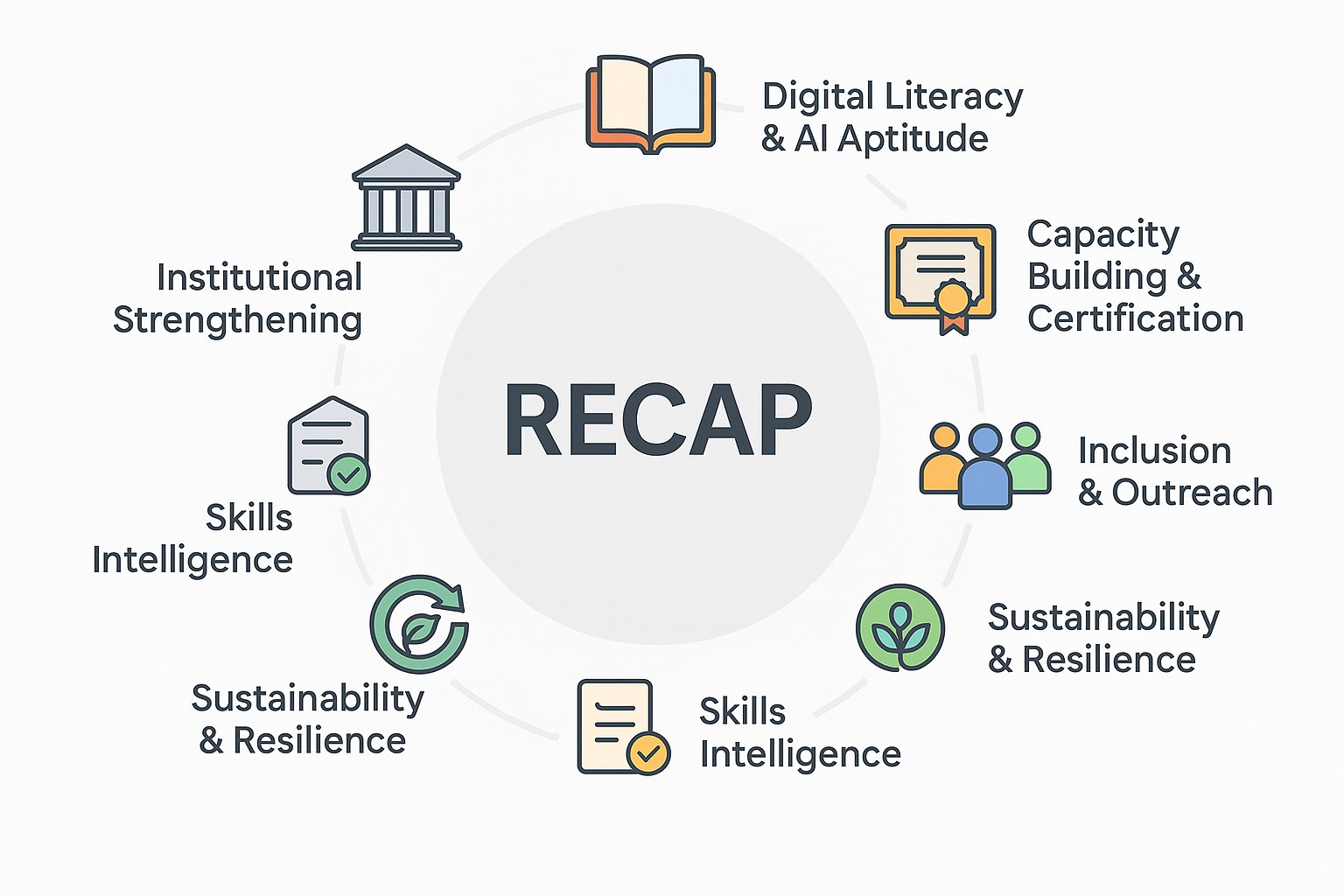 Figure 7.3: Institutional Strengthening & Capacity Building (RECAP) — developing public service capacity through institutional strengthening, skills intelligence, sustainability, digital literacy, and certification.
In the next chapter, we examine the seven gravest ethical and legal risks a public officer faces when using artificial intelligence, the $440,000 lesson Deloitte suffered in Australia, and the Shadow AI that officers are already practicing in secret.