02. From Computing Fundamentals to Generative AI: The Fall of the 70-Year Language Barrier
Core Theme: For seventy years, humans learned the computer's language — coding. Today the computer has learned the natural language of humans. That transition has broken the greatest technological barrier in the history of administration, and in human history itself.
1. The Physical Reality of a Computer: One and Zero (1 and 0)
To understand the true power of artificial intelligence, even a reader with no technical background can easily grasp the basic physical mechanism by which a computer actually works.
Picture yourself in a shop buying a smartphone or a laptop. Without realizing it, you interrogate the seller about a handful of technical specifications:
- "How is the display? How is the camera?" — the camera is an input device; the display is an output device.
- "How much memory (RAM)? How big is the hard disk (storage)?" — temporary memory and permanent memory.
- "Is the processor an Intel? A Core i7?" — the computer's brain: the central processing unit.
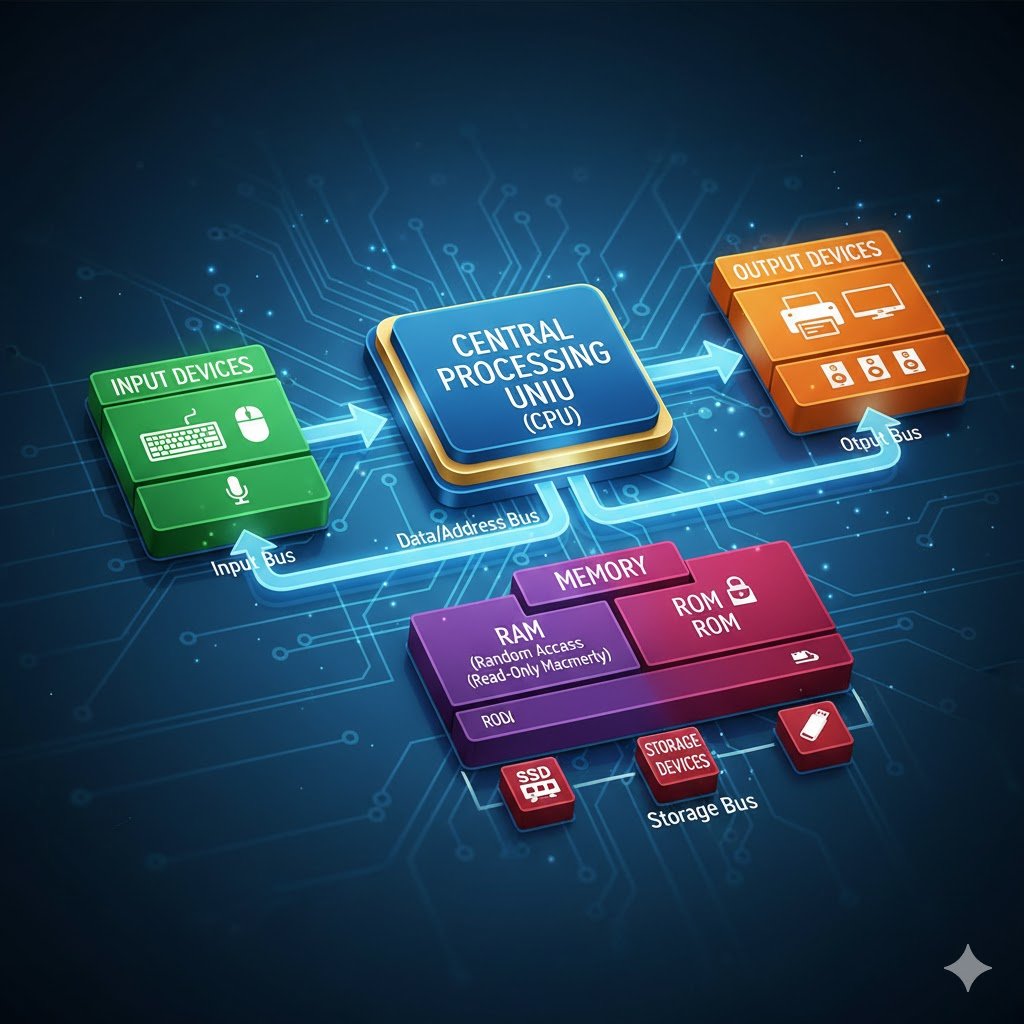 Figure 2.1: The basic architecture of a computer (Von Neumann Architecture) — input devices, the central processing unit (CPU), primary memory (RAM/ROM), permanent storage (SSD/Storage), and output devices.
The System Anatomy and Hardware Components of Figure 2.1:
- Input Devices & Bus: keyboards, scanners, cameras, and biometric readers convert human commands or physical data into electrical signals and feed them into the system.
- The Central Processing Unit (CPU): the computer's principal computation and instruction-execution unit (Arithmetic Logic Unit & Control Unit), running its cycle continuously: Fetch, Decode, Execute.
- Primary Memory (RAM & ROM): * RAM (Random Access Memory): the high-speed memory holding running programs. Its contents vanish when power is cut (volatile). * ROM (Read-Only Memory): the chip permanently storing the basic instructions needed to boot the machine.
- Secondary Storage (SSD / HDD): the permanent store for files, databases, and the operating system itself.
- Data, Address & Control Buses: the electrical highways moving billions of bytes per second between CPU, memory, and storage.
- Output Devices: the display and printers, returning results to the user.
The limitation of this classical architecture is that the CPU executes instructions step by step (sequential processing). This is exactly why AI demands something radically different: parallel chips (GPUs) that perform hundreds of thousands of calculations simultaneously.
2. The Operating System: The First Bridge between the Human and the Silicon Chip
An ordinary person cannot converse with a computer in 1s and 0s. We do not know how — and it would be unbearably tedious. So, to make this complex hardware useful to ordinary people, a special and sophisticated piece of software was created to run on it: the Operating System (OS).
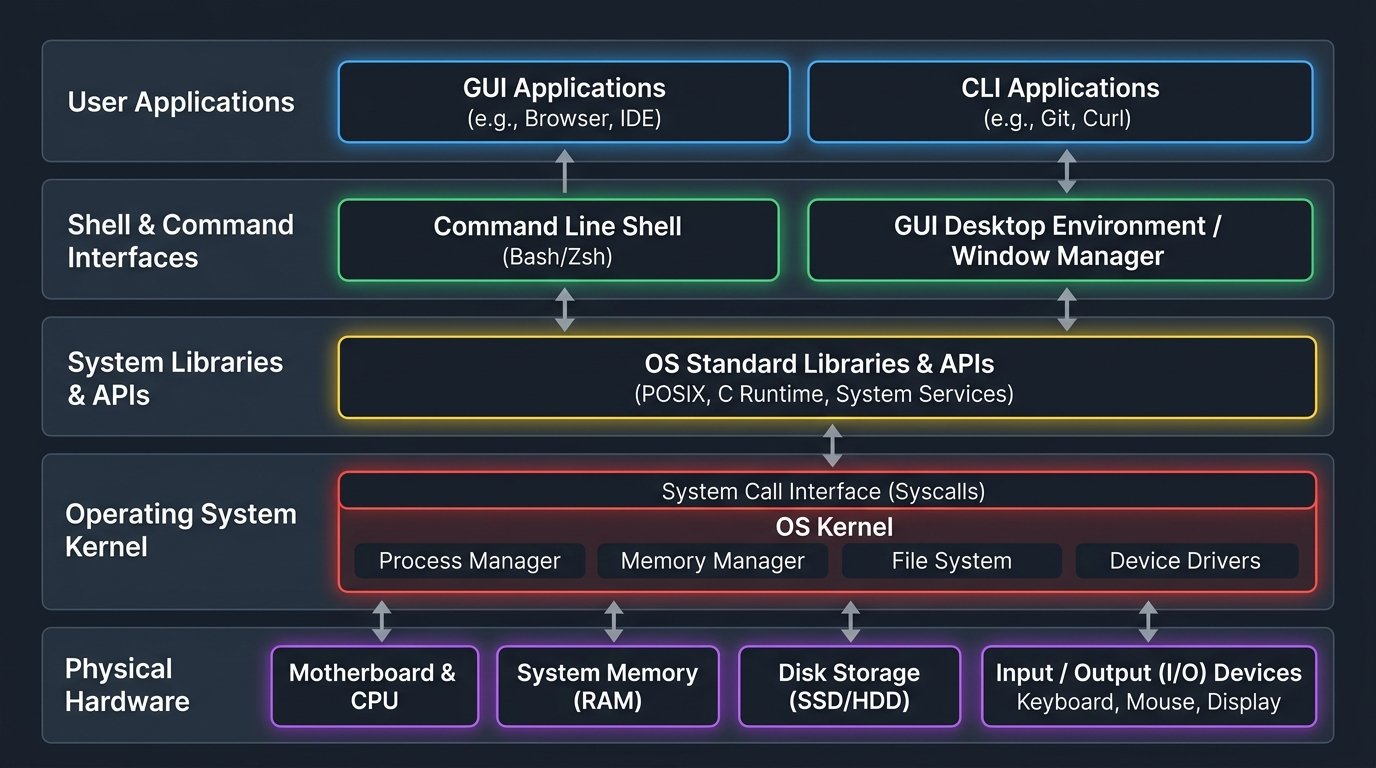 Figure 2.2: The fundamental layers of an operating system — physical hardware, the OS kernel, system libraries (APIs), command interfaces (shells), and user applications.
The Operating System Layers of Figure 2.2:
- Physical Hardware: motherboard, CPU, RAM, SSD/HDD, keyboard, and display.
- The OS Kernel: * Process Manager: dividing CPU time among the hundreds of programs running at once. * Memory Manager: ensuring different programs use RAM without colliding. * File System: organizing the data on storage media into folders and files. * Device Drivers: the controller software through which the kernel deals directly with hardware chips. * System Call Interface (Syscalls): the protective wall through which user applications obtain kernel services safely — without the ability to damage the hardware directly.
- System Libraries & APIs: standard POSIX or C runtime libraries providing common facilities to software developers.
- Shell & Command Interfaces: the Bash/Zsh terminals (CLI) or the Windows/desktop GUI environments through which users issue commands.
- User Applications: the software we use daily — Chrome, Word, Excel, and government systems.
This is why you check for Windows when buying a computer, and for Android or Apple iOS when buying a phone.
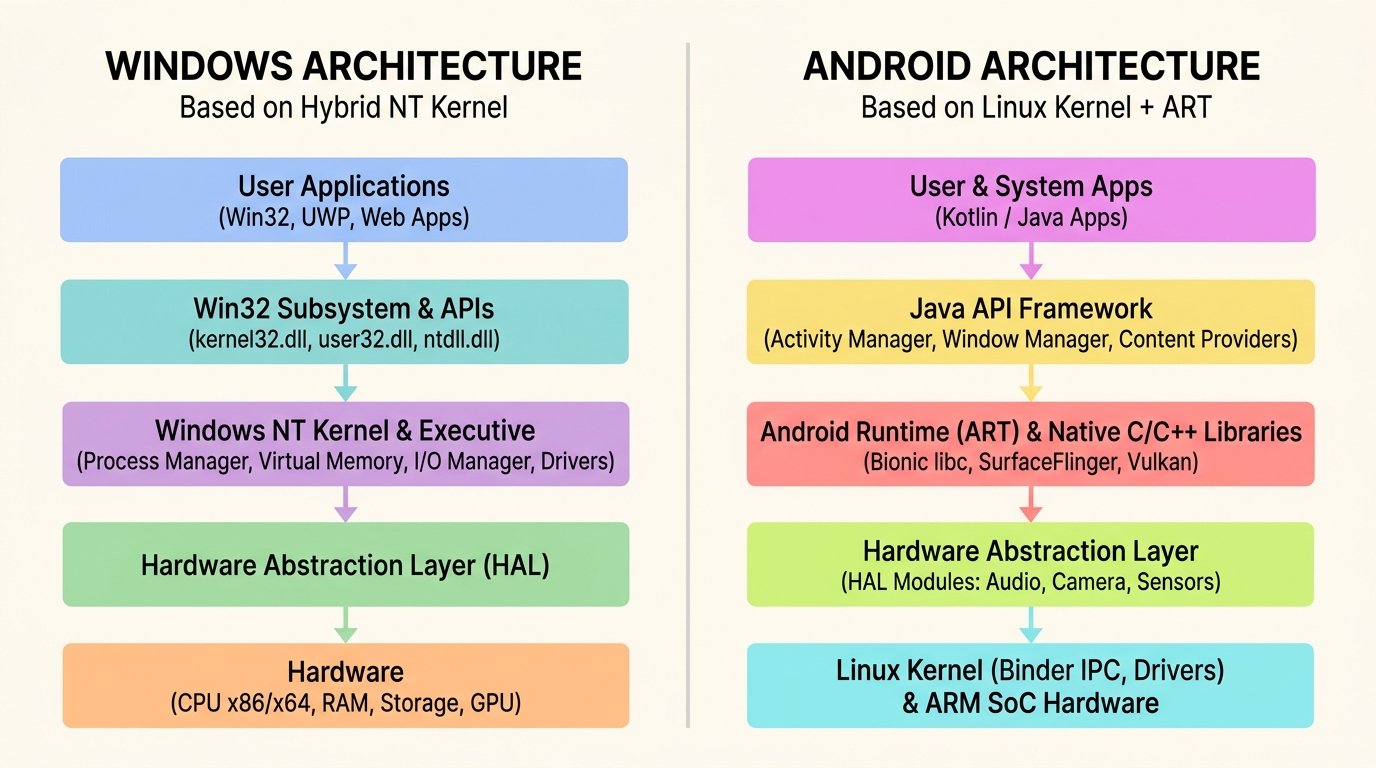 Figure 2.3: Windows NT Architecture and Android Architecture — how two operating systems, desktop and mobile, manage the abstraction barrier between hardware and software.
Figure 2.3: Windows NT versus Android Architecture:
- Windows NT Architecture (Desktop):
- User applications (Win32, UWP, Web Apps).
- Win32 Subsystem & APIs (
kernel32.dll,user32.dll,ntdll.dll). - Windows NT Kernel & Executive (Process Manager, Virtual Memory, I/O Manager).
- Hardware Abstraction Layer (HAL): the protective layer freeing the kernel from x86/x64 motherboard differences.
- Android Architecture (Mobile):
- User applications (Kotlin / Java apps).
- Java API Framework (Activity Manager, Window Manager, Content Providers).
- Android Runtime (ART) and native C/C++ libraries (
Bionic libc,SurfaceFlinger,Vulkan). - Hardware Abstraction Layer (HAL modules: camera, audio, sensors).
- Linux kernel (Binder IPC, power management drivers) and ARM SoC hardware.
The lesson for government technical officers: because a phone and a computer run in two entirely different operating environments, government digital services must be built platform-neutral — on the web and on open APIs — rather than tied to any one platform.
3. Programming Languages, Compilers, and the 70-Year Code Barrier
An operating system alone cannot make a computer perform the specific clerical work we need. To compute a government employee's monthly salary, register a land title, or calculate a pension, the computer must be given a step-by-step series of instructions — an algorithm.
For that purpose, programming languages were born: Fortran, COBOL, C, C++, Java, Python, and the rest.
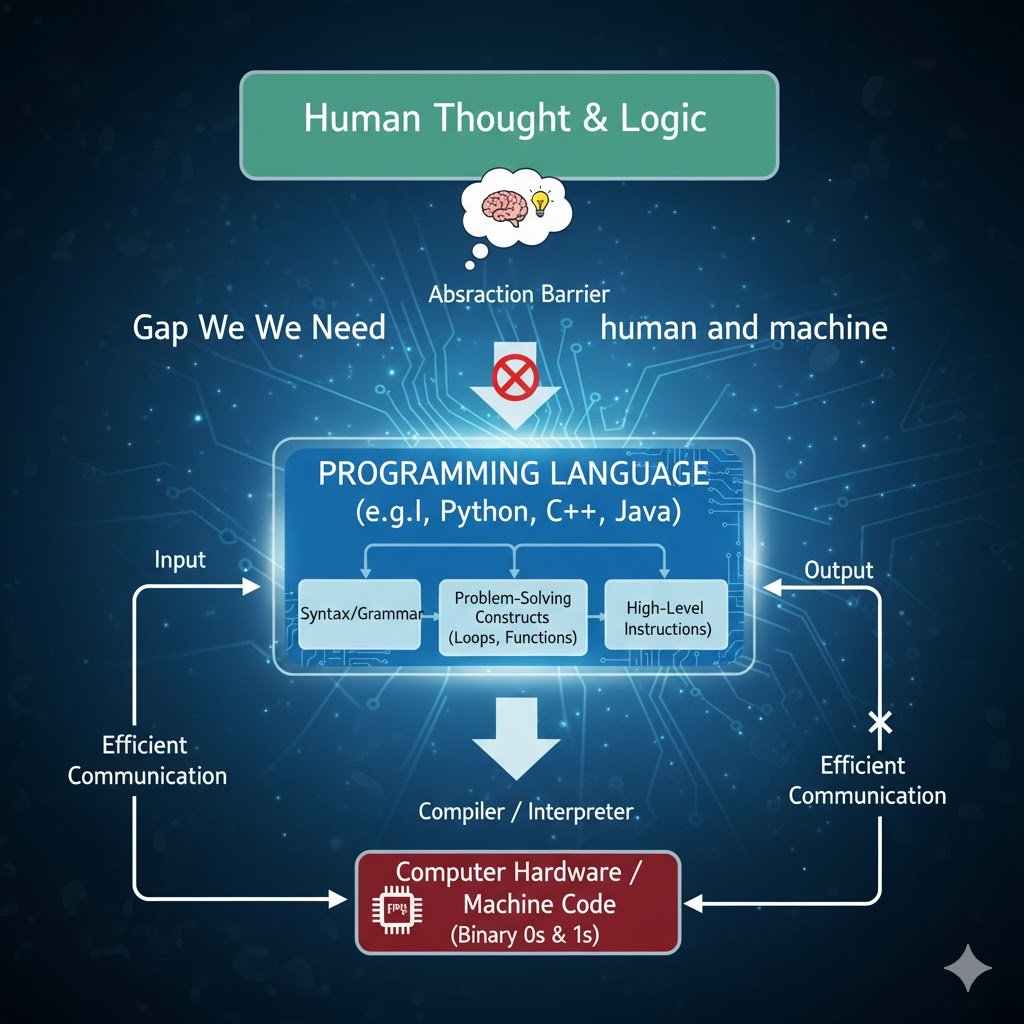 Figure 2.4: The programming language — the abstraction barrier between human logic and the computer's binary signals (0 and 1).
The policies, concepts, and logic in a human mind mean nothing to a silicon chip directly. Programming languages — with their strict grammar (syntax) and problem-solving structures (loops, functions) — existed to bridge that gap.
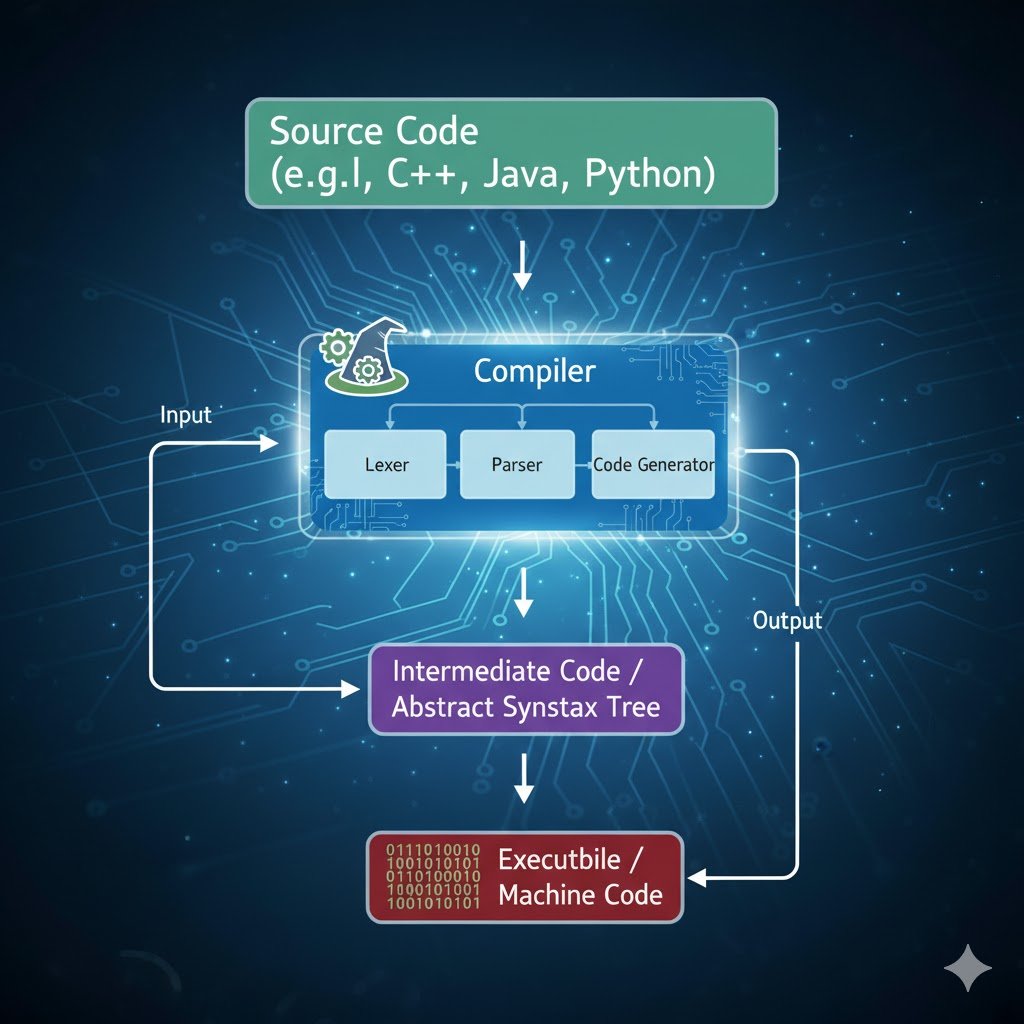 Figure 2.5: The step-by-step pipeline of a compiler — from source code to machine code (binaries).
The Compiler Pipeline Stages of Figure 2.5:
- Source Code Input: the textual code a human writes in a language such as C++, Java, or Python.
- Lexical Analysis (Lexer / Tokenizer): examining every character of the code and separating words, punctuation, and commands into tokens.
- Parsing (Parser): checking conformance to the grammar and reporting syntax errors.
- The Abstract Syntax Tree (AST) and intermediate code: structuring the program's logical flow like the branches of a tree.
- Code Generation: finally producing the binary machine code (an executable of 0s and 1s) that the hardware can run directly.
Note
The 70-Year Bottleneck: From 1950 until 2022 — more than seventy years — the greatest bottleneck in the world of computing was this: to make a computer do anything, you had to learn the computer's language. Coding. One missed semicolon, one wrong character, and the entire program failed. Otherwise, you paid a well-salaried software engineer to explain your needs to the machine on your behalf. That is the rigid technical wall that has now come down!
4. The Historic Revolution: From Code to Conversation
With the arrival of ChatGPT in late 2022, it was precisely this 70-year barrier that collapsed!
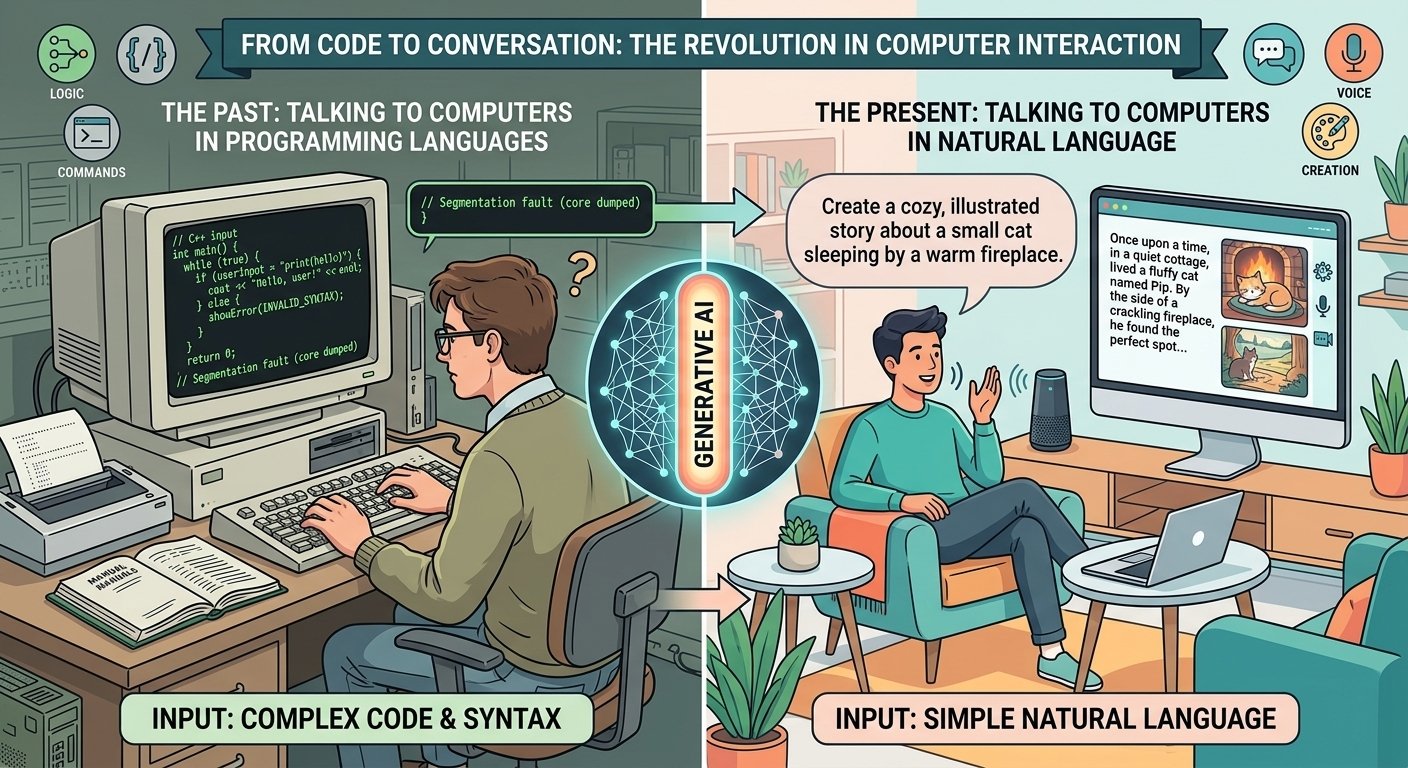 Figure 2.6: From Code to Conversation — natural human language replacing complex coding languages as the computer's new operating interface.
To talk to a computer now, you do not need to learn C++ or Python. You can explain what you need in your own mother tongue — in Sinhala, in Tamil, or in English.
Generative AI has brought the computer to the point of understanding natural human language. Computing power that was once confined to programmers has passed into the hands of the ordinary management assistant at the Divisional Secretariat and the Grama Niladhari officer in the village. That is the shape of this revolution.
5. Traditional AI versus Generative AI
Here we must grasp a fundamental distinction: "AI" and "Generative AI" are not one thing, but two.
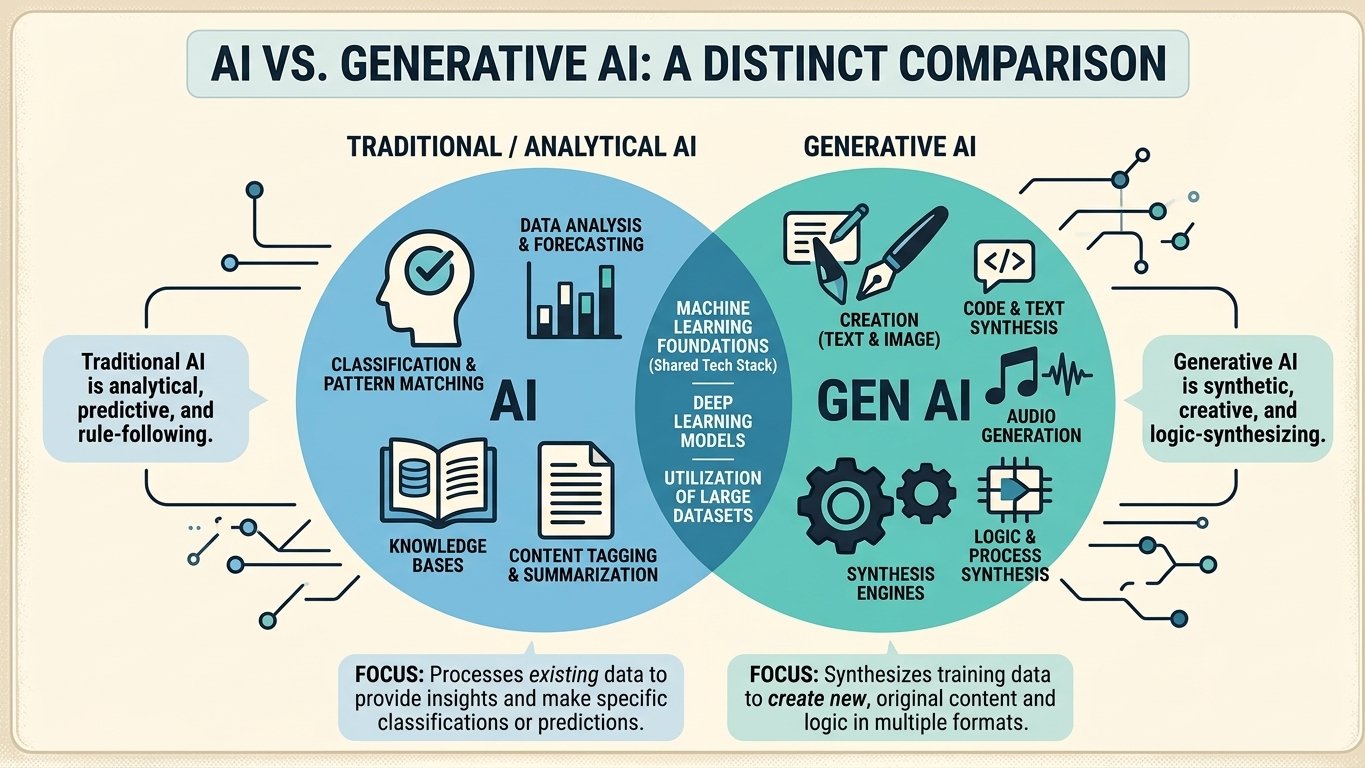 Figure 2.7: Traditional AI versus Generative AI — classifying and predicting from existing data (Analytical AI) versus generating novel content and reasoning (Generative AI).
The Technical Foundation and the Distinction in Figure 2.7:
- The Shared Foundation Stack: both traditional AI and generative AI are built on machine learning, deep learning networks, and large datasets.
- Traditional / Analytical AI:
* Primary purpose: to read and analyze existing data, and return a classification or a prediction.
* Core capabilities:
- Data analysis & forecasting: predicting next month's tax revenue, the harvest, or the number of dengue patients.
- Classification & pattern matching: detecting fraudulent documents, filtering email as spam, matching driving-licence photographs.
- Content tagging: attaching fixed classification tags to files and reports.
- Output: a definite value, a label, or a probability (e.g., "the probability this transaction is fraudulent is 92%").
- Generative AI:
* Primary purpose: to synthesize the patterns in its training data and create wholly new, original content that never existed before (net-new content).
* Core capabilities:
- Code & text synthesis: writing circular drafts, legal opinions, and software code from scratch.
- Audio & image generation: voiceovers, illustrations, and video.
- Logic & process synthesis: automatically composing multi-step plans and reasoning chains to solve a problem.
Figure 2.8: The Complete Capability Map of Generative AI — A Revolution across 12 Domains
Generative AI is not merely a tool that drafts an office letter. Figure 2.8 lays out its vast network of capabilities across 12 domains transforming global industry and government:
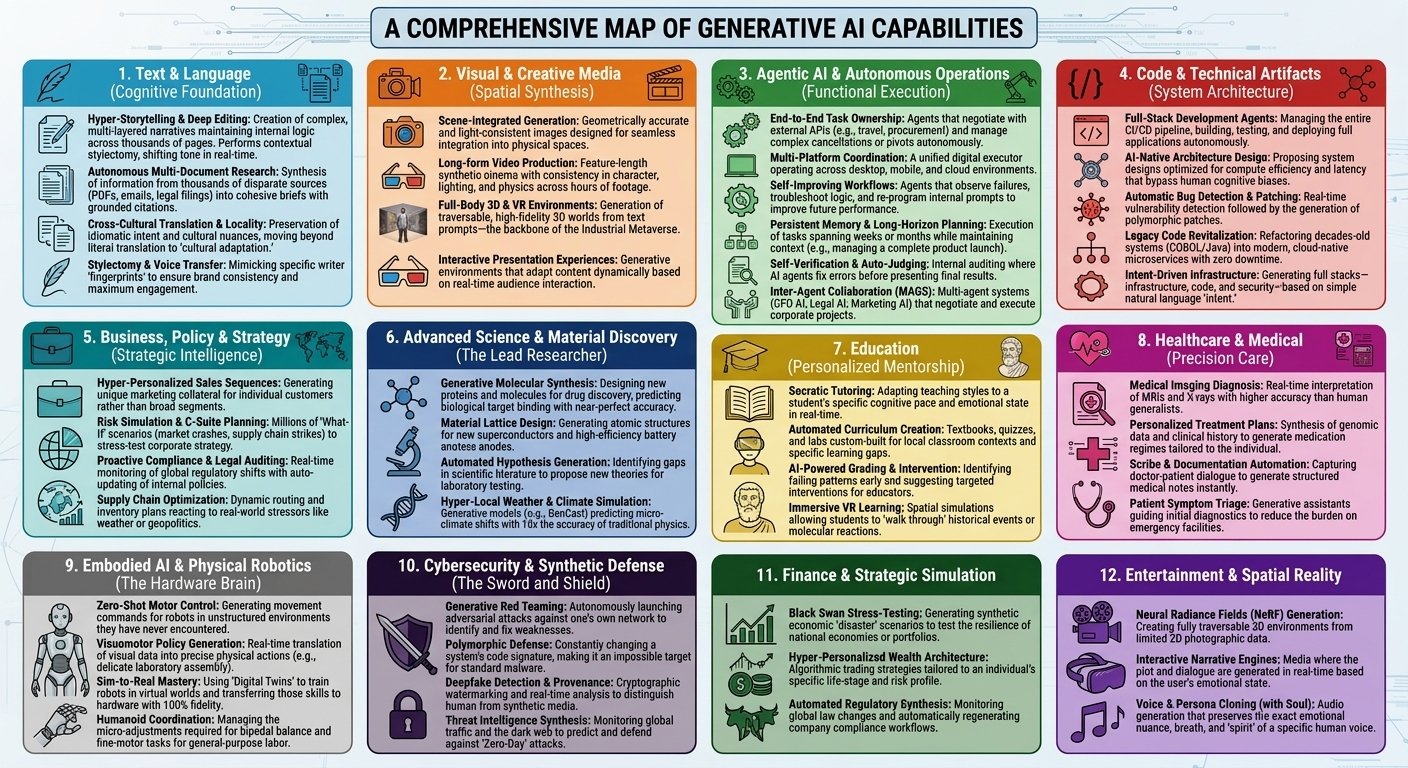 Figure 2.8: The full scope of generative AI — a comprehensive capability map spanning 12 domains across global industry and public governance.
- Text, Knowledge & Translation: * Autonomous multi-document research: reading thousands of circulars, reports, and cabinet decisions in varied formats at once, and producing accurate summaries. * Cross-cultural translation & localization: transmitting meaning while preserving cultural and local nuance, instead of word-for-word substitution. * Style shaping & voice transfer: instantly recasting the same fact into the legal register of a gazette or the plain, warm language a villager understands.
- Visual & Creative Media: * Scene-integrated generation: composing public-awareness visuals with correct lighting and perspective. * Long-form video production: producing educational video with consistent characters and settings throughout. * 3D and VR environment creation: generating three-dimensional virtual models of city plans or archaeological sites from a text query. * Interactive presentation experiences: lecture visuals that adapt in real time to the audience's responses.
- Agentic & Executive Operations: * End-to-end task ownership: completing government procurement or payment workflows automatically through computer APIs, without human intervention. * Multi-platform coordination: moving across websites, databases, and email simultaneously to finish a job. * Self-improving workflows: analyzing its own mistakes and correcting its own prompt when something goes wrong. * Persistent memory & long-horizon planning: steering a months-long state project step by step while remembering everything. * Self-verification & auto-judging: running an internal audit on its own output before handing it to the officer. * Inter-agent collaboration (MAGS): a financial AI, a legal AI, and an administrative AI negotiating among themselves to resolve a file.
- Code & Technical Artifacts: * Full-stack development agents: writing, testing, and deploying software to the cloud automatically. * AI-native architecture design: designing systems for maximum efficiency of compute resources. * Automated bug detection & patching: finding security holes and patching them immediately. * Legacy code revitalization: restructuring decades-old COBOL or Java systems into modern cloud systems without breakage. * Intent-driven infrastructure: standing up an entire cloud server network from a plain English — or Sinhala — sentence.
- Business, Policy & Strategy: * Hyper-personalized citizen communication: sending each citizen official notices tailored to their situation. * Risk simulation & cabinet stress-testing: pre-testing government decisions against hundreds of thousands of scenarios — economic crises, foreign-exchange shocks, port strikes. * Proactive compliance & legal auditing: watching new gazettes and legal amendments live, and updating institutional regulations automatically. * Supply chain optimization: re-routing fuel, medicine, and food distribution in real time as disasters unfold.
- Advanced Science & Material Discovery: * Generative molecular synthesis: designing new drugs and proteins. * Material lattice design: inventing new materials for efficient solar cells and batteries. * Automated hypothesis generation: reading millions of research papers and proposing new scientific discoveries. * Hyper-local climate simulation: forecasting floods or cyclones with high precision.
- Education & Personalized Mentorship: * Socratic tutoring: digital teachers who guide each student personally, at the student's own pace and way of thinking. * Automated curriculum creation: textbooks and exercises fitted to the local environment. * AI grading & early intervention: detecting a student's learning gaps and intervening before the exam is failed. * Immersive VR learning: learning history or space by virtually living it.
- Healthcare & Precision Medicine: * Medical imaging diagnosis: spotting disease indicators in X-ray and MRI scans in seconds. * Personalized treatment plans: dosing decisions grounded in the patient's genetic data and history. * Clinical scribe automation: the medical record writing itself while the doctor talks with the patient. * Patient symptom triage: rapid queue management by severity in a hospital emergency department.
- Embodied AI & Physical Robotics: * Zero-shot motor control: robots navigating and handling objects in environments they have never seen. * Visuomotor policy generation: converting camera data into motor movements precise enough for delicate surgery or assembly. * Sim-to-real mastery: training robots in virtual worlds and releasing them into the real one. * Humanoid coordination: bipedal robots lifting and carrying in factories and warehouses.
- Cybersecurity & Synthetic Defense:
- Generative red teaming: AI safely attacking state systems to expose their weaknesses before criminals do.
- Polymorphic defense: continuously and automatically mutating system code and keys so attackers cannot find a fixed target.
- Deepfake detection & provenance: scientifically identifying forged voice, video, and documents.
- Threat intelligence synthesis: combing the dark web to warn of attacks on state infrastructure in advance.
- Finance & Economic Simulation:
- Black swan stress-testing: testing the national economy's resilience against massive global financial collapses or sanctions.
- Hyper-personalized wealth architecture: shaping pensions and social safety nets to each citizen's income.
- Automated regulatory synthesis: updating internal rules the moment international financial regulations (FATF, IMF) change.
- Entertainment, Culture & Spatial Reality:
- 3D preservation via NeRF: preserving historic sites as complete 3D environments from a handful of photographs.
- Interactive narrative engines: public information that adapts live to the citizen's questions.
- Voice & persona preservation: preserving the emotion and depth of historic voices for future generations.
6. The Great Transition of AI: From Generative to Agentic to Embodied
Figure 2.9 shows the great paradigm shift in which artificial intelligence travels from simple content creation to operating the physical world:
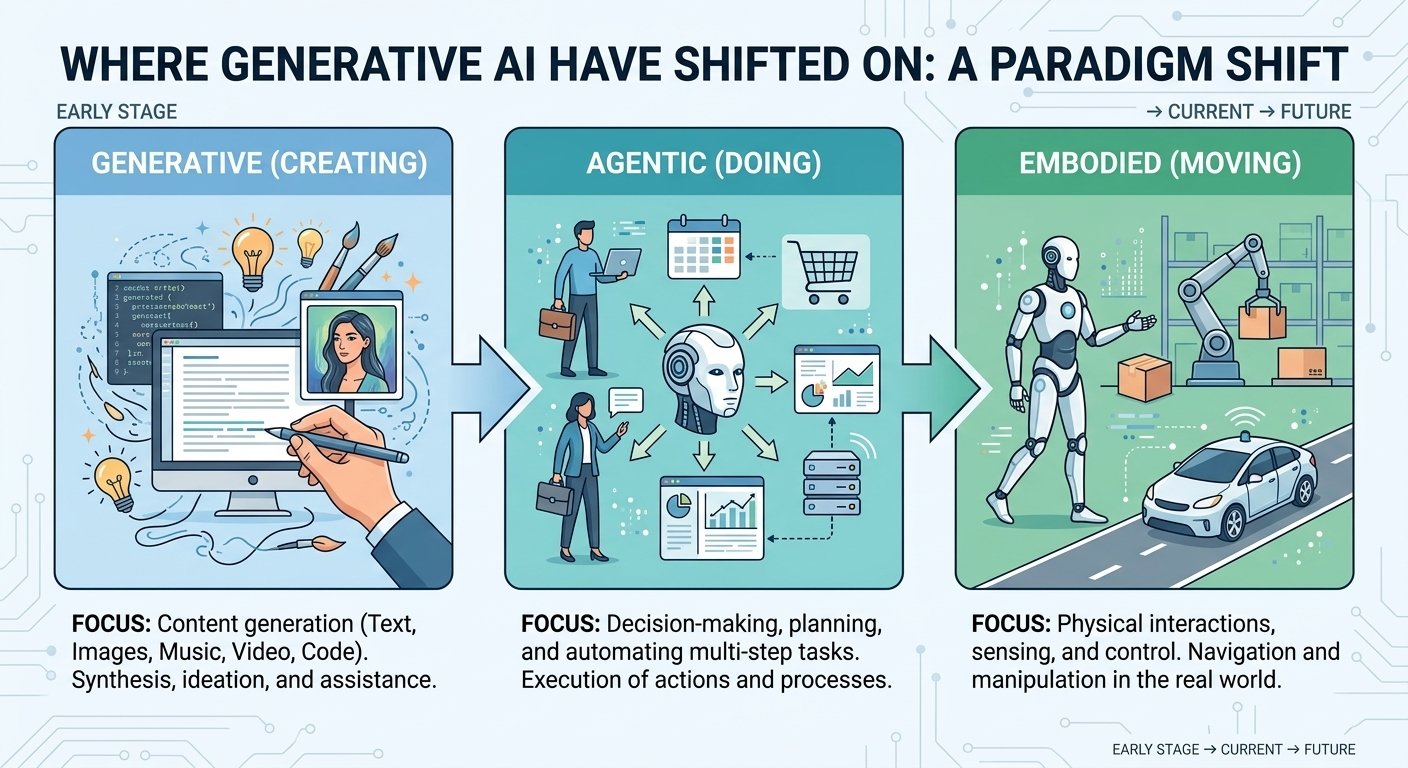 Figure 2.9: The 3 phases of the AI transition — Generative AI (Creating), Agentic AI (Doing), and Embodied AI (Moving).
The Paradigm Transition Stages of Figure 2.9:
- Phase One: the Generative era — Creating (Early Stage): * Primary focus: generating text, images, music, video, and basic code; shaping new ideas; acting as an assistant. * Mode of operation: full operational control remains with the human. The human gives one prompt; the AI gives one answer.
- Phase Two: the Agentic era — Doing (Current Frontier): * Primary focus: making decisions, composing multi-step plans, and finishing tasks independently. * Mode of operation: when a public officer says, "Check this permit application and prepare it for approval," the AI agent checks the database on its own, computes the fees, produces an audit note, and presents the file for the officer's signature.
- Phase Three: the Embodied era — Moving (Future Horizon): * Primary focus: sensing, moving, and manipulating objects in the real physical world (physical robotics). * Mode of operation: AI joins physical labor through humanoid robots, disaster-response drones, and autonomous city-cleaning systems.
Note
🌐 Related reading: for a full analysis of the real timeline along which AI evolves from the 2017 birth of the Transformer architecture to 2035 — from narrow intelligence toward superintelligence — read Idasara Academy's published article, The Gen AI Evolutionary Journey: 2017 to 2035.
7. The 5 Layers of the AI Ecosystem: Where Is Sri Lanka's Real Role?
As NVIDIA's chief executive Jensen Huang points out, artificial intelligence rests on five essential layers (The 5 Layers of AI — From Energy to Intelligence):
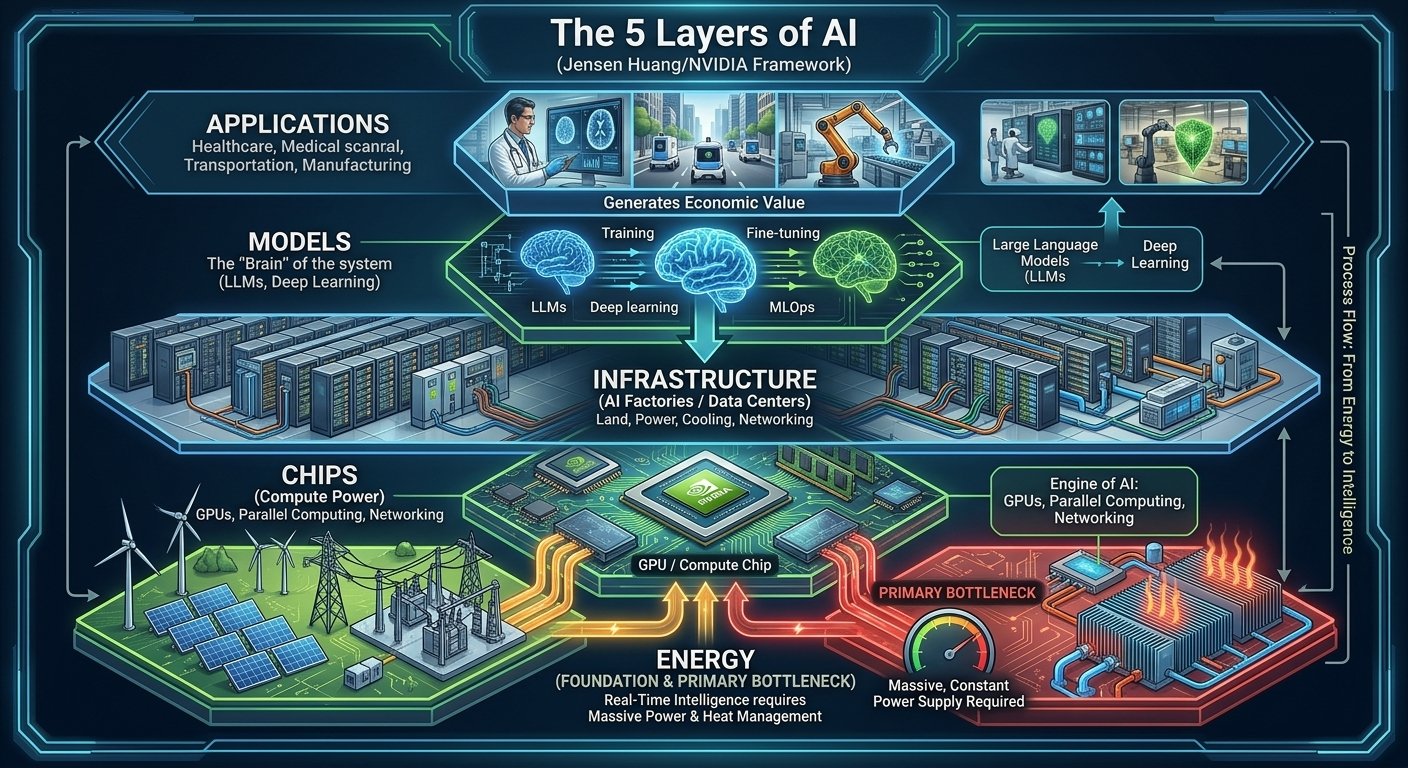 Figure 2.10: The 5 layers of an AI system — Energy, Infrastructure, silicon Chips (GPUs), Foundation Models, and Applications.
The Deep Engineering Anatomy of Figure 2.10's Five Layers:
- Layer 1: Energy and the Power Grid (Foundation & Primary Bottleneck): * This is the entire AI system's chief limiting factor. * Real-time intelligence demands enormous electrical current and heat dissipation. Without continuous, stable, and renewable energy, an AI data center cannot operate.
- Layer 2: Data Centers and Infrastructure (AI Factories): * Land, liquid-immersion cooling systems, and high-speed optical interconnects moving terabits of data.
- Layer 3: Microchips and GPUs (Compute Power): * AI's principal engine — massively parallel tensor chips such as NVIDIA's H100 and B200 (Blackwell).
- Layer 4: Foundation Models (The Brain of the System): * The system's cognitive brain — LLMs pre-trained on trillions of tokens (ChatGPT, Gemini, Claude, DeepSeek).
- Layer 5: Applications (Generates Economic Value): * The only layer where the technology turns into economic value — health, agriculture, transport, manufacturing, and citizen services.
🇱🇰 A Reality Check for Sri Lanka
As public officers, we must recognize our country's real capability:
- Layer 3 (chip fabrication): building $20-billion state-of-the-art fabs is not something Sri Lanka can do at this moment.
- Layer 4 (training frontier models from scratch): spending hundreds of millions of dollars to pre-train models from zero is not our priority either.
- Our real opportunity lies in Layer 5 — Applications! Using the world's most powerful models to eliminate file delays in our public service, accelerate land registration, and deliver fair service to the citizen — that we can do, one hundred percent. And strengthening green energy (Layer 1) and local edge data centers (Layer 2) remains essential to our digital sovereignty.
- Are we going to fabricate chips? No. Two advanced chips can cost a million dollars.
- Are we going to spend billions training foundation models from zero? No.
- Then where is Sri Lanka's opportunity?
Our opportunity is in Layer 5: Applications!
The world's powers may build the chips and the models — but only we can build the applications that solve the land dispute at our own Divisional Secretariat, distribute Aswesuma benefits, speed up services in the Grama Niladhari division, and audit our own accounts. Taking the finest models in existence and building applications that solve Sri Lanka's problems, with a Product Engineering mindset — that is our national duty.
In the next chapter, we explore the Transformer brain inside these models — tokenization, and how A/L Combined Mathematics connects directly to AI.