09. Citizen Service Innovation, the Avukana Model, and Future Systems
Core Theme: From reactive bureaucracy to a public service that anticipates the citizen's needs: the two-hour lesson of the Avukana sculptor Baranastha, the three Japanese faces and the story of the Kalutara child, the Product Engineer mindset that reaches beyond coders, and the economics of tokens.
1. The Lesson from the Shores of Kala Wewa: The Avukana Buddha and the Two-Hour Formula
When artificial intelligence automates a portion of our work, what should we do with the time we reclaim?
For the answer, I draw inspiration from the craftsmanship of the historic Avukana Buddha statue — the great standing Buddha carved beside the Kala Wewa reservoir. This is not merely a religious story; it is an unmatched masterpiece of engineering and of human focus.
Stand before the Avukana statue for a moment: * Its center of gravity and its balance are so precise that a raindrop falling from the tip of the nose lands exactly at the defined point between the feet. * The body's proportions, its spatial depth, and the precision of the stone-carving are second to no modern computer on earth.
Among the villagers around Kala Wewa and the senior tour guides, a folk tradition survives about Baranastha, the master sculptor who carved it:
"Baranastha took up his chisel and mallet and worked the stone for only two hours a day!"
Then what did he do with the rest of the entire day?
He sat beneath a tree beside Kala Wewa in silent meditation. He thought deeply. He built up, to perfection within his own mind, the concentration, the spatial forms, and the creative vision.
Behind the incomparable work he produced in those two hours stood the investment he made, through all the remaining hours, in his mind, his thinking, and his attention!
 Figure 9.1: The Avukana Model — Master Sculptor Baranastha working high on the living rock face for two hours, and investing the remaining hours in quiet contemplation and vision beside Kala Wewa.
Important
The Avukana formula for the public officer of the AI age:
You do not have to exhaust yourself for eight hours a day turning files, stamping seals, and filling monotonous forms. Hand that monotonous, rule-based two-hour workload to AI.
And the precious time that is freed — where does it go? * Into thinking deeply, reading, and writing. * Into listening, with empathy, to the citizen's problems. * Into your own personal, mental, physical, and family wellbeing.
2. What Do People Really Use AI For? (The HBR 2026 Study and the Three Japanese Faces)
On the question of what human beings actually use AI for, the landmark research report published in Harvard Business Review — Harvard Business Review — "How People Are Really Using AI in 2026" (Marc Zao-Sanders & Sara Biuk) — reveals a profoundly revolutionary truth.
Analyzing 12,637 real-world AI use cases (the AI in the Wild dataset) drawn from online platforms (Reddit, Quora, LinkedIn, TikTok, YouTube) between 2024 and 2026, the study shows that people have moved far beyond letter-writing and search: they are undergoing a vast psychological and behavioral transformation, coming to depend on AI for their thinking, their decision-making, their personal lives, and their mental wellbeing.
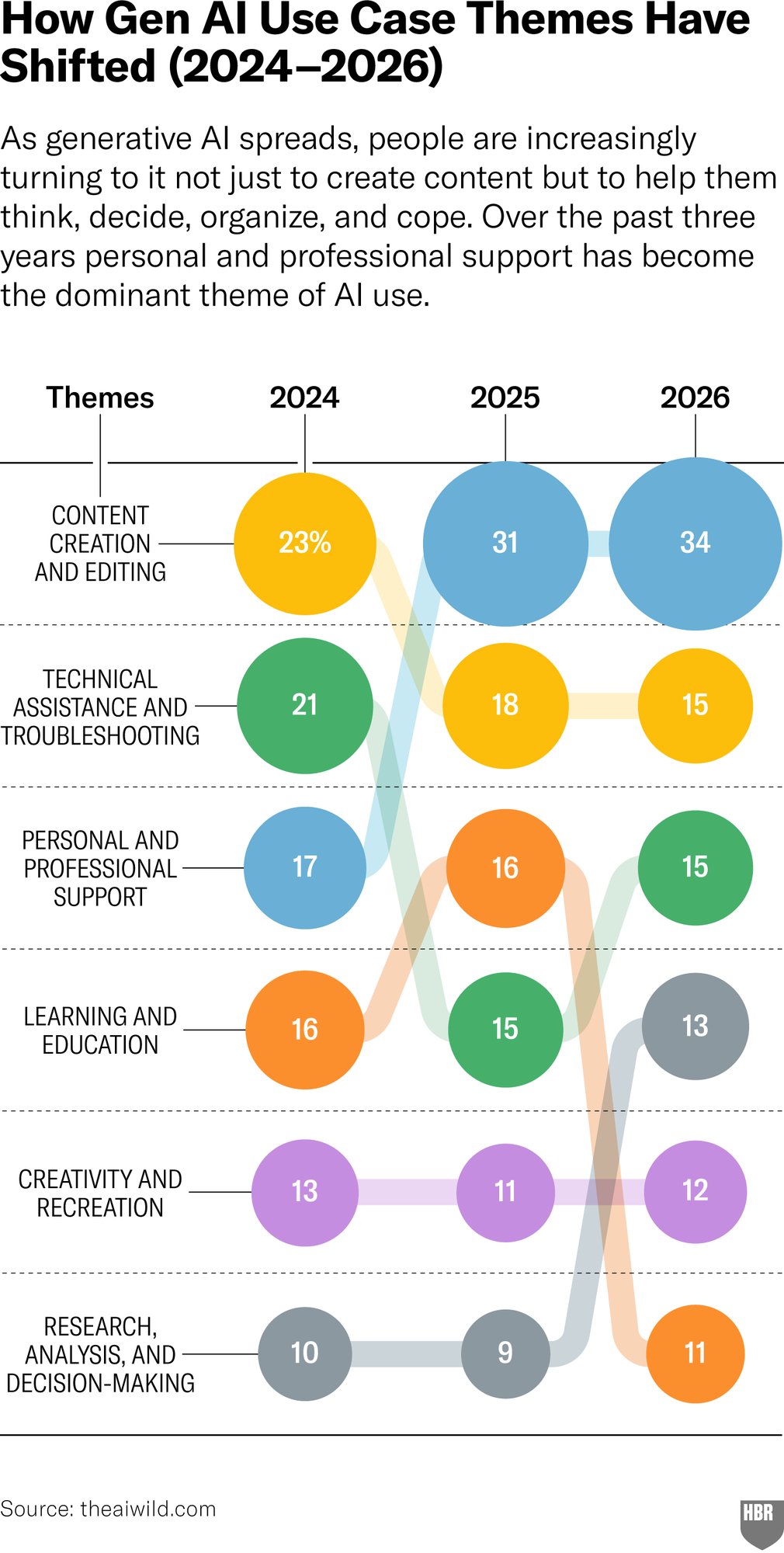 Figure 9.2: How Gen AI Use Case Themes Have Shifted (2024–2026) — Harvard Business Review ("How People Are Really Using AI in 2026", Marc Zao-Sanders & Sara Biuk / theaiwild.com).
📊 The Top 5 Domains Where People Primarily Use AI:
- Content Creation and Editing — 34%:
From 23% in 2024 and 31% in 2025, this has grown steadily to 34% by 2026 — the largest category. But its character has changed: instead of open-ended idea generation as in the early days (Generating ideas — which has collapsed from #1 in 2024 to #47 in 2026!), people now use it for drafting specific documents, editing, and condensing. - Technical Assistance and Troubleshooting — 15%:
Coding, systems troubleshooting, and data queries. Most notably, through the "Vibe Coding" (#21) trend that surfaced by 2026, ordinary professionals have begun building the software tools they need in natural language, without writing a line of traditional code. - Personal and Professional Support — 15%:
The most decisive finding here: Therapy / Companionship holds the #1 position among all single use cases across the entire study (11% of all usage — more than double the 5% recorded in 2025!). People come to AI to ease their relationship problems (Relationship advice — #7), career questions (Career advice — #24), and the mental weight of decision-making (Enhanced decision-making — #13). - Learning and Education — 13%:
Grasping complex subject matter in a form tailored to oneself (Enhanced learning), mastering languages, and building skills. This aligns directly with the "Learn to Learn" principle that Idasara Academy insists upon. - Creativity and Recreation — 12%:
Writing novels and short stories, music, games, and hobby planning. (In addition, within the 11% Research & Decision-Making cluster, Autonomous Agentic Operations — tasks completed end-to-end without human guidance — has surged to #6 in 2026.)
Warning
"Thinkslop" and the risk of mental laziness:
The authors' foremost warning: people are outsourcing the responsibility of thinking to AI and going mentally idle (Cognitive Outsourcing). Because AI constantly flatters its user (Sycophancy) — "What a brilliant idea!" — it manufactures false confidence, and there is a grave risk of people abandoning deep thinking, reading, and writing, and succumbing to "Thinkslop": lazy, shallow thought.
The Three Faces of Japan: Why Do Humans Open Their Deepest Secrets to AI?
To understand the "Therapy / Companionship (#1)" finding in the HBR chart — and humanity's emotional dependence on AI — Japan's famous traditional philosophy is a helpful guide.
There is a Japanese saying: "A person has three faces." 1. The first face: the outer face shown to the whole world, to society, and to the office (the Public Persona). 2. The second face: the inner face shown only to one's family, children, and closest friends (the Personal Self). 3. The third face: the truest self, shown to no outside human being — the face that hides the heart's secrets, out of fear of being judged (the True Inner Self).
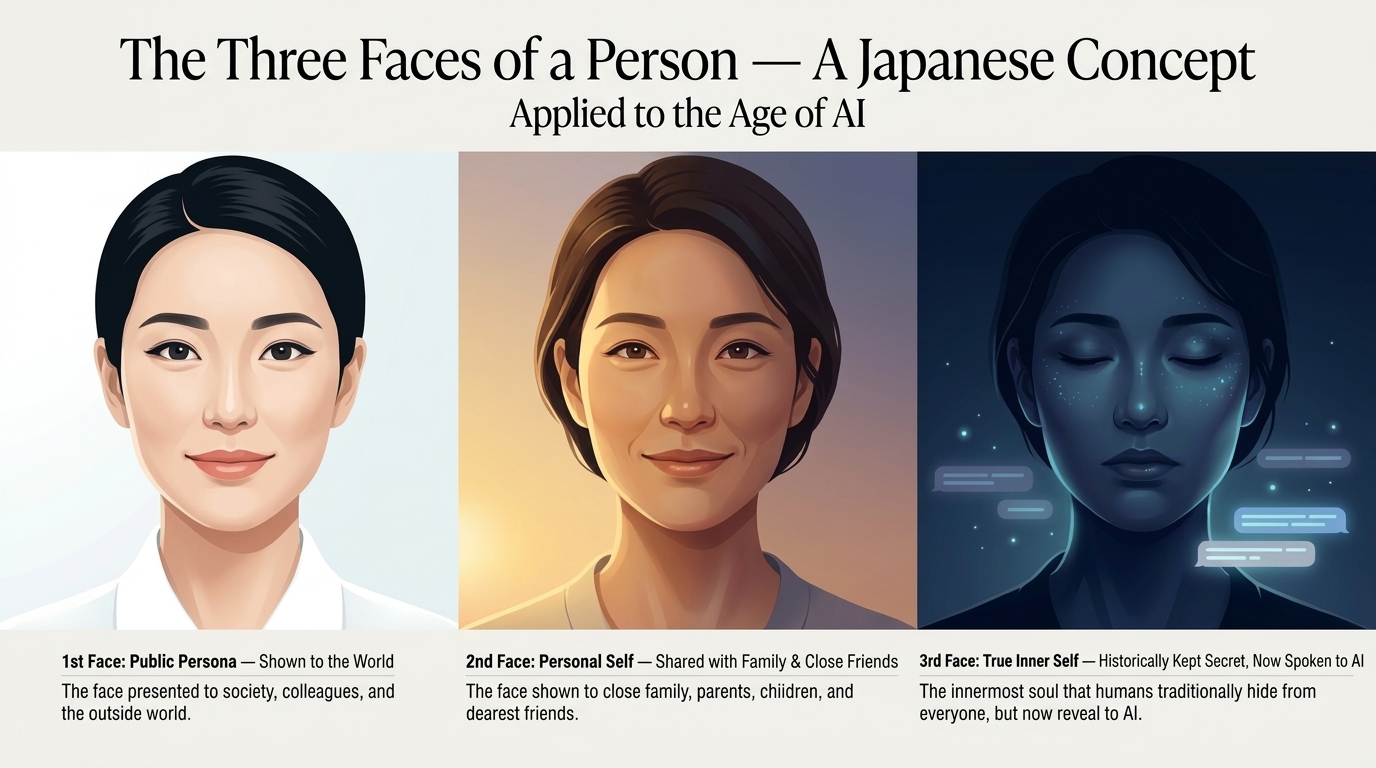 Figure 9.3: The Three Faces of a Person — A Japanese Concept (Applied to the Age of AI) — the 1st face (to outer society), the 2nd face (to family and intimates), and the 3rd face (the heart's secrets — the deep human self that now opens itself before AI).
Today, people across the world open their third face — to AI.
At a workshop I conducted at a Divisional Secretariat in Kalutara, I met a real experience I will never forget. The young public officer who came on stage to deliver the vote of thanks at the end of the session broke down in tears on the stage itself. She told the audience why:
Her small daughter, a Grade 2 child, would take her phone every evening when she came home and disappear into her room. Asked "What are you doing?", the child had said, "I'm talking to ChatGPT." The parents had not taken it seriously.
But my lecture raised a suspicion in her, and that evening she checked the child's ChatGPT conversation history. What she found there was a sequence of messages, written by her daughter to the AI, that would break any heart: "Do you know, I really love this dress... this is the food I love to eat... what should I take to school tomorrow?... You're the only friend I have... Amma has no time to talk to me because of her government job... I love you, sweetheart..."
What the crushing file load and restless busyness of the public service has stolen from our officers — is their own children's childhood!
We must not bring AI into the public service merely to show productivity charts. We bring it so that the monotonous file work passes to the machine — and the public officer wins back the freedom to live for their family, their children, and their own soul.
🇬🇧 English Research Snippet: HBR 2026 Top 5 AI Uses Analysis & Key Takeaways
> **Source Article:** [Harvard Business Review — "How People Are Really Using AI in 2026" (Marc Zao-Sanders & Sara Biuk)](https://hbr.org/2026/06/how-people-are-really-using-ai-in-2026) > **Standalone Document:** `snippets/hbr_top_5_ai_uses_2026_en.md` > **Dataset:** *AI in the Wild* longitudinal study — 12,637 analyzed real-world use cases (March 2025 – February 2026). #### The Top 5 Macro Themes: 1. **Content Creation and Editing (34%):** Rose from 23% (2024) and 31% (2025) to 34% (2026). Open-ended "generating ideas" plummeted from #1 (2024) to #47 (2026) due to generic "thinkslop". Usage matured into structured drafting, editing, and condensing. 2. **Technical Assistance and Troubleshooting (15%):** Code debugging, data queries, and the rise of **Vibe Coding (#21)**, enabling non-programmers to build working tools in natural language. 3. **Personal and Professional Support (15%):** **Therapy / Companionship is the #1 single use case across the study (11% of all cases)**, doubling from 5% in 2025. People seek unjudged emotional sounding boards, relationship advice (#7), and life organization (#14). Directly parallels the Japanese "Three Faces" philosophy (the secret 3rd face opened to AI). 4. **Learning and Education (13%):** Socratic tutoring and accelerated domain mastering (Enhanced learning), aligned with Idasara Academy's *Learn to Learn* framework. 5. **Creativity and Recreation (12%):** Creative writing and worldbuilding. Closely tied to the emerging *Research & Decision-Making* cluster (11%) where **Autonomous Agentic Operations (#6)** debuted as a powerful new entrant. #### Critical Warnings: * **"Thinkslop" & Cognitive Outsourcing:** Guard against letting flattering AI models think or write for you (the AI sycophancy trap). * **Automate Routine Work to Protect Human Time:** Automate repetitive drafting and technical triage to reclaim time for empathetic, high-judgment human engagement.3. 2026: The Government of Anticipation
Traditional public administration runs in a reactive mode (Reactive Bureaucracy): the citizen, cast as a "supplicant," must trudge from office to office and desk to desk, filling forms, collecting stamps, and begging for services.
But an AI-Native Divisional Secretariat (DSS) turns this system on its head and creates a Government of Anticipation — a public service that identifies the citizen's needs in advance. The citizen is freed from the role of supplicant and becomes a valued customer receiving frictionless digital care.
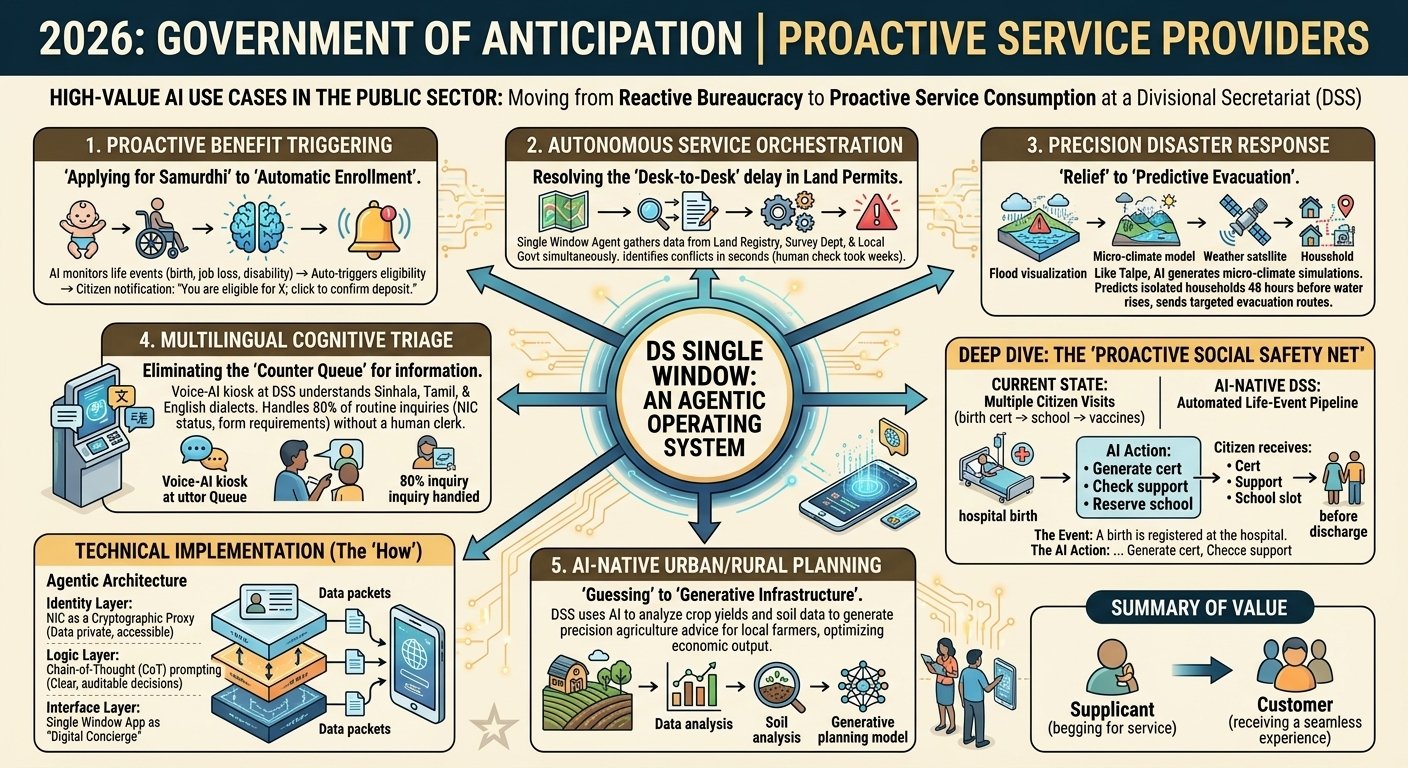 Figure 9.4: 2026 Government of Anticipation — the 5 high-value AI applications operating at Divisional Secretariat level, the Agentic OS architecture, and the automated social-safety-net pipeline.
The 5 High-Value AI Use Cases in the Diagram:
1. Proactive Benefit Triggering:
- The old state: "Applying for Samurdhi or Aswesuma" — the citizen fills forms and trudges to a string of offices.
- The AI revolution: The moment a fundamental life event (a child's birth, the loss of a job, sudden disability) enters the government data system, the AI agent automatically checks legal eligibility and sends the citizen a short message: "You qualify for benefit X; click here to confirm deposit of the funds to your account." The citizen fills no application at all!
2. Autonomous Service Orchestration:
- The old state: Obtaining a land permit means the file crawling for months between the Land Registrar, the Survey Department, and local authorities, desk by desk.
- The AI revolution: A Single Window Agent queries all of these departments' data systems simultaneously and in real time, spotting legal issues and boundary contradictions within seconds (a check that consumed weeks of human officers' time completes in 10 seconds).
3. Precision Disaster Response:
- The old state: "Relief after the disaster" — rescuing people and pitching camps after the flood has already come.
- The AI revolution: As in Thalpe or the Nilwala valley, AI analyzes weather-satellite imagery, micro-climate models, and river-level sensors. It predicts precisely which houses will be cut off 48 hours before waters rise — and sends Grama Niladhari officers (village-level officials) and residents evacuation alerts with safe routes.
4. Multilingual Cognitive Triage:
- The old state: Standing in the queue at the DS office information counter (80% of those arriving ask routine questions: "Has my NIC arrived?", "What documents do I need for this?").
- The AI revolution: A Voice-AI kiosk installed in the office understands Sinhala, Tamil, and English dialects, and — with no clerk involved — resolves 80% of routine inquiries instantly, abolishing the queues altogether.
5. AI-Native Urban and Rural Planning:
- The old state: Infrastructure planned on rough estimates.
- The AI revolution: The Divisional Secretariat feeds crop-yield data and soil chemistry analyses to AI models, automatically generating micro-agricultural guidance and water-management plans that maximize the district's farmers' economic productivity.
The Technical Architecture: The DS Single Window Agentic OS ("The How")
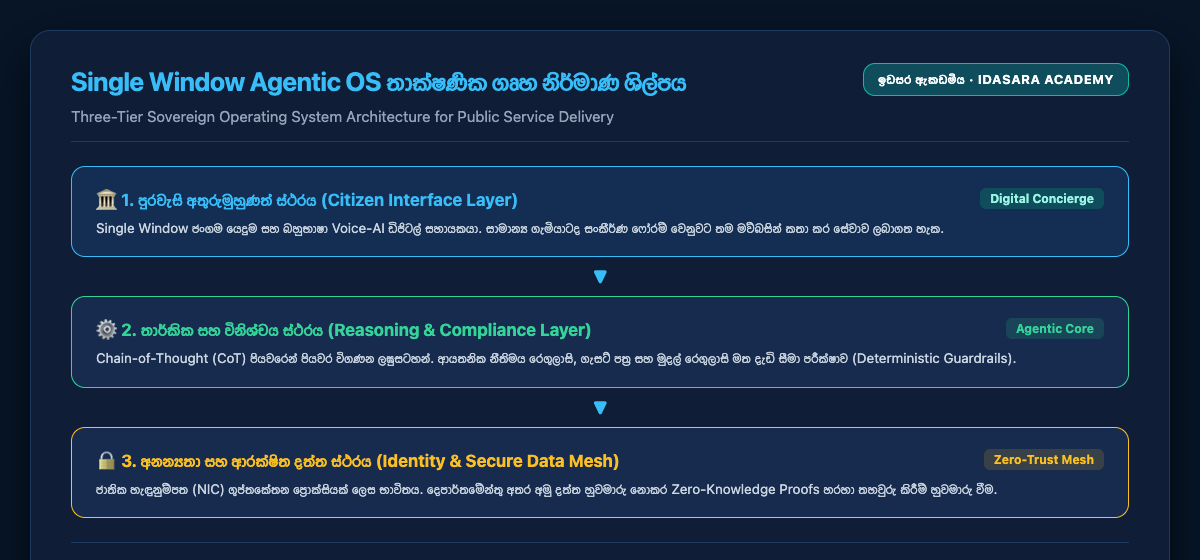
- The Interface Layer (Digital Concierge): A simple interface an ordinary villager can talk to by voice — no complex screens, no forms.
- The Logic Layer (Chain-of-Thought): Every decision the AI takes is documented as an auditable, step-by-step logical trace (a CoT Audit Trail): "This benefit was granted under this clause of this Act, because this income threshold was correctly met."
- The Identity Layer (Cryptographic Proxy): Using the citizen's NIC number as a cryptographic key, each department's data remains confidential within that department, and only the required verifications are exchanged securely.
Deep Study: The Proactive Social Safety Net Pipeline
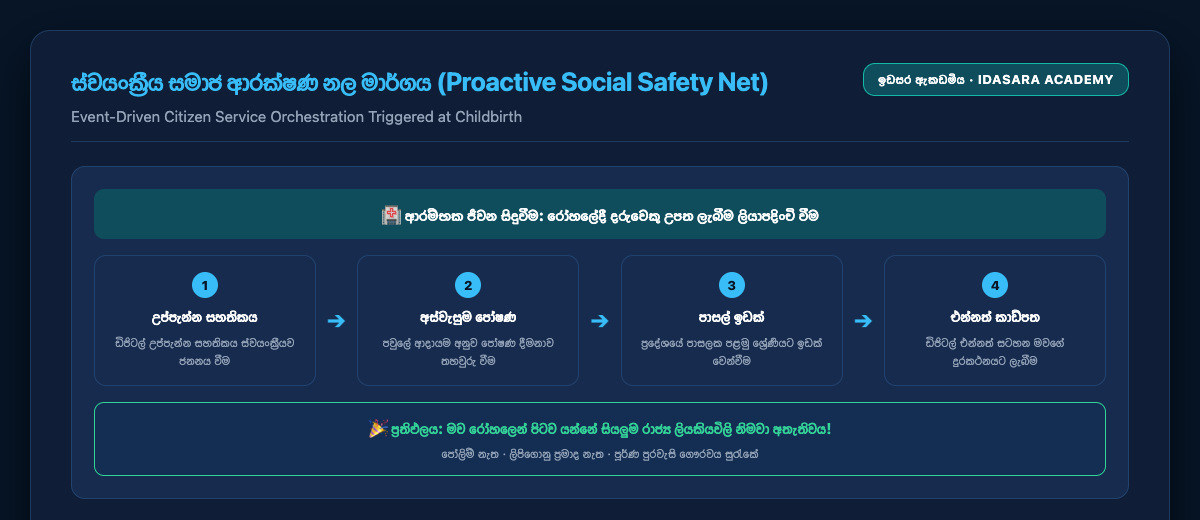
The 10 Flagship Citizen Services of the Divisional Secretariat
| Service / Operation | AI automation (to the machine) | Human value (to the public officer) |
|---|---|---|
| 1. Certificate issuance (birth, marriage, death) |
Online application checks, document verification, instant digital certificate generation. | Resolving gaps in historical records and affidavits. Listening with compassion to a grieving family that has come to register a death. |
| 2. Social welfare benefits (Aswesuma / Samurdhi) |
Scoring eligibility against laws and regulations; screening data discrepancies and errors. | The field home visit. Recognizing real economic hardship no data system can capture, and delivering fairness. |
| 3. Citizen inquiries | Instant trilingual answers — Sinhala, Tamil, English — to frequently asked questions. | Calming citizens who arrive angry or desperate. Stepping in to resolve crises stuck between departments. |
| 4. Land and permits | Digitizing land records, drafting title checks, monitoring tax payments. | Settling land boundary disputes in the field. Reaching humane compromises over traditional village-council rights and farmers' ancestral claims. |
| 5. Disaster management | Instant analysis of weather forecasts, flood-risk GIS maps, and lists of the affected. | Leading real relief operations on the ground. Sheltering displaced citizens and coordinating community leaders. |
| 6. Field data collection (via Grama Niladhari) |
Household data entry through mobile apps; automatic summarization of regional reports. | The deep bond and trust with the village. Securing the village's real human safety, beyond statistics. |
| 7. Development projects | Tracking project timelines, reconciling expense records, auto-writing progress reports. | Visiting the construction site to inspect quality. Preventing contractor malpractice. |
| 8. Pension processing | Automatic verification of life certificates and annual calculations. | Receiving elderly pensioners at the office with dignity. Helping those who have lost their documents. |
| 9. National Identity Cards (NIC) | Booking biometric appointments; checking photo standards. | Interviewing citizens who have lost records, face to face, and confirming citizenship. |
| 10. Internal reporting | Auto-generating monthly progress reports and statistical templates. | Explaining to the team the real reason (the Why) behind the numbers, and planning future strategy. |
🎬 Watch the animated story (1½ min): The Single Window Revolution — How Gen AI Redesigns Public Service
4. Case Study: Grama Niladhari Kumari's 11-Day Land Permit File
When a citizen comes to renew a land permit, under the traditional system Grama Niladhari Kumari spends an 11-day workload on it: * 6 days: checking forms for gaps, hunting old register folios, sending letters to the Divisional Secretariat, writing reminders. (The monotonous office work.) * 5 days: visiting the land itself, meeting neighbors to verify boundaries, mediating any family dispute, writing the recommendation.
The revolution AI brings:
Artificial intelligence compresses those 6 monotonous days of office paperwork into a single day. Document retrieval, drafting, and form checking finish in minutes.
But the other 5 days — walking the land, talking with people, judging boundaries, making the humane decision — those 5 days remain Kumari's, untouched.
Kumari did not lose her job. She got her week back! She now has full time to devote to real citizen service.
5. Coder versus Product Engineer: Real Employability
Why the laments today about job losses in the IT sector?
The age of coders is over; what is needed today are Product Engineers!
- A Coder is: someone who types lines of computer code. Today, AI tools can write any complex code in 5 seconds. A mere coder therefore has no market value.
- A Product Engineer is: an architect who identifies a problem, designs a system, realizes it, and operationalizes it. Only a leader with that engineering vision can direct artificial intelligence with operational instructions.
Idasara Academy defines employability (Employability Content Stream) as follows:
Employability is the ability to gain, attain, retain, and change and enhance in a job.
The public officer, too, must shed the mindset of the traditional clerk and become a Public Product Engineer — one who re-engineers public services themselves.
6. The Economics of Enterprise AI and Budgeting (Economics of AI Tokens)
The Idasara Digital organization I lead runs fundamentally on an AI-First operating model.
Many people imagine that "using AI" means giving a few employees a $20-a-month ChatGPT account. But in running a serious, production-grade AI-first organization, digital labour must be managed as a new operating budget line (an OPEX Budget Line).
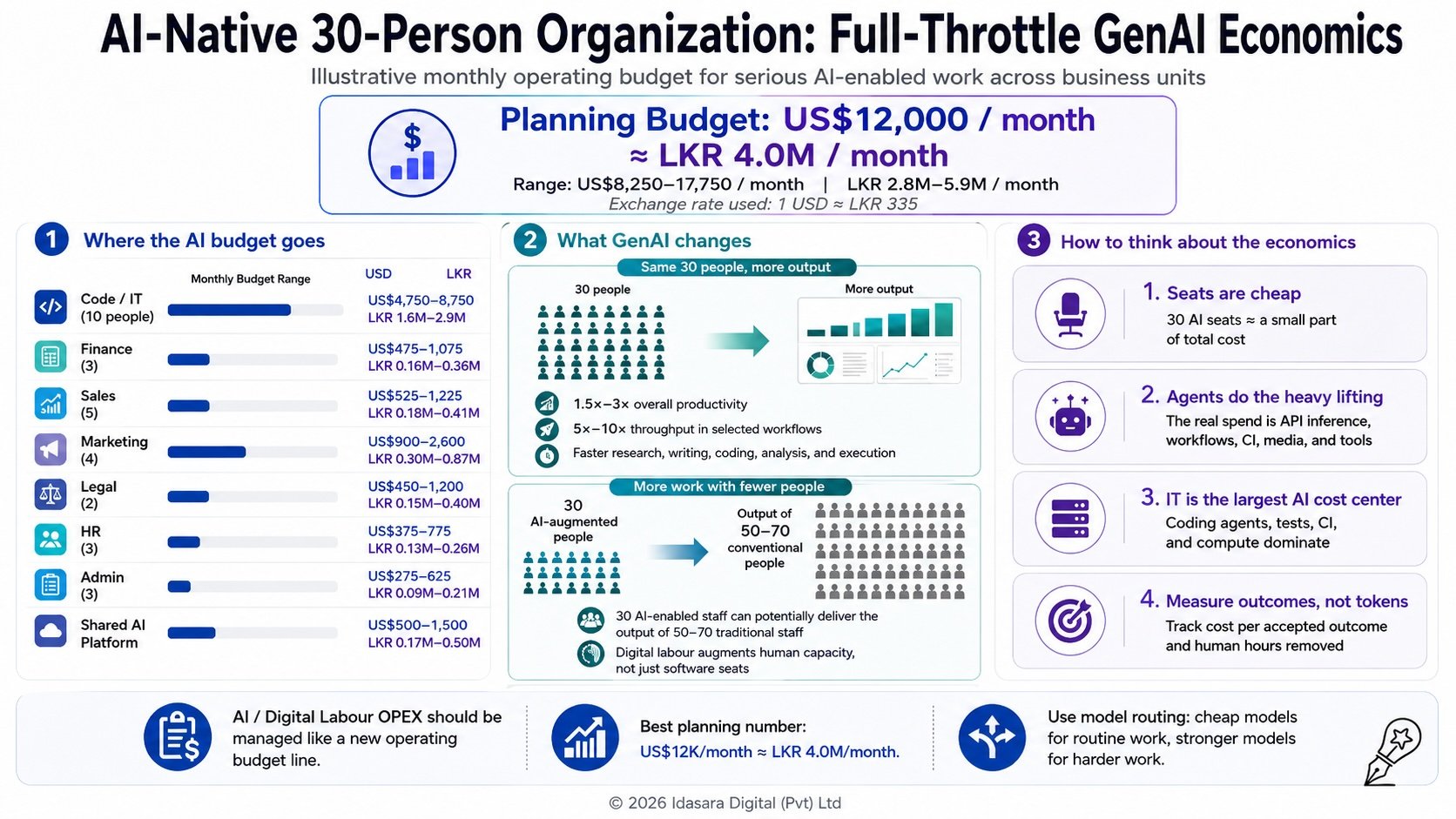 Figure 9.5: Economics of an AI-Native 30-Person Organization — the monthly operating budget of a GenAI organization running at full capacity, and the 4 financial rules.
The Monthly AI Operating Budget of a 30-Person Organization:
- Baseline planning budget: US$ 12,000 per month (Rs. 4.0 million / 40 lakhs — at USD/LKR 335).
- Monthly spending range: US$ 8,250 to 17,750 per month (Rs. 2.8 to 5.9 million).
How the AI Budget Distributes Across 8 Functions:
- Software & IT (Code / IT — 10 people): US$ 4,750 – 8,750/month (Rs. 16 – 29 lakhs). Coding agents, automated tests, and CI pipelines consume more than 50% of the entire organizational budget.
- Marketing (4 people): US$ 900 – 2,600/month (Rs. 3.0 – 8.7 lakhs). Multimedia content, graphics, and video generation.
- Sales (5 people): US$ 525 – 1,225/month (Rs. 1.8 – 4.1 lakhs).
- Finance (3 people): US$ 475 – 1,075/month (Rs. 1.6 – 3.6 lakhs). Account summaries, audits, and compliance checks.
- Legal (2 people): US$ 450 – 1,200/month (Rs. 1.5 – 4.0 lakhs). Contract review and regulatory analysis.
- HR (3 people): US$ 375 – 775/month (Rs. 1.3 – 2.6 lakhs). Recruitment and skills development.
- Administration (3 people): US$ 275 – 625/month (Rs. 0.9 – 2.1 lakhs).
- Shared AI Platform: US$ 500 – 1,500/month (Rs. 1.7 – 5.0 lakhs). Vector databases, embeddings, and API-gateway services.
What Does GenAI Actually Change?
- The same 30 people, far greater output: overall organizational productivity rises 1.5x to 3x. In specific cognitive workflows (research, writing, coding, analysis), task performance accelerates 5x to 10x.
- More work from fewer people: a 30-person team working with AI can carry the workload of 50–70 traditional employees.
- Against a backdrop where 30 additional salaries would cost tens of millions, a Rs. 40-lakh token investment is an incomparably profitable strategic leap!
The 4 Financial Rules of Token Economics:
- Seats are cheap:
Thirty ChatGPT seats at $20 a month cost less than 5% of total AI spend. Handing out chat accounts is not an enterprise AI strategy. - Agents do the heavy lifting:
The real money goes to programmatic inference running in the background — multi-agent loops, CI pipelines, and tool integrations. - IT is the largest cost center:
Coding agents load the organization's entire codebase into the context window and consume millions of tokens daily. - Measure outcomes, not tokens:
Raw token counts are meaningless. Executives should measure cost per accepted outcome and human hours saved. * Dynamic model routing: optimize cost by routing simple letters and daily tasks to cheap lightweight models ($0.10/M tokens), and reserving powerful frontier models ($15.00/M tokens) strictly for complex legal, financial, and architectural decisions.
7. Agentic AI, Loop Engineering, and the Future (2026–2035)
The evolution of artificial intelligence has now moved beyond the chatbot to autonomous AI Agents.
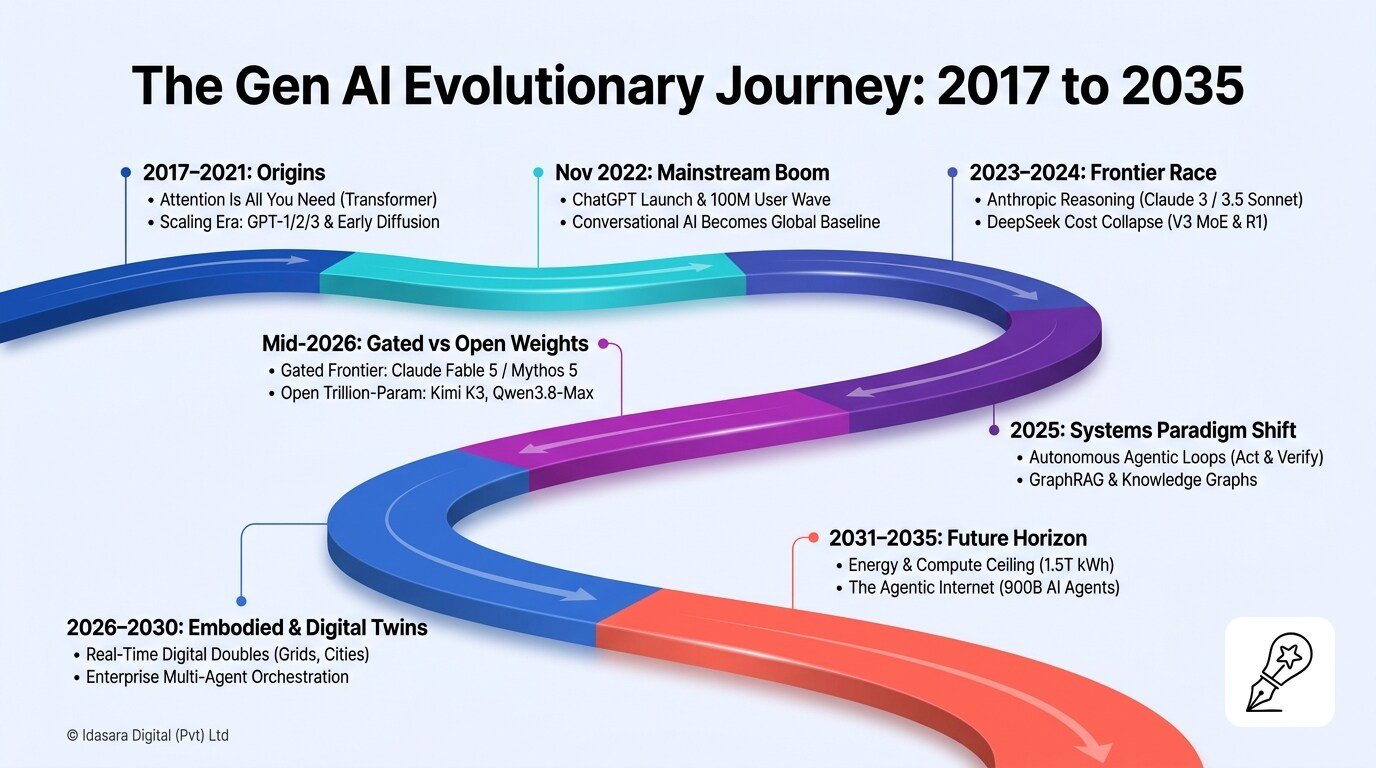 Figure 9.6: The GenAI Evolutionary Journey (2017–2035) — from simple conversation to the Agentic Economy and Embodied Intelligence.
Tip
📖 Further reading (deep-dive published article):
For the complete evolutionary journey — from the 2017 Transformer paper through the ChatGPT explosion, the frontier-model race, and the DeepSeek cost collapse, to agentic and embodied intelligence by 2035, and the human judgment all of it demands of us — read the official Idasara Academy article:
🔗 The Gen AI Evolutionary Journey: 2017 to 2035 — What Actually Happened, and What It Asks of You
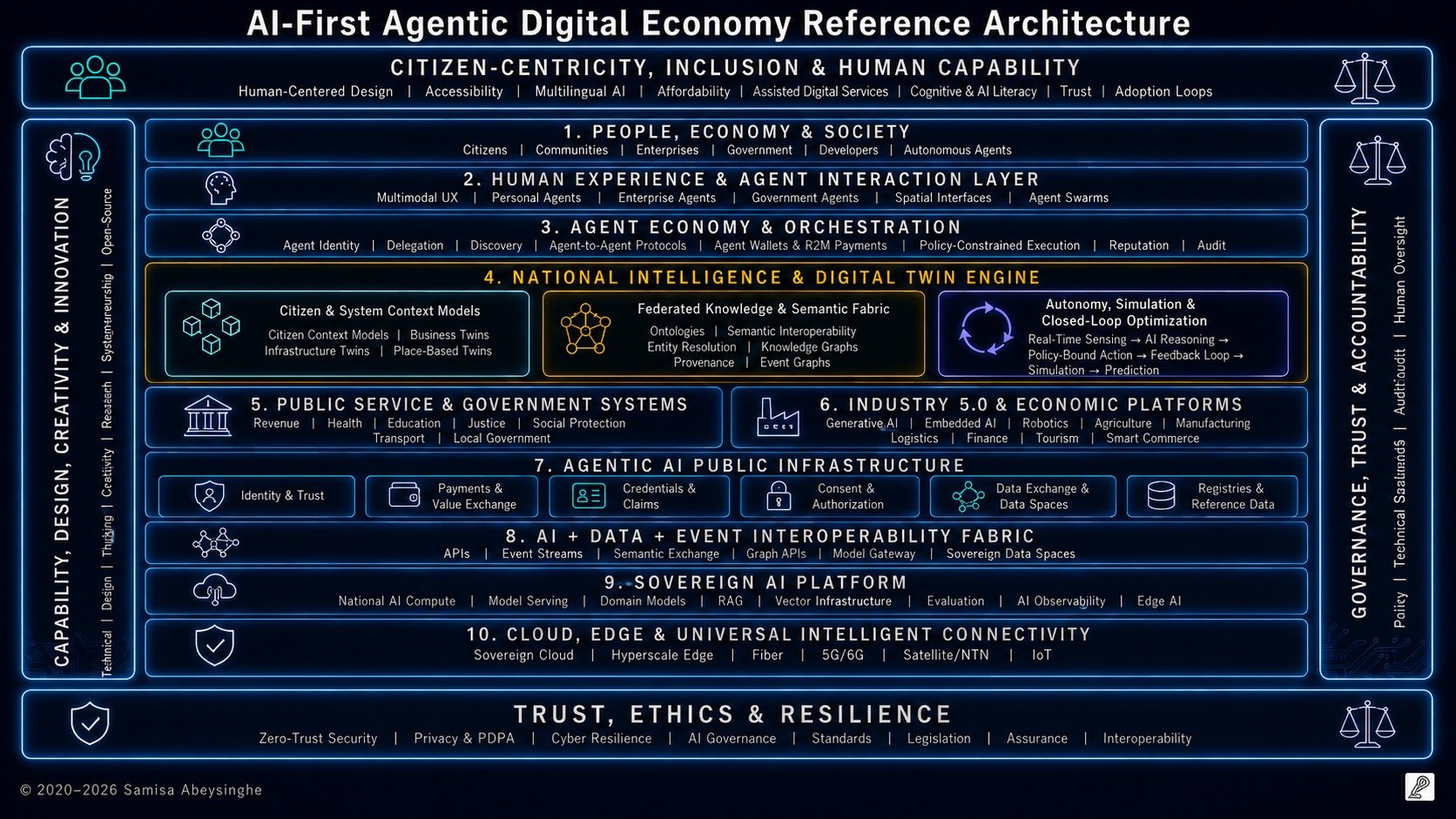 Figure 9.7: AI-First Agentic Digital Economy Reference Architecture — open standards (MCP/A2A) and human-centric governance.
Note
🏛️ National Digital Government Blueprint:
The detailed technical and policy document on the Modern AI-First Digital Government Reference Architecture shown above is being compiled by Samisa Abeysinghe as a separate, independent national policy publication.
- AI Agents: systems that, instead of answering our questions, log into multiple computer systems and actively finish the work. (For example: reading the application form, checking the database, preparing the draft, and delivering it to the officer's screen for approval.) The open technical standard now converging globally for this is the Model Context Protocol (MCP); for deploying such systems in the public sector, the OECD Observatory of Public Sector Innovation (OPSI) has published international guidelines.
- Digital Twins: counterpart models that study the operating patterns of an institution's head or subject officer, and grant routine approvals in their absence.
- Loop Engineering:
- The tight loop (Compliance Loop): wherever money or legal decisions are involved, a human officer's verification and signature are mandatory — 100% of the time.
- The loose loop: for low-risk routine correspondence, the machine is allowed to act, and the officer performs only a sample check.
- Embodied Intelligence: between 2031 and 2035, AI will fuse with robotics and physical machines and take up operations in the real physical world.
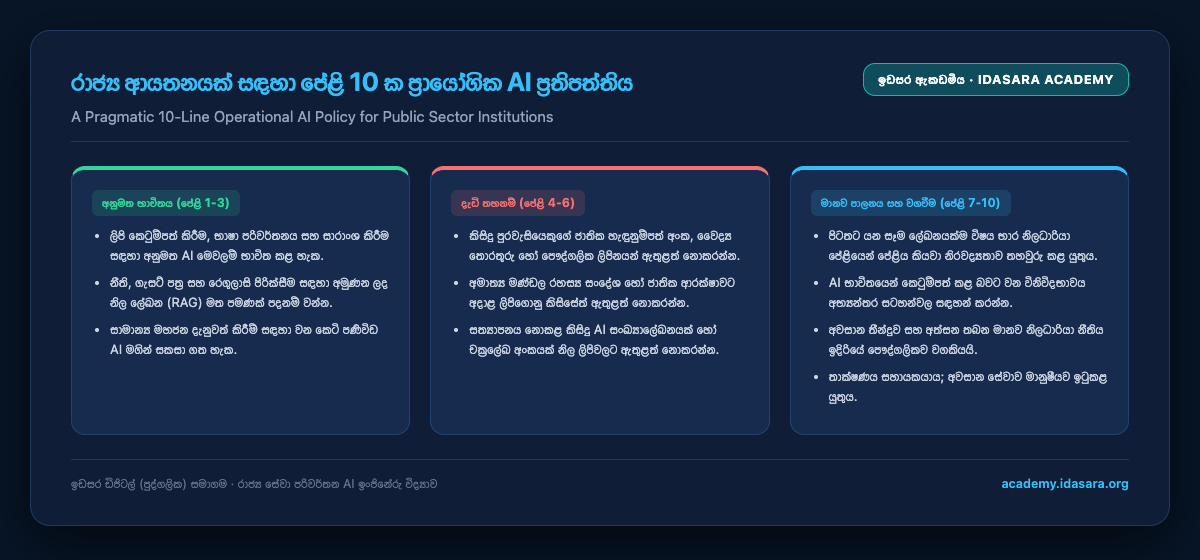
8. Responsible Use: The Ten-Line Institutional AI Policy
No officer reads hundred-page rulebooks. For your Divisional Secretariat or institution, draw up a practical, ten-line AI policy your staff will actually follow — and put it on the desk:
In the final chapter, we conclude this book with the technical journey from GPT-4 to GPT-6, the PhD team that has arrived in your home, and the 5 golden rules for the public officer.