The Gen AI Evolutionary Journey: 2017 to 2035
Eight years that rewrote what a machine can do — and what a person needs to know.
Published 2026-08-17 · last reviewed 2026-08-17 · next review due 2026-11-17. Model pricing and release claims in the mid-2026 section date quickly — check the sources before relying on a figure.
Eight years that rewrote what a machine can do — and what a person needs to know. A verified timeline from the Transformer paper to the agentic present, written for students, parents, and anyone who suspects they are already behind. Updated August 2026.
Most people date the AI revolution to November 2022, when they first typed a question into ChatGPT and something answered back. That is when it became visible. It is not when it started.
The architecture that made it possible was published five years earlier, in a paper with an unusually confident title. What happened between that paper and today is one of the fastest capability curves in the history of technology — and it is still bending upward.
This is a map of that curve. Where it came from, where it stands in 2026, and what can honestly be said about where it goes next.
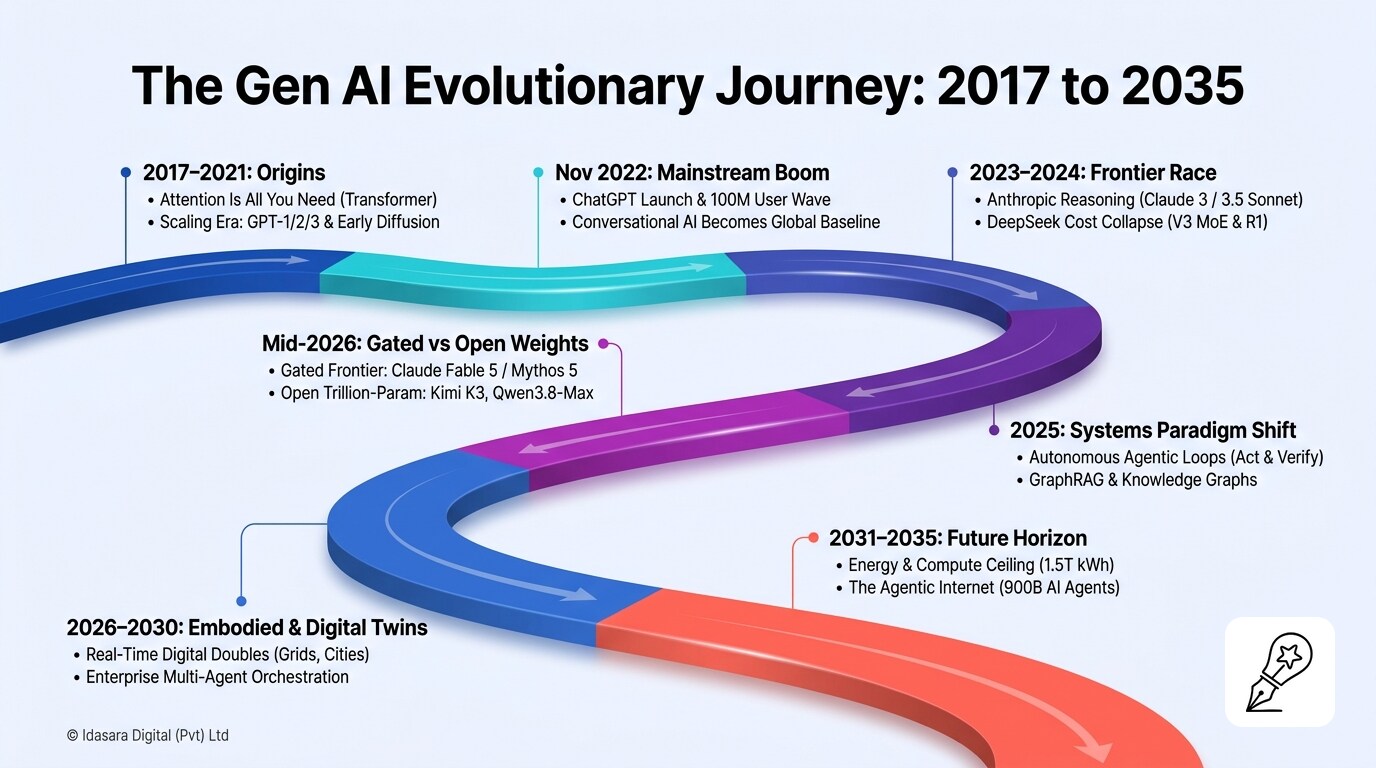
Phase 1 — Origins (2017–2021): the architecture before the audience
In June 2017, eight researchers at Google published "Attention Is All You Need". It introduced the Transformer: an architecture that dropped the sequential processing of earlier language models in favour of a self-attention mechanism, letting a model weigh every word in a sequence against every other word, in parallel.
The practical consequence was scale. Transformers trained efficiently on modern hardware in a way their predecessors could not. Everything that followed is downstream of that single design decision.
The next four years were a quiet, expensive scaling experiment. GPT-1 in 2018. GPT-2 in 2019, withheld from full release because its creators judged it too capable to publish safely — a judgment that reads as almost quaint now. GPT-3 in 2020, at 175 billion parameters, demonstrating that a model given no task-specific training could still perform tasks it was merely shown in the prompt. In parallel, diffusion models began turning text into images, with DALL·E arriving in early 2021.
None of this reached the public. For four years, the most important technology of the decade was a research curiosity with a waitlist.
What this phase teaches: the breakthrough and the adoption are separate events, often separated by years. Anyone waiting for a technology to feel obvious before learning it is already four years late.
Phase 2 — The mainstream boom (November 2022): distribution, not invention
OpenAI released ChatGPT publicly on 30 November 2022. The underlying model was not a dramatic leap over what already existed. The interface was.
The result was the fastest consumer adoption curve anyone had measured. A UBS analysis published in early February 2023, drawing on Similarweb traffic data, estimated that ChatGPT had reached roughly 100 million monthly active users within about two months of launch — against nine months for TikTok and two and a half years for Instagram. UBS analysts noted they could recall no comparable ramp in two decades of covering the internet sector.
Two honest caveats, because they matter more than the headline:
- These were third-party estimates from traffic analytics, not audited figures released by OpenAI.
- The record itself did not survive long. Instagram's Threads passed 100 million users in five days in July 2023. "Fastest-growing consumer app in history" was true when written and superseded within months.
What did not get superseded was the shift in expectation. Before November 2022, conversational AI was a demo. After it, it was a baseline assumption. The technology had existed for years; the permission to use it arrived in a weekend.
Phase 3 — The frontier race (2023–2024): capability becomes contested
Once the market existed, the competition became serious in a way research competition rarely is.
Anthropic and the reasoning frontier. The Claude 3 family arrived in March 2024, with Claude 3.5 Sonnet following in June. This generation set the reference standard for extended reasoning, long-context comprehension, and coding — and, notably, for the developer experience of building on top of a model rather than merely chatting with one. Anthropic's position through this window was built as much on safety methodology and reliability under long-horizon tasks as on raw benchmark scores.
DeepSeek and the cost collapse. In late December 2024, the Chinese lab DeepSeek released DeepSeek-V3 — a 671-billion-parameter Mixture-of-Experts model that activates only about 37 billion parameters per token, trained on 14.8 trillion tokens. The disclosed training run consumed roughly 2.788 million H800 GPU-hours, an estimated US$5.6 million in compute, against public estimates of $50–100 million for comparable frontier models. Weeks later, in January 2025, DeepSeek-R1 applied large-scale reinforcement learning on top of that base to produce a reasoning model competitive with the closed frontier — released under a permissive open licence.
Note the accounting caveat: the $5.6m figure covers the final training run. It excludes research, failed runs, data pipeline, and staff. It is not the cost of building DeepSeek; it is the cost of the last lap. The picture got clearer in September 2025, when R1 became the first major language model to pass peer review, in Nature — with the reinforcement-learning stage disclosed at around US$294,000, sitting on top of the multi-million-dollar base model it was built from. Two numbers, two different questions. Even properly discounted, they broke an assumption the entire industry had been operating on — that frontier reasoning was structurally reserved for those who could spend hundreds of millions.
What this phase teaches: capability stopped being scarce. Two things replaced it as the constraint — the cost of inference, and the skill of the person holding the tool.
Phase 4 — The systems paradigm shift (2025): from prompt to loop
2025 was the year the unit of work stopped being the prompt.
The agentic loop. Instead of a single request producing a single output, systems began running continuously:
Perceive → Reason → Execute tool → Verify result → Refine
A model that can call a tool, read what came back, notice it was wrong, and try again is doing something categorically different from text completion. It is closing a feedback loop. Self-correcting code generation, multi-step research, and multi-agent delegation all descend from this one structural change.
Graph-structured retrieval. The other 2025 shift was in how models are given knowledge. Naive retrieval chops documents into chunks and fetches whichever chunks look similar to the question — which loses every relationship between them. GraphRAG and knowledge-graph backbones instead preserve the structure: entities as nodes, relationships as edges, so a system can answer questions requiring several connected hops rather than one lucky match.
One correction worth making explicitly, because the claim circulates widely: this does not eliminate hallucination. Graph-structured retrieval measurably reduces unsupported answers on multi-hop questions and makes the reasoning path auditable. It does not make a language model incapable of being confidently wrong. Any vendor promising zero hallucination is selling something.
(A note on terms: "loop engineering" and "graph engineering" are useful shorthand for these two shifts, but they are not yet standard industry vocabulary. You will more often see "agentic systems" and "GraphRAG" in the literature.)
Phase 4.5 — The frontier splits (mid-2026): gated or open
Eight weeks in the middle of 2026 redrew the map again, and this time the split was not about who was ahead. It was about who gets to hold the thing.
9 June. Anthropic released Claude Fable 5 and Claude Mythos 5 — the same underlying model, shipped at two different levels of restraint. Fable 5 is the public one. Mythos 5 is that same capability with the safeguards removed, and it is not for sale: access runs through Project Glasswing, a US government collaboration, and vetted partners. No self-serve option, no public API.
The mechanism inside Fable 5 is worth understanding, because it is the shape of things now. It does not simply refuse the hard questions. Classifiers watch for three categories — cybersecurity exploitation, dual-use biology and chemistry, and attempts to extract the model's own capability — and quietly hand those sessions to a smaller model instead. Anthropic reports that more than 95% of Fable sessions never trigger a fallback at all. Safety stopped being a wall and became a routing decision.
16 July. Moonshot AI released Kimi K3 — 2.8 trillion parameters, a million-token context window, routing each token through 16 of its 896 expert networks. The weights went up for public download in late July. Anyone can run it.
3 August. Alibaba announced Qwen3.8-Max — 2.4 trillion parameters, about 95 billion active per request, and the first model in its class from Alibaba to have its weights published openly.
Three honest caveats before anyone reads a winner into this:
- The benchmark claims are mostly the vendors' own. Alibaba's numbers come from internal runs; independent verification was still pending at announcement. Treat any first-party scorecard as marketing until someone else reproduces it.
- "Matches the frontier" is too strong. On independent head-to-head comparisons Fable 5 still takes the majority of shared coding evaluations. What K3 genuinely wins is the long-horizon agentic end — the tasks that run for hours rather than seconds.
- The real number is the price. K3 lists around US$3 per million input tokens against Fable 5's $10, and $15 output against $50. Roughly 70% cheaper for work in the same league.
What this phase teaches: the question stopped being can a machine do this and became who is allowed to hold it, and what does it cost to run. And notice where that leaves the reader of this article. Frontier-class capability now sells for a fraction of what it did eighteen months ago, and in some cases can be downloaded for nothing. The tool is not the scarce thing. It has not been for a while.
Phase 5 — Embodied systems and digital twins (2026–2030): the present tense
This is where the map stops being history and becomes the current job.
As of 2026, agentic AI has crossed out of the demo phase and into production — unevenly. Anthropic's 2026 State of AI Agents Report, surveying over 500 technical leaders, found nearly nine in ten organisations now using AI to assist with development, with 86% deploying agents for production code rather than experimentation. Around 57% run multi-step agent workflows. Eight in ten believe agents have already delivered measurable return. The blockers those leaders name are not model capability — they are integration with existing systems (46%), data quality (42%), and change management (39%).
But the honest reading of 2026 is a gap, not a triumph. Forrester's assessment is blunter: around three-quarters of enterprise leaders say they are adopting agentic AI, while only a small minority have anything running in meaningful production beyond a chatbot with ambitions. Gartner has forecast that more than 40% of agentic AI projects will be cancelled before the end of 2027, citing escalating costs, unclear business value, and inadequate risk controls.
That is the shape of this decade: the technology is ready before the organisations are. Digital twins — live simulation models of factories, logistics networks, power grids, and cities — and multi-agent enterprise orchestration are the direction of travel through 2030. The constraint is organisational readiness, not silicon.
Phase 6 — The future horizon (2031–2035): where the map ends
Everything past this point is projection. Nothing in this section is a verified fact, and it should be read at a completely different level of confidence from everything above it. What follows is the honest extrapolation of trajectories already visible in 2026 — not a forecast, and certainly not a plan.
One useful way to read the decade is against somebody else's homework. Huawei's Global Industry Vision — Intelligent World 2035, published in September 2025, is among the more specific public attempts to quantify where this goes, and it is worth engaging with precisely because it commits to numbers rather than adjectives.
Read it with one eye open. Huawei sells networking equipment, compute, storage, and energy infrastructure. Every trend below happens to imply enormous demand for exactly what Huawei sells. That does not make the forecast wrong — a company that builds this infrastructure has genuine visibility into where it is heading — but a vendor forecast is a position, not a neutral measurement. Treat the direction as informed and the magnitudes as marketing until someone independent checks them. The same rule applied to Alibaba's benchmark table two sections ago; it applies here too.
With that stated plainly, five directions are worth naming.
Energy and compute: ceiling, or just the next bill? This is the most defensible projection on the list, because it is already true. The trillion-parameter generation of 2026 did not arrive because someone had a new idea about architecture — the Transformer is nine years old. It arrived because someone could afford to train and serve it. Mixture-of-Experts designs exist precisely to dodge this wall: activating 95 billion parameters instead of 2.4 trillion per request is an economic decision before it is a technical one.
Huawei puts a number on where that lands. It projects global data centres consuming roughly 1.5 trillion kilowatt-hours of electricity by 2035, alongside a 100-fold rise in data traffic and a 500-fold rise in AI storage demand.
But the same report undercuts the simple version of the ceiling argument, and this is the honest part. It also forecasts global computing capacity rising 100,000-fold by 2035, and solar and wind supplying more than half of all electricity generation. If both halves land, energy is not a wall so much as a bill someone has to pay — and the question shifts from can we power this to who can afford to, and who gets left outside. For a country like Sri Lanka, that second question is the whole game.
Beyond von Neumann. The architecture nearly every computer has used since the 1940s — memory here, processor there, data shuttling between them — is where a large share of AI's energy actually goes. Huawei's argument is that the industry gradually phases it out in favour of new computing paradigms, a "post-Moore" era depending on breakthroughs in semiconductor materials and processes. Take the timing with salt. But the underlying pressure is real and observable today: we are pushing an eighty-year-old design well past what it was built for.
The agentic Internet. Huawei's most striking figure: nine billion people connected to 900 billion AI agents by 2035 — roughly a hundred agents each, negotiating, transacting, and coordinating largely with one another rather than with us. This is the same idea as autonomous AI economies, at a scale that changes what the internet is for. Today's network was built to move pages to people. That one is built to move intent between machines.
The block is not capability — agents can already negotiate and transact. It is liability. The unresolved question is not whether an agent can sign a contract; it is who is accountable when it signs a bad one. Until that has an answer in law, this stays a demo, and no infrastructure forecast changes that.
Going physical, and the end of the keyboard. Huawei's framing is that AI must become embodied to progress — that intelligence which only reads and writes text is missing the feedback loop of acting in a real environment and being corrected by it. Whether or not that is the path to general intelligence, embodied and embedded AI is the most probable item here: low-power neural compute built natively into materials, sensors, and robotics is an engineering trajectory already underway, not a discovery waiting to happen. Direct brain–computer interfaces sit further out — clinical work in speech and motor restoration is real and progressing, but general consumer deployment on a ten-year horizon remains speculative.
Open weights versus the gated frontier. This one is not on Huawei's list, and it may matter more than anything that is. The Fable 5 / Mythos 5 split was the first clear case of a model deliberately released at two levels of restraint — and in the same season, two of the largest models ever built were published for anyone to download. Those facts point in opposite directions. One says the most capable systems should be held carefully and released selectively; the other says capability at that scale is already loose in the world and cannot be recalled. Both are true at once. Through the early 2030s this is less a technical problem than a legal and political one, settled by legislatures and treaties rather than by researchers.
And the part that should interest a student most. Huawei expects software itself to change shape — programs that are no longer only code, but code plus neural models plus agents, rewritten by humans and AI together. It projects AI adopted by 85% of companies by 2035. Strip out the vendor optimism and a modest version still stands: the person who can direct, verify, and correct these systems is doing the work; the person who can only operate yesterday's tools is not.
Anyone offering you confident detail about 2035 is guessing, and that includes both Huawei and this section. The useful posture is not prediction — it is preparation.
What the curve actually asks of you
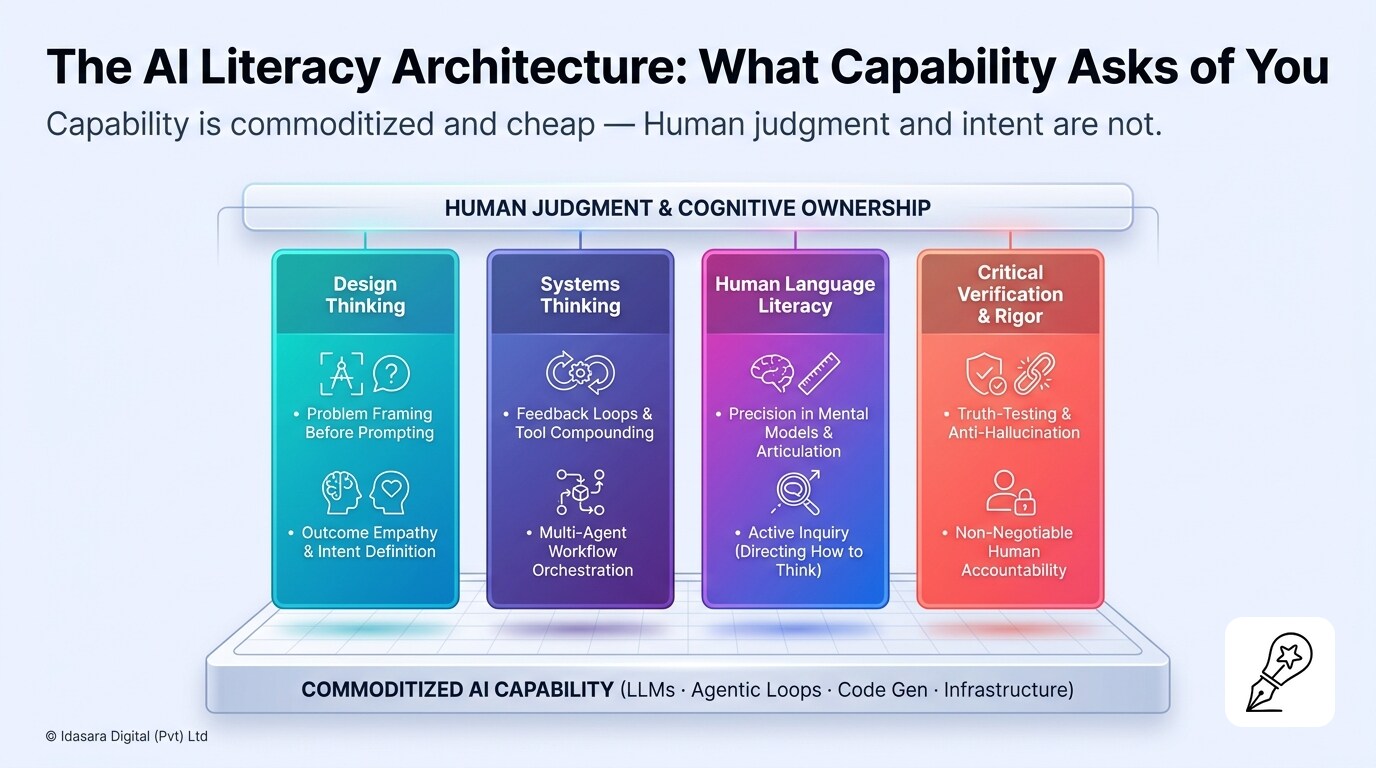
Read the eight years as one line and a pattern emerges. Capability keeps getting cheaper. Judgment does not.
The World Economic Forum's Future of Jobs Report 2025 — surveying over 1,000 employers representing more than 14 million workers across 55 economies — found that AI and big data top the list of fastest-growing skills, with around 90% of employers expecting demand to rise by 2030. Employers expect 39% of workers' core skills to change over the 2025–2030 window. The report projects 170 million new roles created against 92 million displaced by 2030 — a net gain, and a churn that touches almost everyone in between.
That is not a story about machines replacing people. It is a story about the gap between two people using the same tool.
One student asks an AI for the answer, copies it, and submits it. The other asks it to explain why their own attempt failed, works the problem again, and gets it right unassisted the second time. Both used the same model. Only one of them learned anything. Over five years, that gap compounds into something that no longer looks like a gap in tools — it looks like a gap in ability, because by then it is one.
The technology is not the differentiator. It is available to everyone, in most cases for free. The differentiator is whether you use it as a shortcut past the thinking, or as a system that makes the thinking sharper.
That distinction is learnable. And as of 2026, it finally has a name and a syllabus.
The world just wrote this down
For most of the eight years this article covers, "AI literacy" was a phrase without a definition. That changed in the space of a year, and it is worth knowing that the work has been done — because it means nobody has to invent it from scratch.
The US Department of Labor published a national AI Literacy Framework in February 2026, defining it as "a foundational set of competencies that enable individuals to use and evaluate AI technologies responsibly." It names five content areas:
- Understand AI principles — core concepts, capabilities, and limitations.
- Explore AI uses — what the tools do, and how they complement human expertise.
- Direct AI effectively — how to prompt and give context to get useful output.
- Evaluate AI outputs — assess what comes back for accuracy and relevance.
- Use AI responsibly — ethics, protecting information, accountability for outcomes.
The framework is voluntary. It imposes nothing on anyone. It is simply the clearest public statement yet of what a person needs to know.
The European Commission and the OECD went at the same problem from the schooling side with the AILit Framework, built for primary and secondary education and refined through consultation with more than 2,000 stakeholders. Its structure is a progression of four domains — Engage with AI → Create with AI → Manage AI → Shape AI — each combining knowledge, skills, and attitudes.
Read those two lists again and notice something. Almost everything in them is judgment. Evaluate the output. Understand the limitations. Take accountability. Only one item out of nine is about operating the tool at all. The institutions arrived, independently and from opposite directions, at exactly the conclusion this timeline points to: the machine is not the hard part.
So the gap is no longer definition. It is delivery — and language.
Both of these frameworks are written in English, for education and workforce systems that already function. That is not a criticism; it is a description of who they were built for. But a student in Anuradhapura or Jaffna cannot use a competency framework they cannot read, and no amount of authority behind a document closes that distance on its own.
Where to start
If you are a student — or a parent of one — the practical implication of this entire timeline is narrow and actionable: understanding how these systems work, and how to use them without outsourcing your own reasoning, is now a foundational skill rather than a specialist one. The frameworks above say so plainly.
This is the work Idasara Academy exists to do, and it is worth being precise about what that means. We do not compete with those global programs. We carry them. The standards have been set by people better resourced than us to set them, and re-inventing that would be vanity. Our job is the part they cannot do from Washington or Brussels: bring that knowledge into the local domain, in the language the student actually thinks in, and get it to every part of the country rather than the parts that were already fine.
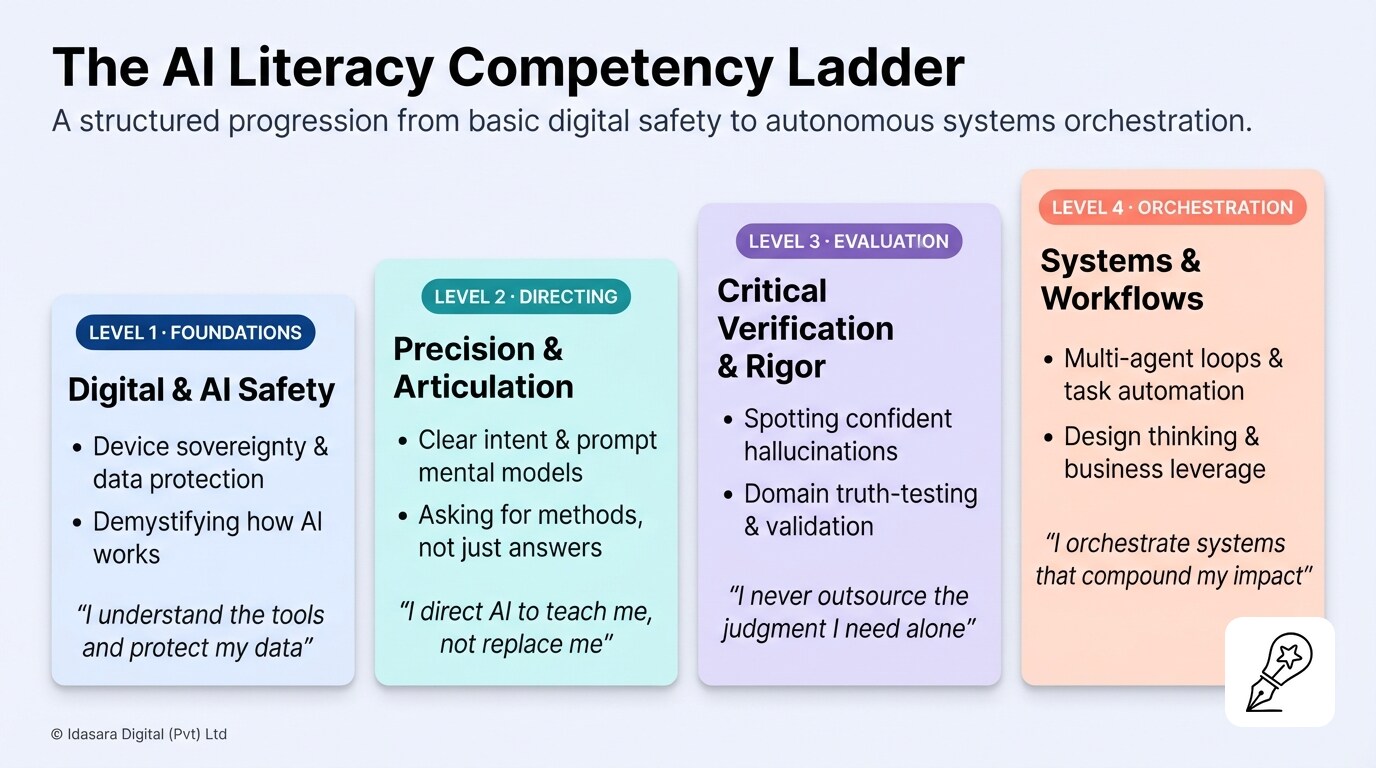
If you are a student, start with DigiReady. It is free, it is five lessons, and it exists in Sinhala and Tamil as well as English. Two of those lessons are, almost line for line, the two competencies both frameworks put at the centre:
- Stop Asking AI for Answers — Start Asking It to Teach You — give the AI your subject, your level, what you already tried, and exactly what confuses you; then ask for the method rather than the answer. (Direct AI effectively.)
- When the Robot Sounds Sure but Gets It Wrong — why a hallucination sounds calm and confident, and how to cross-check a formula, a date, or a source before you trust it. (Evaluate AI outputs.)
That second lesson ends on a sentence that could serve as the summary of this entire article: never outsource the judgement you will need alone in the exam hall.
The other three cover the ground underneath — reading any app screen, keeping your accounts and data safe, and controlling your own device. No prior technical background is assumed, because assuming it is how you exclude the people who most need the thing.
If you are already working, the equivalent is AI Aptitude — practical automation of real HR, finance, and operations tasks, part of the six-pillar OWN YOUR FUTURE roadmap (Digital Literacy · AI · Employability · Financial Literacy · Financial Independence · Entrepreneurship), which opens with a free diagnostic.
All of it runs on the same principle as everything else we build: the student learns to test a claim rather than swallow it.
And the trilingual part is not a feature line. For a great many Sri Lankan students it is the entire difference between this being available and this being theoretical — and it is the reason a global framework needs a local carrier at all. If you want the bigger why — the belief that empowerment is a right, not a privilege — it lives at idasara.org.
The models will keep improving whether or not you learn them. The question is only which side of the gap you are standing on when they do.
At a glance
The Gen AI evolutionary journey runs from a 2017 research paper to a 2026 production reality, in six phases:
- 2017–2021 — Origins. Google's Transformer architecture ("Attention Is All You Need") makes scale possible. GPT-1 through GPT-3 and early diffusion models follow. Almost none of it reaches the public.
- November 2022 — The mainstream boom. ChatGPT's launch changes distribution, not invention. UBS/Similarweb estimated ~100 million monthly users in about two months; Threads broke that record in five days by July 2023.
- 2023–2024 — The frontier race. Anthropic's Claude 3 / 3.5 Sonnet set the reasoning-and-coding reference standard; DeepSeek-V3 and R1 collapse the assumed cost of frontier reasoning and release open weights.
- 2025 — The systems shift. The unit of work stops being the prompt. Agentic loops (perceive → reason → execute → verify → refine) and graph-structured retrieval (GraphRAG) arrive. Neither eliminates hallucination.
- Mid-2026 — The frontier splits. In eight weeks: Claude Fable 5 and Mythos 5 ship as one model at two levels of restraint (Mythos 5 restricted to vetted government and enterprise partners); Moonshot's Kimi K3 (2.8 trillion parameters) and Alibaba's Qwen3.8-Max (2.4 trillion) publish their weights openly. Frontier-class capability at roughly 70% lower cost — or free to download.
- 2026–2030 — Embodied systems and digital twins. Agents are in production but unevenly: ~86% of surveyed organisations deploy coding agents, yet integration, data quality, and change management — not model capability — are the named blockers. Gartner expects >40% of agentic projects cancelled by end-2027.
- 2031–2035 — Horizon (projection, not fact). Read against Huawei's Intelligent World 2035 forecast — a useful, quantified, and openly commercially-interested view. Energy and compute as the binding constraint (data centres at ~1.5 trillion kWh) versus the counter-case that supply scales too (computing capacity up 100,000-fold, renewables past 50%); the "agentic Internet" of 900 billion agents serving 9 billion people, blocked by liability law rather than capability; the slow phase-out of von Neumann architecture; embodied AI as the probable next step; and — not on Huawei's list — open weights versus the gated frontier as a question for legislatures.
The through-line: capability keeps getting cheaper, judgment does not. The WEF expects 39% of workers' core skills to change by 2030. The differentiator is not access to AI — it is whether you use it as a shortcut past the thinking or as a system that sharpens it.
And it now has a syllabus. In 2026 the US Department of Labor published a national AI Literacy Framework (understand AI principles · explore AI uses · direct AI effectively · evaluate AI outputs · use AI responsibly), and the European Commission and OECD released the AILit Framework for schools (Engage → Create → Manage → Shape AI). Almost every competency in both is judgment rather than tool operation. The remaining gap is not definition — it is delivery, and language: both frameworks are published in English, for systems that already work.
FAQ
When did generative AI actually start? June 2017, with the publication of "Attention Is All You Need," which introduced the Transformer architecture. Public awareness arrived five and a half years later with ChatGPT in November 2022. The breakthrough and the adoption were separate events roughly five years apart — which is the single most useful thing to know about how this technology spreads.
Was ChatGPT really the fastest-growing app in history? It was, briefly, on third-party estimates. A UBS note in early February 2023, using Similarweb traffic data, put ChatGPT at roughly 100 million monthly active users about two months after launch — faster than TikTok (nine months) or Instagram (two and a half years). Two caveats: those were traffic-analytics estimates, not audited OpenAI figures; and Instagram's Threads beat the record in July 2023 by reaching 100 million users in five days.
Why did DeepSeek matter so much? DeepSeek-V3 (December 2024) and DeepSeek-R1 (January 2025) showed that frontier-level reasoning did not require hundreds of millions of dollars, and released the weights openly. The widely quoted US$5.6 million covers only V3's final training run — not research, failed runs, data, or staff. R1's later peer-reviewed Nature paper disclosed about US$294,000 for the reinforcement-learning stage on top of that base model. The exact numbers are contested; the direction is not.
Does GraphRAG or a knowledge graph stop AI from hallucinating? No. Graph-structured retrieval measurably reduces unsupported answers on multi-hop questions and makes the reasoning path auditable, which is genuinely valuable. It does not make a language model incapable of being confidently wrong. Any vendor promising zero hallucination is selling something.
What happened to AI models in mid-2026? The frontier split along a new line — not who was ahead, but who is allowed to hold the technology. In June 2026 Anthropic released Claude Fable 5 and Claude Mythos 5: the same underlying model at two levels of restraint, with Mythos 5 restricted to vetted government and enterprise partners rather than sold openly. Weeks later, two of the largest models ever built went the opposite way — Moonshot AI's Kimi K3 (2.8 trillion parameters) and Alibaba's Qwen3.8-Max (2.4 trillion) both published their weights for public download. Both directions are now real at once.
Is an open model like Kimi K3 as good as a closed one like Claude Fable 5? Not across the board, and be sceptical of anyone who says otherwise — including the model makers, whose benchmark tables are usually their own internal runs. On independent head-to-head comparisons Fable 5 still wins the majority of shared coding evaluations. What the open models genuinely changed is price: Kimi K3 lists at roughly 70% less per token for work in the same league, and the weights themselves are free to download. Capability got dramatically cheaper without the leader changing.
Is agentic AI actually working in businesses in 2026? Unevenly. Anthropic's 2026 survey of 500+ technical leaders found 86% deploying agents for production code and eight in ten reporting measurable return. Forrester's read is blunter: around three-quarters say they are adopting agentic AI, but only a minority have anything meaningful in production. Gartner expects more than 40% of agentic AI projects to be cancelled by the end of 2027. The blockers are integration, data quality, and change management — not model capability.
What will AI look like in 2035? Nobody knows, and anyone giving you confident detail is guessing. The most quantified public attempt is Huawei's Intelligent World 2035 forecast, which projects 9 billion people connected to some 900 billion AI agents, computing capacity up 100,000-fold, global data centres drawing around 1.5 trillion kilowatt-hours, and AI adopted by 85% of companies. Read those numbers knowing Huawei sells networking, compute, storage, and energy infrastructure — every trend it forecasts implies demand for its own products. The direction is informed; the magnitudes are a position, not a measurement. What is safe to say is narrower: energy and compute become the real constraint, agent-to-agent activity is limited by liability law rather than capability, and the ability to direct and verify these systems becomes the thing that separates people.
Is there an official definition of AI literacy? Yes — two, published within a year of each other, and they agree more than they differ. The US Department of Labor released a national AI Literacy Framework in February 2026 built on five content areas: understand AI principles, explore AI uses, direct AI effectively, evaluate AI outputs, and use AI responsibly. The European Commission and the OECD released the AILit Framework for primary and secondary schools, structured as a four-domain progression — Engage with AI, Create with AI, Manage AI, Shape AI. What stands out in both is how little of it is about operating the software. Almost every competency is judgment: assessing output, understanding limitations, taking accountability.
If the frameworks already exist, what is missing? Delivery, and language. Both frameworks are published in English and written for education and workforce systems that already function — which is entirely reasonable given who built them, but it leaves a student who does not read English with an authoritative document they cannot use. That is the gap Idasara Academy is built to close: not by writing a competing Sri Lankan framework, but by carrying the established global standards into Sinhala and Tamil and out across the country. Augment, not replace.
Where can a Sri Lankan student actually learn this, for free? Idasara DigiReady is a free five-lesson digital-literacy program available in English, Sinhala, and Tamil. Two lessons map directly onto the competencies the international frameworks put at the core: how to prompt an AI tutor so it teaches you rather than answering for you, and how to spot when AI is confidently wrong. The other three cover reading any app screen, account and data safety, and controlling your own device. For working adults, the equivalent is AI Aptitude within the Own Your Future roadmap.
What should a student learn from all this? That the tool is not the differentiator, because everyone has it. The differentiator is whether you use AI as a shortcut past the thinking or as a system that makes the thinking sharper. One student asks for the answer and copies it; another asks why their own attempt failed and then solves it unassisted. Same model, opposite outcomes — and over five years the gap in tools becomes a gap in ability.
The evidence behind this piece
- The Transformer architecture — Vaswani, A. et al., Attention Is All You Need, NeurIPS 2017. The self-attention design that everything since is downstream of. arxiv.org/abs/1706.03762
- ChatGPT reached ~100 million monthly active users in about two months — UBS analysis citing Similarweb data; UBS analysts said they could "not recall a faster ramp in a consumer internet app" in 20 years covering the sector. Third-party estimate, not an audited OpenAI figure. Reuters, 1 Feb 2023. reuters.com
- Threads passed 100 million users in five days, superseding ChatGPT's record within months. TechCrunch, 10 Jul 2023. techcrunch.com
- Claude 3 (Mar 2024) and Claude 3.5 Sonnet (Jun 2024) — the reasoning/coding reference generation of this window. Anthropic model announcements. anthropic.com/news/claude-3-family · anthropic.com/news/claude-3-5-sonnet
- DeepSeek-V3: 671B total parameters, ~37B activated per token, 14.8T training tokens, 2.788M H800 GPU-hours — the disclosed figures for the final training run only. DeepSeek-AI, Dec 2024. arxiv.org/abs/2412.19437
- DeepSeek-R1: large-scale RL for reasoning, open weights — DeepSeek-AI, Jan 2025. arxiv.org/abs/2501.12948
- R1 peer-reviewed in Nature (Sept 2025), with the reinforcement-learning stage costed at roughly US$294,000 on top of the base model — the first major LLM to clear peer review. nature.com
- Independent cost analysis of the DeepSeek numbers — Epoch AI, What went into training DeepSeek-R1? Useful for why the headline figures are contested. epoch.ai
- GraphRAG — Edge, D. et al., From Local to Global: A Graph RAG Approach to Query-Focused Summarization, Microsoft Research, 2024. Reduces unsupported multi-hop answers; does not eliminate hallucination. arxiv.org/abs/2404.16130
- Claude Fable 5 and Claude Mythos 5 (9 Jun 2026) — one underlying model at two levels of restraint. Fable 5's classifiers cover cybersecurity exploitation, dual-use biology/chemistry, and capability-extraction attempts, routing those sessions to a smaller model rather than refusing; Anthropic states more than 95% of Fable sessions involve no fallback at all. Mythos 5 has those safeguards removed and is limited to Project Glasswing (a US government collaboration) and trusted partners — no public API. Both priced at $10 / $50 per million input / output tokens. anthropic.com · platform.claude.com
- Kimi K3 — 2.8 trillion parameters, 1M-token context, 16 of 896 experts routed per token; API 16 Jul 2026, open weights late Jul 2026 — the largest open-weight model released to that date. Moonshot AI, via Tom's Hardware. tomshardware.com
- Qwen3.8-Max — 2.4 trillion total parameters, ~95 billion active per request, weights published openly (announced 3 Aug 2026) — the first model in Alibaba's Max class to have its weights released. ⚠️ The accompanying benchmark table is Alibaba's own internal runs; the source notes independent verification was still pending. the-decoder.com
- Kimi K3 vs Claude Fable 5, independent head-to-head — Fable 5 takes the majority of shared coding evaluations; K3 leads the long-horizon agentic evals and lists at roughly 70% lower cost per token ($3 / $15 vs $10 / $50 per million). Used here for the "cheaper, not better across the board" claim. llm-stats.com
- 86% of organisations deploy agents for production code; 57% run multi-step workflows; ~8 in 10 report measurable ROI; top blockers are integration (46%), data quality (42%), change management (39%) — Anthropic, The 2026 State of AI Agents Report, survey of 500+ technical leaders. claude.com
- Adoption claims outrun production reality — "companies are chasing, few are catching": most agentic deployments remain chatbots with ambitions. Forrester, The State Of Agentic AI In 2026. forrester.com
- More than 40% of agentic AI projects will be cancelled by end-2027 — citing escalating costs, unclear business value, and inadequate risk controls. Gartner press release, 25 Jun 2025. gartner.com
- Intelligent World 2035 — the 2035 projections — 9 billion people connected to 900 billion AI agents ("agentic Internet"); global computing capacity up 100,000-fold; data traffic up 100-fold; AI storage demand up 500-fold, eventually >70% of all storage; global data centres consuming ~1.5 trillion kWh by 2035; solar and wind supplying >50% of electricity generation; AI adopted by 85% of companies, lifting productivity ~60%; the gradual phase-out of von Neumann architecture. ⚠️ This is a vendor forecast, and every trend implies demand for products Huawei sells (networking, compute, storage, energy infrastructure). Cited as an informed industry position, explicitly not as a neutral measurement. Huawei Global Industry Vision, published 16 Sep 2025. huawei.com/en/giv · press release
- AI literacy defined for the US workforce — five foundational content areas (understand AI principles · explore AI uses · direct AI effectively · evaluate AI outputs · use AI responsibly) plus seven delivery principles. Defines AI literacy as "a foundational set of competencies that enable individuals to use and evaluate AI technologies responsibly." Voluntary; imposes no regulatory requirement. US Department of Labor, Employment and Training Administration, Training and Employment Notice 07-25, 13 Feb 2026. dol.gov · full notice (PDF)
- AI literacy for schools — the four-domain progression Engage with AI → Create with AI → Manage AI → Shape AI, each combining knowledge, skills, and attitudes; for primary and secondary education, refined through consultation with 2,000+ stakeholders. A joint European Commission / OECD initiative. Published in English. ailiteracyframework.org
- AI and big data are the fastest-growing skills; 39% of workers' core skills change by 2030; 170 million roles created against 92 million displaced — surveying 1,000+ employers representing 14m+ workers across 55 economies. World Economic Forum, Future of Jobs Report 2025 (Jan 2025). weforum.org
© Idasara Digital (Pvt) Ltd
Students — DigiReady
DigiReady is free, five lessons, and available in English, Sinhala and Tamil. Two of its lessons map directly onto the competencies both international frameworks put at the centre.
Start DigiReady freeWorking adults — AI Aptitude
AI Aptitude covers practical automation of real HR, finance and operations tasks, inside the six-pillar Own Your Future roadmap.
Explore AI AptitudeReady to start learning? Create a free account