01. AI for Transforming Public Service: Concepts, Applications, and Guidance for Public Officers
Core Theme: Artificial intelligence is not a passing technology fashion, nor a software vendor's sales pitch; it is a national reality that has already arrived on your desk. What it takes from you are the repetitive tasks that exhaust you — never your post, and never your human accountability.
1. The Approach: The Public Officer's Desk and a Technological Transition
Sri Lanka's public service is the lifeblood of the nation. From the Grama Niladhari division (the village-officer level, the state's smallest administrative unit) up through the Divisional Secretariat, the District Secretariat, and the ministries, the lives of thousands of ordinary citizens are decided every day amid the files stacked on public officers' desks. Land permits, birth certificates, social welfare benefits (Aswesuma and Samurdhi, the national support programs), pensions, licence renewals, and requests tied to development projects flow onto those desks without pause.
But the traditional file-based way of working is now in deep crisis. With limited resources, limited staff, and a documentary burden accumulated over generations, an ordinary citizen can spend days — sometimes weeks — shuttling between offices to obtain even a simple service. On the other side of the counter, the public officer spends the entire day re-checking the same information, filling the same forms by hand, and combing through bookshelves for old circulars.
It is at precisely this moment that the most powerful technological leap of our era arrives before us: Generative AI.
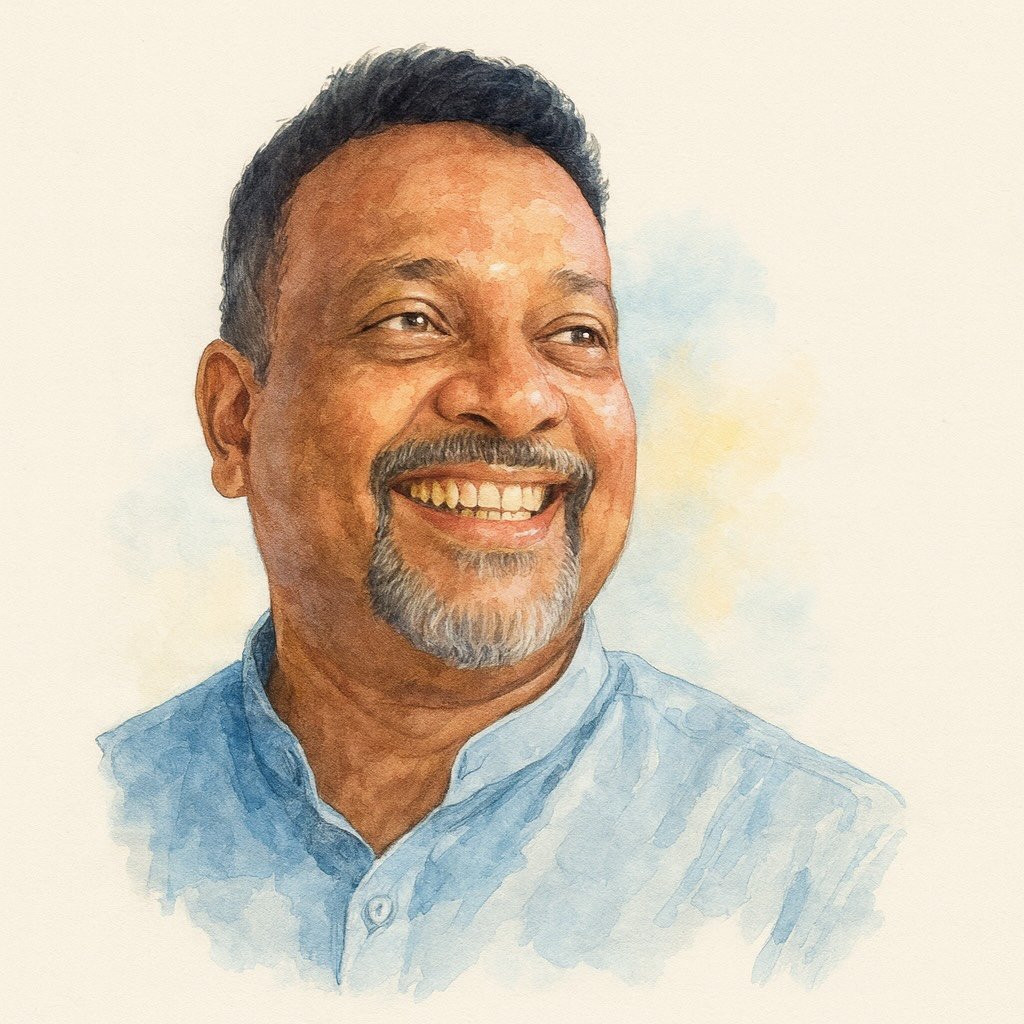 Figure 1.1: Samisa Abeysinghe (Founder & CEO, Idasara Digital) — leadership for the digital transformation of the public service and for artificial intelligence literacy.
In April 2025, at the invitation of the Presidential Secretariat, my friend Harsha Purasinghe and I launched this AI training program for public officers. Since that day, the two of us have traveled beyond Colombo — to Jaffna, Kandy, Matara, Kalutara, Hambantota, and Kataragama — sharing this knowledge with more than 10,000 public officers. What you now hold is the tenth edition of that program (Version 10.0).
My aim is not to intimidate you with a wall of complex technical jargon. It is to show you, from an engineering and practical standpoint, how a public officer can use artificial intelligence to make the daily workload radically more efficient, how to serve the citizen with greater dignity, and which safeguards must be taken along the way.
2. The Three Questions I Ask in Every Lecture Hall
At every workshop I have conducted across the island, I put three simple but decisive questions to the public officers in the audience:
- Do you already use ChatGPT, Google Gemini, or a similar AI tool on a weekly basis?
- What do you use it for? (Personal needs, your children's education, drafting official letters, language translation?)
- What is the single greatest fear or uncertainty about AI sitting at the bottom of your mind?
Watching the show of hands, a very clear reality emerges:
- A majority already use it privately: most often for their children's schoolwork, to correct an English letter, or out of personal curiosity.
- Officially, it is still a secret: many officers quietly draft office letters with ChatGPT on their personal phones. Not out of laziness — out of exhaustion from a crushing workload. But because there is no institutional policy and no proper training, they do it with a lingering sense of guilt.
- A deep fear runs through society: "Will this take our jobs? If I use it, will our confidential data leak? Will the computer be hacked? Are our bank accounts at risk? Will machines rule the world?"
There is also an experience Sri Lanka's younger generation lived through in recent years. Many parents put their children through information technology degrees expecting well-paid careers. Yet after 2023, even finding an internship became extraordinarily difficult for graduates. The reasonable suspicion — "Did AI do all this? Will the same thing happen to our jobs?" — has lodged itself firmly in the public officer's mind as well.
Let us now face that fear directly, and scientifically.
3. The Direct Answer to the Fear: "Tasks Go to the Machine — the Post Stays with You" (AI Takes Tasks, Not Posts)
Let us answer this question honestly, with nothing hidden: artificial intelligence will never seize your post. But it will, inevitably, take over certain tasks on your desk. In fact, what it takes over is exactly the monotonous, rule-bound, mechanical portion of the work you complain about every day — the portion that wears you down!
Any repetitive task that can be done digitally on a computer can today be done by an AI model a hundred times faster than a human. But a post — a designation — is not a bundle of repetitive tasks. A post is a responsibility. It is judgment. It is the comprehension of context.
Here is the clear dividing line every public officer must understand:
| What Moves to the Machine | What Stays with the Officer |
|---|---|
| Repetitive Rules: checking forms for completeness, routing letters to the correct division, filing documents. | Empathy & Listening: hearing the grief of the citizen who breaks down at your counter; understanding the true situation of a destitute family that has lost its Aswesuma benefit. |
| Retrieval & Cross-checking: searching and comparing old circulars, clauses of the Establishments Code, gazette notices, and financial regulations in seconds. | Discretionary Judgement: reaching a fair, lawful, and optimal decision in an exceptional human situation that no circular anticipates to the letter. |
| First Drafts & Translation: ending the agony of the blank white page; producing an instant first official draft in Sinhala, Tamil, or English. | Field Reality: traveling to the village to settle a land dispute; inspecting boundaries; seeing the actual conditions on the ground. |
| — | Legal Accountability: signing the decision, and answering for that act of state personally before the law. This can never be delegated to a computer. |
Important
Remember: a machine can read a thousand circulars at once — but only you can understand the tears and the helplessness in a citizen's eyes. A machine can write drafts — but only a public officer can sign them and exercise the authority of the state. Tasks may go to the machine; accountability never does.
4. The Leading AI Models: Who Built Them? Who Owns Them?
There are several AI tools every public officer in today's world must know. Before using any tool, there is one question you should always ask first: "Which country built this model? Which company? And on what data was it trained?"
The answer matters, because the environment in which a model was built directly determines its language ability, its grasp of our culture, and its biases:
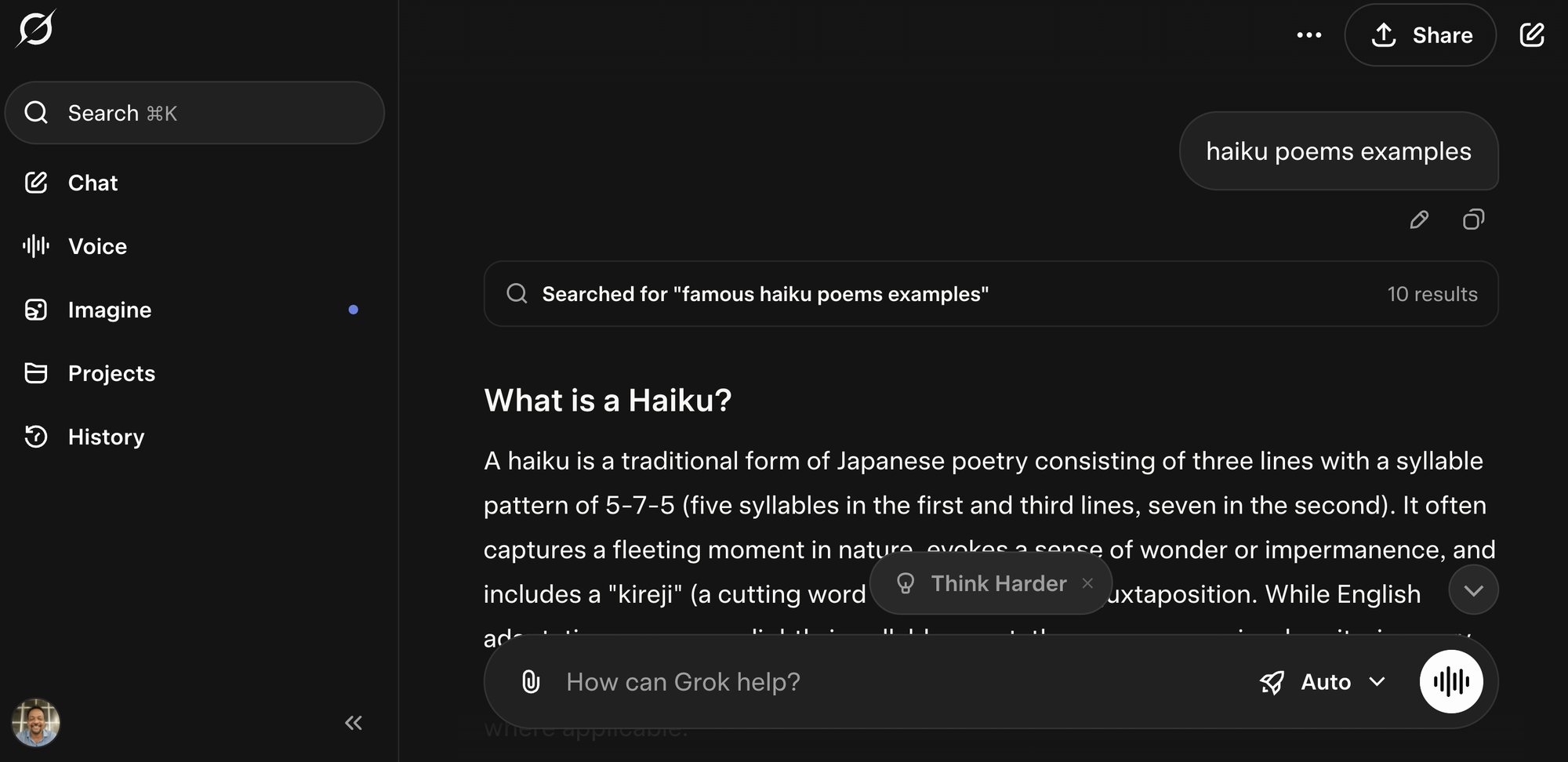 Figure 1.2: The anatomy of a modern frontier AI interface (the Frontier AI Cognitive Cockpit) — conversation, live information search, extended reasoning, and multimodal controls operating in a single environment (illustrated with xAI's Grok).
The Interface Anatomy of Figure 1.2 and Its Engineering Principles
A modern generative AI interface is not a simple "chat box"; it is a complete digital cockpit with high-order cognitive capabilities (a Cognitive Cockpit). The environment shown in Figure 1.2 consists of three principal zones:
-
The Cognitive Navigation Sidebar (left): * Instant internal search (
⌘K/ Search): semantic search that instantly retrieves every previous conversation, draft, and saved item. * Multimodal operation zones (Chat,Voice,Imagine): the ability to move effortlessly beyond text into real-time two-way voice conversation (Voice) and image generation (Imagine). * Project isolation (Projects): the ability to keep a public institution's different domains — say "Land Registrar Circulars" and "Establishments Code Queries" — in separate workspaces with their own data and instructions, never cross-contaminating (Workspace Isolation). * Chronological memory (History): continuing earlier conversations without losing their context. -
The Grounding Canvas (center): * The live web-search marker (
Searched for "famous haiku poems examples" — 10 results): the model does not rely on its static training weights alone. It sweeps the live internet for the user's query, reads the retrieved sources, and composes its answer grounded in that verified material (Retrieval-Augmented Grounding). * Structured intelligent response: instead of an unbroken wall of paragraphs, the answer arrives structured — headings, the governing rules (the 5-7-5 syllable pattern), and cultural context (the "kireji" cutting word). -
The Inference Command Strip (bottom): * Extended reasoning mode (
Think Harder ✕): the biggest shift in modern AI (Test-Time Compute / Extended Reasoning). For a complex legal or financial question, the model is forced not to answer instantly but to work through thousands of reasoning steps behind the screen (Chain-of-Thought) before responding. * Multimodal document input (📎 Attachment Icon): scanned circulars, PDF reports, photographs, or spreadsheets can be fed directly to the model for analysis. * Automatic model selection (Auto ⌵): simple queries are routed to fast, low-cost lightweight models; complex computations to powerful reasoning models (Intelligent Model Routing). * Two-way voice input (Voice Waveform Icon): giving instructions by speaking directly into the microphone instead of typing.
As a public officer, you should see this interface not as a toy, but as a powerful instrument panel for file inspection, circular comparison, and decision support.
- ChatGPT (OpenAI / USA): * The world's most widely used model — the one that launched the conversational revolution. * Exceptionally strong in English, with a broad ecosystem of tools and plugins (Advanced Data Analysis, Custom GPTs). It can hold simple conversations in Sinhala, but has limits with complex Sinhala grammar.
- Google Gemini (Gemini / USA): * A critically important model for the Sri Lankan public officer. Because Google has indexed Sinhala and Tamil websites, news, and data through Google Search for decades, Gemini holds an unusually broad and accurate grasp of the Sinhala language. * It also offers an enormous context window — the capacity to read documents spanning millions of pages' worth of text in a single session.
- Claude (Anthropic / USA): * The most trusted model among the world's top technical and engineering teams. * Unmatched at long legal documents, complex report analysis, reasoning, and principled behavior (Constitutional AI). The best-suited tool for serious state-level policy and drafting analysis.
- DeepSeek (DeepSeek AI / China): * The Chinese open-source model that demonstrated top-tier mathematical and reasoning ability at a fraction of the compute cost. * Trained on complex Chinese character patterns and broad non-English multilingual data, it shows a distinctive strength with Sinhala and other structurally complex Asian languages.
- Meta AI / Llama (Meta Llama / USA): * The world's leading open-weight model. A sovereign foundation: a government or institution can install and run it on its own internal servers without sending data to the outside internet.
- Grok (xAI / USA): * A model directly connected to the X (Twitter) platform, analyzing global news and data in real time.
5. The National Plan Arrives on Your Desk (Where This Sits)
Many in the public service assume an AI workshop is a private software company's vendor pitch. It is not. This is the Government of Sri Lanka's national program reaching your desk.
- The National Digital Economy Blueprint: the government's foundational vision for digitalizing the country's economy.
- PIC-Net (Public-Impact Champions Network): the national network turning public officers across 95 ministries, state enterprises, and provincial councils into champions of digital transformation.
- The 2026 Budget: the 2026 budget makes a historic allocation for Digital Public Infrastructure (DPI), the MOSIP-based national digital identity (SLUDI), and the National Data Exchange for government data sharing.
- Your division and your desk: however many cabinet decisions and central bank reports are written at the national level, a national plan is won or lost by you — the officer serving in the Divisional Secretariat and the Grama Niladhari division. To the ordinary citizen, you are the government. The country moves forward only insofar as you use these tools to solve the citizen's actual problems.
6. The Idasara Mission: Economic Empowerment through Digital Empowerment
The founding vision of Idasara Digital, the company I established, is Economic Empowerment through Digital Empowerment.
For the people of a country like Sri Lanka to rise economically, they must first possess digital literacy and modern skills. That is why we established Idasara Academy. Idasara Academy is not another conventional tuition class or lecture hall. Its core is Learn to Learn: how to find knowledge for yourself, how to learn from your own mistakes, and how to build real workplace skills (the Employability Content Stream).
And there is no reason to feel any anxiety that the technical diagrams in this book are in English. The English Learn Ladder framework introduced by Idasara Academy lets anyone build their language capacity step by step, from exactly where they stand today to the very top.
The public service is a nation's largest human resource. When you arm yourself with AI, what you empower is the future of the entire nation.
In the next chapter, we examine in depth how generative AI shattered the complex coding barrier that stood for seventy years — since the birth of the computer itself.