07. Future Corporate Leadership & The Idasara Career Roadmap
Published 2026-09-14
Core Theme: "The people who reach the C-suite of tomorrow's organizations will not be officers walled inside a single department. They will be Cross-Functional AI Champions — professionals who weave artificial intelligence through the organization's entire workflow, across finance, HR, marketing, sales, and software engineering, and multiply its value tenfold. Idasara Academy exists to lead you to that future leadership."
Why do corporate silos cost so much?
The greatest structural weakness of a traditional organisation is that its departments operate as isolated islands. Sales knows nothing about the leads marketing is generating. Engineering knows nothing about the promises sales is making. Finance complains continuously about collections and margins. And HR, understanding none of it, runs generic training programmes.
Most organisations then repeat the same mistake while adopting AI: each department buys ten disconnected tools and manufactures a new layer of chaos on top of the old one.
One example prices the failure precisely. The marketing department of a Colombo services firm spent Rs. 800,000 on a campaign that produced 400 leads. Sales was informed by emailing an Excel sheet — four days later. By the time the sales team called, half the interested prospects had signed with a competitor. At month-end, finance reported that marketing's return on investment was poor.
Read that sequence carefully, because the diagnosis everyone reached was wrong. Marketing did its job: 400 leads for Rs. 800,000. Sales did its job with what it received. Finance reported accurately. No department failed. The failure was in the silence between them — four days of it — and the organisation responded by concluding that marketing was ineffective, which will lead it to cut the one function that worked.
In an AI-integrated organisation the same lead is scored the moment it arrives, appears on the sales dashboard, and receives its first follow-up within the hour. Nothing about the campaign changed; only the gap closed.
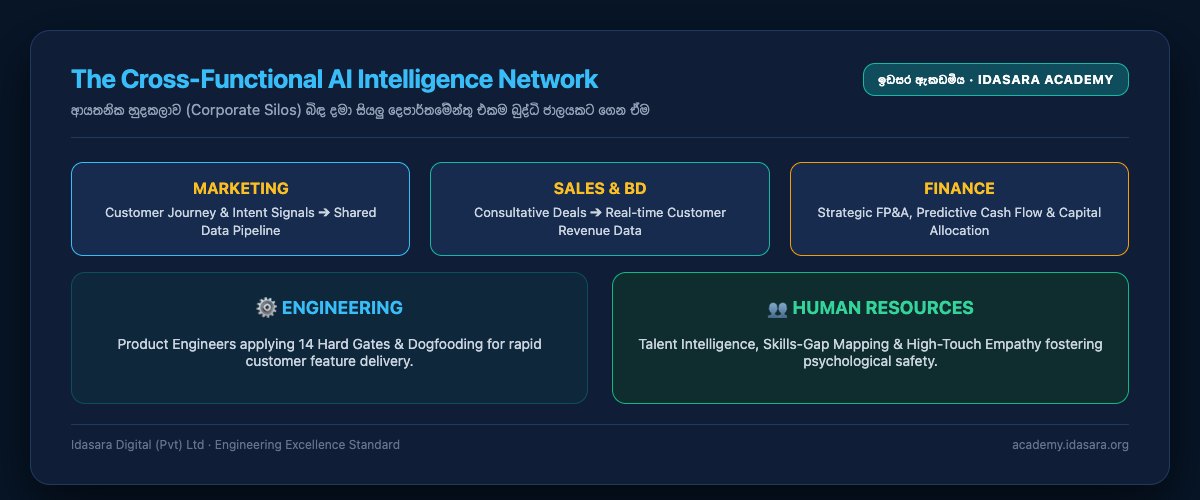 Figure: The Cross-Functional AI Intelligence Network — Idasara Academy
The young professional who can see that whole network from above and connect the organisation's processes with AI is the most valuable asset available to a chief executive — and note that the scarce capability is not technical. It is the ability to see across boundaries that everyone else treats as fixed.
The four-stage career path
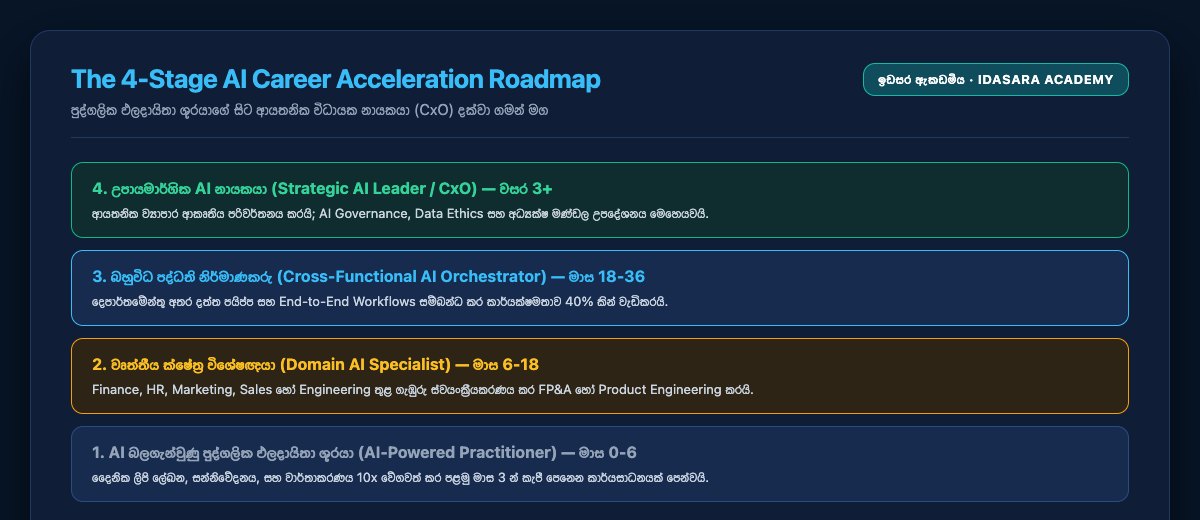 Figure: The 4-Stage AI Career Acceleration Roadmap — Idasara Academy
Stage 1: personal productivity champion, months 0–6
Completing daily documents, emails, meeting minutes and executive memos at ten times speed — finishing in two hours, excellently, what takes others eight, and earning management's trust in the process.
This is Chapter 01's daily loop, applied consistently. It is also the stage that cannot be skipped: nobody is given a wider scope before demonstrating command of a narrow one.
Stage 2: functional domain expert, months 6–18
Becoming a deep expert inside your own field, using the workflows from Chapters 03 to 06.
In accounts, that means automating reconciliation and moving up into strategic FP&A. In HR, replacing clerical work with talent intelligence and retention analytics. In software, shedding the coder mindset and becoming a product engineer who lives by the 14 hard gates.
The pattern is identical in every function: hand the mechanical half to the machine, and move into the judgment half that was always being squeezed out.
Stage 3: cross-functional orchestrator, months 18–36
Stepping past your department's boundary to connect data and AI workflows across others — for example, bringing marketing data, the sales funnel and finance billing into one automated system.
This stage solves the Rs. 800,000 problem above, and it is where careers separate sharply. Nobody is assigned this work. It is taken on by the person who noticed the gap.
Stage 4: strategic AI leader, year 3 onward
Reinventing the business model itself, advising the board on strategy, and leading corporate AI governance.
Tip
Remember: The real gap between these four stages is not technical knowledge — it is breadth of ownership. At Stage 1 you own your desk; at Stage 2, your field; at Stage 3, the connections between departments; at Stage 4, the organization's entire future. At every stage, the question asked of you is the same: "How large a scope can you be trusted with?" AI literacy is the fastest road to building that trust.
That reframing is worth internalising, because it explains why technical skill alone stalls a career. Each promotion is a decision about trust rather than capability, and trust is built by reliably owning the scope you already have.
Four pillars of corporate AI governance
As you move toward senior leadership, four safeguards become your responsibility rather than someone else's.
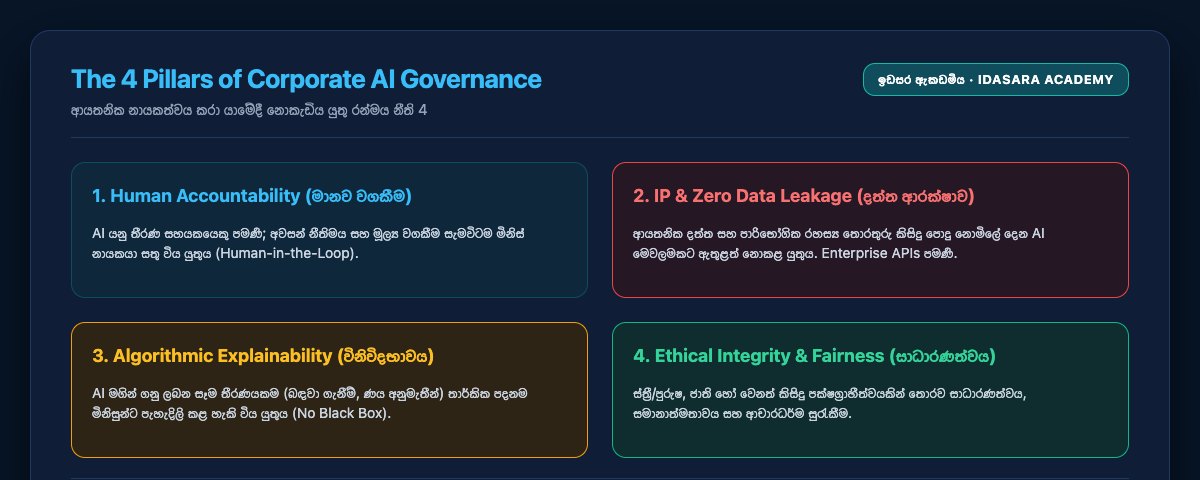 Figure: The 4 Pillars of Corporate AI Governance — Idasara Academy
Data confidentiality and sovereignty
Enforce a data classification policy guaranteeing that corporate financials, customer information and employee records never enter public AI tools. Give every employee an approved list of enterprise zero-data-retention tools, and a clear guide to what data may and may never be entered.
Specificity is what makes such a policy function. "Be careful with sensitive data" is not a rule anyone can follow; a named list of prohibited data types is.
Human accountability
AI proposes; humans decide. Define explicitly a tight loop requiring a human signature on every decision touching money, legal obligations or employees' lives, and a loose loop with sample checks for low-risk work.
And strike the sentence "the system made a mistake" from the corporate vocabulary. Every AI output needs a human owner, named in advance rather than identified after something goes wrong.
Fairness and bias auditing
Audit every AI system influencing hiring, promotion or customer decisions at fixed intervals, against fairness metrics. Accept that HR applications — classified high-risk under international regulation such as the EU AI Act — carry the heaviest transparency burden of all.
The interval matters as much as the audit. A system certified once at launch drifts as its inputs change, and a fairness result from last year says nothing about this year's applicant pool.
Cost governance and outcome measurement
Manage AI spending as a new operating budget line: digital labour, not software subscriptions. Measure cost per accepted outcome and human hours saved rather than raw token counts, and establish model routing that sends simple tasks to cheap models and reserves frontier models for genuinely complex decisions.
As Chapter 09 of the public-sector track shows in detail, the price difference between those model classes can be more than a hundredfold — which makes routing the single highest-return governance decision available.
Shadow AI: the problem a leader must actually solve
One reality deserves stating plainly, because policy is often written as though it were false: your employees are already sending corporate documents to ChatGPT on their personal phones.
Not from bad intent — from workload. And banning AI does not stop the use; it converts it into an unprotected, ungovernable secret, removing the organisation's visibility while leaving all of its exposure intact.
The correct response is not prohibition but a sanctioned route: a secure corporate tool, a clear list of what data may be entered, and a culture in which saying "I prepared this with AI assistance and then reviewed it" carries no penalty. Remove the penalty and you get the disclosure; keep it and you get the same behaviour with none of the information.
Begin today
In 2026 and beyond, jobs will not be lost to artificial intelligence. They will be lost when professionals who use AI well — problem-solvers with the product engineer mindset — replace ordinary employees who do not.
That distinction is the whole argument of this book, and it is also the reassuring part: the deciding factor is a set of habits available to anyone willing to build them, starting with the fifteen minutes at the end of today.
👉 Visit Idasara Academy — academy.idasara.org
Role-specific prompt packs for accounting, HR, marketing, sales and software engineering — purpose-built rather than generic.
Ask AI and the document marking engine — a system that evaluates your business reports, analyses and code live, so you find the weaknesses before a manager does.
A living professional community for knowledge exchange with field experts and other young professionals, which is where most of the practical learning actually happens.
The Idasara Certified AI Professional credential — a credential that adds value not to your CV but to your proof of work, which is what the market now reads.
Do not fear the technology; make it your superpower. Idasara Academy is the most trustworthy guide on your journey to professional victory.