01. AI Literacy & The Superpower of Employability
Published 2026-09-14
Core Theme: "In the corporate world of 2026 and beyond, your fate in the job market is no longer decided by the university degree or paper certificates you hold. Your success is decided by your Cognitive Velocity — how fast, and at what level of quality, you convert organizational problems into business value using Generative AI. AI literacy is the superpower that multiplies a young professional's employability tenfold."
Why has the old job-market equation stopped working?
For decades, the equation in Sri Lanka and everywhere else read:
University degree / professional qualification + 1–2 years of internship = a secure corporate job
That equation has collapsed, and not for vague reasons about "disruption." Three specific things happened.
Entry-level clerical work became a commodity
Consider what organisations traditionally handed a fresh graduate or management trainee in their first two years. Typing up minutes of meeting from a notebook. Shuffling data across Excel sheets to compute totals and percentages. Searching the internet and writing short summaries. Drafting standard client emails.
Any frontier model now completes every one of those in about fifteen seconds, without a spelling error, in professional English or Sinhala. And no organisation will pay a salary for a candidate whose only offering is that category of work.
This is worth stating without softening, because it explains something young graduates are experiencing as personal failure. The problem is not that they are less capable than the previous cohort. It is that the rung of the ladder they were trained to stand on has been removed.
Productivity expectations went vertical
A few years ago, three weeks was a reasonable timeline for a corporate deliverable. Management now expects the first working draft in 24 to 48 hours.
The implication is subtler than "work faster." What is being asked for is a draft — something to react to — which means the professional who produces a rough version quickly and improves it under feedback now outperforms the one who disappears for three weeks and returns with something polished.
The static PDF resume died
Anyone can produce a dazzling, keyword-stuffed CV in two minutes. So hiring managers have stopped trusting the words on a CV or the GPA printed under them, and ask one question instead:
"Can you show us a living product — proof of work — where you solved a real problem?"
Sri Lanka's young generation has felt this earthquake directly. Many parents invested in IT degrees expecting secure, well-paid careers; after 2023, even securing an internship became brutally difficult. The cause was not that graduates knew less. It was that the entry-level workload they had trained for had already been absorbed.
So where does security actually live? Idasara Academy defines employability this way:
Employability is the ability to gain, attain, retain, and change and enhance in a job.
Note that the definition contains no reference to a position. Security lives in that ability, not in a job title — and AI literacy is what multiplies it.
Two applicants, one job: Kasun and Dilshan
Two young men applied for a management trainee position at a leading Colombo FinTech company. What separated them is the whole argument of this chapter.
Kasun graduated with a Second Upper in Business Administration. His CV runs two pages: the degree, his A/L results, secretary of the school sports club. Asked at interview "do you use AI?", he answered: "I got some help from ChatGPT for my assignments." He received the standard reply — "we'll let you know." Eight months later he is still applying.
Dilshan's degree class was lower — a Second Lower. He arrived carrying more than a CV, and opened his laptop.
He showed a one-page executive summary of that same company's public annual report, analysed with AI three days before the interview: three growth opportunities and two risks, clearly argued. He showed a simple invoicing and inventory system he had built with AI over two weekends for his uncle's hardware shop, running live. And he showed the LinkedIn article series documenting the journey.
The interviewers talked with him for an extra fifteen minutes. The offer arrived in two days.
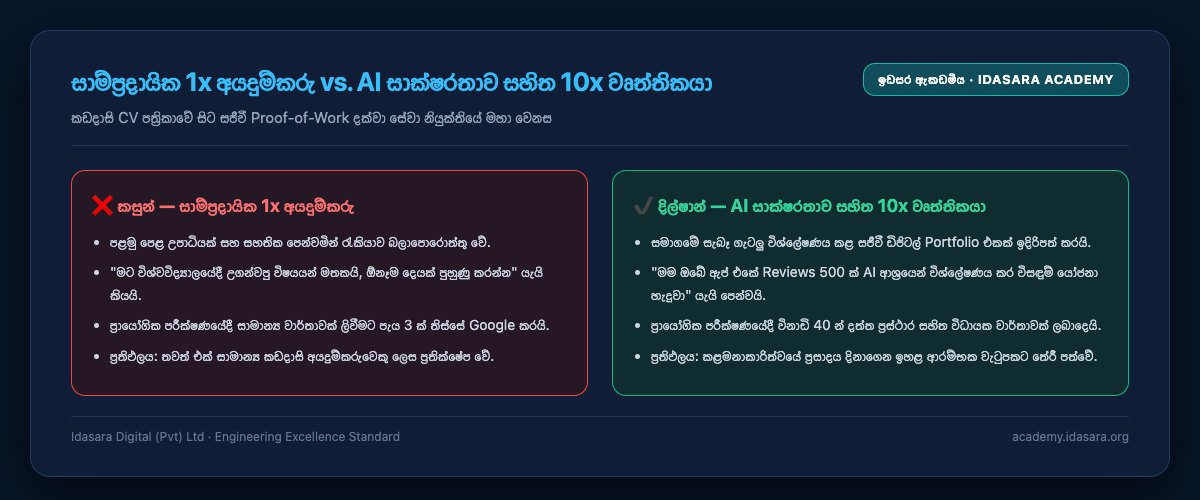 Figure: The traditional 1x applicant vs. the AI-literate 10x professional — Idasara Academy
| Dimension | Kasun (1x mindset) | Dilshan (10x mindset) |
|---|---|---|
| How competence is shown | Paper certificates and GPA | Living, working products (Proof of Work) |
| Use of AI | Assignment shortcuts (consumer level) | Solving business problems (producer level) |
| Preparation | A few lines from the company website | A deep analysis of the company's annual report |
| The language spoken | "Give me a chance" (supplication) | "Here is how I would solve your problem" (value) |
Read the last row of that table carefully, because it is the one a candidate can change today. Kasun's language was supplication — give me a chance. Dilshan's was value — here is how I would solve your problem. One asks the company to take a risk; the other has already started doing the job.
Kasun is not a weak candidate. He is running a 2015 mindset in 2026. Dilshan won because he converted his cognitive velocity — his ability to direct AI — into something the company could see.
Important
Remember: Dilshan's victory was not the AI tool's victory. Kasun had free access to the exact same tool. The difference was in the thinking: Kasun saw AI as a shortcut; Dilshan saw it as an engine that amplifies his own value.
The daily loop that makes you the standout performer
How do you become the obvious high performer in your first four weeks at any organisation? Through a routine rather than a talent.
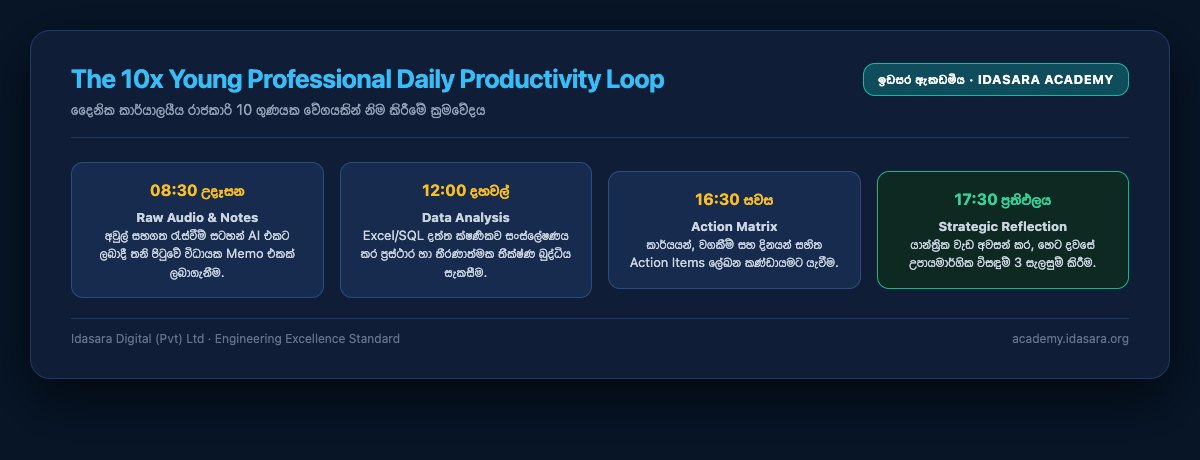 Figure: The 10x Young Professional Daily Productivity Loop — Idasara Academy
Turn raw notes into a one-page executive memo
The average employee sends their manager an unreadable five-page email. The standout professional sends a single page from which the executive team can decide immediately.
💬 The Executive Memo Prompt (Executive Briefing Architecture): ```text Act as a senior advisor to the Chief Operating Officer (COO). Below is a collection of raw notes on last week's delays in our company's supply chain.
Convert this into a single-page executive-level memo. Format: 1. Executive Summary: the core problem and its business impact, in 2 sentences. 2. Root Causes Matrix: the 3 factors driving the delays, with each factor's impact (in % or money). 3. Three actionable solution options (Options Analysis): - Option A: Immediate fix (low cost, short term) - Option B: Process re-engineering (medium term) - Option C: Long-term automation 4. My Justified Recommendation: the best option for us to choose, and the reason why.
Language: concise, sharp, data-centric corporate prose. ``` Notice what that structure forces. Two sentences for the problem and its business impact — which means you must know what the impact is. Three options graded by cost and horizon, then your justified recommendation rather than a neutral summary. A memo built this way demonstrates judgment, and judgment is the thing being assessed.
Turn meeting notes into an action list
Feed a one-hour meeting transcript to AI and instruct it: "produce an action-item table from this discussion with decisions, owners and deadlines; list any unresolved or ambiguous points separately."
The second half of that instruction is where the professional value sits. Anyone can extract what was decided; surfacing what was left ambiguous is what prevents the same meeting happening again in three weeks. The two hours others spend writing notes becomes five minutes for you.
Interrogate your own data before someone else does
Before presenting an Excel report, hand it over and ask: "critically point out the mathematical inconsistencies, suspicious outliers, and anything that weakens my conclusions in this data."
Finding your own errors before your manager finds them is professional maturity, and it is available to anyone willing to invite the criticism. Most people do not ask, because the honest answer is uncomfortable — which is exactly why asking is an advantage.
Close the day with fifteen minutes of learning
Set aside fifteen minutes daily to open up, in conversation with AI, one concept you met that day and did not understand. Not a course, not a certification — one concept, every day.
In six months this makes you the person in the team with the freshest working knowledge of the field, and it is the practical daily form of the Learn to Learn principle. The compounding is the point: two hundred and fifty concepts a year is a different professional.
Tip
Remember: At every step of this loop, you must read and verify, line by line, everything AI writes. AI is a confident intern — skilled, fast, and entirely capable of being wrong without hesitation. You carry full responsibility for any document that goes out under your name; "the AI made a mistake" is not a valid defense in front of any manager.
Building a proof-of-work portfolio
Your strongest asset entering the job market is a collection of proof-of-work artefacts — and four of them can be built in two weeks.
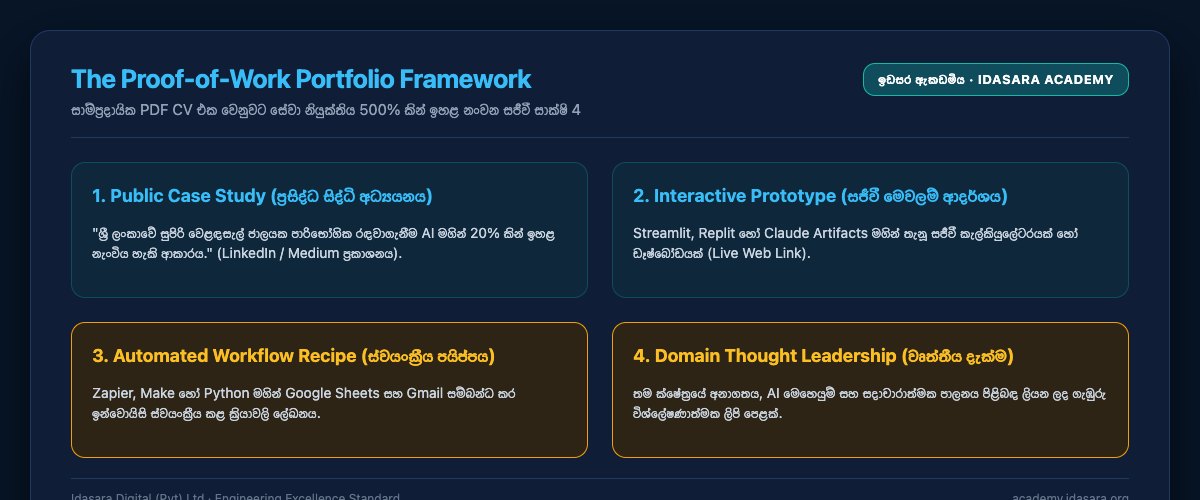 Figure: The Proof-of-Work Portfolio Framework — Idasara Academy
A real solved problem
A live, working solution built with AI for a small business in your hometown, a family member, or a school society. The decisive property is not technical sophistication — it is that real people use it. A toy project demonstrates that you can follow a tutorial; a system your uncle's shop actually runs on demonstrates that you can finish something under real constraints and support it afterwards.
Published thinking
Three or four short articles on LinkedIn or a blog, each structured as problem → approach → result. What a hiring manager reads there is not your writing ability but the quality of your reasoning, which no CV can convey and no interview has time to explore.
An executive-grade sample artefact
A one-page analysis memo built from public data — a listed company's annual report, for instance. This is evidence that you can already think at an organisational level before anyone has given you the job, which reverses the usual chicken-and-egg problem of experience.
A transparent AI workflow
Show clearly how you used AI: the prompts you gave, and the places you corrected by hand. Demonstrating that you directed AI with professional discipline — rather than concealing that you used it — is what separates you from every other applicant, because it answers the question every interviewer now has and most candidates dodge.
Open those four links in front of a hiring manager and you often win not just the job but the organisation's most interesting projects.
How to talk about AI in an interview
How you discuss AI reveals your professional maturity faster than anything else you say.
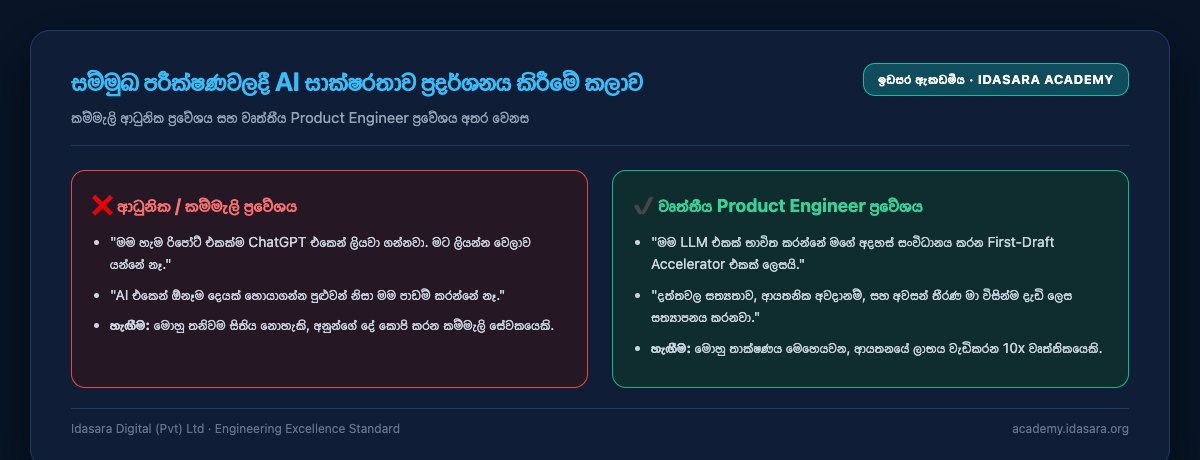 Figure: The art of demonstrating AI literacy in interviews — Idasara Academy
| Question | Weak / risky answer | The 10x professional's answer |
|---|---|---|
| "Do you use AI?" | "No, I do everything by hand." (or) "Yes, ChatGPT writes everything for me." | "Yes — for first drafts and data checks. But the final decision and the verification are always my responsibility." |
| "Will AI take your job?" | "That's a real worry..." | "AI takes over my tasks, not my accountability. I invest the time it frees up in higher-value analysis." |
| "Can you give an example?" | (Silence / generalities) | "Here's the system I built — this problem, this approach, this result." (opens the laptop) |
Notice that both weak answers to the first question fail for opposite reasons. "I do everything by hand" signals someone who will be slower than the team. "ChatGPT writes everything for me" signals someone whose output cannot be trusted. The winning answer names both the use and the boundary — first drafts and data checks, with verification and the final decision remaining the candidate's responsibility.
The second row is the more sophisticated distinction: AI takes tasks, not accountability. A candidate who can say that has understood the thing most of the market has not.
And the secret of the winning answer is not eloquence. Every answer points to a working artefact. Which is why the portfolio comes before the interview preparation.
What Idasara Academy provides
Idasara Academy supports young professionals with four things aimed directly at career velocity.
The Executive Prompt Engineering Vault — tested prompt toolkits engineered for corporate communication, executive memos and business analysis, so you start from a working instruction rather than a blank box.
The Document Diagnostics & Marking Engine — instant checking of your business proposals, reports and case studies against corporate standards, with the defects identified rather than merely scored.
Employability Accelerator Workshops — hands-on sessions in Colombo and major cities that walk you through building a proof-of-work portfolio inside a single weekend.
The Idasara Certified AI Professional credential — industry-recognised certification that validates practical working capability rather than attendance.
In the next chapter, we examine the revolutionary transformation under way in software engineering — and how an ordinary coder grows into a world-class Product Engineer.