02. The Evolution of Software Engineering: The Product Engineer Era
Core Theme: "In software engineering, the era of 'ordinary coders' who type syntax is ending. In an age when AI writes code in seconds, a real software engineer's value is no longer measured in lines of code. It is measured by becoming a Product Engineer: someone who identifies the customer's real pain, designs system architecture from first principles, and builds a complete end-to-end product through the 14 Hard Gates of engineering excellence."
1. The Market Death of the Syntax Writer vs. the Product Engineer Renaissance
For the last two decades, the yardstick of success in IT was memorizing the grammar of a programming language (Python, Java, JavaScript, C++, Go), solving LeetCode puzzles, and coding exactly what a Jira ticket said before marking it "Resolved." The industry had a name for such workers: "Code Monkeys" — people who merely type code.
By 2026, that entire model has been turned upside down:
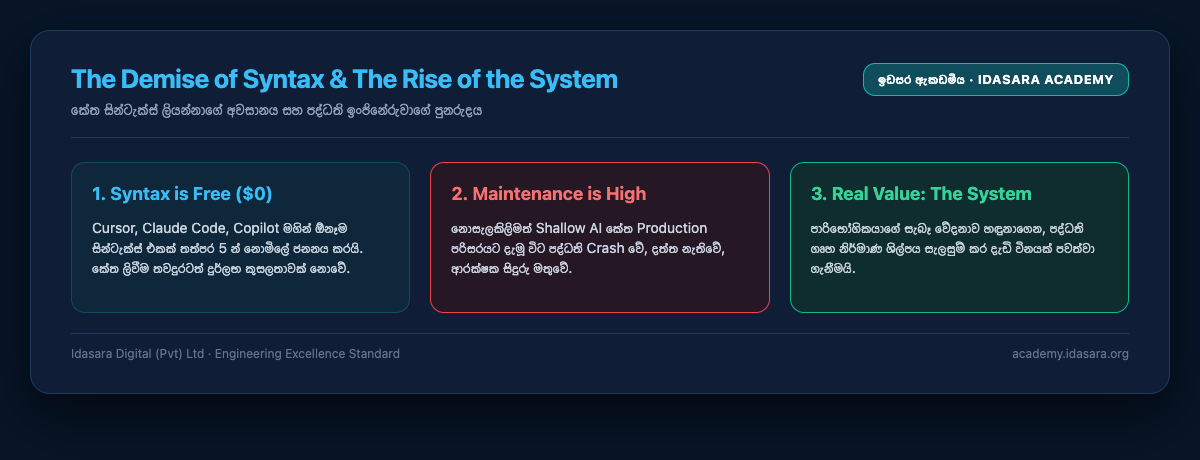 Figure: The Demise of Syntax & The Rise of the System — Idasara Academy
Anatomy of the Figure: As Syntax Dies, the System Rises
To understand this transformation, take a parallel from history. When the calculator arrived, mathematicians did not lose their jobs — only the "human computers" who did arithmetic by hand did. The mathematician was freed to solve higher-order problems. The same is true today:
- What dies: Memorized syntax, typing boilerplate, copying from Stack Overflow, drilling LeetCode patterns. AI performs all of it in seconds — usually with fewer errors than a human.
- What rises: Problem framing, deciding system boundaries, data modeling, enforcing quality gates, and measuring business value. None of these are "code-writing" skills — they are the skills of systems thinking.
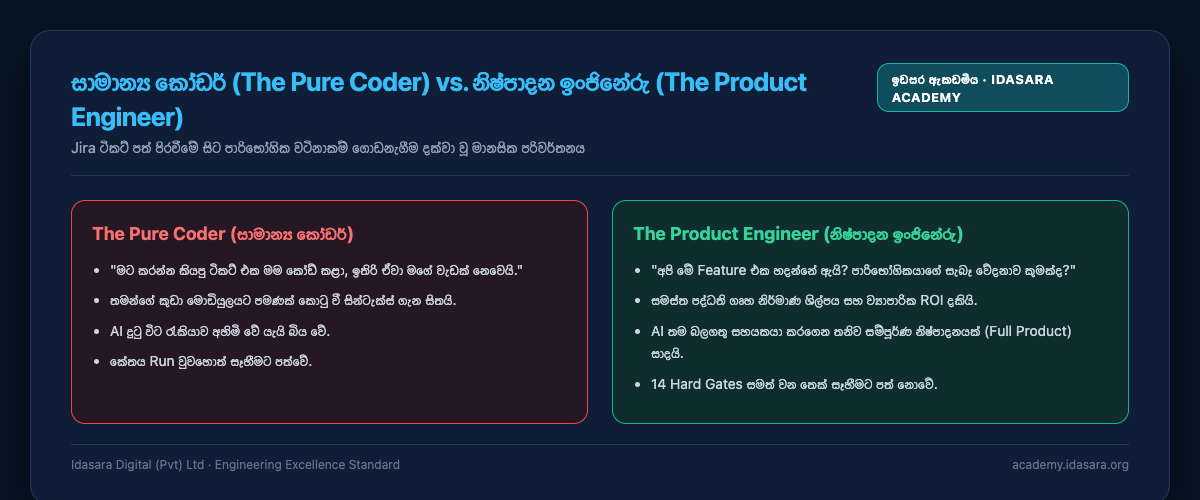 Figure: The Pure Coder vs. The Product Engineer — Idasara Academy
Anatomy of the Figure:
| Dimension | The Pure Coder | The Product Engineer |
|---|---|---|
| Starting point | "What does my Jira ticket say?" | "What is the customer's real pain? (Why)" |
| Measure of success | The code compiles and the ticket reads "Resolved" | The customer is freed from the problem and uses the product daily |
| Relationship with AI | Racing AI at writing code — and losing | The lead architect directing AI agents |
| Boundary of responsibility | "My part works" | Design → Realize → Operationalize — end-to-end ownership |
| Market value | Rapidly approaching zero | Higher than it has ever been |
The Product Engineer's working frame is three simple steps: Design — define the problem, the data, and the system boundaries; Realize — build a working system, deploying AI agents where they serve; Operationalize — put it in the hands of real users, observe, and improve continuously. The line of code is one small part of this three-step journey.
2. First Principles Thinking: Interrogating the "Why" and the "How"
The Product Engineer's most fundamental weapon is first principles thinking. When a problem appears, instead of copying what others have done, you interrogate the problem down to its most basic physical and logical foundation.
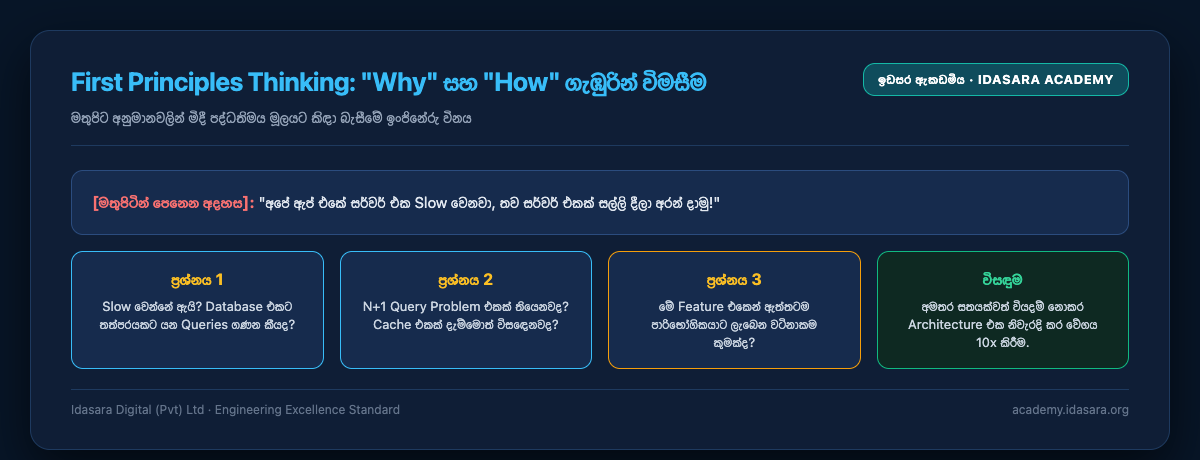 Figure: First Principles Thinking — interrogating the "Why" and the "How" in depth — Idasara Academy
The Reasoning Tree in Practice: Asking "Why?" Five Times
Take a real-world example. The request arrives from the business side: "We need push notifications in our mobile app."
The ordinary coder immediately opens the Firebase documentation. The Product Engineer first unfolds the reasoning tree:
- Why do we need push notifications? → "Because users aren't coming back to the app."
- Why aren't they coming back? → "Because they only check the data once a month."
- Why only once a month? → "Because the reports update monthly."
- Why do they update only monthly? → "Because the data is uploaded by hand."
- The root problem: Not a shortage of push notifications — a shortage of automation in the data pipeline.
Instead of a two-week notification project, a three-day pipeline automation solves the real problem. This is the true reason for the salary gap between a coder and an engineer: one builds what was asked for; the other discovers what is needed and builds that.
3. The 14 Hard Gates of Engineering Excellence
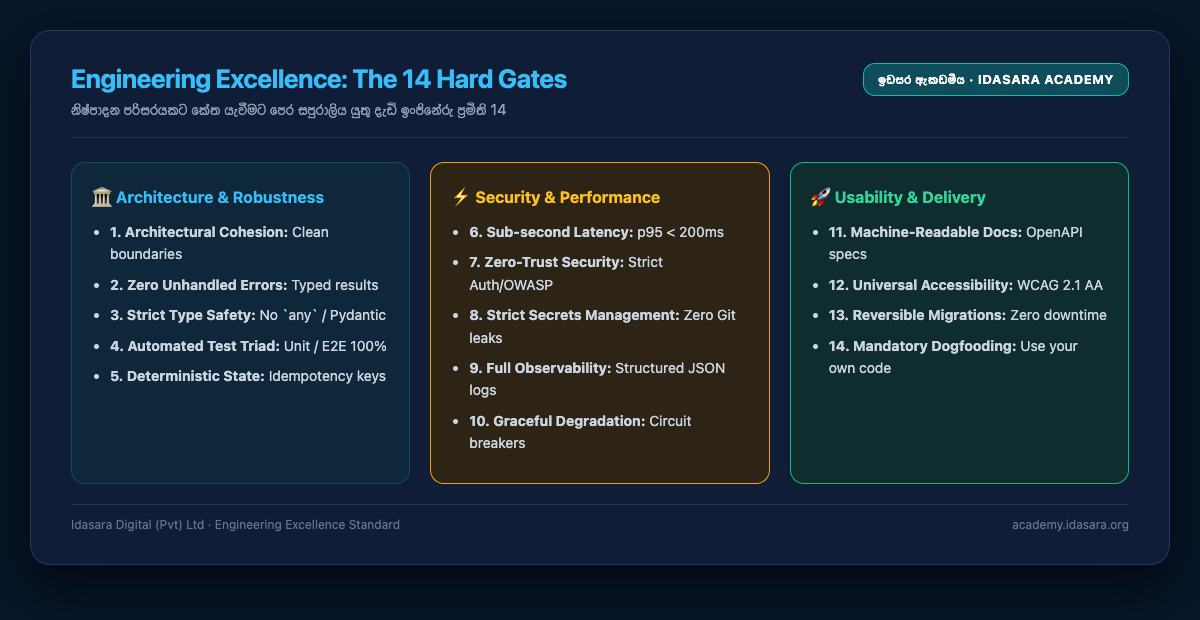 Figure: Engineering Excellence — The 14 Hard Gates — Idasara Academy
Gate 1: Architectural Cohesion & Domain Boundaries
The system's business logic, data layer, and user interface must never be entangled. Following Clean Architecture principles, a change in one module must not break another.
Gate 2: Zero Unhandled Errors & Defensive Code
No unexpected runtime exception may crash the server. Every function must have safe fallbacks and typed error returns (Result/Either patterns).
Gate 3: Strict Type Safety & Contract Enforcement
any and loose typing are forbidden. Every piece of data entering or leaving the system must pass strict schema validation — TypeScript strict mode, Python Pydantic, or the Rust type system.
Gate 4: The Automated Test Triad — Unit, Integration, E2E
Unit tests alone are not enough. Integration tests between API endpoints and the real database, plus Playwright/Cypress end-to-end tests simulating real user behavior, must pass at 100% inside the automated CI/CD pipeline.
Gate 5: Deterministic State & Idempotency
If a network fault delivers the same payment request twice, the customer must be charged exactly once — idempotency keys and database transactions are mandatory.
Gate 6: Sub-Second Latency Budgets
Every API must hold its 95th-percentile (p95) response under 200 milliseconds. N+1 database queries and unnecessary network hops must be driven to zero.
Gate 7: Hardened Security & Zero-Trust Auth
Every request must be authenticated and authorized. The OWASP Top 10 protections (SQL injection, cross-site scripting, CSRF, and broken object-level authorization) must be fully satisfied.
Gate 8: Strict Secrets Management & Zero Git Leaks
No API key, database password, or token may ever be committed to a Git repository. Pre-commit hooks must automatically block secret exposure.
Gate 9: Full Observability — Structured Logs, Metrics, Traces
When a fault occurs, the engineering team must be able to identify the exact failing line of code from structured JSON logs and OpenTelemetry traces — before the customer calls to report it.
Gate 10: Graceful Degradation & Resilience
If a third-party service (an SMS gateway, an AI API) goes down, the system must not collapse with it; a circuit-breaker architecture must give the user a sensible alternative or notice.
Gate 11: Machine-Readable Documentation & OpenAPI
Maintain automatically updated OpenAPI/Swagger specifications so that AI agents, as well as human engineers, can understand the system.
Gate 12: Universal Accessibility (WCAG 2.1 AA)
The system must be usable without barriers on any screen size (responsive down to 320px), on slow connections, and by people with disabilities (screen readers, keyboard-only navigation).
Gate 13: Reversible Migrations & Zero Downtime
Database changes must not take the system down, and if a new release ships a defect, a zero-risk rollback to the previous state must be possible within 30 seconds.
Gate 14: Mandatory Dogfooding Verification
The engineer must use the product they built as a real user, in the real environment, for their own daily needs — experiencing and certifying every defect and friction personally.
Important
The 14 Gates and accountability in the AI era: However fast AI coding agents write code, not one of these gates loosens — they tighten. Because AI is a confident intern: it writes code containing a security vulnerability with exactly the same confidence as flawless code. Final responsibility for every line that reaches production belongs to the engineer who presses the Merge button — not to the AI. The 14 Gates are the engineer's rampart for discharging that responsibility systematically.
4. The Dogfooding Principle: Consume What You Build, as a Customer
"Eat your own dog food" — dogfooding — is the highest yardstick of engineering excellence.
Most novice coders run their code against dummy data ("test123", "abc@gmail.com"), see that it works, and hand it off. A real Product Engineer: * Genuinely integrates the software they are building into their own daily life. * Feels the awkward button, the slow load, the cryptic error message as their own problem — and fixes it immediately. * The software that results earns the right to be called world-class.
5. Specification-Driven Development (SDD) and Multi-Agent Workflows
The modern Product Engineer does not write code alone. They operate as the engineering lead — the orchestrator directing AI agents:
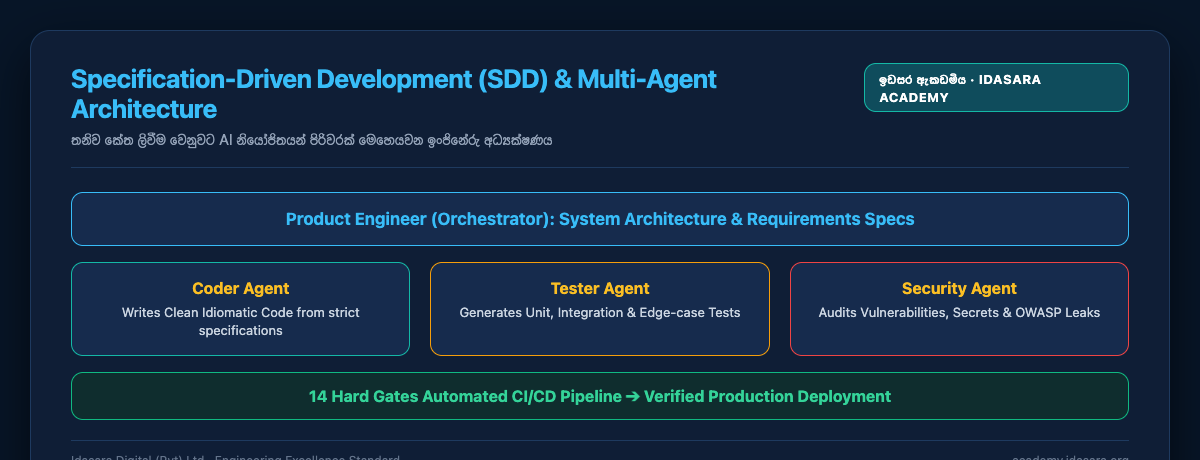 Figure: Specification-Driven Development (SDD) & Multi-Agent Architecture — Idasara Academy
Anatomy of the Figure: The Three Stages of the SDD Pipeline
- Specification-Driven Development: The engineer writes the system's data models, API contracts, and edge cases as a crystal-clear Markdown document. What happens here is the work of the sculptor who carved the Avukana statue: building the complete image in the mind before touching the stone. The quality of the specification sets the upper bound on the quality of the final product — a vague specification simply gives an AI agent the freedom to run confidently in the wrong direction.
- Agentic Execution: AI coding agents write code to that specification, run the tests, and resolve failures on their own. While one agent writes code, another writes tests; a third documents. The engineer is conducting not a soloist but an entire orchestra.
- Architectural Review: Final control — and the 14 Hard Gates check — belongs to the Product Engineer. This is the engineering reflection of the Deloitte lesson: however beautiful the AI's output, nothing reaches production that has not been read, questioned, and verified.
Tip
A practical first step: You can practice this today, even on a small project. Before coding the next feature, write its full specification (inputs, outputs, edge cases, error handling) in a Markdown file. Then hand it to an AI agent and audit the result against your own specification. Within a few weeks you will discover that your real skill is not typing speed but clarity of thought.
6. How to Become a Product Engineer Through Idasara Academy
Idasara Academy provides the complete practical training required to become a Product Engineer — the role commanding the highest global salaries and value in software:
- Product Engineer Masterclass: Hands-on training in first principles thinking, system architecture, and Domain-Driven Design (DDD).
- 14 Hard Gates Automated CI/CD Engine: A tool that audits your repositories live and scores them against the standards of the 14 Gates.
- Agentic Software Workflows: Laboratories for building real systems with Cursor, Claude Code, and multi-agent orchestration.
- Real-World Capstone Incubator: The opportunity to build software real users depend on — not toy apps — and to master the dogfooding principle.
In the next chapter, we examine the enormous AI transformation under way in accounting and finance.