03. AI for Accountants & Financial Management
Published 2026-09-14
Core Theme: "Accounting is not merely computerizing invoices or balancing ledgers. In an era when Generative AI automates all the mechanical work of traditional bookkeeping, the accountant of the future is no longer a record keeper — they are the organization's Strategic Financial Co-Pilot: the professional who creates value and steers capital."
What is month-end actually costing the finance team?
Ask anyone in a traditional accounts department what they dread, and the answer is the stretch from the 28th of the month to the 5th of the next.
Four activities fill those days. Comparing hundreds of bank statement lines against the general ledger by hand, hunting discrepancies of a few cents. Typing suppliers' paper bills and PDF invoices into the ERP. Leafing through dozens of Excel sheets to work out why each department overran its budget. And making errors from sleep deprivation — then answering the auditors' queries about them.
Put a person in that description and the cost becomes visible. Nirupama is an accounts assistant at a mid-sized Colombo distribution company, preparing for her CA final examination. Her month looks like this: in the office until 10 p.m. through the final week; scanning 3,200 rows by hand to locate a Rs. 4,850 mismatch; re-typing PDF invoices from 60 suppliers into the ERP, two hours a day. Time left for CA study: zero.
Now the arithmetic that should concern her employer. On a Rs. 85,000 monthly salary, this mechanical work consumes over Rs. 50,000 of her time every month — and the company is paying a qualified financial mind to perform data entry, while her actual financial judgment goes unused.
There is no case for this model in 2026. AI-literate finance teams have turned that exhausting seven-day process into a controlled two-hour one. And what Nirupama stands to lose is not her job — with real AI literacy she gets back her study time and the headroom to lift her eyes toward strategic work, which is the work the company needed from her in the first place.
The four workflows that change the finance role
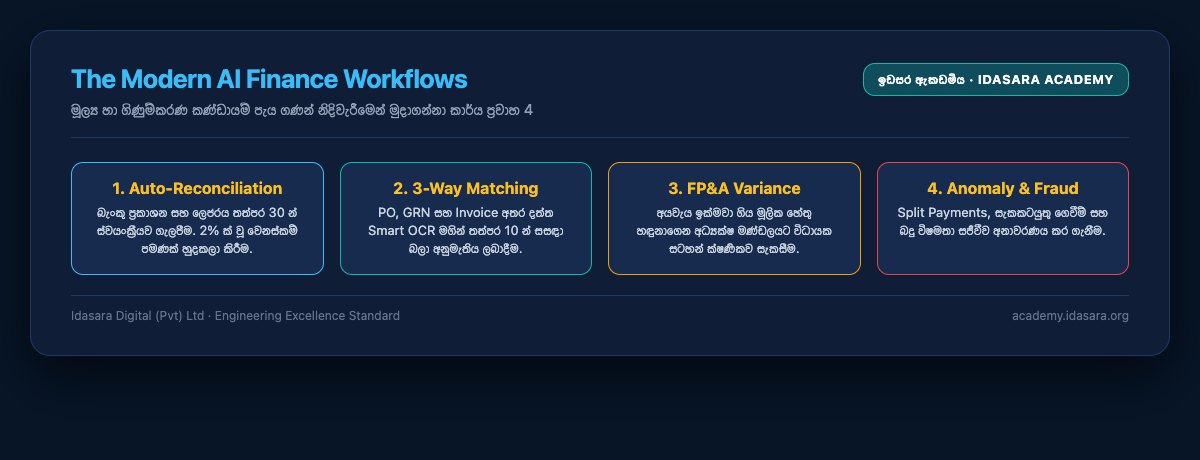 Figure: The Modern AI Finance Workflows — Idasara Academy
Workflow 1: automated bank–ledger reconciliation
Thousands of bank transactions are auto-matched against ledger records, leaving only the unmatched 2% of exceptions for the human accountant.
That ratio is the whole value proposition. Reconciliation has never been difficult work; it has been voluminous work, in which the accountant's expertise was needed for a small minority of items and spent on all of them. Matching is a mechanical comparison. Judging what an unexplained discrepancy means is professional work — and it is what the accountant should be doing with the hours the matching consumed.
💬 The Reconciliation Exception Prompt (Reconciliation Exception Architecture): ```text Act as a chartered senior accountant with 15 years of experience. Compare the two tables below: Table 1: the list of transactions from the bank statement [data here] Table 2: the corresponding account entries from the general ledger [data here]
Task: 1. Automatically flag transactions that match by date, amount, and description. 2. Classify every unmatched item into these categories: (a) Timing Difference, (b) Bank Charges, (c) Duplicates, (d) Unexplained Discrepancies. 3. Present the "Unexplained Discrepancies" list in risk order (by amount and suspicious patterns).
Constraints: Under no circumstances guess the reason for a mismatch and mark it "resolved". Leave every item you cannot confirm labeled "Requires human review". ```
The final constraint in that prompt — the negative constraint — is the most important line in it. It forces the model to say I don't know about what it does not know, and to leave the item labelled for human review rather than quietly closing it.
Nothing in accounting is more dangerous than a report in which a discrepancy has been papered over, because a reconciliation that appears complete stops anyone from looking. An open item is a task; a falsely closed item is a loss nobody will find until the audit.
Workflow 2: smart OCR and three-way matching
The supplier's invoice, the company's purchase order and the goods receipt note are compared for quantity and price in about ten seconds, and the approval cleared.
Three-way matching is the standard control against paying for goods that were never ordered or never arrived, and it is also the control most often performed carelessly — because doing it properly for every invoice is slow, and the pressure to release payments is not. Automating the comparison means the control is actually applied every time rather than sampled, which strengthens governance while removing work. It is unusual for those two to move in the same direction.
Workflow 3: budget variance analysis and executive commentary
The root causes behind each department's overspend are synthesised into a one-page report for the CFO and the board.
The hard part of variance analysis was never the subtraction. It was writing the explanation — converting a column of differences into an account of what happened and what should be done, in language a board will act on.
💬 The Financial Variance Prompt (Executive FP&A Prompt): ```text Act as a senior financial analyst to the Chief Financial Officer (CFO). Below are our company's departmental Budget and Actuals for Q1 2026:
[Insert the relevant CSV or tabular data here]
Prepare a Board-Level Variance Commentary: 1. Identify the 3 departments that exceeded budget by more than 10%, and the main expense heads responsible. 2. Identify under-budget areas and assess whether the savings reflect operational paralysis. 3. Recommend 3 actions to protect the company's EBITDA margin target in Q2. Language: corporate prose with strict financial discipline and professional precision. ```
The second instruction in that prompt is the one an analyst would miss: assessing whether under-budget areas reflect savings or operational paralysis. An underspend is usually reported as good news. Sometimes it means a department stopped functioning, and that is a more serious finding than an overrun.
Workflow 4: real-time anomaly and fraud detection
Suspicious patterns surface immediately rather than at audit: split transactions engineered to dodge approval limits — several invoices of Rs. 99,000 each to the same supplier on the same day — weekend payments, and credits flowing to dormant suppliers.
Each of those patterns is nearly invisible to a human reviewer for the same reason: individually, every transaction is legitimate and within authority. The fraud exists only in the pattern across records, which is exactly the kind of thing a machine examining every row at once can see and a person checking a sample cannot. This is the workflow where AI does something a larger finance team would not have achieved.
Where are finance careers actually moving?
The future of the traditional accounts clerk is poor. The value of the strategic finance specialist has never been higher — and the same person can move from one to the other, which is the point of this chapter.
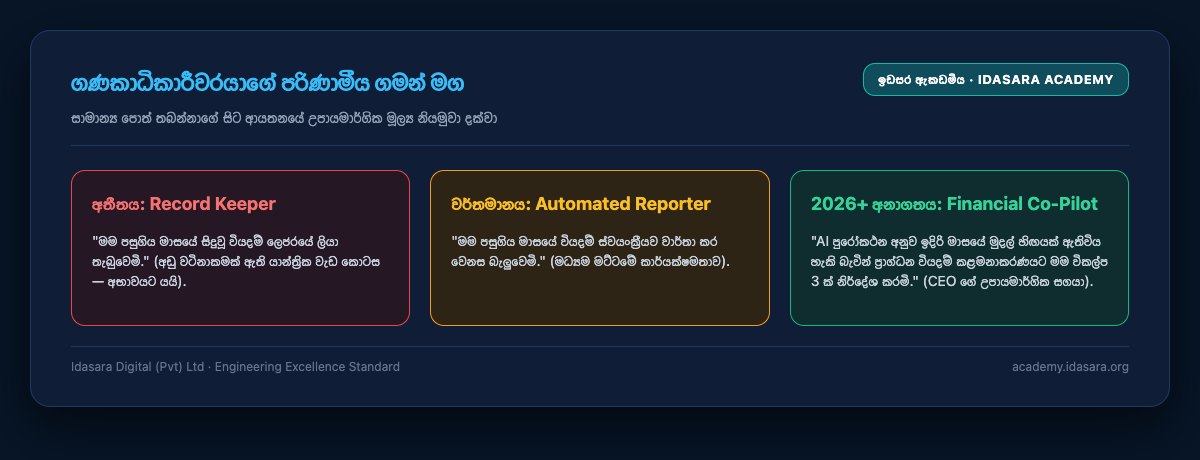 Figure: The accountant's evolutionary path — Idasara Academy
Strategic FP&A means building scenario models — best case, worst case, expected case — around future revenue, market volatility and inflation. The work shifts from recording what happened to preparing for what might.
Predictive cash flow optimisation means forecasting customer payment delays before they occur, to protect liquidity. For a Sri Lankan business, where a delayed receivable can halt operations, this is among the most valuable analyses available.
Capital allocation advisory means advising the chief executive, on evidence, where surplus capital should go. This is the finance function at its most influential, and it has always been limited by how much of the team's time was spent on bookkeeping.
AI forensic auditing means detecting irregularities hidden inside vast transaction networks in seconds — Workflow 4 turned into a specialisation.
What moves to the machine, and what stays with you
| Tasks that move to the machine | Duties that stay with the accountant |
|---|---|
| Data entry and matching: invoice OCR, bank reconciliation, 3-way matching. | Professional judgement: the final call on whether a suspicious transaction is fraud or an honest error. |
| First drafts: variance reports, management accounts, audit letters. | The signature and legal accountability: from the moment you sign a financial statement, every number in it is yours. |
| Pattern detection: split transactions, weekend payments, dormant-supplier credits. | Relationships and trust: the professional credibility built with auditors, banks, and management. |
| Scenario computation: best/worst/expected models in seconds. | The strategic choice: deciding which scenario the company bets its future on. |
The final row is the one that defines the profession. A machine can compute the best, worst and expected scenarios in seconds. Deciding which scenario the company bets its future on is not a computation — it requires knowing the board's appetite for risk, the state of the market and what the organisation can survive. That decision was always the valuable part of the job; it was simply buried under the data entry.
Important
The Deloitte lesson for the finance professional: Remember that Deloitte — one of the world's leading consulting firms — handed the Australian government a report containing AI-hallucinated sources, and had to refund part of a $440,000 contract. Verifying every AI-generated number and every citation against its source — that is the core of the accountant's professional identity in the AI era. In a report that goes out under your signature, an "AI mistake" is your mistake.
Protecting financial data
Three rules govern AI use in finance, and none of them is optional.
Never enter company financial data into free public AI tools. Free chatbots may use what you type to train their models, which means a management account pasted into one has left the company. Use only enterprise-grade APIs under zero-data-retention agreements.
Anonymise before you share. Convert company names, client names and employee identifiers into codes — Company_Alpha, Client_99 — before any data goes to a model. The analysis is unaffected; the exposure disappears. This takes a find-and-replace and removes most of the risk in most cases.
Keep a human in the loop, because the liability is personal. No tax payment, salary run or statutory financial statement leaves the building without personal review by a chartered accountant. The professional signature is not a formality on top of the process; it is the thing that makes the process legally meaningful.
Becoming a finance leader
For Sri Lanka's CA, CIMA and ACCA students and young finance executives, Idasara Academy provides four things.
Executive Finance and FP&A prompt packs — tested prompt tools for financial modelling, budget analysis and board presentations.
Spreadsheet automation with Python and AI labs — practical sessions combining Excel or Sheets with Python to complete hours of data cleaning in thirty seconds. This is the skill that most directly buys back Nirupama's evenings.
Audit automation and governance workflows — real case studies in automating audit work accurately and ethically, with the controls intact.
The Idasara Certified Financial Co-Pilot credential — recognition as a professional capable of giving an organisation financial leadership, rather than a traditional accountant.
In the next chapter, we examine the revolution AI literacy is creating in Human Resources — and the rise of the Talent Intelligence role.