04. AI for Human Resources Management
Core Theme: "Human resources is not approving leave forms, running payroll, or reading a thousand CVs. In an era when Generative AI automates all transactional HR, the modern HR professional transforms into the organization's Talent Intelligence Architect — the guardian of its culture, and the leader of its deepest human work: high-touch empathy."
1. HR's Present Trap: Transactional HR
Look at the daily calendar of HR officers in most organizations and a saddening picture emerges: * Spending a week reading 600 CVs, one by one, for a single vacancy. * Writing individual replies to hundreds of daily employee questions like "How many leave days do I have left?" and "How do I claim medical insurance?" * Building job descriptions for hours by copying JDs off the internet and swapping words. * Drowning in collected appraisal forms, writing summaries.
See this through a real character. Chathurika is an HR executive at a Colombo apparel company. Last month, a Merchandiser vacancy drew 600 CVs. Over six days, five hours a day, a hundred CVs at a time, she read them all and shortlisted fifteen. What did she think at the end of that week? "I didn't really read 400 of those 600 with proper attention. The best candidate may have slipped past me." Meanwhile, a talented employee walked into her office holding a resignation letter — and she had ten minutes to give him. He left the company. Because clerical work had swallowed her time, the real human work became the work that never happened.
Under this model, the HR manager has no breathing room left for the organization's actual human capital: employee wellbeing, skills development, or culture. AI literacy is the liberator that frees the HR professional from the transactional trap.
2. The 4 Core AI Workflows That Empower the HR Professional
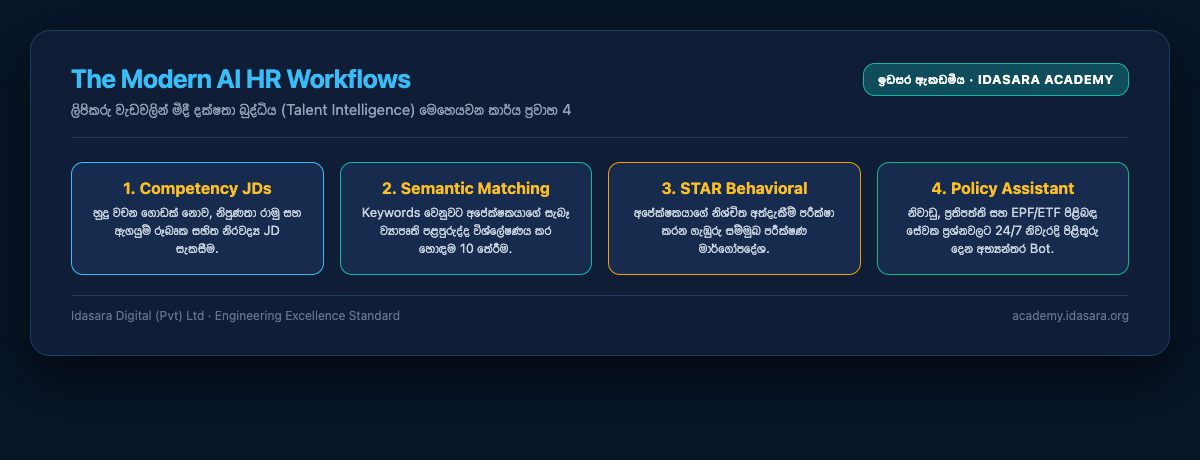 Figure: The Modern AI HR Workflows — Idasara Academy
Workflow 1: Competency-Based JDs & Rubrics
Instead of a pile of generic words, producing in minutes a precise JD with the role's core competencies, its success KPIs, and its evaluation scales.
Workflow 2: Semantic Resume Matching
Instead of keyword hunting like legacy software, having AI synthesize each candidate's real project depth, problem-solving experience, and organizational fit — and shortlist the best ten.
💬 The Fair CV Shortlisting Prompt (Fairness-Constrained Screening Architecture): ```text Act as a senior Talent Acquisition consultant and an expert in fair hiring. Attached: (1) the competency-based job description for the Merchandiser role, (2) 50 candidate CV summaries.
Task: 1. Score each candidate 1–5 against the JD's 5 core competencies. 2. For every score, cite an evidence quote drawn from the CV. 3. Present the top 10 candidates as a table with scores and evidence.
Strict fairness constraints: - The candidate's name, gender, age, religion, ethnicity, marital status, home district, and the "prestige" of their school or university must play no part in the evaluation. - Do not deduct points merely for a career gap; note the gap and refer it for human review. - Do not infer any attribute for which you have no evidence. ```
This shortlist is a proposal, not a decision — in every hire, the final call must be made by a human manager who has examined the evidence.
Workflow 3: Tailored Behavioral Interview Guides
Building a deep question set aimed precisely at the weak or unclear points in a candidate's CV.
💬 The HR Interview Prompt (STAR Interview Architecture): ```text Act as a senior advisor to the Chief Human Resources Officer (CHRO) of a leading company. We are interviewing a candidate for the Senior Business Analyst position. Based on the attached job description (JD) and the candidate's CV summary, prepare an interview guide:
- 3 behavioral questions probing the candidate's ability to solve complex data problems (answers expected in STAR format: Situation, Task, Action, Result).
- 2 follow-up questions testing the truth of — and the candidate's actual contribution to — the claim in their previous role that they "improved operational efficiency by 40%".
- A precise scoring rubric for the interview panel (a 1-to-5 scoring basis). ```
Workflow 4: The Internal HR Knowledge Assistant
A secure internal AI assistant loaded with the company's internal circulars, leave rules, maternity policies, and health insurance details — answering employees' questions correctly in five seconds.
3. The Career Migration: Where Is the HR Profession Moving?
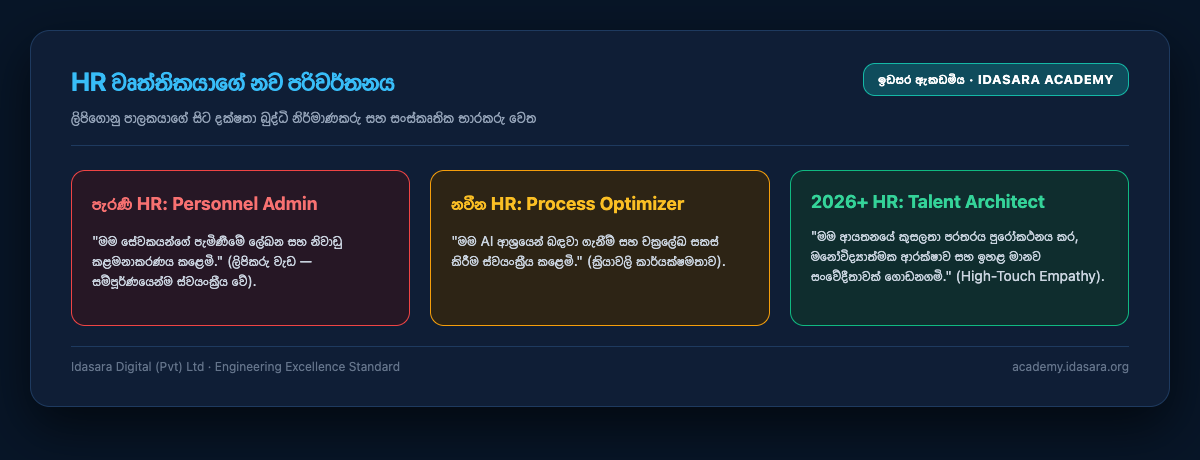 Figure: The HR professional's new transformation — Idasara Academy
The New High-Demand HR Roles of the Future:
- Talent Intelligence & Retention Analytics: Detecting early — from performance and communication patterns — that a top performer is a flight risk, and acting to retain them.
- Skills-Gap Mapping & Upskilling Architecture: As AI reshapes the world's jobs, identifying the new skills your organization's people will need next year and designing personalized learning paths.
- Psychological Safety & Culture: Building teams with mutual trust, transparency, and an environment where employees speak their minds without fear.
- High-Touch Empathy & Conflict Resolution: The work no AI can do — understanding human feelings, standing beside employees in personal crises, resolving conflict between departments peacefully.
4. Ethical AI in Hiring and Bias Mitigation
Using AI in HR carries a supremely consequential human responsibility. A hiring decision changes the direction of a person's life — get it wrong and no compensation can undo it.
- Algorithmic bias: An AI system trained on historical data can discriminate — without anyone intending it — by gender, school, or region. The classic example: two identically qualified CVs, and the one bearing a woman's name is rejected while the one bearing a man's name is selected. If most past hires into the role were men, the model learns that historical injustice as a "rule" — and amplifies it into the future (algorithmic amplification).
- The international regulatory reality: The EU AI Act classifies AI systems used for recruitment and employee evaluation as "High-Risk AI" — with strict audit, transparency, and human-oversight requirements. For a Sri Lankan HR professional working with international companies, this is not "some other country's law" — it is the arriving professional standard.
- Human-in-the-Loop: AI is only an assistant; the final decision to hire or reject a candidate must always rest with a human HR manager. "The system rejected you" is not an answer any candidate can be given — every decision must carry a human reasoned determination.
- Data privacy: Employees' health information, salary data, EPF/ETF details, and performance appraisals must never be exposed to public AI tools. Use only approved tools with enterprise-grade Zero Data Retention agreements.
Important
Remember: AI can read 600 CVs in 60 seconds; but only you can read the real cause of the dissatisfaction in the eyes of the employee who arrives holding a resignation letter. The more clerical work AI absorbs, the more human the HR profession becomes — not less. That is the true meaning of this transformation.
5. How to Become a Modern HR Leader Through Idasara Academy
For young HR professionals and CIPM students, Idasara Academy provides:
- Strategic HR Prompt Packs: Tools for competency-based JD creation, behavioral interview guides, and appraisal summaries.
- Talent Intelligence & Sentiment Analytics Labs: Practical laboratories for analyzing employee satisfaction and performance data with AI to drive strategic decisions.
- Ethical AI & Fair Hiring Governance Frameworks: Establishing bias-free recruitment methods aligned with international standards.
- Idasara Certified Talent Intelligence Partner: Certification for becoming not an administrator, but the CEO's most trusted human-strategy partner.
In the next chapter, we take a deep look at AI in modern marketing — and the discipline of Customer Journey Architecture.