06. AI for Sales & Business Development
Published 2026-09-14
Core Theme: "The 'pushy salesman' era — cold-calling thousands of numbers and carpet-bombing the internet with spam email — is completely over. In an age when AI analyzes customer data and market intelligence in an instant, the sales and business development professional of the future is not someone who forces products on people. They are the Consultative Trusted Advisor: the professional who brings solutions to the customer's problem."
Why did cold calling stop working?
For decades, corporate sales ran on one law: make 100 calls, 10 will talk, one will buy. The numbers game.
Three things killed that model, and none of them is reversible. AI spam filters on phones and email services now block unsolicited marketing automatically — the message never arrives. Executives and decision-makers no longer give time to generic salespeople, because they receive too many approaches to evaluate any of them. And before meeting a representative at all, today's buyer has already researched roughly 80% of the product through the internet and AI.
That last change is the one that redefines the job. A salesperson reciting product features is now offering information the customer already has — and arriving with less of it than the customer does. What the customer is looking for is a business advisor who understands their problem and can solve it.
Two approaches, same market. Tharindu is a BD executive at a software company, working the old way: forty cold calls a day, one meeting a week if he is fortunate.
Hasini changed the method. Each week she selects ten companies, has AI analyse each one's annual reports, press releases and the public statements of its decision-makers, and sends ten messages — each written in that company's own language, addressing that company's own problem.
Her result: three to four meetings a week, half of which open with "how do you know so much about our business?"
Ten messages outperformed two hundred calls, because she was selling understanding rather than a product. And notice what made that possible: the research that would have taken a day per company now takes minutes, which means personalisation at scale stopped being a contradiction.
The four workflows that change the sales role
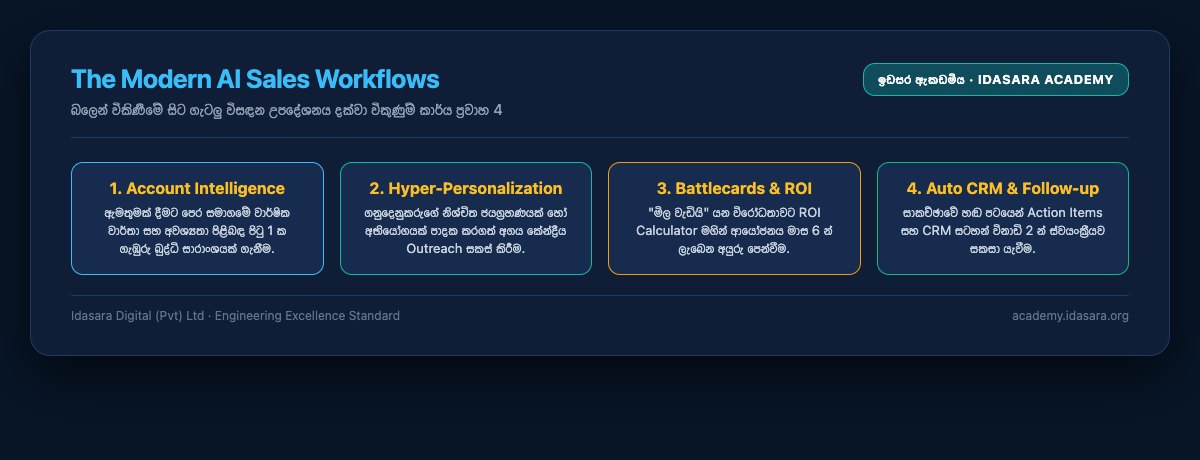 Figure: The Modern AI Sales Workflows — Idasara Academy
Workflow 1: account intelligence
Before speaking to any organisation, a one-page deep brief in about two minutes: their financials, recent press releases, their executives' public statements, and the technology they run.
This is Hasini's advantage in a single workflow. The brief is not there to impress the client with research; it is there so that your first sentence is about their situation rather than your product — which is the difference between a conversation and an interruption.
Workflow 2: hyper-personalised outreach
Instead of the same template to everyone, a professional message grounded in a specific recent win or challenge at that exact company.
💬 The B2B Prospecting Prompt (Executive Outreach Architecture): ```text Act as the Head of Business Development at a leading Enterprise AI and automation firm. Draft the first executive cold outreach email to the Chief Information Officer (CIO) of a major commercial bank in this country.
Context: - The bank launched a new mobile app last week; media report transaction volumes up 200%. - Our solution is a Cloud API Architecture that automatically manages surges of this scale without destabilizing core-banking systems.
Requirements: 1. Maximum 150 words. 2. Do not hard-sell anything. 3. Genuinely congratulate them on the new app's success. 4. Include a short case study of how a client bank of ours solved the transaction-latency problems that emerge as volumes grow. 5. Invite them to a low-friction, 15-minute knowledge-sharing consultation call. ```
Four constraints in that prompt do the work. A 150-word limit, because a CIO will not read more. Do not hard-sell anything, because the goal of a first message is a conversation rather than a sale. A genuine congratulation on the app's success, which demonstrates that you noticed. And a low-friction fifteen-minute invitation, because the ask has to be proportionate to the relationship, which is currently nothing.
Compare that to the standard cold email — long, product-centred, asking for a meeting to "explore synergies" — and it is clear why one gets answered.
Workflow 3: real-time objection battlecards
When the customer says "your price is higher than your competitors'" or "we have no budget this year", a prepared conversation architecture that calmly demonstrates the payback period rather than discounting.
💬 The Objection Battlecard Prompt (Objection Handling Architecture): ```text Act as a B2B enterprise sales coach. Our product: [product description and price]. Main competitors: [names and prices].
Prepare battlecards for the following 5 objections: 1. "Too expensive" / 2. "No budget" / 3. "We'll stay with our current supplier" / 4. "The IT team doesn't like it" / 5. "Let's look at it next year"
Each battlecard must contain: - The underlying fear beneath the objection. - 2 acknowledge-first response sentences. - A numerical ROI argument (a template for a 6-month payback calculation). - The wrong response that must never be given (What NOT to say).
Constraints: Disparaging competitors is forbidden. Fabricating numbers is forbidden — where data needed for the ROI calculation is missing, mark it [customer data required]. ```
Three elements of that battlecard structure repay attention.
The underlying fear beneath the objection is the most useful item on the card. "No budget" rarely means no money exists; it usually means the buyer cannot yet justify the spend to someone else. Answering the stated objection when the real one is different is why so many deals stall politely.
The wrong response that must never be given is the item most sales training omits. Knowing what not to say under pressure is more useful in the moment than knowing the ideal answer.
And the two constraints are ethical rather than tactical. Disparaging competitors is forbidden, and so is fabricating numbers — where data for the ROI calculation is missing, the card says [customer data required] rather than inventing a figure. An invented payback number in a proposal is a fabrication you will be held to.
Workflow 4: automated CRM sync and follow-ups
From an hour-long meeting transcript: the customer's key requirements, the next steps and the documents to send, organised and synced in about two minutes.
The value here is not the admin time, though that is real. It is that follow-ups actually happen. Deals are lost far more often to a promised document that was never sent than to a competitor.
Where are sales careers moving?
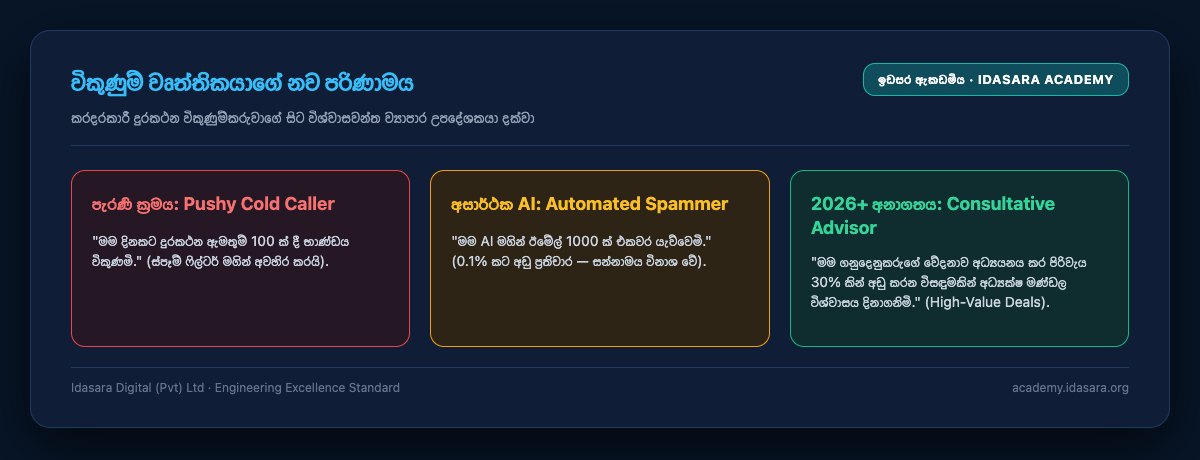 Figure: The sales professional's new evolution — Idasara Academy
Consultative solution advisor — understanding the customer's business model before selling anything, and earning durable trust by saying honestly, when it is true, "our solution is not the right fit for you." That sentence costs one deal and wins a decade of referrals.
Predictive intent data and lead scoring — reading online behaviour and firmographic signals to identify which prospects have a real, current need. Hasini's selection of ten companies, done systematically.
Multi-stakeholder consensus building — in an enterprise deal, the CEO, CFO and CTO each want different things, and often want incompatible things. Winning all three requires human leadership and cannot be automated at all.
High-stakes negotiation and long-term partnerships — designing agreements that create durable value for both sides instead of simply discounting. Discounting is what a salesperson does when they have run out of arguments.
What moves to the machine, and what stays with you
| Tasks that move to the machine | Duties that stay with the sales professional |
|---|---|
| Research: account intelligence, news, tech-stack analysis. | Trust: the face-to-face human relationship that endures for years. |
| Copy and follow-ups: outreach drafts, CRM notes, follow-up sequences. | Honesty: the courage to say "our solution isn't right for you" — and the long-term respect it wins. |
| Objection preparation: battlecards, ROI models, negotiation simulations. | Live reading: understanding the meaning in the customer's eyes, voice, and silences at the table. |
| Lead scoring: purchase-intent data analysis. | The signature on the deal: the personal responsibility to deliver what was promised. |
The second row is the one that defines a career. The courage to say "our solution isn't right for you" is unavailable to any automated system, because a system optimises for the conversion in front of it. A salesperson who has said that once to a customer is believed for years afterwards — which is an asset no volume of outreach can manufacture.
Important
Remember: AI can write 1,000 messages on your behalf; but only you can keep the promise inside any one of them. If hyper-personalization is nothing more than a writing trick, it rapidly becomes the modern form of spam. Personally read every AI-assisted message you send, and confirm that every fact in it is true and every promise in it is one you can keep. The capital of the sales profession is not money — it is trust.
That warning is the necessary counterweight to this entire chapter. The same tooling that let Hasini research ten companies properly can produce a thousand messages that merely look researched. The first builds a career; the second burns a market, and it burns it for everyone selling into it.
Becoming an exceptional sales leader
Idasara Academy provides four things for this path.
Consultative B2B sales prompt packs — target-account intelligence, C-level outreach copy and objection-management tools.
Deal closing and RFP acceleration workflows — methods for producing accurate, compliant drafts of fifty-page tenders in hours rather than days, which is where sales teams lose most of their week.
Negotiation simulator labs — live practice against varied AI customer personas, so the difficult conversations are rehearsed before they happen with a real account.
The Idasara Certified Consultative Advisor credential — recognition as a strategic leader of business growth rather than an ordinary salesperson.
In the final chapter, we examine the Cross-Functional AI Champion — the role that stitches every department of the organization together — and the Idasara career acceleration roadmap.