05. Child Online Safety, Privacy, and Family Digital Discipline (Child Online Safety & Privacy)
Core Theme: "Just as artificial intelligence hands your child a superpower, carelessness hands cyber-criminals new weapons too. Here is the unbreakable protective wall that shields your child and your family from deepfakes, voice cloning (voice-mimicry extortion), and personal data leaks."
1. Three Modern Cyber Dangers of the AI Age
Today's internet is not the environment of five years ago. Every mother and father must understand the newest threats that generative AI has made possible:
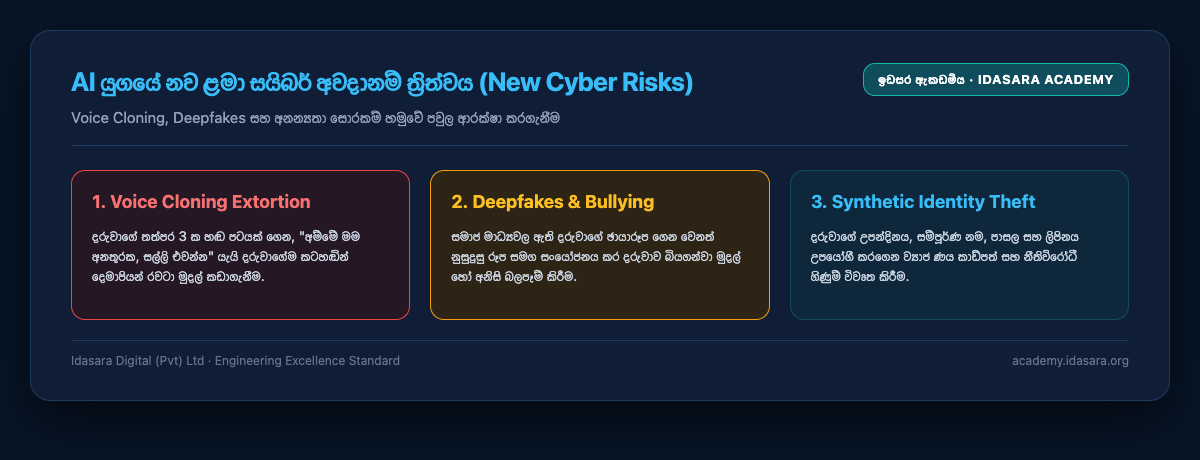 Figure: The new triad of child cyber risks in the AI age (New Cyber Risks) — Idasara Academy
A deeper reading of the risk triad shown in the figure:
- Deepfakes (fabricated images and videos): An AI tool today can take an ordinary photograph from social media and, within minutes, manufacture a fake image or video of that person doing something they never did. Among schoolchildren, this has already become a weapon of bullying. Teach your child two things in advance: (a) share their own photos sparingly and carefully; (b) if this ever happens to them, it is not their fault — they must not hide it in shame, but tell you immediately.
- Voice Cloning (voice-mimicry scams): Ten seconds of audio is enough for AI to clone anyone's voice. The call that arrives in your own child's voice — "Amma, something has happened to me, send money right now" — may be a fraudster. The defence (the family safe word) is in Section 2 below.
- Synthetic Identity Theft (assembling data into a fake identity): A fraudster collects your child's name from one place, their school from another, their birthday from a third post — and builds a complete false identity out of those true fragments. Each individual post looks innocent; assembled together, they hand a criminal the full map of your child's life. The only prevention is not to let the data accumulate, drop by drop, in the first place.
Warning
Do not rush to confiscate your child's phone after reading these threats — that is not the solution. A ban pushes the child into secret use; and when something goes wrong during secret use, the child hides it from you. The solution is not fear but informed discipline — the rest of this chapter is about exactly that.
2. The Family's Golden Rules of Data Protection (Family Privacy Rules)
Here is the strict protective discipline to put in place today to keep your child safe:
Rule 1: Never post photos in school uniform, or with name boards, on Facebook/Instagram
Never publish photos where your child wears school uniform or where the school's crest or name is visible. That is all a cyber-criminal needs to learn when your child travels to school, where, and by which route.
Rule 2: Never enter personal data into public AI tools
Warn your child firmly: while doing homework, never type your full name, school name, parents' phone numbers, home address, photographs, or family financial details into public AI systems such as ChatGPT or Gemini.
Why so strict? What you type into a free public AI tool may be stored on that company's computers and used to train future AI models. In other words, what you wrote can never truly be "taken back." The simple rule to teach your child: "If you wouldn't tell it to a stranger on the road, don't type it into an AI." You don't need a name and a school to ask a homework question — "a Grade 10 student" is enough.
Rule 3: The Family Safe Word
If an urgent call comes — even in your child's own voice — saying "Amma, the police have taken me, send a hundred thousand rupees," do not panic! * Today, agree on a secret word known only to your family (a Family Safe Word — e.g., "blue mango"). * On any suspicious call, ask: "Putha, what's our secret word?" * An AI voice clone can never say it!
3. The Family Digital Contract
To protect the peace of your home and your child's mental health, discuss and agree a "digital contract" with your child, containing commitments like these:
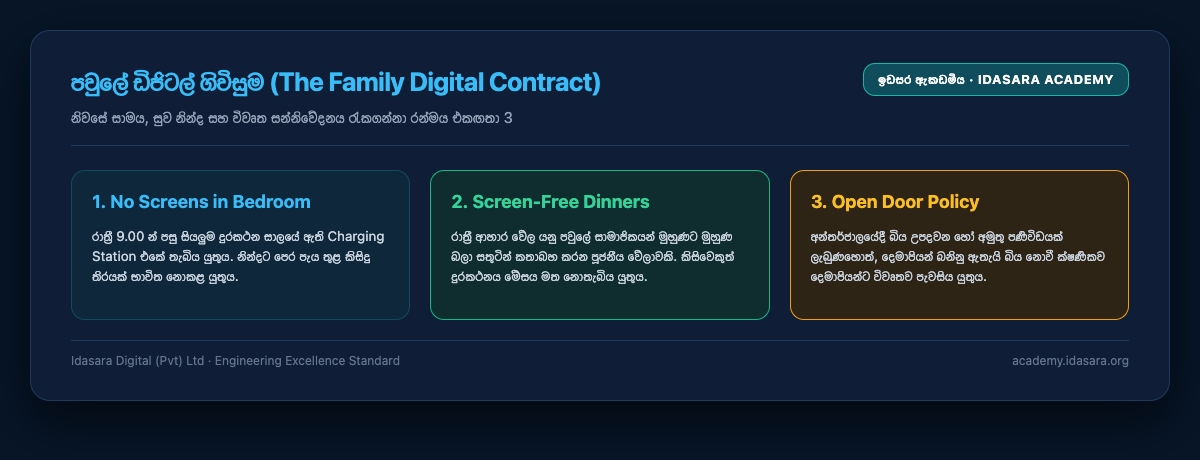 Figure: The Family Digital Contract — Idasara Academy
Model clauses for the contract:
This is not "a rule sheet imposed by parents." It is a mutual agreement signed by everyone in the family — parents included:
| # | Clause | Applies to |
|---|---|---|
| 1 | After 9:00 p.m., all phones charge outside the bedrooms, in one shared place. | Everyone |
| 2 | No phones at the dinner table — conversation only. | Everyone |
| 3 | When AI or the internet is used for schoolwork, the room door stays open. | Children |
| 4 | Before installing a new app, we talk about it as a family. | Children |
| 5 | Ten minutes on Sunday evening — we look at the progress map and the week's digital experiences together. | Everyone |
| 6 | If something strange / uncomfortable / frightening appears online, it can be talked about without punishment. | Children + a parental promise |
| 7 | Once a month, we practise the safe word. | Everyone |
Important
Clause 1 says "Everyone" — and that is no accident. A parent scrolling in bed until 11 p.m. will never succeed in telling a child to "put that phone away." Digital discipline is not an order issued to a child; it is the way the family lives together. A contract you refuse to sign is a contract your child will not honour either.
3.1 The Loneliness Behind the Screen: When a Child Makes the AI Their "Best Friend"
Let us return to the uncomfortable truth from the first chapter — this time through the lens of online safety. Research from around the world shows that people — young children included — open their deepest, never-spoken thoughts to AI chatbots. For a child with no one to listen to them, a chatbot that never judges, never scolds, and answers at any hour can easily look like "the best friend in the world." That should not surprise us.
The risk here is double: (a) the child pours their secrets, sorrows and family details into an outside company's computers (Rule 2 breaks); (b) the deeper risk — the child's emotional world drifts away from real human beings and rebuilds itself around a machine.
Signs a parent should watch for: the child abandons things they used to love (games, friends) and spends more and more time alone with the phone; becomes flustered when asked "Who are you talking to?"; speaks less and less about real friends.
What to do if you see them: Not confiscation, and not secret surveillance — both destroy the child's trust and drive the problem underground. What works is filling the empty space yourself: fifteen minutes a day, no screen, no advice-giving — just listening. The child talks to the AI not because the AI is clever, but because it listens patiently. You can offer that same patience — and yours comes with love.
4. Parental Wisdom: Not Punishment, but Love and Trust
What is the most powerful protective wall a child can have in the digital world? It is not antivirus software, and it is not spyware.
"The best cyber-safety a child can ever have is the trust and love that lets them run to their parents, unafraid, the moment anything goes wrong."
When a child makes a mistake, the parent who listens calmly and guides them out of it — rather than shouting and striking — is the parent whose child stays safe.
In the final chapter, we look at the future world of work beyond 2030, and at "Kavi's" decisive crossroads and the Idasara parent vision — steering your child's education and career journey wisely.