04. Snap & Score and the Weekly "Mastery Heat-Map"
Core Theme: "Under the traditional tuition system, parents learn their child's marks once every four months, when the term test report arrives. By then it is too late! Here we look at how Idasara Academy's 'Snap & Score' (Mark Papers) technology marks your child's handwritten work in 60 seconds — and how the 'Mastery Heat-Map,' delivered to your phone every Sunday, lets you spot your child's weaknesses long before the exam does."
1. From Darkness to Live Telemetry (Moving from Darkness to Telemetry)
Look at the relationship between parents and a child's education in a typical family: * Every day the parents ask: "Putha, what did you do in class today?" * The child says: "It went well, Amma. I understood the lessons." * Four months later the term test marks arrive: 38 for Mathematics (a W — fail)!
The parents are stunned: "Dear gods, the child went to class every single day, the notebooks are full — how is it 38?"
The answer is simple: For four months, the parents were operating in total darkness (zero telemetry). They discovered which lesson their child truly hadn't understood only after the exam had already failed them.
The world's best education systems do not work this way. The point where a child goes wrong must be caught the same day, in the same hour (real-time diagnostic feedback).
2. "Snap & Score" (Mark Papers): Marking Handwriting in 60 Seconds
The "Snap & Score" (Mark Papers) technology introduced by Idasara Academy operates right on your own dining table:
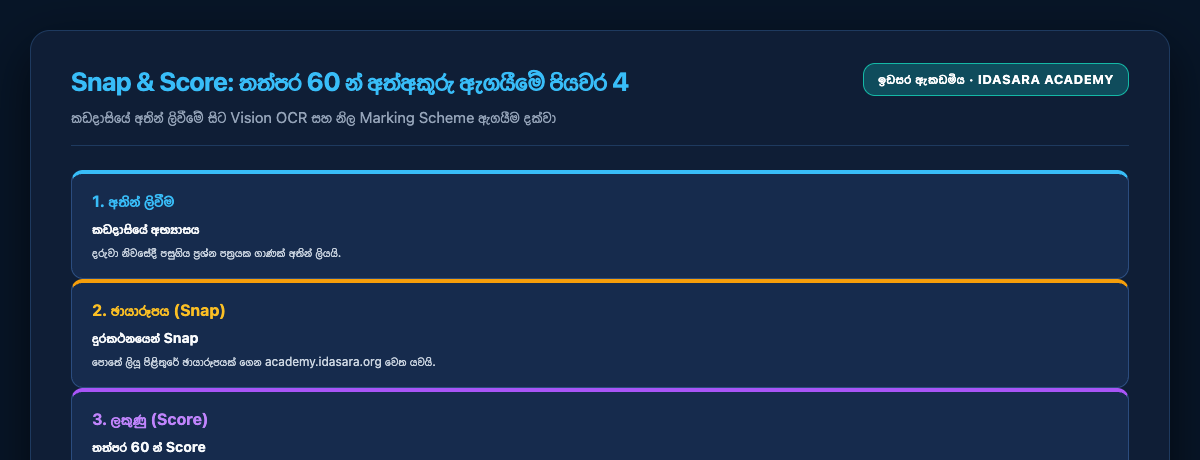 Figure: Snap & Score: the 4 steps of 60-second handwriting assessment — Idasara Academy
Reading the 4 steps shown in the figure:
- Snap: The child photographs their handwritten answer sheet with a phone — ordinary handwriting, scribbles and crossings-out included.
- Read: The system converts the child's handwriting, numbers and mathematical symbols into digital text and reads it (OCR).
- Match: Every written step is compared against the official marking scheme — checking not just the final answer, but the entire path taken to the solution.
- Feedback: Within 60 seconds, the marks, the exact step that went wrong, and guidance for fixing it arrive in the child's hands — in their own language.
Method Marks (M) and Accuracy Marks (A): The Secret Parents Should Know
In official government examinations, the marks for a single problem are split into two parts: * Method Marks (M): Was the route to the solution correct? (Factorising, applying the formula, the order of the steps.) * Accuracy Marks (A): Was the final value correct? (Computational precision.)
A real example — Sandevmi's quadratic equation:
Sandevmi solves a Grade 10 quadratic equation: x² - 5x + 6 = 0 → (x - 3)(x - 2) = 0
At the end she writes: $x = 3$ or $x = -2$ (the sign is wrong!).
- To an ordinary chatbot: this is simply "a wrong answer" (0/10). All the child receives is discouragement.
- The Idasara Snap & Score system:
- Awards Method Marks (M) of 8/10 for the correct factorising steps — acknowledging that her reasoning was 80% right.
- Recognises that only Accuracy Marks (A) were lost, and shows her, in a red box, in her own language: > "Duwe, when $x - 2 = 0$, you must add 2 to both sides. So the sign of the number must be positive ($x = +2$)."
Sandevmi understands her mistake within 60 seconds — and learns that she failed not because "she can't do maths," but because one sign flipped. That mistake will never happen again in an exam!
Important
The label "this child just can't do maths" is very often a lie. Split the marks into M and A and you usually find the child's method (M) is sound — what leaks away are careless accuracy marks (A). The day you see those two separately, the fear called "can't do maths" shrinks into a solvable problem called "needs a little more attention."
3. The Weekly "Mastery Heat-Map"
Every Sunday evening, Idasara Academy sends a detailed "Mastery Heat-Map" — a subject progress map — to the parents' phone:
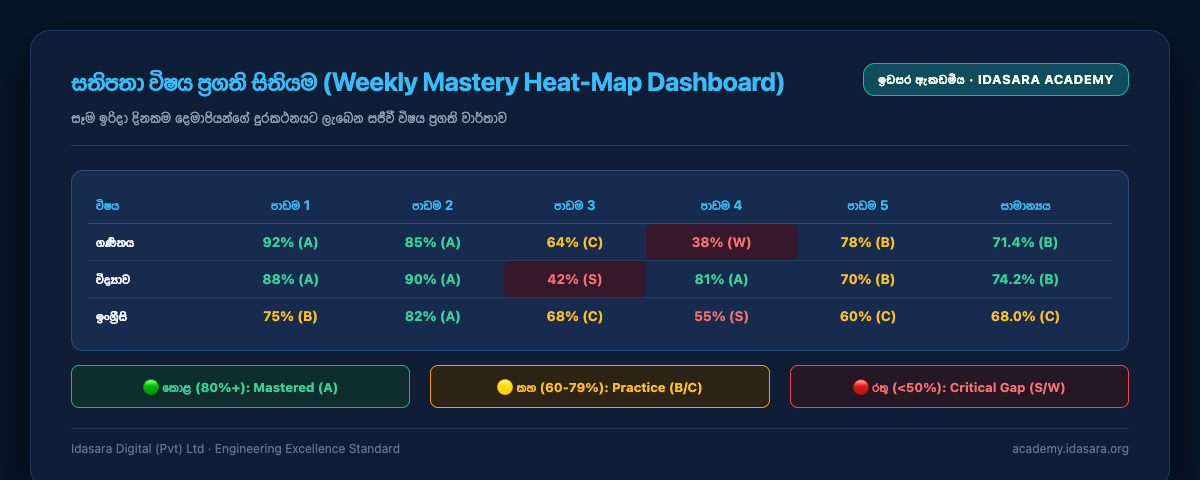 Figure: The weekly Mastery Heat-Map dashboard — Idasara Academy
How to read the progress map shown in the figure:
The map is laid out as a grid of subjects and lessons. The colour of each cell tells you how far your child has mastered that lesson:
- 🟩 Green (Mastered): The child solves problems from this lesson consistently and correctly. No extra work needed — piling more classes onto this cell is a waste of time.
- 🟨 Yellow (Needs Practice): The lesson is understood but mistakes still happen; typically the M marks are earned and the A marks slip away. A few practice problems during the week are enough.
- 🟥 Red (Critical Gap): The core concept itself has not taken hold. This one cell is worth more than your entire monthly tuition bill — because until it is repaired, every lesson built on top of it is a building on sand.
The difference between the old way and this way:
| The class attendance card | The Mastery Heat-Map | |
|---|---|---|
| What it tells you | Whether the child attended | Whether the child understood |
| How often | Once a month (when paying) | Every Sunday |
| The action it enables | None | Repair the red cell this very week |
🎬 Watch the animated story (1½ min): The Tutor Who Never Gives the Answer — Ask AI & Self-Paced Learning
4. How Should Parents Use This Map?
As a parent, you need to do only one thing: 1. On Sunday evening, open the map on your phone. 2. Identify the red cells (critical gaps) — for example: Mathematics, Lesson 4 — 38%. 3. Do not scold the child! Instead, smile and say:
"Putha, you've taken A's in every other maths lesson — you're really good at this. Only this Lesson 4 has slipped a little. Shall we sit with 'Ask AI' tonight, do three problems from that lesson, and turn this one green too?"
The child happily agrees. In thirty minutes, the gap is repaired.
The miracle no tuition teacher can perform amid 500 children — you, the parent, can perform at your own dining table, exactly like this.
Tip
Make "ten minutes on Sunday evening" a family ritual. Over a cup of tea, look at the map together with your child. Talk about the green cells first and praise them; then pick one single red cell and agree: "This is the one we'll repair this week." One red cell turning green each week is fifty lessons repaired in a year — a pace no hall class can come near.
In the next chapter, we turn to child online safety, privacy, and family digital discipline — protecting your child as they use the internet.