01. The Tuition Trap, the Screen Time Crisis, and Real Learning (The Tuition Trap vs Active Mastery)
Core Theme: "Is your child covering the syllabus — or actually learning? That is the hardest question every parent should ask themselves before paying next month's tuition fees. If your child sits in mass tuition classes for 20 hours a week, why are their exam marks stuck around 45? In this chapter we look at how to stop treating the phone in your child's hand as a demon — and turn it into a genuine engine of learning."
1. The Biggest Gap Parents Never See (The Silent Gap)
Look at the daily routine of a typical Sri Lankan family: * The child leaves for school in the morning. * The moment school ends at 2:00 p.m., they sling the heavy book bag over their shoulder and run to a tuition class. (In Sri Lanka, "tuition" means the vast private after-school class industry — often halls of hundreds of students — that most families treat as compulsory alongside school.) * Five weekdays and the weekend too are spent in classes from morning until night. * At 8:30 or 9:00 p.m. they come home hanging off a crowded bus, drenched in sweat, utterly exhausted.
As a parent, you tell yourself: "With great difficulty we spend twenty thousand rupees a month to put our child in the hall classes of the best sir in the country. Surely the child is learning well now."
But then the term test report arrives: 48 for Mathematics, 52 for Science!
Why does this happen? What is the secret parents never see?
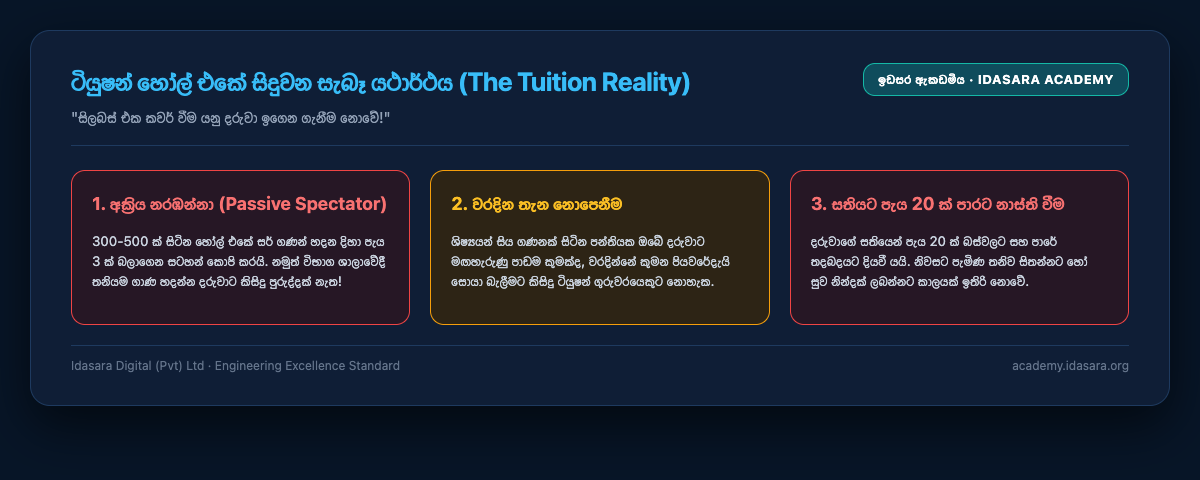 Figure: The reality inside the tuition hall (The Tuition Reality) — Idasara Academy
Reading the tuition-hall reality shown in the figure:
- The Passive Spectator: In a hall of 300 or 500 students, your child is just one chair. It is doubtful the teacher even knows your child's name. For two hours, the child mechanically copies whatever appears on the board — the brain never actively solves a problem.
- Zero Feedback Loop: The teacher does not know when your child fails to understand something; the child is too shy to raise a hand and ask; and the parent sees nothing at all. The mistake only surfaces four months later, on the term test report.
- One Speed — 300 Students: For the quick child the lesson is too slow; for the struggling child it is too fast. The class is calibrated for an "average child" — not for your child.
Here is the truth: "Covering the syllabus is not the same as your child learning it!" The teacher may finish writing the entire syllabus on the blackboard, yet no real understanding (mastery) has been built in your child's mind.
1.1 Do the Real Numbers with Kusum's Family: The Monthly Tuition Audit
Sandevmi, the daughter of Kusum and Ranjith of Panadura, is in Grade 10. Her monthly education spend looks like this:
| Expense item | Monthly cost (Rs.) |
|---|---|
| Mathematics hall class (4 weeks) | 4,000 |
| Science hall class | 3,500 |
| English class | 3,000 |
| Sinhala / History combined class | 3,000 |
| Commerce / ICT extra class | 2,500 |
| Three-wheeler / bus fares (6 days a week) | 4,800 |
| Photocopied notes and papers | 1,200 |
| Total | 22,000 |
And beyond the money, look at the time: Sandevmi leaves home at 6:30 a.m.; after school she finishes two more classes and gets home at 9:00 p.m. She sleeps five and a half hours a night. Her entire weekend belongs to hall classes.
The result? 48 in Mathematics at the term test. Rs. 22,000 and 20 hours a week bought the mental comfort of "the child attended class" — not the child's actual understanding. For a typical Sri Lankan household, that is a painfully large share of the family's monthly income, spent on reassurance rather than results.
Important
The question to ask as a parent is not "Did the child go to class?" The question is: "Which problems could my child not solve alone last month — and can now solve alone?" If there is no answer to that question, you are paying for a habit, not for learning.
2. The Hard Contrast: Traditional Tuition vs the Idasara Method
Here is the clear difference between the old tuition system and a modern learning method that uses technology and AI intelligently:
| Aspect | Traditional tuition classes | Idasara Academy + AI method |
|---|---|---|
| Identifying your child's weaknesses | Unknown (the whole class is one crowd) | Pinpoints the exact lessons your child struggles with within 60 seconds. |
| Practising problems | Copying notes until the bell rings | Active practice — solving problems until they are truly understood. |
| Language comfort | One language only | Sinhala, Tamil or English (whichever the child prefers). |
| Progress visible to parents | Only the stamp on the class card | A live progress report on your phone every Sunday. |
| Predicting exam marks | In the dark until results arrive | The likely grade is visible in advance from practice performance. |
| Time management | 20 hours a week lost to the road | Studies from home and saves about 15 hours a week. |
| Monthly cost | Rs. 15,000 – 25,000+ for 3–4 subjects | A genuinely affordable monthly investment. |
3. The Screen Time Crisis: Not a Demon, but a Learning Laboratory
What is the biggest fight in almost every home today, between parents and children? "This child has the phone in hand all day long! Throw that wretched thing away!"
That parental anger is fair. Because what many children are actually doing is: * Scrolling for hours through empty videos on TikTok and Instagram Reels. * Getting trapped in an addiction of instant gratification — dopamine hits. * Wearing their attention span down to fifteen seconds.
But the solution is not "ban the phone and snatch it away." When you snatch the phone, the child either uses it in secret or starts to resent you.
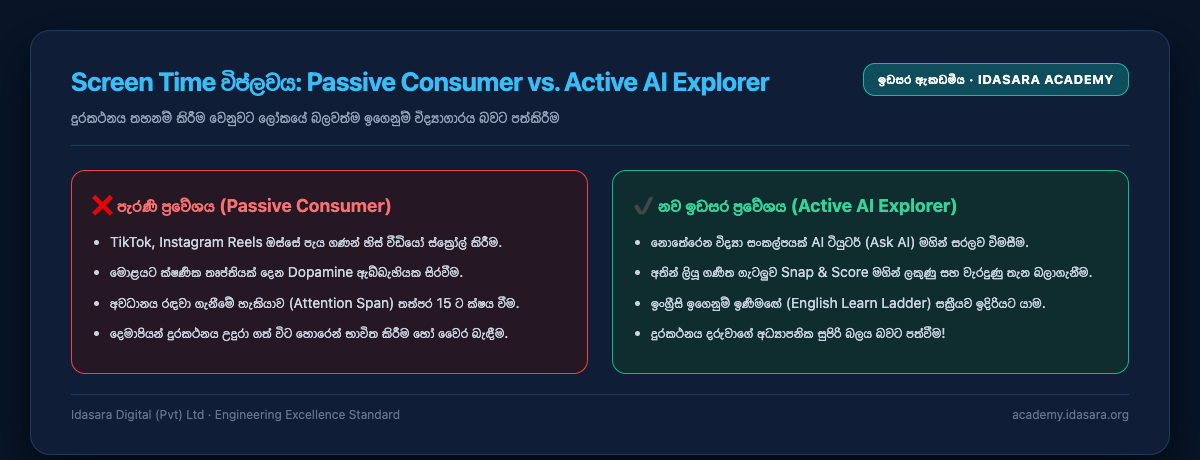 Figure: The Screen Time revolution: Passive Consumer vs. Active AI Explorer — Idasara Academy
Reading the paradigm shift shown in the figure:
- Left side — the Passive Consumer: The child sits motionless, watching a stream of videos chosen by an algorithm. The screen controls the child. After an hour, all that remains is fatigue and an itch for "just a little more."
- Right side — the Active AI Explorer: The child brings their own question to an AI tutor; asks; checks the answers; tries again where they went wrong. The child controls the screen. After an hour, what remains is the self-respect of a problem they solved themselves.
Same phone, same child — the only difference is the pattern of use. The phone is not a plague; it is the most powerful learning instrument on Earth. Everything depends on what the child does with it.
Let Us Also Talk About the Loneliness Behind the Screen
There is another uncomfortable truth we must speak about honestly. Some children cling to the phone not only for fun — but because there is no one who listens to them. In a family where the parents are worn out by two jobs and the child runs from class to class, no one has time to hear the child's small joys, fears and questions. So the child fills that empty space with a screen — sometimes even with an AI chatbot.
Warning
Before you hold a police inquiry — "What are you doing in there?" — when your child sits in their room with the phone, count how many times this week you spoke with your child for fifteen minutes without a screen. Before banning the screen, there must be a relationship at home more interesting than the screen. The remaining chapters of this book are about the practical tools that build that relationship.
4. Three Practical Steps for Parents
Follow these three steps to start turning your home's learning environment in the right direction today:
- Audit the tuition classes: Discuss openly with your child which classes genuinely produce results, and which hall classes they attend merely out of habit or because friends go. Three questions to ask about any class: "Do you get a chance to ask questions in this class?", "Does sir know your name?", "Tell me one thing from last month that you couldn't solve alone before this class — and can solve alone now."
- Stop one or two passive hall classes: In their place, set up a comfortable study desk at home and give your child the freedom to solve problems independently with Idasara Academy's AI tools.
- Measure your child's weekly "ME Hours": Find out how many hours a week your child actually gets — free of classes — to do their own study in their own way, and to sleep properly.
In the next chapter, we explore the scientific secret behind Idasara Academy's core philosophy — "More ME Hours. Better Results." — and how it raises your child's exam marks.