02. "More ME Hours" — Giving Your Child Their Own Time, Deep Sleep, and Happiness (The Power of ME Hours)
Core Theme: "Sending a child to more classes does not mean the child earns more marks. Real understanding and memory settle into a child's brain not while listening to someone else read aloud, but while thinking alone in their own time, solving problems by themselves — and while sleeping deeply. Here is the scientific secret behind Idasara Academy's founding vision: 'More ME hours. Better results.'"
1. The "Own Time" We Have Taken from Our Children (The Lost ME Hours)
Look carefully at how the 168 hours of a typical Sri Lankan schoolchild's week are divided:
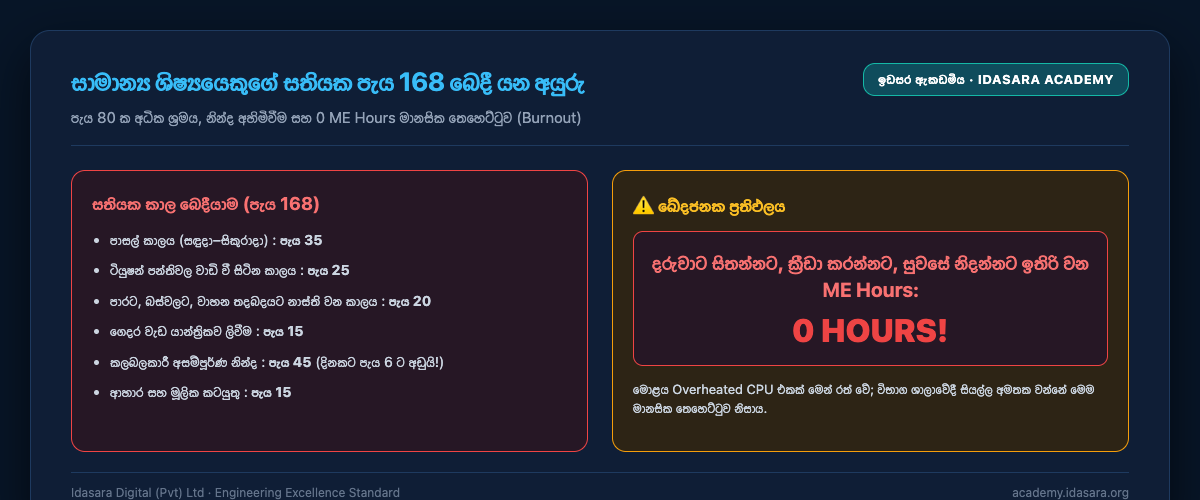 Figure: How a typical student's 168-hour week is spent — Idasara Academy
Reading the 168-hour audit in the figure — Sandevmi's week:
Let us write out, in plain numbers, one week in the life of Sandevmi — the Grade 10 student we met in the previous chapter:
| Activity | Hours per week |
|---|---|
| School (5 days × 6½ hours) + morning preparation | ~ 38 |
| Tuition classes (weekdays + weekend) | ~ 14 |
| Time lost on the road (buses, three-wheelers, queues) | ~ 6 |
| Homework and copying out notes | ~ 10 |
| Meals, bathing, daily routines | ~ 18 |
| Sleep (at 5½ – 6 hours a night) | ~ 40 |
| What is left — phone, TV, "just sitting" | ~ 42 |
| Time spent studying alone, at her own pace — or truly resting | ~ 0 |
The saddest line is the last one. Out of 168 hours in the week, Sandevmi does not spend even one hour learning with her own hands, at her own speed, wrestling with her own questions. She is perpetually being taught — and never once learning.
Think about it: can the brain of a child who spends 60–70 hours a week only listening to others, dissolving into the road, starved of sleep, actually learn anything?
No. Neuroscience has established a simple fact:
"The human brain consolidates long-term memory only when the child sleeps deeply and when they quietly reflect on what they learned, alone."
The brain of a child with no sleep and no rest runs like an overheated CPU. However much they study, everything evaporates in the exam hall — because of that mental burnout.
Here is a simple household analogy. Sleep is the brain's "Save button." If you type a document on the computer all day and the power cuts before you press Save — what happens? Everything is lost. Your child "types" all day in class after class — but if the night does not bring eight hours of deep sleep, the brain never saves that day's learning into long-term memory. Sending a child to eight classes while cutting sleep to five hours is typing all day and shutting down the computer without saving.
Important
Making a child study through the night before an exam is one of the most dangerous things a parent can do. By taking away that night's sleep, you erase the "saves" of weeks of study. The best gift you can give a child in exam week is not one more class — it is eight hours of sleep.
2. The Science Behind "More ME Hours. Better Results."
The revolutionary motto that Idasara Academy brought into education is:
"More ME hours. Better results."
What does it actually mean?
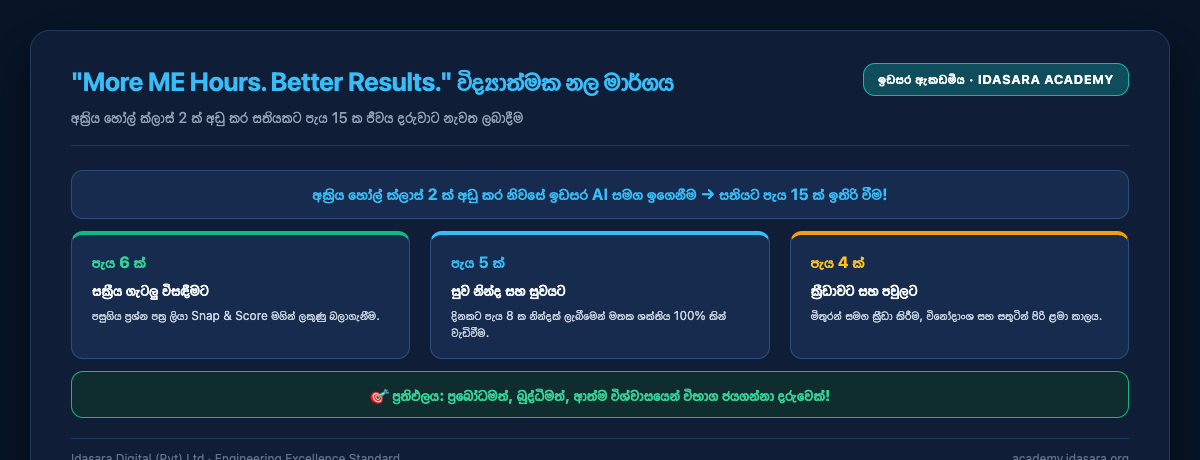 Figure: The "More ME Hours. Better Results." scientific pipeline — Idasara Academy
Reading the pipeline in the figure:
This is not a magic claim that "fewer classes means higher marks." It is a clear three-step mechanism: (1) stop the lowest-yield hall classes and free up 12–15 hours a week → (2) divide that time three ways — active practice, sleep, and life → (3) active practice builds understanding, sleep builds memory, and life builds mental wellbeing — and the marks rise. Cutting classes is not the goal; changing the way the child learns is.
- Learning at home instead of the hall class: Instead of four hours dissolving into the road and a weekend hall class, the child sits comfortably at home and solves the exact problem they don't understand in thirty minutes, with Idasara Academy's AI tutor (Ask AI).
- Fifteen "ME Hours" recovered every week: * 6 hours for active problem-solving (Active Practice): The child writes a past paper alone and gets it marked with Snap & Score. * 5 hours for extra sleep: The child gets at least eight hours of proper sleep a night. Memory consolidation improves dramatically. * 4 hours for life: Cricket with friends in the evening, a book, or simply talking with you.
3. The Stress-Free High Performer
Many parents believe a child must be locked in their room with a book at all times. But the world's top-performing students never memorise books all day long.
They share three traits: 1. High-intensity focus: Two or three hours a day of complete, undistracted problem-solving. 2. Deep rest: The moment the brain tires, they play or sleep and return refreshed. 3. Self-efficacy: The quiet pride of "I can solve this on my own."
Instead of crushing your child under eight tuition classes, protecting their ME Hours is the greatest act of justice you can do for their life.
4. For Parents: The Formula for Calculating Your Child's ME Hours
Tonight, sit beside your child and do this simple calculation together:
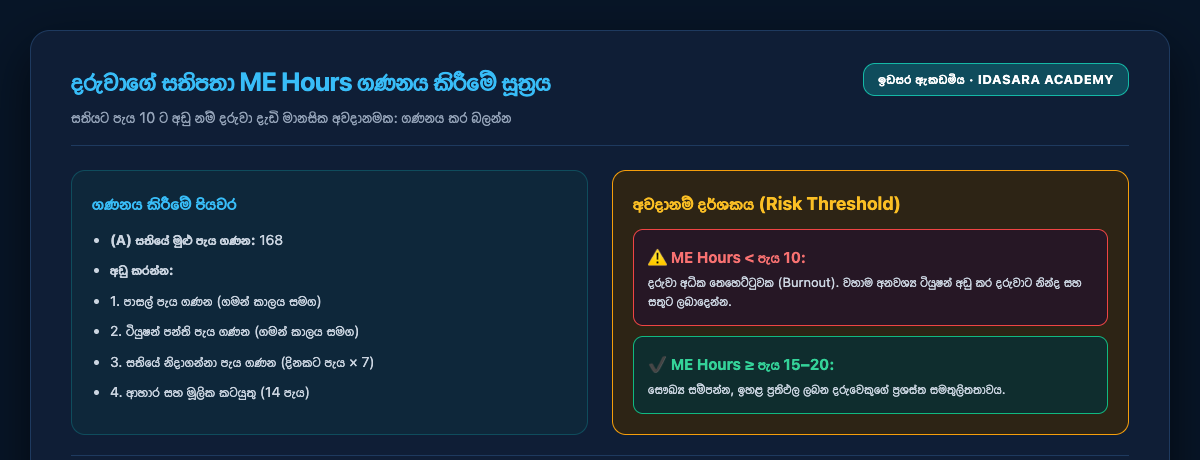 Figure: The weekly ME Hours calculation formula — Idasara Academy
The arithmetic is simple — take a piece of paper and fill it in with your child:
- Write the total hours in a week: 168
- Subtract: school hours + tuition hours + travel hours + homework hours + sleep hours (count 8 × 7 = 56 — not what they currently get, but what they should get) + meals, bathing and so on.
- What remains is your child's true ME Hours — the time available for studying alone, for play, for family conversation, and for simply being.
Warning
The risk threshold: If the remaining ME Hours come to less than 10 hours a week, your child is living under serious mental strain. Cut one or two unnecessary tuition classes immediately and give back their free time and sleep. And remember — doing this calculation together with your child tells them, in the most audible sentence a child can ever hear: "Your time matters to us."
In the next chapter, we learn the art of Socratic Parenting — how to face your child's difficult "Why?" questions at home without fear, with AI as your thinking partner.