03. Answering Your Child's "Why?" Questions at Home with AI (Socratic Parenting)
Core Theme: "A child conquers the world not by memorising marks in a school exam, but by keeping alive the insatiable curiosity in their own mind. Here we learn the role of the Socratic parent — the parent who, faced with a child's hard 'Why?' questions, does not stand helpless, but takes AI as a thinking partner and lights the lamp of intelligence in the child."
1. The Helplessness Parents Face at Home
As children move into Grades 7, 8, 9 and 10, their curiosity — and their subject matter — grows sharply more complex: * "Amma, why is the sky blue at noon and red in the evening?" * "Thaththa, why are most leaves green but some leaves red?" * "I don't understand why $x$ turns out to be a negative number in this equation."
Most parents never studied advanced science or mathematics. So what are the usual answers? 1. "Don't ask me those things — ask your tuition sir tomorrow." 2. "Stop bothering me. Just memorise it and write it down."
With that response, the curiosity in the child's mind dies on the spot. The child concludes that learning is merely memorising what sir says to collect marks — not an adventure of understanding the world.
2. Refusing to Be a "Vending Machine" Parent (The Anti-Vending Machine Parent)
Some parents use the internet or ChatGPT like this: the moment the child asks a question, the parent types it into Google or ChatGPT, reads out the answer — or copies it onto a piece of paper — and hands it over.
This is the "Vending Machine parent": * Insert a coin, and a bottle drops out; * the child inserts a question, and the parent dispenses an answer.
What is the danger here? The child's brain performs no thinking exercise at all. The child learns to expect ready-made answers from someone else for every question in life.
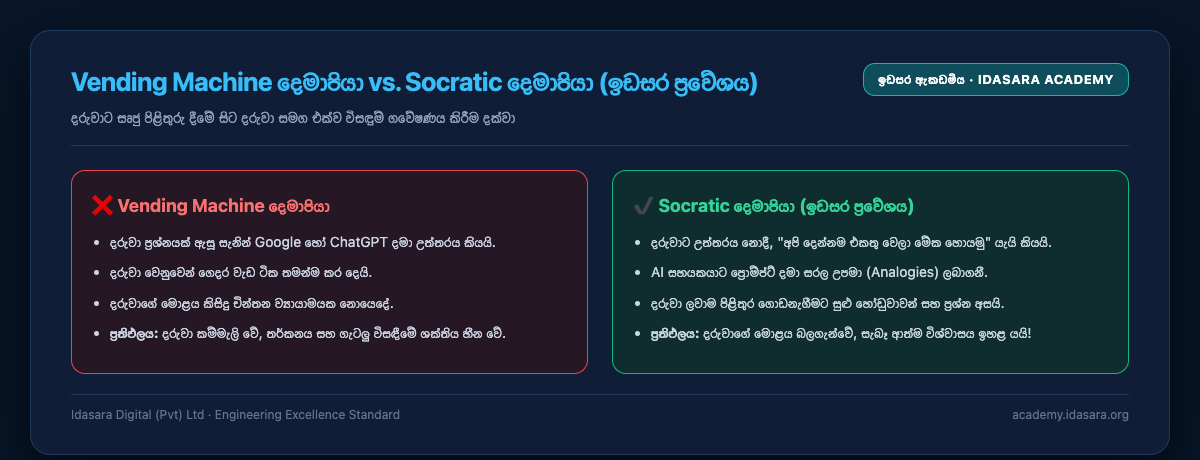 Figure: Vending Machine parent vs. Socratic parent (the Idasara approach) — Idasara Academy
Reading the two approaches shown in the figure:
| The Vending Machine way | The Socratic way (Idasara approach) | |
|---|---|---|
| Response to a question | An instant ready-made answer | A counter-question that provokes thought |
| The child's brain | Idle (waiting) | Active (exploring) |
| Long-term habit | An "ask and receive" mindset | A "seek and find" mindset |
| In the exam hall | Helpless — the answer-giver is absent | Reasons it out and solves it alone |
The Greek philosopher Socrates became famous not for giving answers, but for asking the right questions — and letting the other person discover the truth themselves. In the AI age, the most skilful parent is not the parent who knows everything; it is the parent who says, "Let's find out together."
3. Socratic Parenting: Model Prompts to Use With Your Child
You do not need to be an expert in any subject. All you need is to sit beside your child and give the AI assistant a prompt like these:
Model 1: Getting an age-appropriate analogy
💬 Parent prompt: "My daughter is in Grade 8. She is finding the concept of 'photosynthesis' hard to understand. Please explain it using a simple daily-life analogy she will enjoy — something like how a meal is cooked in a kitchen — pitched exactly at a Grade 8 student. Then give me 2 simple questions I can ask her to check whether she has really understood it."
The result:
The AI replies: "Think of the leaf as a tiny kitchen. The firewood stove is the sunlight. The water comes in through the roots. The flour brought from the mill is the carbon dioxide taken from the air. And the meal cooked in that kitchen from all these ingredients — that is glucose..."
The parent reads this to the child, then asks the two checking questions. The child answers, smiling. In that moment, science stops being a memorisation burden and becomes a real joy!
Model 2: A maths prompt that makes the child do the thinking
💬 Parent prompt: "My son needs to solve a Grade 9 mathematics problem on 'percentages and discounts.' Please do NOT write out the answer or the working!* My son and I will read your reply together. Give me 3 questions, in order, that will help him think through it step by step.
The problem: A shirt priced at Rs. 2,500 is given a 15% discount. How much must be paid?"*
The parent then asks the child those three questions: 1. "Putha, what is the discount on every 100 rupees?" (Rs. 15) 2. "So what is the discount on 2,500 rupees?" (The child multiplies: 25 × 15 = 375) 3. "After taking off the discount, how much do we pay the shop?" (The child subtracts: $2{,}500 - 375 = 2{,}125$)
The quiet satisfaction of a child who found the answer alone cannot be bought from any tuition hall!
Model 3: The storytelling method for a history or language "Why?"
💬 Parent prompt: "My daughter is in Grade 8, and she is trying to memorise the answer to the history question 'Why did King Parakramabahu build reservoirs?' Please don't give her the answer directly. Instead, give me 3 questions that will help her reason her way to the answer herself — questions that make her think about rainfall, farming, and how a country keeps its people fed."
The AI sends back three questions: "Does rain fall evenly in Sri Lanka all year round?" → "How do farmers grow rice during the dry season?" → "What can a king do to make sure his country never goes hungry?"
When the child walks down those three questions, the answer — "far-sighted kings built irrigation works" — rises from within her. A memorised sentence evaporates after the exam; an understanding you built yourself stays for life.
Tip
This costs you nothing — not one cent. Every prompt above works today on an ordinary phone with a free AI app. No new devices, no laptop, no payments. The only requirement is twenty minutes sitting beside your child — because the magic here is not in the AI, it is in your presence.
Important
Never mock your child's question. One sentence — "What kind of foolish question is that?" — is enough to make a child stop asking you questions forever. And then the child will ask their questions not of you, but of a screen you cannot see. Every "Why?" from your child is an invitation card delivered into your hand. Do not turn it down.
4. Making Idasara Academy's "Ask AI" Your Home Study Partner
As a parent, you don't even have to write these prompts yourself. The "Ask AI" tool at academy.idasara.org is built on precisely this Socratic principle.
- All you do is point "Ask AI" at the difficult problem in your child's textbook.
- The system automatically stays within the Sri Lankan school syllabus and leads your child forward with guiding questions that make them think.
- Your job is simply to sit nearby and encourage.
In the next chapter, we look at Snap & Score (Mark Papers) — which marks your child's handwritten answers at home in 60 seconds — and the Mastery Heat-Map, the live subject progress report that arrives on your phone every Sunday.