02. Instant Lesson Plans, Teaching-Assistant Materials & the Modular Tute Architecture
Core Theme: "A lesson plan or a tute is not a stack of paper made weighty by its page count. It is a living road map that awakens a child's curiosity in the classroom, provokes them to think, and confirms their understanding. Here we learn how to build superior teaching-assistant materials with AI's help — while cutting printing costs in half."
1. The AI Revolution in Building Teaching Materials
Picture the Sunday night of Pradeep Sir, who runs an O/L Mathematics tuition class in Kandy. The family has gone to bed. He is still at the computer — building the 3 tutes needed for this week's 3 classes. He leafs through 4 past-paper books choosing questions; he types them out; he fixes, again and again, the symbols that break when typesetting equations. By 12:30 a.m., one tute is finished. This has been the story of every one of his Sundays — for 12 years.
Traditionally, a teacher must spend hours of the weekend or the night writing teaching notes, combing exercise books for questions, and sending material off for computer typesetting.
AI is the teacher's Ultimate Teaching Assistant. For any unit in the syllabus, it can produce — in minutes, and shaped to the teacher's own vision: * engaging classroom activities, * diagnostic starter quizzes that measure where the children truly stand, * bilingual worksheets, and * modular tutes that cut printing costs in half.
2. The Modular Tute Architecture: Halving Your Printing Costs
The single biggest factor eating tuition teachers' profit today is the sky-high cost of paper and printing.
The Modular Tute Framework, introduced by Idasara's educational engineering, cuts that cost immediately by 50%:
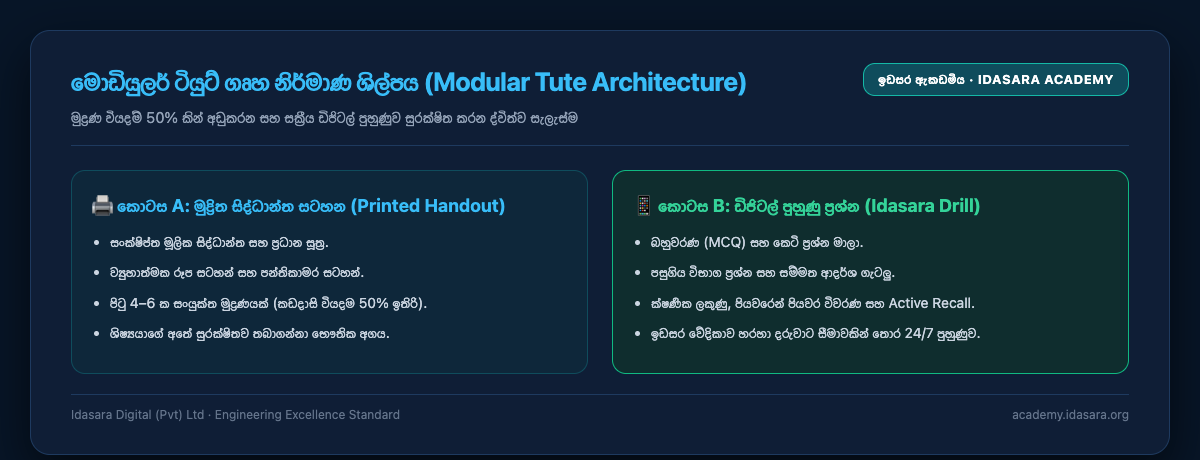 Figure: The Modular Tute Architecture — Idasara Academy
- Your printed tute is your strength: Do not abandon it. Keep printing the theory and key-concepts section, in compact form.
- Practice questions go digital: Route the practice problems, MCQs, and past exam papers — more than half of any tute — to Idasara. Children can practise the short notes and revision questions free, without limit.
Pradeep Sir's Printing Arithmetic — In Real Numbers:
- Pages in a typical tute: 16 (6 pages of theory + 10 pages of practice questions).
- 40 students × 16 pages × 3 classes a week = 1,920 photocopied pages a week.
- After switching to the modular method, only the 6 theory pages are printed: 720 pages a week — an immediate saving of over 60% of the printing bill.
- And the more valuable gain: an MCQ printed on paper never talks back. The same question, digitized, reports to the teacher which child got it wrong — and which distractor they chose.
Tip
Do not switch overnight. In the first week, digitize only the final 2 pages of the tute. Once the children and parents are comfortable, move the practice section fully digital step by step. Trust is built gradually.
3. The International 5E Instructional Model
The world's most respected framework — the one under which children learn with the greatest engagement — is the 5E Model:
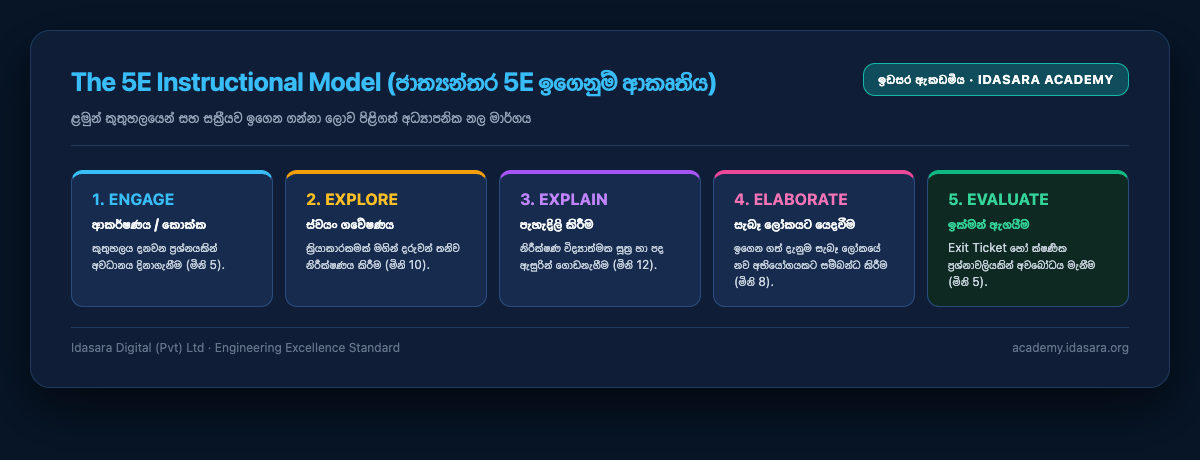 Figure: The 5E Instructional Model — Idasara Academy
- Engage (The Hook — 5 min): A curiosity-sparking question or everyday-life event that captures the child's attention instantly.
- Explore (10 min): Before teaching the theory, let the children observe for themselves through an activity.
- Explain (12 min): Teacher and students together build what was observed into scientific terms and formulas.
- Elaborate (Apply — 8 min): Connect the new knowledge to a fresh real-world problem.
- Evaluate (5 min): A rapid check of understanding (the Exit Ticket).
4. The Teacher's Master Lesson-Plan Blueprint
The prompt architecture for drawing a high-quality lesson plan out of AI:
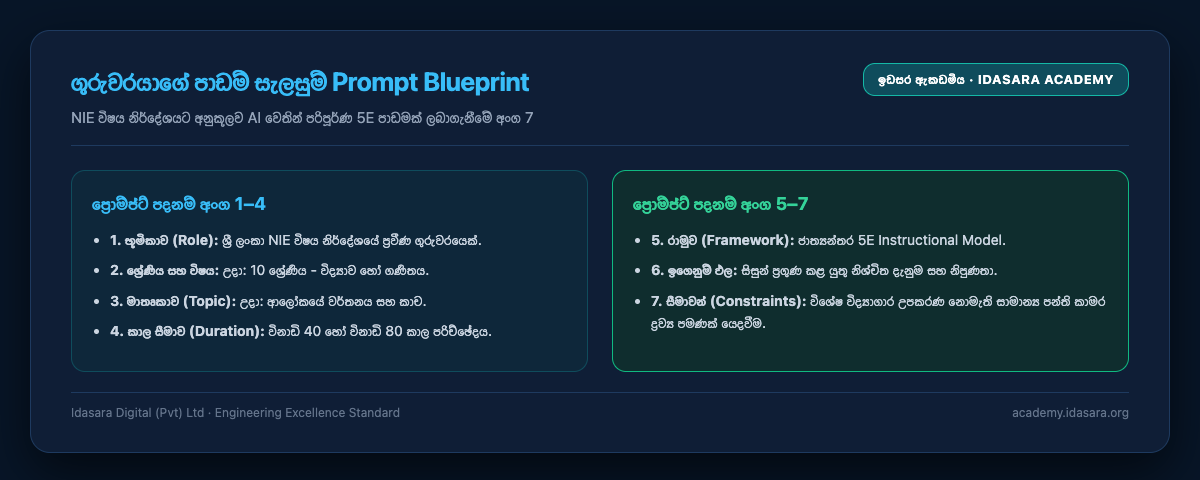 Figure: The Teacher's Lesson-Plan Prompt Blueprint — Idasara Academy
A Live Example: Grade 10 Science — Photosynthesis
💬 The teacher's prompt: "You are an expert science teacher with deep knowledge of Sri Lanka's NIE syllabus. Prepare a complete 40-minute 5E lesson plan for the Grade 10 Science lesson 'Photosynthesis'. It must include an activity that can be done in an ordinary classroom with no special laboratory equipment."
The plan the AI assistant returns:
- Engage (5 min): The teacher holds up an apple and a small potted plant: "When I'm hungry, I eat an apple. When this plant is hungry, it can't go to the shop. So how does this plant make its food?"
- Explore (10 min): Observe an ordinary green leaf beside a pale leaf that spent a week covered with cardboard, and discuss the differences.
- Explain (12 min): Build up the 4 factors of photosynthesis (sunlight, chlorophyll, water, carbon dioxide) and the products (glucose, oxygen), then write the chemical equation.
- Elaborate (8 min): "What is the cheapest machine on earth for absorbing the carbon dioxide that vehicles emit?" (the environmental value of planting trees).
- Evaluate (5 min — Exit Ticket): On a small slip of paper: (1) Gas the plant takes in: ___ (2) Gas it releases: ___ — write and hand in.
The Advanced Pattern: Role–Goal–Constraints Plus Negative Constraints
Now take that prompt one step further and add the negative constraints that guarantee a professional-grade result:
💬 The upgraded prompt: "You are an expert science teacher with deep knowledge of Sri Lanka's NIE syllabus (Role). Prepare a 40-minute 5E lesson plan for Grade 10 'Photosynthesis' (Goal). Constraints: it must suit a classroom with no laboratory equipment; every stage must carry its time allocation (Constraints). What NOT to do: do not include any Advanced Level material beyond the syllabus (for example, the chemical steps of the Calvin cycle); do not guess any textbook page number or official definition you are not certain of — mark it [teacher to verify] instead (Negative Constraints)."
A prompt without negative constraints is a "lazy prompt"; one with them is a "precision prompt." The difference between the two is where your professional dignity survives — or breaks — in front of a classroom.
5. The 60-Second Diagnostic Starter Quiz
Before opening a new lesson, you can have AI instantly build a 60-second starter quiz (5 questions) to check whether the class still holds the foundational concepts from earlier years or earlier lessons:
💬 Prompt: "Before I begin the Grade 10 lesson 'Equations of Motion', create a 5-question Diagnostic Starter Quiz testing the foundational knowledge of velocity, acceleration, and time they learned in Grade 9. Students must be able to answer it within 2 minutes."
This prevents children from getting lost mid-lesson, and lets foundational weaknesses be caught and corrected within the first 5 minutes.
6. Building Bilingual Worksheets
For teachers who teach in both Sinhala and English mediums, AI makes producing parallel, side-by-side bilingual worksheets almost effortless:
💬 Prompt: "Create a 5-question worksheet for the Photosynthesis lesson above. Every question and every answer option must appear in both Sinhala and English, side by side. Attach the answer key at the end."
Two hours of translation and typing collapse into 2 minutes.
7. Teacher Wisdom: Verifying Syllabus Compliance
The foundational truth we learned in Core Module 06 applies here in full force: an AI tool is like a confident intern. It does 3 hours of work in 3 minutes; but it can also write a wrong fact beautifully, without a flicker of hesitation. So before any AI-produced teaching material enters your classroom, these 3 checks are mandatory:
- NIE syllabus boundaries: Check whether material beyond the syllabus has crept in and overloaded the lesson.
- Standard Sinhala terminology: Confirm the exact official terms from the Department of Examinations' resource books have been used.
- Factual accuracy (Fact Check): Verify every number, equation, and definition line by line against your own subject knowledge. Above all the worked model answers — AI can be very convincingly wrong in arithmetic.
Important
Final responsibility for the tute: You — not AI — answer for every word on every page that goes out under your name into children's hands. "The AI got it wrong" will not save your professional reputation in front of a parent. AI writes; you verify; you approve; you answer for it.
In the next chapter: the differentiated pedagogy that turns children of every learning speed in the same class — Advanced, Average, Struggling — into equal achievers, and how small-group classes reclaim their lost time.