01. The Teacher Renaissance & the AI Co-Teacher
Published 2026-09-14
Core Theme: "The arrival of artificial intelligence is not the end of the teaching profession. It is a great renaissance — one that releases the teacher from the mechanical burden of being a mere 'broadcaster' who reads textbook facts aloud, and restores them to their true calling: the mentor and catalyst who awakens a child's spirit."
What is a teacher for, once knowledge is free?
For the two centuries of the industrial-era classroom, the teacher's role was "the Sage on the Stage" — the one learned authority in the room. Knowledge lived in the teacher and the textbook; the teacher stood at the blackboard and read the facts aloud; children copied them down, went home, and memorised them.
That model rested on a condition that no longer holds. Knowledge was scarce and the teacher was where it lived. Today any subject fact, scientific law or mathematical formula is available to any child on a phone in seconds — which forces an uncomfortable and clarifying question: if knowledge is free and instant everywhere, what is the real value of a teacher standing in a classroom?
The question is worth facing squarely rather than deflecting, because the answer is the foundation of everything else in this book. And the answer is that the part of teaching which was always most valuable is the part that was always being squeezed out by the transmission of facts.
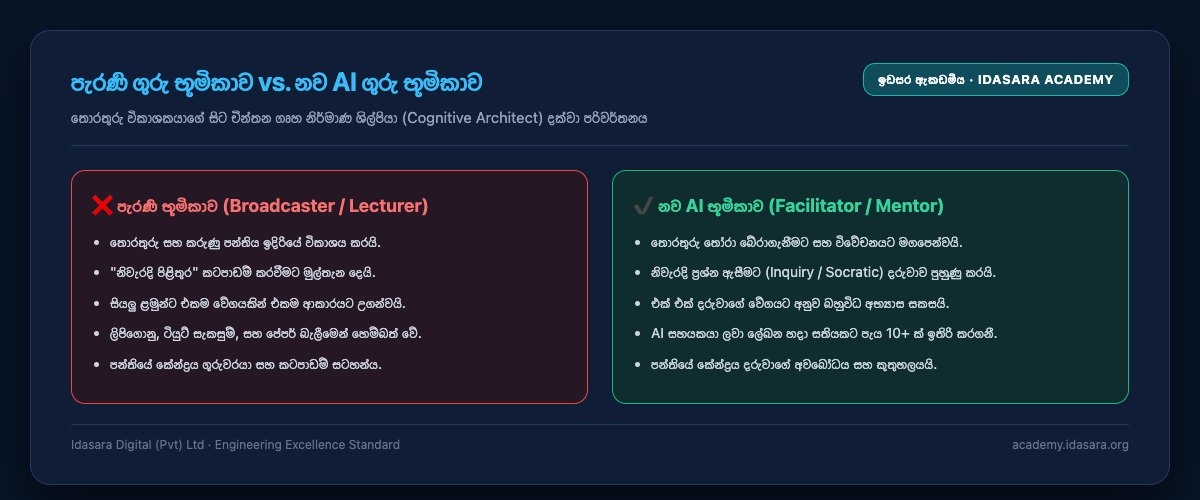 Figure: The Broadcaster vs. the Facilitator — the old teacher role and the new AI-era teacher role — Idasara Academy
The broadcaster
On the left of the figure, information flows one way. The teacher talks; forty children copy notes at the same speed, in the same way. The question forming in a child's mind, the point they did not grasp, the silent helplessness — none of it registers anywhere, because the model has no channel for it.
And the number that should give any teacher pause: fully 80% of the teacher's energy goes into repeating aloud what is already printed in the book. Not teaching — recitation of material the children are holding in their hands.
The facilitator
On the right, the mechanical burden of transmitting facts has been handed to the AI assistant. The teacher moves through the classroom, looking each child in the eye, asking questions, provoking thought.
The division is worth stating as a principle: knowledge comes from the machine; wisdom and courage come from the teacher. The teacher of this era is not a postal worker distributing information. They are the chief architect of a child's thinking capacity, critical intelligence and human character.
Nilūka Teacher's week: what the job has actually become
This transformation is not abstract, and the clearest way to see why it is needed is an ordinary week in the life of Nilūka Teacher — a government-school teacher in the Kurunegala district who also runs an evening O/L Science tuition class.
Monday to Friday, at school: teaching five classes from 7:30 a.m., checking last week's exercise books during the short intervals.
Evenings, at tuition: classes three days a week, two hours each, forty students per class.
After 9 p.m.: preparing tutes for tomorrow's lesson, typing question papers, tallying bills from the photocopy shop.
The weekend: two stacks of answer scripts — the school's term-test papers and the tuition class's weekly papers.
In her own words: "I became a teacher to teach children. But most of my time now goes not into teaching — it goes into paperwork."
Read the rest of this book with that week in mind. Notice that not one item on the list above is the thing she trained for, and notice that none of it is optional under the current system. What we are looking for is not encouragement but an engineering path — one that raises her professional standing while returning her sleep and her family's time.
The doctor and the MRI scanner
The deepest fear among teachers is direct: when AI arrives, will students stop coming to my class? Will the machine replace me?
The most useful answer is a clinical analogy.
🩺 "Sir, you are the consultant physician. Idasara is your MRI scanner." An MRI scanner can show, instantly and to the millimetre, exactly where the illness sits in a patient's body. But a scanner cannot perform surgery. It is the human specialist who operates, who prescribes, and who holds the patient's hand and comforts them. Patients seek out the skilled doctor who has a good MRI scanner and modern technology.
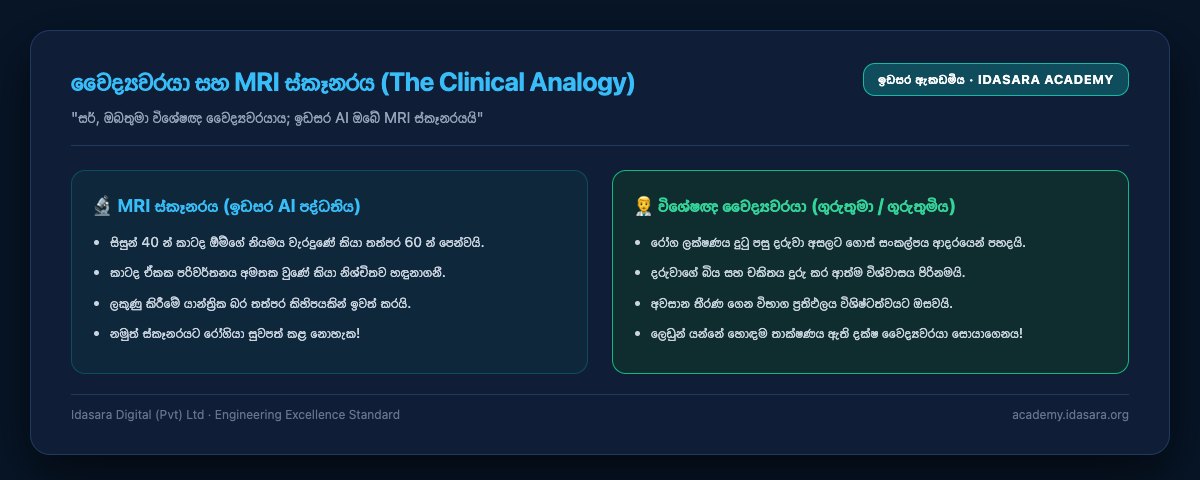 Figure: The Doctor and the MRI Scanner (The Clinical Analogy) — Idasara Academy
The final line carries the argument. The scanner did not reduce demand for the physician; it concentrated demand on the physician who could read it. Diagnostic power does not substitute for expertise — it raises the value of expertise, because a precise diagnosis is useless to anyone who cannot act on it.
AI, on this reading, is not the teacher's rival. It is the most powerful diagnostic assistant ever placed in a teacher's hands.
The four bottlenecks pinning down the Sri Lankan teacher
Sri Lanka's O/L and A/L tuition masters and school teachers are not only instructors. Each one carries the operational weight of a small business, and four constraints hold that business down.
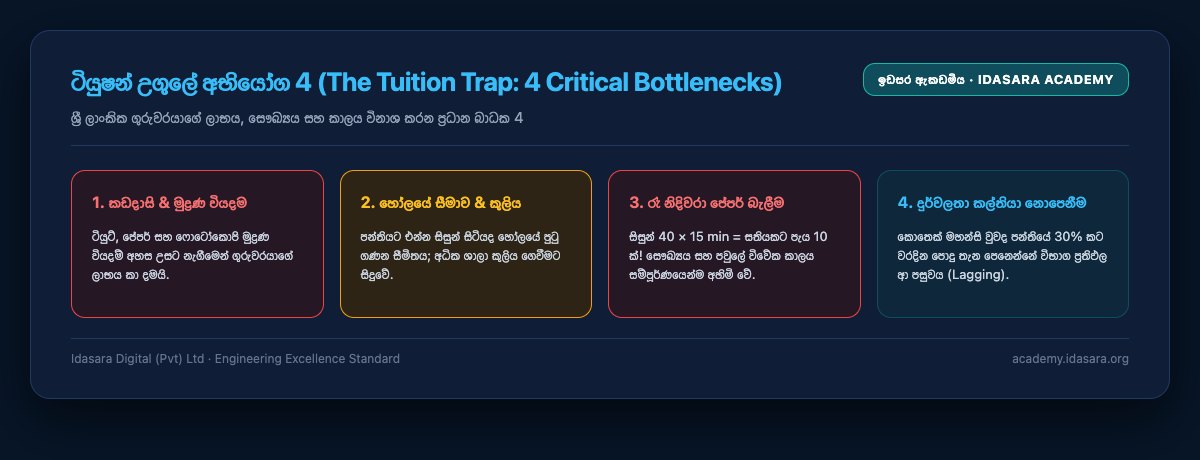 Figure: The Tuition Trap: 4 Critical Bottlenecks — Idasara Academy
Paper and printing costs. As the monthly bill for tutes, papers and photocopies climbs, every rupee comes straight out of the teacher's net profit. This is a cost that grows with student numbers, which means it eats the reward for success.
The limit of the hall. However many more students a teacher could enrol, the chairs in the hall and the hall rent cap growth absolutely. The business has a hard ceiling set by furniture.
Marking through the night. Forty scripts at fifteen minutes each is ten hours a week — taken directly from family and health, and producing nothing the teacher could not have learned faster another way.
Seeing the trouble too late. This is the most damaging of the four and the least discussed. However diligently the papers are marked, the common weakness tripping 30% of the class, and the identity of the child quietly falling behind, become visible only when results arrive — by which point the teaching that could have fixed it is months in the past. Marking produces a verdict when what the teacher needed was a warning.
The hybrid learning hub
The escape from that crisis is to restructure the class as an AI-powered hybrid learning hub — dividing the work by what each side is actually good at.
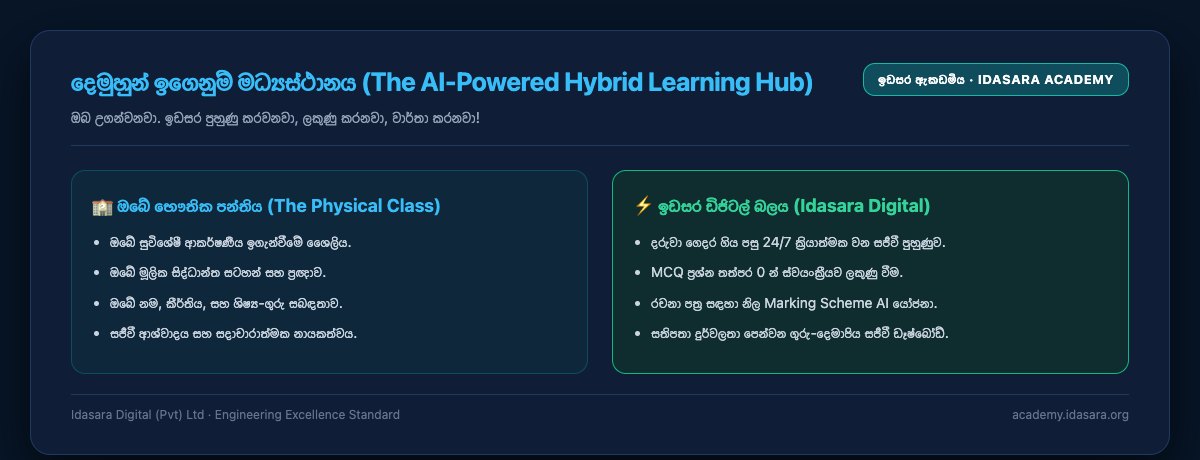 Figure: The AI-Powered Hybrid Learning Hub — Idasara Academy
The physical classroom stays the teacher's domain: theory, concept-building, worked examples, and the living guidance delivered while looking a child in the eye. This is never digitised, and it is precisely what parents value beyond price.
The digital practice layer takes the repetition: the MCQ drills, past-paper questions and revision quizzes the child does at home after class. Whether the child practises at 9 p.m. or 5 a.m., every answer is marked instantly — which no human teacher can offer at any price.
The weekly intelligence report goes to the teacher's phone: which concept is the class's weakest, which child is slipping, who has not practised at all, presented as a live Mastery Heat-Map.
That third component is what converts the fourth bottleneck from a structural problem into a solved one. Parents pay for your name and your in-person guidance. What the system does is mark every practice attempt made after the child goes home, and tell you on Monday what you would otherwise have discovered in December.
Tip
Extending the medical analogy: When the MRI scanner arrived at the hospital, the doctor's value did not fall — demand for the specialist who could read the scan correctly and decide the treatment multiplied. In exactly the same way, the teacher who reads the class Mastery Heat-Map and decides, "Today we revisit this lesson," stays ahead of every other class in the area.
What the teacher actually gains
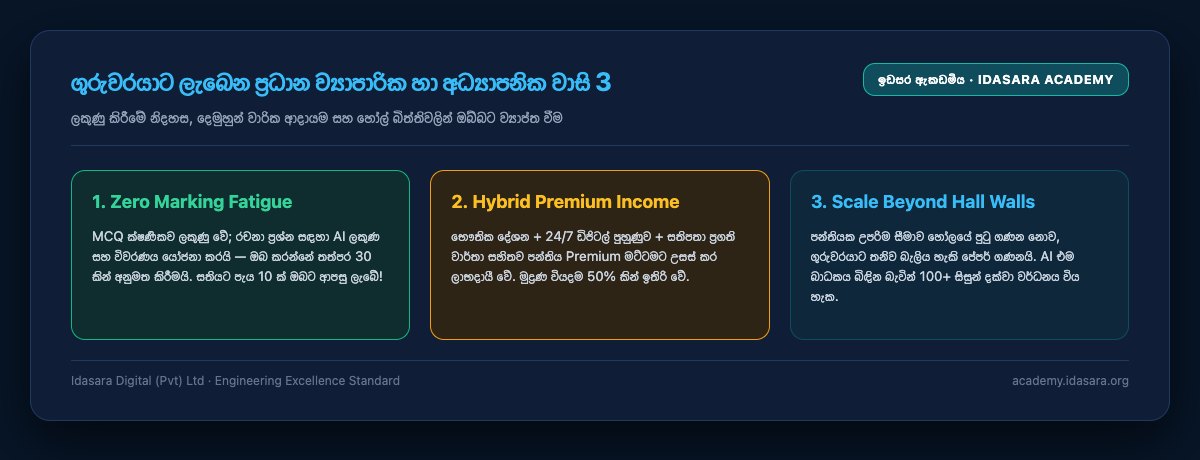 Figure: The Teacher's 3 Core Business and Educational Gains — Idasara Academy
Ten liberated hours a week. The time recovered by handing the mechanical burden of marking to the system. Chapter 04 works through the full arithmetic, and the figure is not an estimate.
A hybrid revenue stream. On top of class fees, additional monthly income from digital practice and weekly report cards — which parents value because it gives them visibility they have never had.
Growth beyond the chairs in the hall. Once practice is digital, the physical size of the hall stops being the ceiling on the class. The second bottleneck is removed rather than mitigated.
The revenue model, for a class of 40
Charging an extra Rs. 500 a month for digital practice and weekly report cards:
- Additional revenue: 40 × Rs. 500 = Rs. 20,000
- Idasara Insight teacher package fee: -Rs. 11,000
- Net additional profit: Rs. 9,000 — and at an extra Rs. 1,000 per student, net profit is Rs. 29,000.
On top of that sits the printing saving from Chapter 02, which halves a cost the teacher is currently paying every week.
The three things no AI will replace
The principle established for the public service applies to teaching word for word: AI takes tasks, not posts. Here is how the work on a teacher's desk divides.
| What Moves to the Machine | What Stays with the Teacher |
|---|---|
| Marking MCQs and structured questions: Instant, unerring marking against the standard marking scheme. | Approving the final mark: AI proposes; it is the teacher who signs off on the mark and answers for it. |
| First drafts of tutes, worksheets, quizzes: Draft materials aligned to the NIE syllabus (Sri Lanka's National Institute of Education curriculum) in minutes. | Expert editorial judgement: Fitting the draft to the exam pattern, the official terminology, and the true level of this class. |
| Collecting and analysing progress data: Logging every answer from every child and surfacing the patterns. | Seeing the child the data cannot: Recognizing the child who came to school without breakfast, or whose heart is broken by trouble at home. |
| Routine administration: Attendance registers, report generation, parent-notification drafts. | Inspiration, discipline, and character-building: Changing a child's life through a living example. |
| Read the right-hand column and notice that it contains every reason a person becomes a teacher, and the left-hand column contains everything that currently prevents them from doing it. |
Important
Remember: A machine can check a thousand answer scripts at once; but only you can read the fear, the shame, and the hope in a child's eyes. Marking may pass to the machine, but the judgement made about a child — and the responsibility for it — can never be delegated to a machine.
Three human capacities remain the teacher's alone, however fast the technology moves.
Reading a child's eyes. Only a teacher walking the classroom can tell whether the child in the corner came to school hungry, is distracted by trouble at home, or is staring in silent fear at a problem they cannot follow. No data system captures any of those three, and all three change what that child needs today.
Inspiration and faith. No machine has ever placed a hand on the shoulder of a child the world had written off and said, "I believe in you — you can." That has always been the work of teachers, and it is often the single intervention a person remembers forty years later.
Moral character and community. Respect for others, resilience in defeat, truthfulness. A child does not learn these from an explanation. They learn them from watching how a teacher behaves when something goes wrong — which is why this capacity cannot even be described as a task, let alone automated.
In the next chapter, we turn practical: how to use AI and the Idasara toolset to build the teacher's own teaching-assistant materials — lesson plans, worksheets, and modular tutes.