04. The Digital Revolution in Marking Papers & Exercises (Automated Paper Marking & Diagnostics)
Core Theme: "The real constraint on a class's growth is not the number of chairs in the hall; it is the number of answer scripts one teacher can mark alone. Here we learn how to escape the exhaustion of marking papers through the night and reclaim 10 hours every week — through the modern AI assessment model: 'You don't mark; you approve.'"
1. The Marking Crisis That Stole the Teacher's Sleep
Ask any O/L or A/L teacher in Sri Lanka to name the most exhausting, most monotonous, most mentally corrosive part of their work, and the answer is the same: manual paper marking.
Let us do the arithmetic: * Students in a typical class: 40 * Average time to mark one exam answer script: 15 minutes * Total: 40 × 15 = 600 minutes = 10 hours!
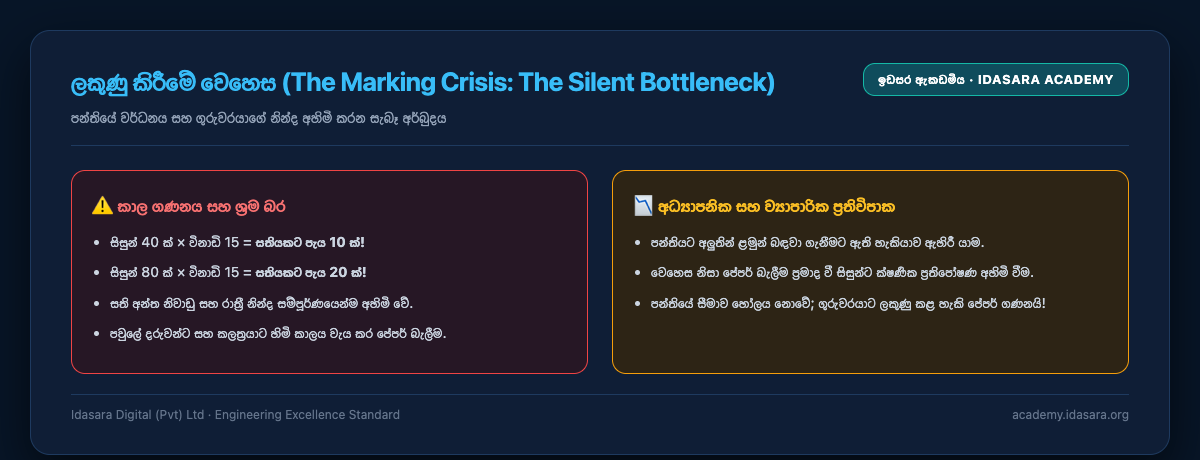 Figure: The Marking Crisis: The Silent Bottleneck — Idasara Academy
At term-test time the crisis sharpens. Think of Nilūka Teacher, whom we met in Chapter 1: 120 term-test papers from her 3 school classes in Grades 10 and 11 are stacked on her desk. Even at 15 minutes per paper, that is 30 hours of work — two entire weekends, back to back. And meanwhile the weekly papers from her evening tuition class keep arriving. This is why so many teachers end up taking 3–4 weeks to finish a stack of marking — by which time the child no longer even remembers the mistake. Every day that feedback is delayed, its learning value drains away.
The revolutionary truth a teacher must grasp: The hall is not your only ceiling. What has truly capped the size of your class is the number of papers your own two hands can mark! The Idasara AI assessment engine removes that ceiling entirely.
2. The New Golden Rule: "You Don't Mark; You Approve!"
In the AI era, the teacher is not a mechanical worker scratching red-pen crosses onto blank pages. The teacher is the Approving Authority — the supreme judge who makes the final call.
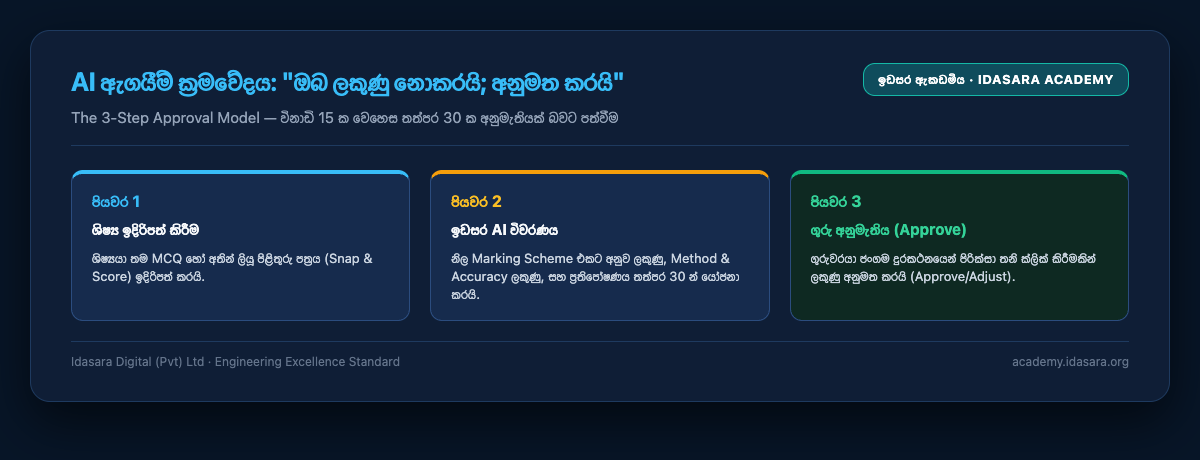 Figure: The AI Assessment Model: "You Don't Mark; You Approve" — Idasara Academy
Reading the Figure's 3 Steps:
- Step 1 — The Machine Marks: The system checks every answer against the standard marking scheme, recording marks and error points.
- Step 2 — The Teacher Reviews: What arrives on the teacher's screen is a completed mark sheet — with the answers the AI was uncertain about (borderline cases) highlighted. The teacher examines not the whole script, but only the points that need judgement.
- Step 3 — The Teacher Approves: With the teacher's approval, the mark is released to the student and the weekly report to the parents. Not a single mark is published until the Approve button is pressed.
If reading an answer script from scratch takes you 15 minutes, reviewing and approving a mark sheet the AI has already checked and prepared takes about 30 seconds!
Important
The accountability principle: The AI mark is only a proposal. The final mark that enters a child's progress report is answered for by the teacher who approved it. See this not as a burden but as power — your professional judgement remains the system's supreme verdict. The machine supplies speed; you supply justice.
3. The Three Tiers of Automated Marking
The assessment capabilities Idasara Academy places in the teacher's hands:
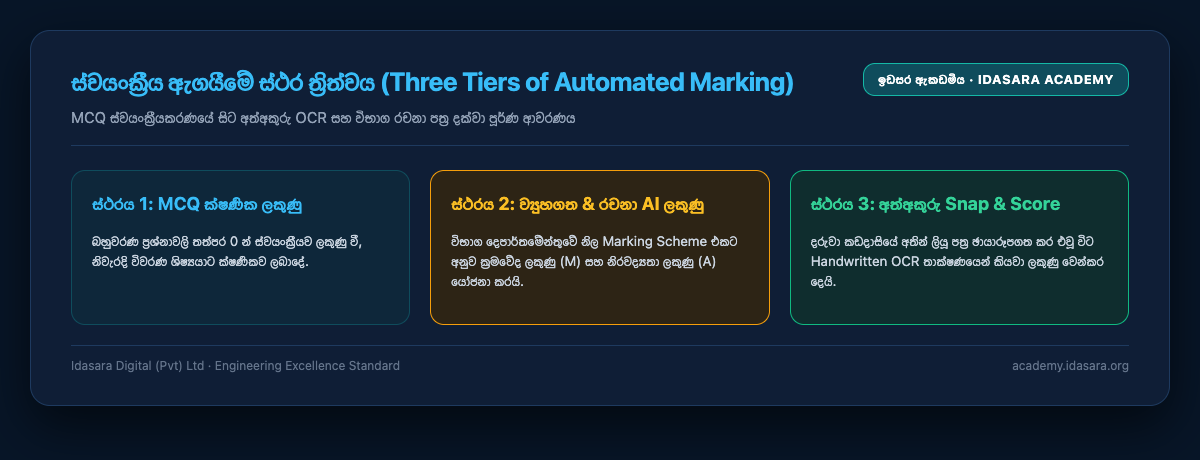 Figure: The Three Tiers of Automated Marking — Idasara Academy
- Automatic MCQ marking: Any multiple-choice quiz done inside the system is marked instantly — no teacher involvement — and updated to the student and the teacher dashboard.
- Structured and essay question assessment: Against the standard marking schemes of the NIE syllabus and the Department of Examinations, the AI shows the marks earned on each sub-question and pinpoints where the answer went wrong.
- Handwritten answer-script assessment (Snap & Score): When students photograph answer scripts handwritten on paper — in the exam hall or at home — and submit them from a phone, handwritten-OCR technology reads the writing and awards the marks.
The Heart of Snap & Score: Separating Method (M) and Accuracy (A) Marks
Faithfully following the Department of Examinations tradition, the Idasara assessment engine analyses essay and calculation questions with Method Marks (M) and Accuracy Marks (A) scored separately. A live example:
- Question: Find the equivalent resistance of two parallel resistors (4 Ω and 12 Ω). (5 marks: M 3 + A 2)
- Kasun's answer: He writes the formula 1/R = 1/R₁ + 1/R₂ correctly, substitutes the values correctly, and then botches the final division, getting R = 4 Ω (the correct answer is 3 Ω).
- The danger of the old way: A tired teacher's red pen falls beside the final answer — "✗ — 0 marks" — and the odds of that are high.
- The Snap & Score analysis: M 3/3 (formula + substitution + method correct), A 0/2 (final computation wrong) → 3/5 marks, with the note: "Re-check the division in the final step."
The effect of this difference on a child's mind is enormous. Instead of "I'm just no good at Physics," the child sees the truth: "My method was right — I slipped on one small calculation." And on the class Heat-Map, the teacher sees two distinct groups — children losing M marks (concept not understood) and children losing A marks (carelessness) — because the two conditions need two different treatments.
4. From Autopsy to Real-Time Diagnostics
Assessment in the traditional classroom is like an autopsy: * By the time the term test is over and the mark sheets arrive, the term itself is finished. * The teacher discovers the student never understood Newton's laws only after the child has failed the exam. By then there is no time left to save them!
But the Idasara Class Dashboard & Mastery Heat-Map turns this into real-time diagnosis:
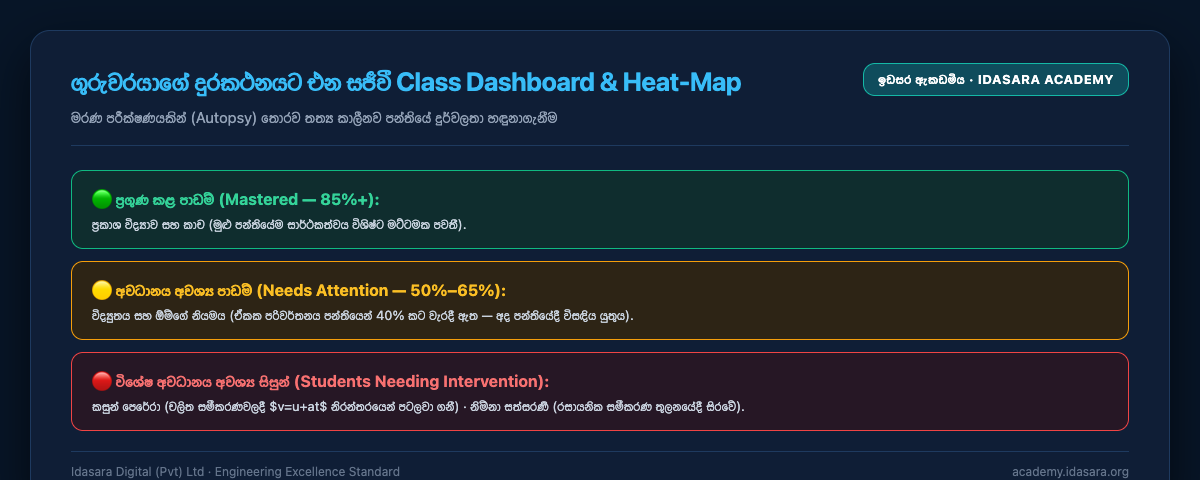 Figure: The Live Class Dashboard & Heat-Map on the Teacher's Phone — Idasara Academy
The teacher no longer walks into class blind, but knowing precisely which concept is the class's weakest — and exactly which child needs a personal hand!
5. Bloom's Taxonomy and Engineering the Distractors
When building a question paper with AI's help, use this prompt to produce an MCQ paper of genuinely high standard:
💬 Prompt: "You are a G.C.E. Ordinary Level examiner. Create 3 multiple-choice questions on 'Ohm's Law' ($V=IR$) for Grade 10 Science. Important: the 3 wrong options (distractors) must be engineered around common calculation errors — failing to convert units ($mA$ to $A$), inverting the formula (R = V × I), and so on. For every option, add a Teacher Diagnostic Note explaining why a student would choose it."
The Model Question and Its Teacher Diagnostics:
Question: Find the value of a resistor through which a current of 500 mA flows under a potential difference of 12 V. (1) 6000 Ω | (2) 0.0416 Ω | (3) 24 Ω | (4) 6 Ω
- Correct answer: (3) 24 Ω (R = 12 V/0.5 A = 24 Ω)
- Teacher diagnostics:
- A student choosing (1) multiplied 12 × 500 (wrong formula).
- A student choosing (2) divided $0.5 / 12$ (formula inverted).
- A student choosing (4) never converted $mA$ to amperes and took 12 × 0.5 = 6 (units forgotten).
The wrong answer a child picks reveals to the teacher, instantly, the precise misconception in that child's mind!
6. The Liberated 10 Hours: A New Beginning for the Teacher's Life
Freed from the mechanical burden of marking, what can a teacher do with 10 reclaimed hours a week? 1. Start another new class: double your income. 2. Talk with students one to one: dissolve children's anxieties and their fear of the subject. 3. Family happiness and proper sleep: a genuinely restful weekend with your children and your family.
In the next chapter: the "AI Detectors" myth now misleading so many teachers, the process-based assessments that measure true understanding, and honest answers to the 9 deepest doubts teachers raise.