05. The "AI Detectors" Myth, Authentic Assessment & Honest Answers to Teachers' Doubts
Core Theme: "When students use AI to write their essays, chasing them with 'AI Detectors' is a futile war. Only a teacher's wisdom — never a piece of software — can truly measure understanding in a human mind. And here we give transparent, honest answers to the 9 deepest questions teachers ask in the AI era."
1. The New Trap Teachers Are Falling Into: How "AI Detectors" Actually Work
Across the world — and in Sri Lanka — many teachers have begun running student assignments and essays through software such as ZeroGPT, GPTZero, CopyLeaks, or Turnitin's AI Writing Detector.
How do these tools actually work? * They are in no sense "detectives" uncovering the truth. * All they measure is the text's predictability (perplexity) and the variety of its sentence patterns (burstiness). * If a document is written in careful, orderly, grammatically correct prose, the software concludes it was "AI-generated"!
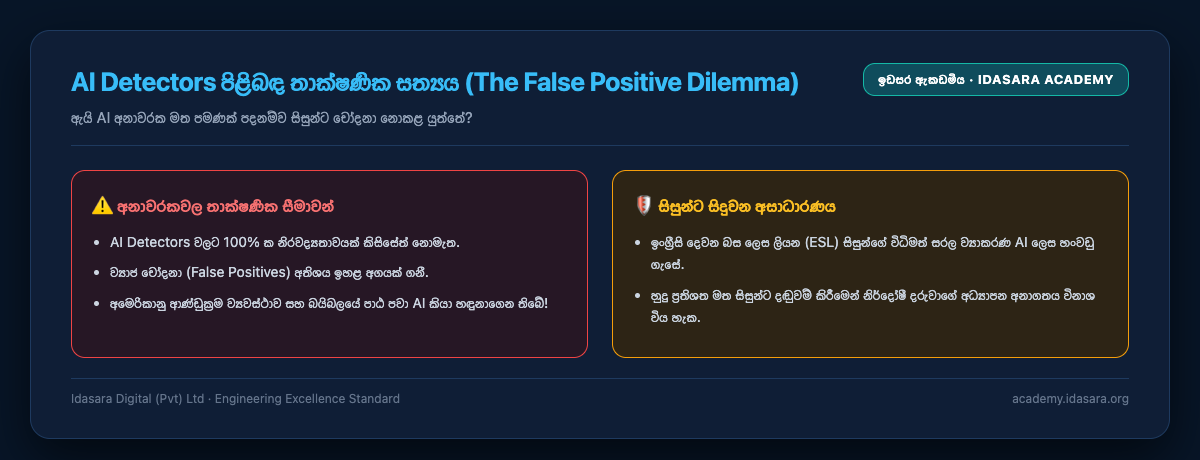 Figure: The Technical Truth About AI Detectors (The False Positive Dilemma) — Idasara Academy
The Danger to Hold in Your Mind: The Tears of the Best Writer in the Class
Now picture the human price of that technical weakness. The most gifted English essayist in the class — dictionary at her elbow, grammar book open, two late nights of honest work — hands in a flawless, polished essay. The teacher runs it through a detector. The verdict: "87% AI-generated."
What actually happened? Her essay was too correct. By the perplexity index the detector measures, disciplined grammar and standard sentence patterns are "machine markers." In other words: the better a child writes, the more likely she is to be branded a cheat! And the students at greatest risk of these false accusations are our own children learning English as a second language — precisely because they reproduce the standard sentence patterns they memorized. This is the principal reason universities around the world have suspended disciplinary action based on AI detectors.
⚠️ A hard warning for teachers: Never accuse a student of cheating, and never cut marks, on the strength of a percentage score from an AI-detector program! You may be destroying — permanently — the self-respect and the academic life of an innocent child who genuinely did the work.
2. Practical Methods of Authentic Assessment
The best defence against students copying whole essays out of AI is to stop grading only the final product and start grading the learning process.
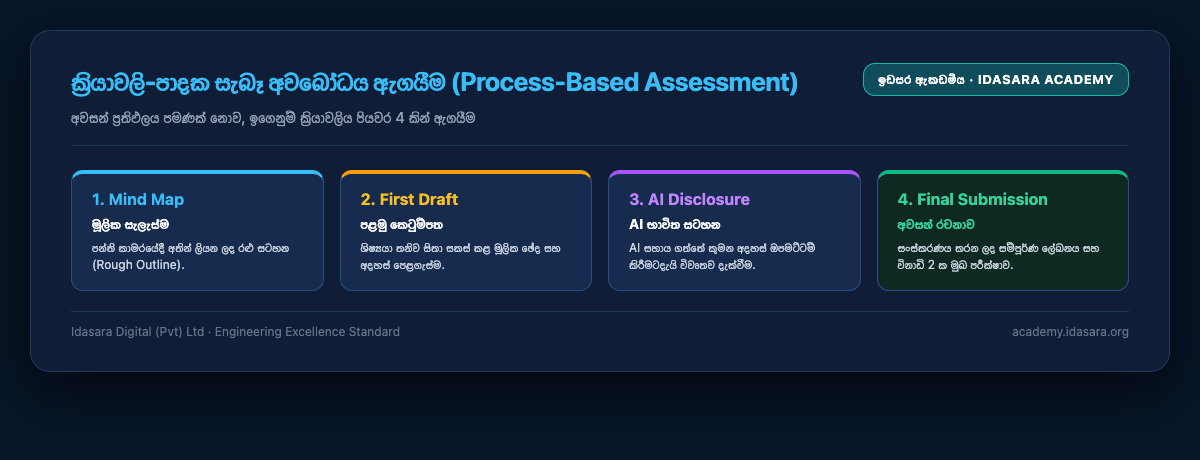 Figure: Process-Based Authentic Assessment — Idasara Academy
When a student may not simply hand in a finished essay, but must show their first rough notes and each stage of the build, no student can paste from ChatGPT and submit in an instant.
The 4 Practical Components of a Process-Based Assignment:
- The idea map (10%): Handed in — handwritten — in class on the day the assignment is set.
- Source list and draft (30%): The first draft at mid-week, accompanied by an AI Use Disclosure stating openly at which step, if any, AI was used.
- The final piece (40%): The completed essay.
- The oral defense (20%): The 2-minute conversation described in the next section.
The most beautiful property of this scheme: AI use stops being "theft." The child's conversation with AI becomes a transparent part of the learning process — exactly like an adult borrowing a library book and citing it.
3. The 2-Minute Oral Defense
After collecting the assignment, the teacher calls the child over and asks one of these 3 questions: 1. "Now, this important concept you've written on page 3 — explain it to me in your own words, without looking at the paper." 2. "What was the hardest thing to understand while doing this assignment? How did you work through it?" 3. "If someone argued the exact opposite of the position in your essay, what would your answer be?"
- The child who truly understood the subject smiles and explains it in their own words.
- The child who printed an AI's words without reading a single one stands speechless on the spot.
4. The Classroom AI Policy
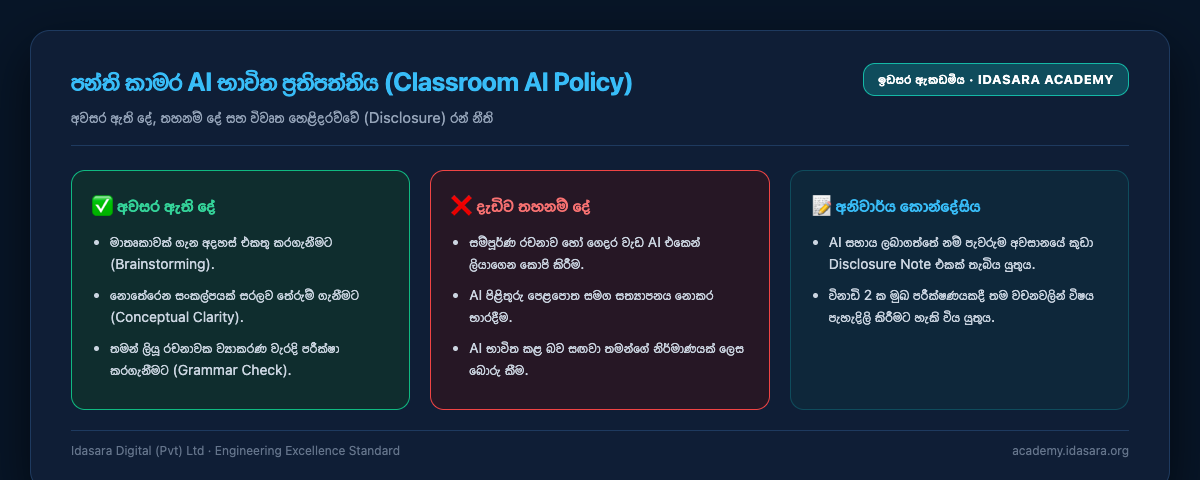 Figure: The Classroom AI Policy — Idasara Academy
A classroom that bans AI reproduces exactly the "Shadow AI" condition of government offices: the usage does not stop — it goes underground, secret, and unguided. So instead of a ban, agree a short, clear, written policy with your students on day one. Model clauses:
- "Using AI to understand a concept, to ask questions, and to practise is fully approved."
- "Submitting something AI wrote under your own name is plagiarism — the same as copying from a book."
- "Whenever you use AI, state at the end of the assignment which step you used it for — there is no penalty whatsoever for saying so."
- "In the exam hall and in classroom tests, AI use is banned — there, what we are measuring is your own mind."
5. The 9 Real Doubts Teachers Raise — and Honest, Practical Answers
Across Idasara Academy's workshops with Sri Lanka's leading O/L and A/L teachers, the same 9 questions surface. Here they are, with transparent answers:
Q1: "Will children stop coming to my class?"
Answer: No, sir! Students come to your class for your teaching, your guidance, and the trust their parents place in you. Idasara is simply your class's digital instrument — a child joins through your Join Code, under your name. Remember: patients flock to the skilled doctor who owns a good MRI scanner!
Q2: "I have no time to learn new technology."
Answer: There is nothing new for you to learn. Student registration and system setup are done by our team. All you do is glance at the weekly report in your phone's browser — about as hard as reading a WhatsApp message!
Q3: "Are online questions as good as my printed tute?"
Answer: Your tute is your strength, sir — keep it. Keep the theory section in your own printed tute. Idasara's questions are built to the NIE syllabus and past-paper patterns, and you can also load your own questions into the app as a quiz. The difference is not in the question — it is in the instant marking and feedback. A sheet of paper will never tell you which child got the question wrong!
Q4: "What does it cost after the pilot?"
Answer: With complete transparency: teachers have a free package (up to 3 classes and 15 students). The Classroom package — Rs. 4,500 per month — has no student or class limits. The Insight package — Rs. 11,000 per month — adds the lessons needing attention and per-student analytics. Even charging 40 students just Rs. 500 each, you keep a net profit of Rs. 9,000 a month. Students can start free.
Q5: "You sell directly to children, don't you? Doesn't that make you my competitor?"
Answer: Honestly: yes — a child can use Idasara alone. But your class has something no stand-alone app can offer: a living teacher who reads the report, recognizes the symptom, and acts! Your student joins under your Join Code. What we want is for your class to post the best results in the area.
Q6: "Our children don't have good phones or internet."
Answer: Idasara runs in the browser of an ordinary smartphone — one shared phone at home is enough, and the child can practise at whatever hour suits. Whether it fits your students is exactly what we find out together in the 30-day free pilot.
Q7: "Parents won't pay an extra fee."
Answer: Parents pay for results, sir. When the child's weekly progress report lands on their phone, the value is self-evident. At the end of the pilot, show parents those reports first — and only then discuss the extra fee!
Q8: "What if the AI gives a wrong answer?"
Answer: On essays, the AI mark is only a proposal — the final mark is approved by you. The AI study assistant answers only from NIE syllabus content. And since you are the subject expert, any error you spot can be corrected on the spot.
Q9: "I do the hard work building the hub — and the teacher in the next room reaps the benefit."
Answer: Every teacher's classes and data are kept fully separate. And the first teacher to join earns the name and the head start of the area's first "AI-Powered Hybrid Learning Hub"!
In the final chapter: student data privacy, the 30-Day Free Pilot, and the unified teacher vision of Idasara Academy.