03. Differentiated Pedagogy & Managing Small-Group Classes
Core Theme: "Just as one shoe size does not fit every child in a class, one teaching method does not fit every learner. Here is how AI enables personalized, differentiated pedagogy — teaching that makes every child in the same classroom, whatever their learning speed, an equal achiever."
1. The Tragedy of the Traditional Classroom: "One Size Fits All"
A typical Sri Lankan school or tuition classroom holds 35 to 50 students. Look closely at those children and you will see 3 main groups:
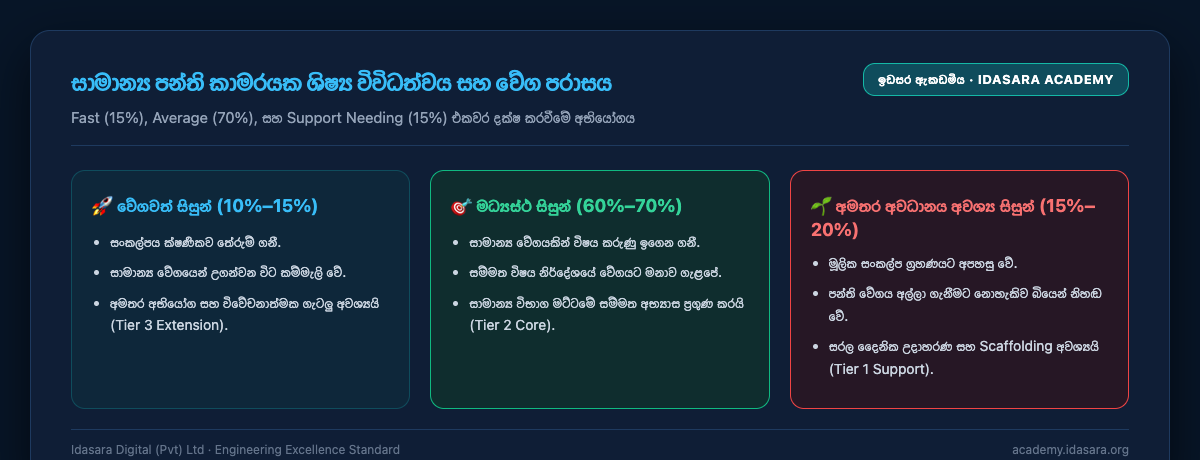 Figure: Student Diversity and the Range of Learning Speeds in a Typical Classroom — Idasara Academy
Reading the Figure's 3 Layers:
- The fast layer: Children who grasp the concept from its very first explanation. What they need is not another repetition but a challenge.
- The middle layer (the majority — about 60%): Children who grasp the concept after 2–3 examples and some guided practice. The traditional class is designed for them.
- The layer needing extra support: Children for whom today's lesson is hard to grasp because of gaps in earlier lessons (foundation gaps). These are not weak children — they are children trapped at the wrong speed.
Traditionally, the teacher has no choice but to aim at the middle 60% and teach at an average pace: * The fast students, starved of new challenge, sink into boredom. * The students needing extra attention, unable to hold the teacher's pace, drift off course, grow afraid of the subject, and finally give up on learning.
The scientific answer to this crisis is Differentiated Instruction. And AI is the fastest curriculum designer on earth — able to split any concept into 3 levels within 30 seconds!
2. The 3-Tier Scaffolding Framework
When teaching any concept, AI can shape the content into 3 tiers:
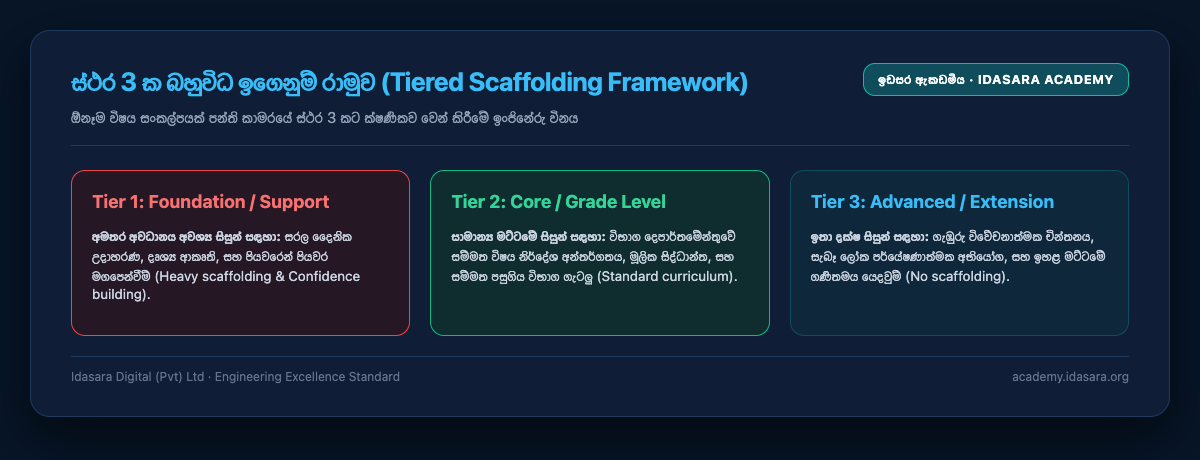 Figure: The 3-Tier Scaffolding Framework — Idasara Academy
A Live Example: Grade 10 — Newton's Second Law ($F = ma$) at 3 Levels
💬 The teacher's prompt: "I am teaching Newton's Second Law ($F=ma$) in Grade 10 Physics. My class has students at 3 levels: (1) students afraid of mathematics (Tier 1), (2) average students (Tier 2), (3) very able students (Tier 3). Prepare one explanation and one problem suited to each of the 3 groups."
- Tier 1 (students needing extra attention): Explanation: "Son, which is easier to push up to the same speed — a toy car or a real lorry? The toy car, isn't it? The lorry needs a much bigger force, because its weight (mass) is greater. The greater the mass, the greater the force required ($F = ma$)." Problem: What force is needed to give a ball of mass 2 kg an acceleration of 3 ms⁻²? (F = 2 × 3)
- Tier 2 (average students): Explanation: "The rate of change of momentum of a body is proportional to the unbalanced force acting on it ($F=ma$)." Problem: A car of mass 1200 kg reaches a velocity of 20 ms⁻¹ from rest in 5 seconds. Find the applied force.
- Tier 3 (able students): Challenge: "As a rocket climbs, fuel combustion reduces its mass $m$. Using F = d(mv)/dt, analyse how acceleration changes under a constant thrust force ($F$)."
Important
The ethics of tiering: The 3 tiers are the teacher's internal planning tool — never a label announced to the class. Never say "you're in the Tier 1 group" aloud — a blow like that to a child's self-respect lasts for years. The best practice: hand every student a worksheet on the same topic, and vary the difficulty of the problems silently. And tiers are not permanent cages — moving a child upward as the Mastery Heat-Map shows progress is part of the teacher's weekly duty.
3. Liberation for Individual & Small-Group Masters
What is the single largest time-leak facing Sri Lanka's individual and small-group class teachers?
⏱️ The 20 wasted minutes of homework-checking: In a typical 2-hour class, the first 20 minutes vanish into leafing through children's books — "Did you do the homework? Did you work this one out?" — checking by hand. Those 20 minutes are 16% of the entire class!
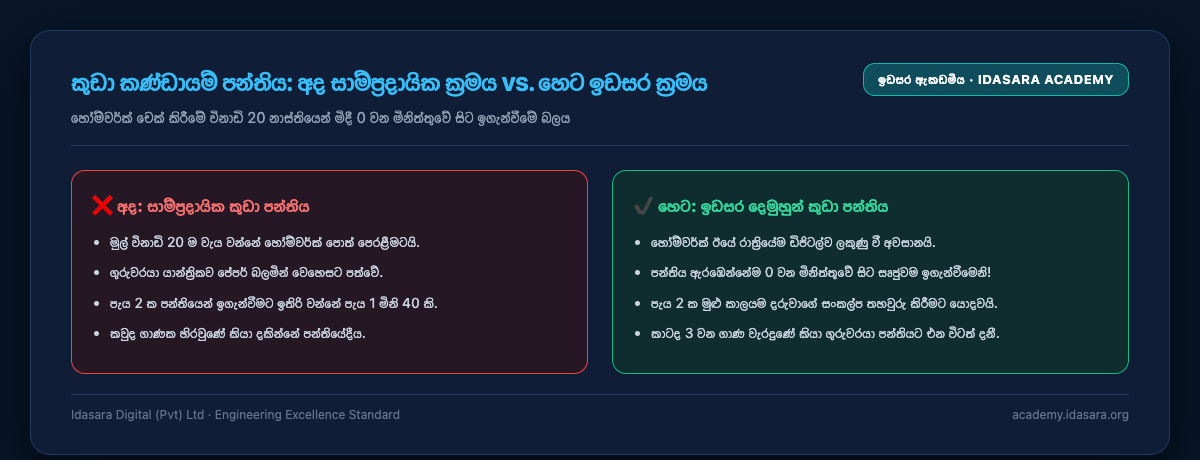 Figure: The Small-Group Class: Today's Traditional Method vs. Tomorrow's Idasara Method — Idasara Academy
When homework happens digitally through Idasara, the teacher walks into the room already saying: "Children, three of you got question 4 wrong in last night's exercise set. So that's exactly where today's class begins." The children — and their parents — are astonished at the teacher's preparation and professionalism!
4. Addressing Different Learning Styles (VARK Modalities)
Children absorb information through different senses: 1. Visual learners: Pictures, charts, and mind maps. 2. Auditory learners: Discussion, debate, and spoken explanation. 3. Kinesthetic learners: Hands-on experiments and role-play.
💬 Prompt: "For the Grade 11 History lesson 'Causes of the First World War', suggest 3 classroom activities that together cover all 3 styles — Visual, Auditory, and Kinesthetic."
- Visual: A colour-coded concept flowchart of the web of secret treaties between nations.
- Auditory: A short mock peace-conference debate, students representing the powers and trying to prevent the war.
- Kinesthetic: Four students standing in the four corners of the room as four nations, experiencing the alliance network through a ball of string.
5. Special Educational Needs (SEN) and AI Support
Children with reading difficulties (dyslexia) or attention difficulties (ADHD) suffer in the ordinary classroom. Too often these children are handed unjust labels — "the lazy one", "the child who never pays attention" — when the real problem is not their effort but material formatted in a way their brain cannot use. AI lets a teacher re-engineer that material in minutes:
- Dyslexia: Replace dense paragraphs with simple reading cards of 3–4 short bullet-pointed sentences.
- ADHD: Replace one 40-minute lecture with 6 micro-tasks of 5 minutes each.
💬 Prompt (SEN re-formatting): "Rewrite the following passage for a Grade 10 student with dyslexia: a maximum of 8 words per sentence; only 3 facts per card; every card must end with a simple analogy that aids memory. Do not alter any scientific fact in the original content. [Paste passage here]"
Until now, this kind of re-formatting meant seeking out a specially trained resource teacher. Today it sits in every teacher's phone — all that is required is the teacher's heart that refuses to abandon a child.
6. The Teacher's Heart: Leaving No Child Behind
Every teacher knows the silent girl in the back row who never dares raise her hand. She holds back her questions not because she understands everything, but because of one fear: "If I ask this, the whole class will laugh at me." In the traditional classroom she is discovered only when the term-test results arrive — and by then it is too late.
But with digital practice data, even if her silence cannot speak, her answer patterns can. The moment her row turns red on the weekly Heat-Map, the teacher can pause beside her for 5 minutes after class — no one else aware — and untangle the problem. This is the true meaning of differentiated pedagogy: the technology supplies the data; the teacher supplies the love.
"The real success of an education is measured not by the marks of the child who came first, but by how far the child who came last has travelled."
In the next chapter: the great digital revolution in marking papers and exercises — the work that has stolen the teacher's sleep — and the road to complete freedom from the burden of marking.