01. The Student's AI Superpower: Your Personal Learning Companion
Core Theme: Artificial intelligence is not a shortcut discovered by a lazy student who wants homework copied for free. It is an unprecedented superpower that lets a curious student summon the world's finest professor to their own study desk. And yet — ordinary ChatGPT or Gemini will not get you through your national exams. Understanding exactly why is where this chapter begins.
1. A Historic Equalizer: World-Class Knowledge for Every Sri Lankan Child
You may study at a leading national school in Colombo. Or you may study at a small school in a remote village in Monaragala, Jaffna, Anuradhapura, or Ratnapura. For generations, an enormous resource gap separated these two children. One had expensive international textbooks, highly qualified private tutors, and computer labs; the other had to make do with a handful of well-worn textbooks.
Today, for the first time in human history, that unjust gap has collapsed.
Hold two real scenes in your mind for a moment. A Grade 11 girl at a prominent Colombo school attends five private tuition classes a week — the after-school paid tutoring that has become a near-universal ritual for Sri Lankan exam candidates. Her parents spend Rs. 15,000–25,000 a month on those classes; she gets home after 9 p.m. Meanwhile, an equally gifted girl in a remote Monaragala village cannot attend even one of those classes; reaching the nearest A/L Physics class means three hours on buses. For decades, the gap between these two students' exam results was decided not by intelligence but by the family wallet and the accident of birthplace.
That equation has now changed.
The most powerful AI models used today by a researcher at Harvard or Oxford are available to you, a Sri Lankan student, on an ordinary smartphone.
What does this mean? Wherever you were born, you now have the power to keep a brilliant personal tutor — on any subject in the world — beside your desk, 24 hours a day.
2. Tasks Go to the Machine — The Power of Thinking Stays with You (The Great Cognitive Boundary)
Here is the sternest warning I will give you, right at the start:
Warning
If you begin using AI in place of your own brain, your thinking capacity will wither (Cognitive Atrophy), and you will end up a person with no real skill at all.
To understand this, think about lifting weights at a gymnasium. A person lifts weights to strengthen their body. Now imagine someone brings in a crane or a robot and lifts all those weights in a single second. The task gets done — but not one muscle in that person's body grows!
School education is precisely that kind of mental gymnastics:
- spending half an hour wrestling alone with a mathematics problem,
- logically connecting two historical facts,
- struggling to find the right words for a Sinhala or English essay —
these are not merely chores for collecting exam marks. In every one of those moments, the connections between the neurons of your brain — your synapses — are being strengthened, and your capacity to think and reason is being massively amplified.
If you hand your homework or essay to an AI, copy the instant answer, and give it to your teacher, you are doing exactly what the fool at the gym does: letting a robot lift the weights while your own muscles waste away.
So our formula is this:
- Give the repetitive and exhausting tasks to the machine (summarization, formatting, flashcards, proofreading).
- Keep decision-making, deep conceptual understanding, and control of your thinking for yourself!
Here is how that boundary applies to a student's everyday study life:
| What Moves to the Machine | What Stays with You |
|---|---|
| Summarizing notes and building flashcards: turning a 20-page lesson into question-and-answer cards. | Truly understanding the concept: the ability to answer "Why does this law hold?" in your own words. |
| Generating practice questions: instantly producing exercises at different difficulty levels for the same concept. | The struggle of solving alone: those difficult minutes with a pencil over a blank page, failing and correcting — that is exactly where the brain's muscles grow. |
| Checking grammar and spelling: finding the language errors in the essay you wrote. | Building the argument and the idea: your own point of view and creative thinking — the soul of the essay. |
| Timetables and revision plans: dividing the 8 weeks before the exam across the syllabus. | Discipline and execution: the decision to actually sit down and study according to the plan — no machine can ever do that for you. |
3. Why Ordinary ChatGPT or Gemini Is Dangerous for Your School Exams
Many students think: "I've got free ChatGPT or Gemini. I'll just throw any question at it and study for the exam."
But for a student preparing for Sri Lanka's G.C.E. Ordinary Level (O/L) or Advanced Level (A/L) — the national examinations sat at Grades 11 and 13 that decide a student's academic future — depending on a generic chatbot alone is a grave exam risk. There are four main reasons:
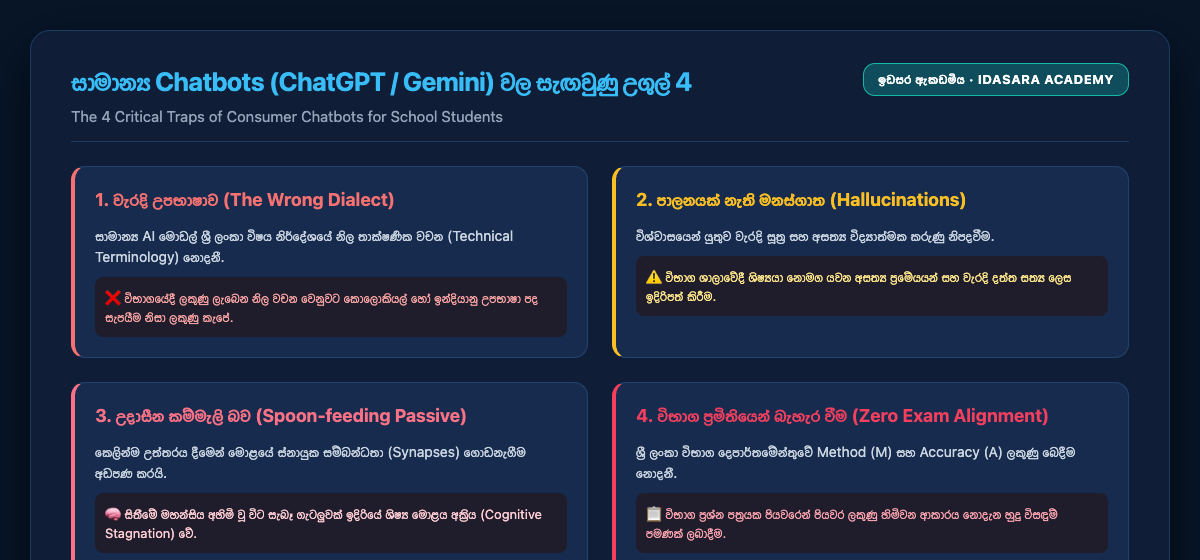
Trap 1: The Wrong Dialect
Your exam paper is not marked by professors in America or England; it is marked by the chief examiners of the Sri Lanka Department of Examinations. They award marks only for the precise terminology (keywords) in the National Institute of Education (NIE) textbook and for the prescribed method steps (Method Marks).
ChatGPT was trained on the entire world's internet data — American AP, British A-Levels, Indian JEE. It explains physics or chemistry the world's generic way. The science may be correct, but because it does not match our marking scheme, you lose the marks!
Trap 2: Silent Hallucinations
A chatbot does not stumble when it gets facts wrong; it will present a wrong date or a wrong formula to you in flawlessly elegant English or Sinhala. Believe it, write it in the exam, and every mark is gone.
Trap 3: The Answer Vending Machine
Drop a coin into a vending machine and a bottle rolls out — no questions asked. A generic chatbot works exactly the same way: the instant you paste the question, before your brain gets even one second to think, the complete answer pours onto the screen. It never does what a teacher does — ask back, "What do you think the first step is?" The answer arrives; the learning never happens. And you cannot carry the vending machine into the exam hall!
Trap 4: Unwired Chat (No Memory Bank)
Suppose you asked ChatGPT about a problem tonight and understood it. Tomorrow, that chat vanishes into the abyss. Your study system does not know you failed to understand that problem. It never enters your weekend revision schedule or your book of mistakes (Mistake Bank)!
4. The Four Questions Test for Judging Any AI Tool
Before you use any AI tool for an exam, put it through these four questions:
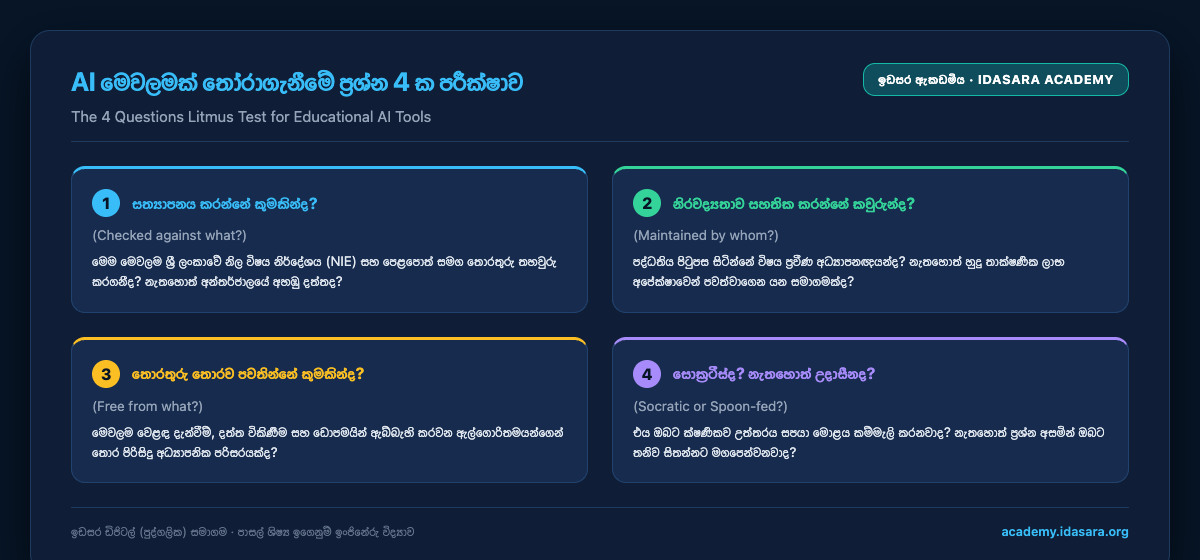
The four questions in the figure, examined closely:
- "Is this trained on our syllabus?" — Do the answers come from the National Institute of Education (NIE) textbooks and our exam patterns, or from the world's generic internet data?
- "Does this hand me the answer, or provoke me to think?" — Is it a vending machine that pours out instant answers, or a companion that guides with questions, like a Socratic teacher?
- "Can it mark my handwritten answer script against the official marking scheme?" — The exam is handwritten; can this system read that script and split out Method and Accuracy marks?
- "Does it remember my mistakes and drill me on them again?" — Is it a chat that forgets today's error by tomorrow, or a learning system that resurfaces that error at the weekend?
Ordinary ChatGPT or Gemini answers yes to none of these four questions!
5. Why Idasara Academy Is Different
To close this gap, Idasara Academy was engineered specifically for Sri Lankan students, on an educational foundation that answers all four questions completely:
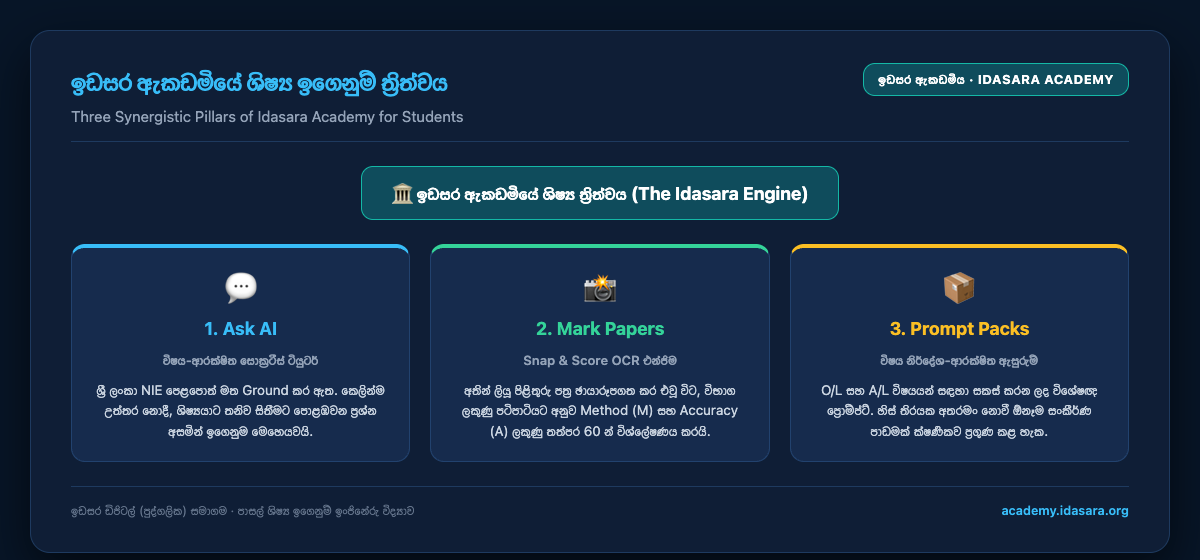
- Ask AI (the syllabus-guarded Socratic companion): It runs grounded in the National Institute of Education (NIE) syllabus and textbook sources. When you ask a question, it withholds the final answer and instead leads you toward it with questions that make you think.
- Mark Papers (handwritten answer-script evaluation): This is the task no generic chatbot can ever perform. Photograph your handwritten answer script and submit it; the system reads it, compares it against the Department of Examinations' official marking scheme, and shows you your Method Marks (M) and Accuracy Marks (A) separately!
- Idasara Prompt Packs (official prompt packages): Instead of wasting time inventing prompts, students can directly use scientifically engineered prompt packages built for O/L and A/L subjects.
📜 The Non-Negotiable Standing Rule: "Above our Academy — above any AI system whatsoever — the official school textbook always stands supreme!" AI is your companion; the final truth lives in your textbook.
6. The Three Kinds of Students in the AI Age (Which One Are You?)
The world's school students are dividing into three camps:
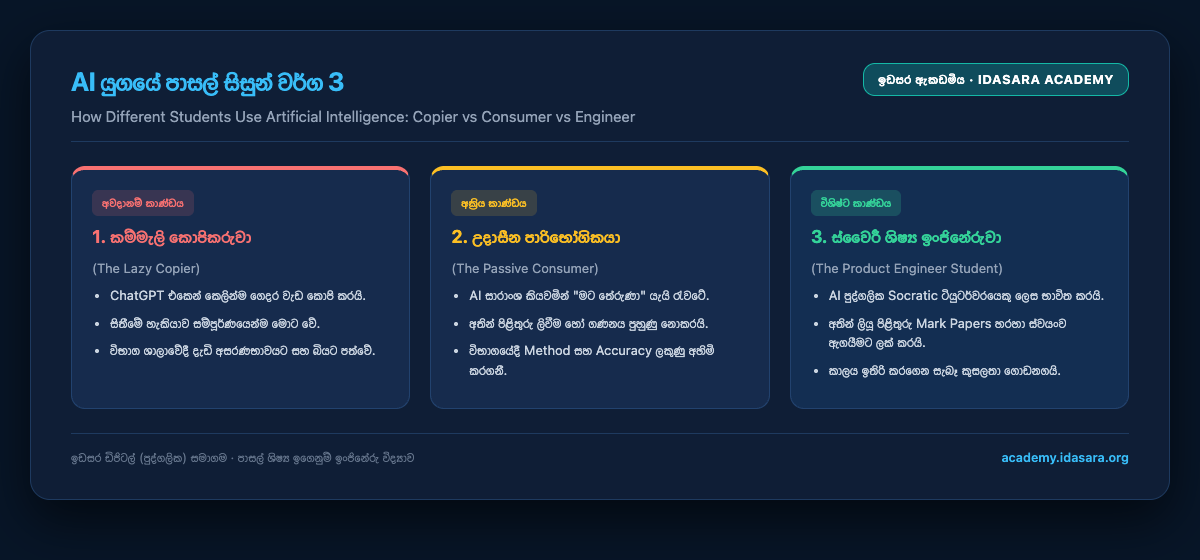
- The Shortcut Cheater: Pastes the teacher's question into an AI and copies the answer into the book without even reading it. In the exam hall, utterly helpless.
- The Fearful Luddite: Afraid of the technology, trapped in the old memorization method, flung out of the competition.
- The Empowered Thinker — this is who you must be: Never asks AI for a direct answer. Uses the Idasara methodology — Ask AI and Mark Papers — to hunt down their own mistakes and strengthen the thinking muscles of the brain.
In the next chapter, we put the Socratic method into practice: using Idasara Academy's Prompt Packs and Ask AI to solve problems step by step — without ever asking for the direct answer.