02. The Socratic Method, Idasara "Ask AI" and the Official Prompt Packs
Published 2026-09-14
Core Theme: In an exam, you earn marks not for an answer someone wrote for you, but for an answer your own brain constructed through reasoning. Instead of demanding answers from a generic ChatGPT, this chapter teaches you to build genuine understanding using Idasara Academy's official Prompt Packs and "Ask AI".
What did Socrates actually do?
Socrates, teaching in Greece 2,400 years ago, built his entire method on a single refusal: he never gave a student a direct answer.
That sounds like unhelpfulness. It was the opposite, and understanding why is the most useful thing in this chapter. When a student brought him a problem, Socrates would decline to answer and instead ask a question aimed at provoking thought. He would listen to the student's reasoning, then ask the question belonging to the next step. He steered the mind forward this way, one rung at a time, until the student's own mind arrived at the answer.
The point of the refusal is what it forces. A student who is told the answer has received information. A student who is questioned into the answer has done the reasoning — and the reasoning is the thing that will still be there in the examination hall three months later, when the information has gone.
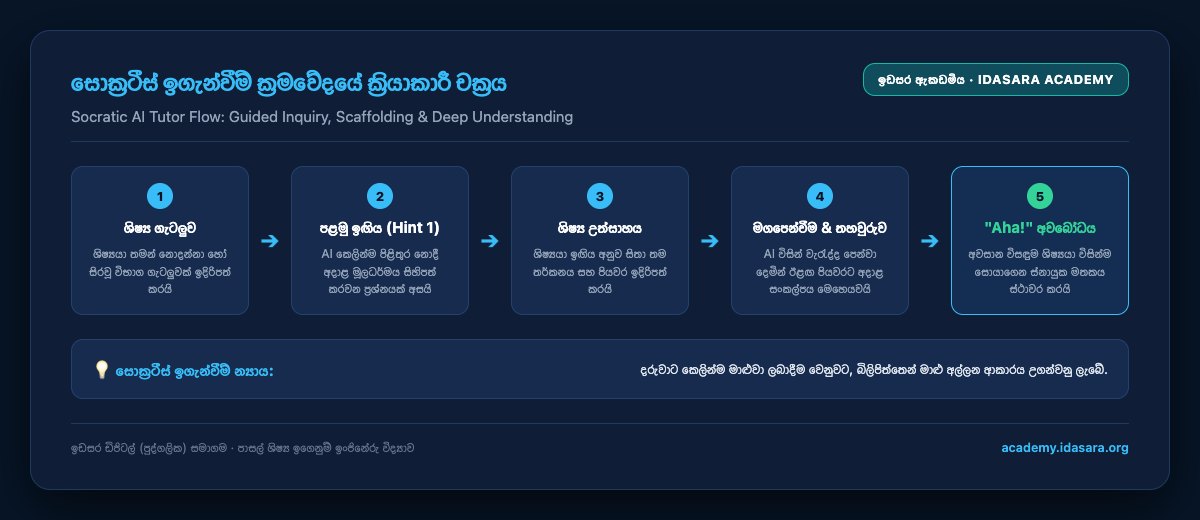
The loop, step by step
The student presents the problem, and the system does not hand over the answer. This first refusal is the whole design, and everything else follows from it.
The AI asks a guiding question aimed at the first conceptual step — "What data are you actually given here?" Notice how ordinary that question is. Most students who are stuck have skipped exactly this step, which is why so many problems dissolve the moment somebody asks it.
The student reasons and replies. This is where the real work happens, and it is the part a generic chatbot removes entirely.
The AI checks the reply and unlocks the next step. Wrong, and it points at the error and lets the student think again — it does not supply the correction. Right, and it moves up the next rung.
In the end the student finds the answer, and both the confidence of having found it and the durability of the memory belong to the student rather than to the screen.
Modern educational science calls this cognitive scaffolding. Builders erect scaffolding around a structure and take it down once the building can stand alone; the AI supports your thinking only until it does not need supporting. Scaffolding that never comes down is not scaffolding — it is a crutch, and that is precisely what a vending-machine chatbot becomes.
Why do ordinary chatbot prompts fail?
Most students open ChatGPT or Gemini, look at the blank box, and type something like:
❌ "Solve this sum for me" ❌ "Write an essay about photosynthesis"
What happens next is not the model being lazy. Generic models are trained to please the user — through a process called Reinforcement Learning from Human Feedback — so within two seconds the complete answer appears. The student's brain has learned nothing. The student has become a reader.
Consider a real scene. A Grade 10 boy at 10.30 p.m. with ten maths exercises due tomorrow. He types "solve this sum for me", copies the steps, closes the book in twenty minutes and goes to bed. Two weeks later the same type of problem appears in the term test, and his hand freezes over the blank page.
Nothing dishonest happened in those twenty minutes, and that is what makes this trap so effective. The homework was completed. The pages of his book got written. The neural connections in his brain did not.
Warning
The hidden danger of RLHF: Because a generic chatbot is trained to please you, it will praise even your half-wrong answer with "Great effort!" The chief examiner in the exam hall does not do that — he looks only at the marking scheme. What you need is not a flattering friend but a teacher who moves you to the right place.
That warning is worth sitting with, because the flattery is genuinely pleasant and genuinely harmful. A tool that tells you your answer is promising when it is half wrong has given you false information about the one thing you most needed to know. And there is a second failure underneath it: a student who cannot construct a proper prompt receives answers drawn from foreign methods that sit outside the Sri Lankan syllabus entirely.
What guardrails does a study prompt need?
Idasara Academy addresses both problems with official Prompt Packs engineered for specific O/L and A/L subjects, built on a four-layer guardrail architecture.
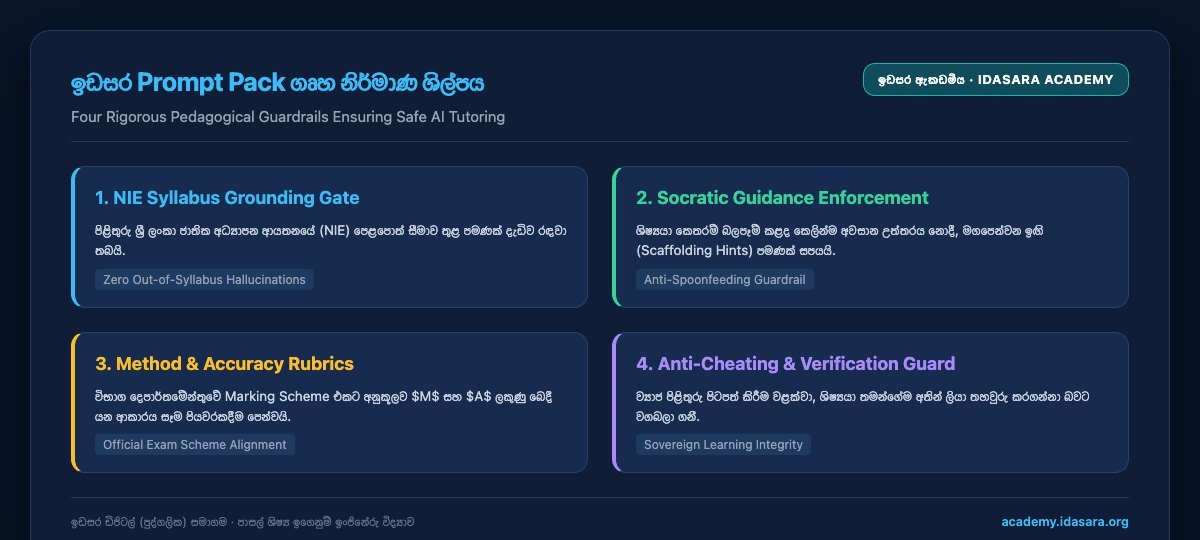
The curriculum grounding layer binds every prompt to the NIE syllabus and the official textbook terminology, which blocks foreign methods from leaking into your answer script. This closes the wrong-dialect trap from Chapter 01.
The Socratic rule layer writes the hard conditions — never give the final answer; one step at a time — into the prompt itself. The restraint is not left to the model's goodwill; it is an instruction the model has to follow.
The negative constraint layer is the protective fence: no guessed facts, no out-of-syllabus methods, no word-limit violations. As Chapter 01 noted, telling a model what it must not do is often more decisive than telling it what to do.
The mistake extraction layer captures the places where you went wrong during the conversation and routes them into your revision cycle — which is what turns a single study session into a system that knows something about you.
Three prompt packs you can use tonight
Prompt Pack 01: O/L Science — balancing chemical equations
💡 Copy the Idasara Science Prompt Pack:
"You are the Idasara Academy science tutor teaching the Sri Lankan NIE syllabus. I need to balance the chemical equation below.
Strict conditions: 1. Under no circumstances give me the final balanced equation! 2. Follow the Socratic method and discuss exactly one step with me at a time. 3. First, ask me to list the types of atoms on the reactant side and the product side, and how many of each there are. Check my answer before moving to the next step.
My equation: Fe + O₂ → Fe₂O₃"
What actually happens
The AI does not write 4Fe + 3O₂ → 2Fe₂O₃. It asks: "How many iron atoms are on the reactant side? How many oxygen atoms?"
As you count and answer alone, your brain is being trained to balance equations — which is the skill the examination tests. The balanced equation itself is worth nothing to you; the counting habit is worth everything.
Prompt Pack 02: O/L Mathematics — proving a geometry theorem
💡 The Idasara Mathematics Prompt Pack:
"You are the Idasara Socratic coach for O/L Mathematics. I need to work through the proof of a geometry theorem.
Conditions: 1. Do not write out the complete proof at once. 2. First ask me to state the 'Given Information' and 'What needs to be proved'. 3. Make me decide whether the proof requires an additional construction. 4. Make me write the geometric reason for each individual step.
Theorem: The perpendicular drawn from the centre of a circle to a chord bisects the chord." Look at the third condition — making you decide whether the proof needs an additional construction. That single decision is where most geometry proofs are won or lost, and it is exactly the decision a finished proof hides from you. Reading someone else's completed proof, the construction line looks obvious. Producing it from nothing is the actual skill.
Prompt Pack 03: A/L Physics — equations of motion
💡 The Idasara Physics Prompt Pack:
"You are an expert Idasara tutor for the A/L Physics syllabus. I am attempting the problem below.
Solution protocol: 1. Do not give the final numerical answer. 2. First check whether I have correctly identified the data in the problem ($u, v, a, s, t$). 3. Guide me toward selecting the appropriate equation of motion. 4. Make me confirm that my unit conversion ($km/h$ to $m/s$) is correct.
Problem: [Insert the past-paper A/L problem here]" The fourth condition — confirming your unit conversion from km/h to m/s — looks trivial beside the physics. It is there because unit errors are one of the most common ways a student who fully understands the concept still loses the mark. A good study system spends attention where the marks are actually lost, not where the theory is most interesting.
How the "Ask AI" service works
You do not have to copy these prompts anywhere. Inside the "Ask AI" tool at academy.idasara.org, the Socratic teaching rules and the NIE textbook grounding are already built into the system.
Three things come with it. Five free questions a day for every Sri Lankan student. Textbook grounding, so answers come only from the national syllabus. And mistake extraction, where every place you go wrong is recorded automatically and brought back to you at the weekend.
That last feature is the one worth valuing most, and it is the hardest to appreciate while using it. A chat you had on Tuesday is gone by Wednesday. A system that remembers your Tuesday error and puts it in front of you on Saturday is doing the single most effective thing in learning science — spaced retrieval of the exact material you got wrong — without requiring you to have the discipline to organise it yourself.
🎬 Watch the animated story (2 min): The Tutor Who Never Gives the Answer — Ask AI & Self-Paced Learning
In the coming chapters we apply this method to the STEM subjects and to History — and in Chapter 05 we examine in detail Snap & Score, the world's first system that marks handwritten exam scripts against the official marking scheme.