05. Exam Mastery: Active Recall and the Idasara Snap & Score Revolution
Published 2026-09-14
Core Theme: You cannot conquer an exam by reading a textbook ten times, because reading is a passive act. Real marks are built by closing the book, pulling answers out of memory onto paper (Active Recall), having your handwritten script marked against the official Marking Scheme (Snap & Score), and repairing exactly what went wrong.
Why does four hours of studying produce so little?
Watch how most schoolchildren study. They read the textbook and their notes again and again. They paint the important sentences with a yellow highlighter. They copy out beautifully condensed notes — while looking at the notebook.
After four hours the child feels: "Now I really know this lesson." Educational psychology has a name for that feeling, and it is not a compliment: the illusion of competence.
The cost of that illusion is enormous and almost entirely invisible. An O/L candidate studying five hours a day, four of them spent reading, highlighting and copying, puts in 28 hours a week — more than 1,400 hours a year. Only a small fraction of that investment converts into marks, because the one thing that builds retrievable memory almost never happens in those hours. The problem is not the child's effort. It is the method. These students are working extremely hard at an activity that does not do what they believe it does.
Then the blank question paper arrives, and it has all evaporated.
The reason is mechanical. Looking at the book, your brain performs recognition — it sees the sentence and thinks yes, I know that, at almost no cost. In the examination, marks are earned by pulling facts out of memory onto a blank page by hand, which is an entirely different and much harder operation. Practising recognition and being tested on recall is like training for a swimming race by watching videos of swimmers.
What method actually works?
Thousands of educational studies worldwide converge on one answer (Dunlosky et al., 2013): the single method producing the highest examination results is practice testing and active recall.
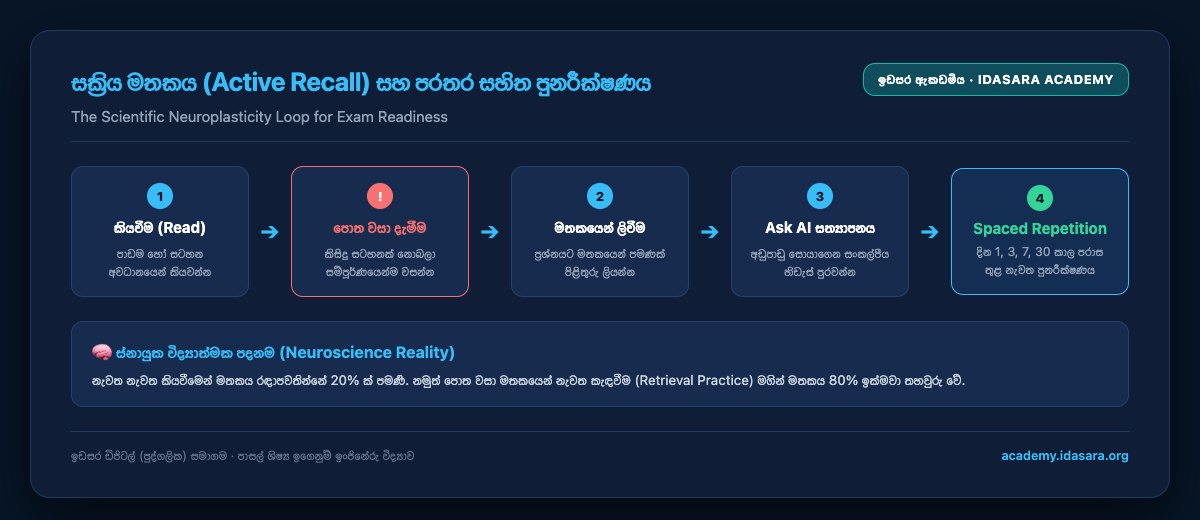
The principle is uncomfortable and simple. You must close the book and try to produce the answer, and the moment of effortful struggle — the bit that feels like failure — is exactly where the learning occurs. Retrieval that feels easy is building very little. Retrieval that hurts slightly is building a lot.
Worked this way, the connections between your neurons harden like letters chiselled into rock, and the exam hall holds no surprises.
The one task no generic chatbot can do
However capable ChatGPT or Gemini become, there is one thing they cannot do for an examination candidate, and it happens to be the most important thing.
"Your exam is handwritten. A generic chatbot cannot read three pages of your handwritten Combined Maths or Science answers and mark them according to the official Marking Scheme!"
To see why that matters, you need to know how marks are actually awarded. The chief examiners of the Sri Lanka Department of Examinations divide them into two parts.
Method marks are awarded for the correct formula, the theory, and the steps taken toward the solution. Accuracy marks are awarded for the final simplification and the correct answer with its unit.
Here is the consequence that most students never learn: a candidate whose final answer is wrong can still collect the majority of the method marks, provided the steps are correctly written. Marks are not all-or-nothing, and knowing that changes how you should write an answer under time pressure — you write the method out fully even when you suspect you will not reach the end.
A generic chatbot sees only that the final answer is wrong. It has no mechanism for awarding marks to the steps, which means its feedback is not merely incomplete but actively misleading about how you performed.
How Snap & Score closes the gap
To close that gap, Idasara Academy built Snap & Score — an exam-script evaluation engine, developed for Sri Lankan students first.
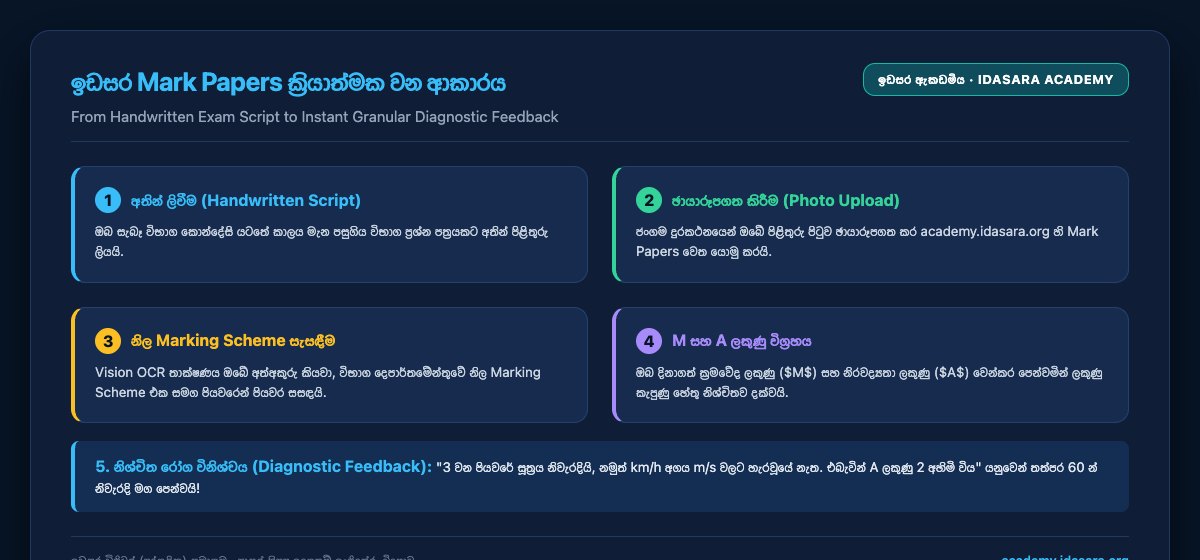
Snap
Answer a past paper by hand on blank paper, photograph it, and submit. Note what this forces: you train under the exact conditions of the examination hall, by hand, on blank paper, with no book open. Most study methods fail precisely because they are more comfortable than the exam.
Handwritten recognition
The system reads your handwriting, your equations and your diagrams. This is the step no generic chatbot can take, and it is what allows everything after it.
Comparison against the official marking scheme
Your answer is checked not against the internet's general knowledge but against the Department of Examinations' official marking scheme — which, as Chapter 01 explained, is the difference between being correct and being credited.
Method and accuracy separation
Every step receives its method marks and accuracy marks separately, so the precise reason for each lost mark is visible. A student who loses method marks needs to revisit the concept. A student who loses accuracy marks needs to train attention. Those are different problems with different remedies, and a single total conceals which one you have.
Deposit into the Mistake Bank
Each identified weakness is wired automatically into your Mistake Bank and progress map, and the next revision cycle is scheduled. Nothing depends on you remembering to organise it.
Used properly, a student can find and repair their mark-losing blind spots before walking into the examination hall.
Important
The value of knowing the truth before the exam: the average child discovers their true level on results day — when nothing can be changed. The child who uses Snap & Score learns that truth weeks before the exam, while there is still time to fix it. The difference lies not in the knowledge, but in when it becomes known.
That last sentence is worth reading twice. Both students eventually learn exactly the same fact about themselves. One learns it while it is still actionable.
The Mistake Bank: why strong students stop repeating errors
"The only difference between the outstanding student and the average student is this: the average student repeats the same mistake in exam after exam; the outstanding student writes the mistake down and drills it until it can never happen again."
The most valuable component of both Ask AI and Snap & Score is the Mistake Bank, and the reason is that it automates the habit described above — a habit almost every student agrees with and almost none maintains.
Whenever Snap & Score marks a script, or you stumble during an Ask AI discussion, that error is deposited into your personal Mistake Bank automatically. A spaced repetition engine then brings it back on a deliberate schedule: after three days, a short exercise on that exact concept; after a week, a deeper question testing your memory again; after a month, a consolidation as pre-exam rehearsal.
Those intervals are not arbitrary. They are timed to catch the concept just as it begins to fade, because retrieving something you have almost forgotten strengthens the memory far more than retrieving something still fresh. Reviewing too soon feels productive and achieves little.
Your errors are not buried in a chatbot's forgotten history. They become the fuel.
Reading your Mastery Heat-Map
The most useful thing the Idasara Academy app puts in your study room is the Mastery Heat-Map — a picture of which parts of the syllabus you actually command, rather than which parts you have covered.
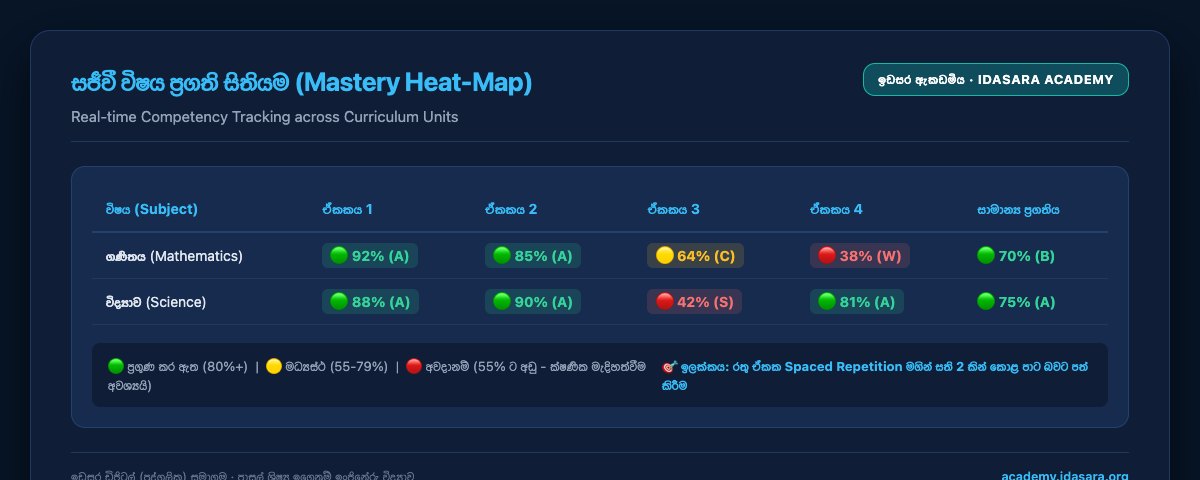
Coverage and mastery are not the same thing, and the gap between them is where results are lost. The heat-map shows the difference, which means it will occasionally tell you something unwelcome about a topic you believed was finished. That is the point of it.
So what should you do when you find a red cell? Something small and immediate, which is why the drill below is fifteen minutes rather than an afternoon.
🚀 The 15-minute action drill the moment you spot a red cell (critical gap): 1. Do not panic: a red cell does not mean you are stupid; it means one small concept has slipped. 2. Open Ask AI: click the red cell and interrogate the unit's core concept Socratically with Ask AI (7 minutes). 3. Work one problem by hand: solve a similar past-paper problem on blank paper (5 minutes). 4. Snap & Score it: photograph it and submit it for marking (3 minutes).
The result: your red cell turns yellow! Check again in a week and it has turned into a green-cell A. Notice the first instruction. A red cell is information, not a verdict — it means one concept slipped, and it has now been located precisely enough to fix in a quarter of an hour. The reason this drill works is that it closes the full loop in one sitting: understand the concept, produce it by hand, get it marked. Any one of those three alone would leave the cell red.
Flashcards: ten minutes a day
Flashcards are excellent for the material that must simply be held — formulas, definitions, dates.
💡 The Idasara Flashcard Generator Prompt: "From the Grade 11 Science lesson 'The Chemical Basis of Life', create 10 flashcards from the 10 definitions and facts most essential for the exam. * Front: the short question * Back: the concise answer, in the official textbook's own words Give this to me as a table." The condition worth copying is the concise answer, in the official textbook's own words. A definition you can produce in your own approximate phrasing may not earn the mark; the examiner is looking for the textbook's terminology, as Chapter 01's first trap explained.
Ten minutes with these cards on the bus, or before sleep, does more for examination anxiety than an hour of re-reading — because anxiety before an exam is mostly uncertainty about what you can retrieve, and flashcards answer that question directly.
Closing note
Examination marks are not luck attached to memorisation. They are the product of running three things systematically: active recall, handwritten script evaluation, and the Mistake Bank.
Each one addresses a specific failure. Active recall fixes the illusion of competence. Script evaluation fixes the misdiagnosis of what went wrong. The Mistake Bank fixes the repetition of errors you have already made. Together they replace hope with a process.
In the next chapter, we take a hard look at the intellectual frauds a student must never commit — and the ethics of the honest student.