06. Student Ethics and Defeating Intellectual Laziness (Academic Integrity & Cognitive Resilience)
Core Theme: You can use AI to deceive your teacher or the exam hall; but you can never deceive yourself. Copy your homework from an AI and collect your "A" grades — and in the real world you will eventually stand revealed as a person with nothing inside. The only real victory is intellectual honesty.
1. Cognitive Atrophy: How a Brain Falls Idle
In medicine, when a broken arm or leg spends three months in a plaster cast, the limb emerges thin and lifeless, its muscle wasted away. The reason: any organ of the body left unused steadily decays (disuse atrophy).
The human brain works in exactly the same way. If, instead of regularly straining your brain —
- to write an essay,
- to solve a mathematics problem,
- to read a book and build your own summary —
you hand it all to an AI and watch, then within a few years your brain's capacity for deep thought and independent judgment will be destroyed.
This is called Cognitive Atrophy.
You may copy your homework and collect ten out of ten from your teacher — but what you have actually accomplished is the deactivation of your own brain's muscle. At tomorrow's job interview, or in the moment you must make a decision that steers a country, there is no ChatGPT in your hand; the only thing under examination there is the strength of your own mind!
2. Teachers Always Know
Many school children believe that when they hand the teacher an essay written by AI, the teacher is fooled.
But an experienced teacher can tell within ten seconds whether your essay came from an AI:
- Vocabulary Mismatch: when a Grade 9 or 10 child who speaks ordinary classroom language submits an essay containing phrases like "the contradictory paradigms of socio-economic variables" — university-professor language — the teacher sees the truth instantly.
- The Oral Defense Test: the teacher needs only one move: "Son, explain to me in your own words — without looking at the paper — what this paragraph says." The student who copied stands stammering, speechless, on the spot.
Never let yourself be brought to that humiliation before your teacher.
3. The Golden Rule of Student Ethics: Transparency
So what is the honest way for a student to use AI?
The answer: full transparency.
If you received AI assistance on an assignment or project, do not try to hide it. Instead, add a note like this at the end of your submission (an AI Disclosure Statement):
📝 Sample Student AI Disclosure:
"For this essay, I used Claude / ChatGPT to help organize my ideas and prepare the outline. However, every sentence and every analysis here was written in my own words, and the facts were verified against my school textbook."
A teacher looks at a student who writes such a note not as a cheat, but as a mature, intelligent student who uses technology responsibly.
4. The Verification Habit: Do Not Be Fooled by AI Hallucinations
As we examined in depth in Core Module 06:
An LLM is not an engine of truth. It is a probability engine that guesses the most plausible next word.
An AI tool is like a confident intern. It works with dazzling skill and speed; but when asked something it does not know, instead of stopping to say "I don't know," it fabricates without hesitation. Just as a senior doctor checks the intern's report before signing it, you are the one who must check every fact the AI gives you before it goes into an exam script.
So when you ask an AI for the year of a battle, the name of a scientific law, or a mathematical formula, be warned: it can sometimes deliver a completely false fact in supremely elegant English or Sinhala (a hallucination).
Trust it blindly, write it in the exam paper, and every mark is lost.
Therefore, the non-negotiable habit of the student must be:
- Cross-verify every fact the AI provides against your official government school textbook or the Department of Examinations' resource book.
5. The Dopamine Scroll Trap: The Catastrophe of Scattered Attention
Beyond AI itself, the most powerful invisible enemy facing today's school student is the cheap dopamine loop that social media (TikTok, Instagram Reels, YouTube Shorts) ignites in the brain.
- Watch one 15-second video, and dopamine — the brain's pleasure chemical — spikes instantly.
- Watch fifty such videos over an hour, and the prefrontal cortex — the brain region needed for deep thought — is left dehydrated and exhausted.
- The result? Your attention span shrinks to seconds — too short to read a mathematics problem or a difficult science passage for even twenty consecutive minutes.
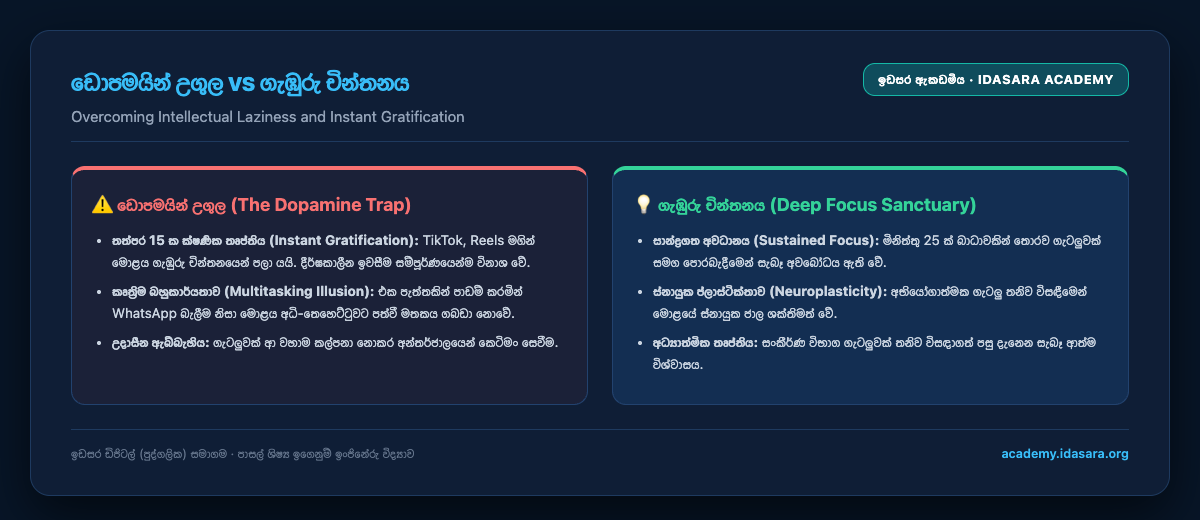
You can harvest AI's full power only when your attention is sharp and stable. To a student whose focus snaps every fifteen seconds, AI is just one more time-wasting toy!
6. The Deep Work Sanctuary Protocol
To escape the dopamine trap — and win both top exam marks and genuine intellectual growth — build a Deep Work Sanctuary in your study room:
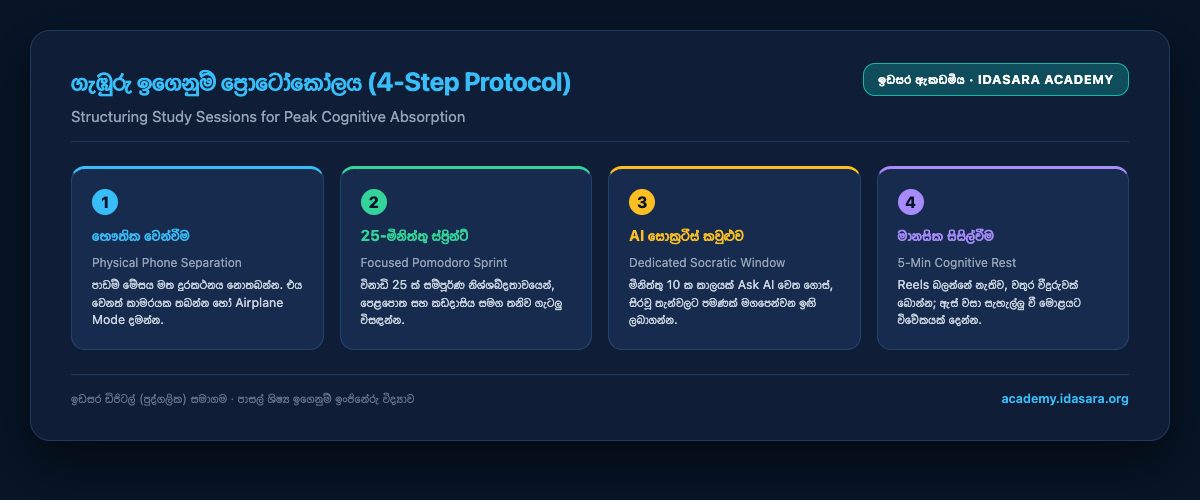
The sanctuary's core rules shown in the figure:
- The phone stays outside the room: silent mode is not enough — psychology has confirmed that a phone merely visible in the room steals a share of your attention.
- 25-minute Pomodoro blocks: one concept of one subject per 25-minute block; then a real 5-minute break (walk, drink water — not a screen!).
- One task at one time: every leap from the maths problem to a WhatsApp message costs the brain several minutes to sink back into deep focus (context-switching cost).
- AI use obeys the sanctuary's rules too: when working with Ask AI, dedicate those same 25 minutes to that one concept — bouncing between ten tabs is not deep learning.
A student who follows this protocol can achieve, in two concentrated hours a day (2 hours of deep work), double the productivity of another child sitting six hours in a tuition hall!
Tip
Try it tonight: before tomorrow's studying, leave your phone in another room and give 25 minutes to one type of maths problem only. The mental clarity you feel at the end of those 25 minutes will teach you — better than any lecture — what three hours of "studying with the phone in hand" never gave you.
In the final chapter: the 5 Golden Rules a Sri Lankan student needs to conquer the AI-age world, the crossroads after the O/L exam (Kavee's journey), and the Idasara vision for education.