07. The 5 Golden Rules for Students and Readiness for the Future World
Published 2026-09-14
Final Message: "In the age of artificial intelligence, the most helpless people in the world will be the students who memorized their way through exams; the most powerful people steering the world will be the creative students who made AI their companion and can solve problems independently. The choice is yours."
The five golden rules
Everything in this book compresses into five rules. They belong on the wall beside your desk, because their value is in being seen at the moment a decision is made rather than remembered afterwards.
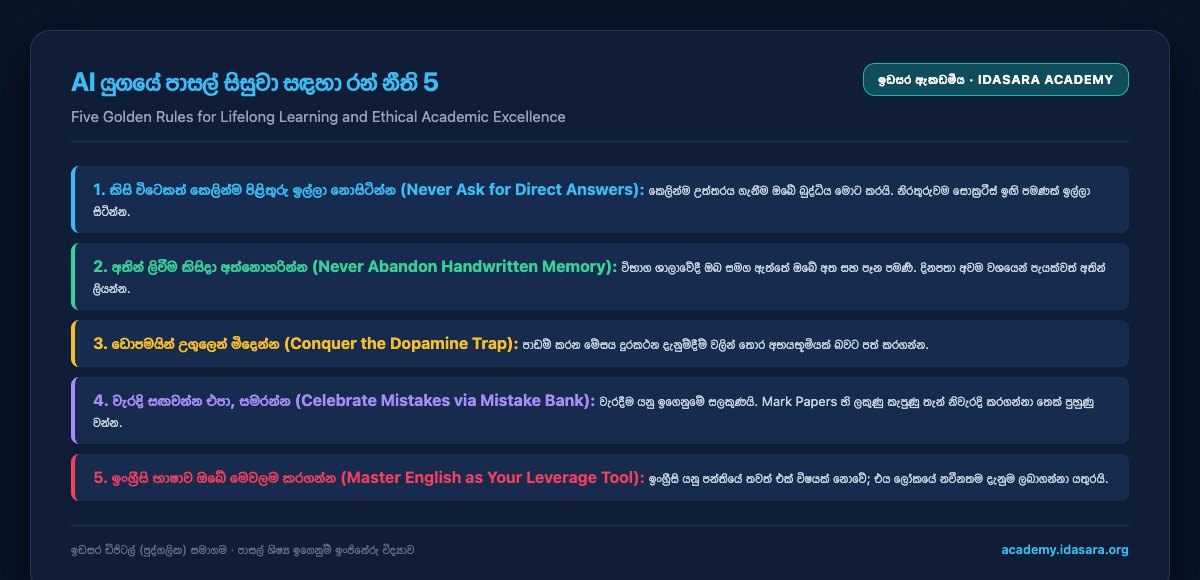
Rule one: the textbook and the teacher come first
Whatever frontier model arrives, your marks are decided by the NIE syllabus and the official textbook. Verify what an AI tells you against the textbook, and where they conflict, the textbook wins — not because it is always more accurate in the abstract, but because it is what the examiner marks against. Chapter 01's first trap was exactly this, and it catches able students rather than weak ones.
Rule two: ask for the path, not the answer
"Solve this for me" is the vending-machine prompt, and it wastes the only thing that matters. Make the Socratic request your permanent habit instead: "Lead me step by step to my own answer; do not give me the final one."
The difference between those two prompts is the difference between finishing homework and acquiring a skill. Both take a similar amount of time tonight. Only one of them is still with you in the examination hall.
Rule three: verify everything
AI is a confident intern — fast, capable, and willing to fabricate what it does not know without a flicker of hesitation. Every AI sentence that enters your answer script unread is a live risk to your marks.
Reading is the only wall that keeps you in control, and Chapter 06 explained why it cannot be delegated: a fabricated fact and a true one are generated by the same process and arrive looking identical.
Rule four: mine your mistakes
Once a week, Snap & Score a handwritten past paper and study the method and accuracy breakdown. As long as your red cells keep flowing into the Mistake Bank and back into your revision, you are becoming the student who does not repeat an error.
The weekly rhythm is the operative part. One paper a week, marked properly and acted on, outperforms a month of reading — because it generates information about you that reading cannot.
Rule five: work with radical transparency
Declare AI assistance openly on any assignment that used it. You may manage to fool a teacher; you can never fool yourself, and the examination hall settles the matter regardless.
Intellectual honesty is not a constraint that slows you down. It is capital accumulating in your own name — the only account that still holds anything when the homework marks are forgotten.
Important
The first four rules protect your marks; the fifth builds your character. Exams are passed with marks — but life is won with character.
Tuition hours or YOU hours?
Recall the Grade 11 girl from Chapter 01: five tuition classes a week, Rs. 15,000–25,000 a month, home after 9 p.m.
Now do the arithmetic of her week. Fifteen hours of classes plus six hours of travel is 21 hours surrendered to someone else's pace and someone else's timetable. Not wasted, necessarily — but not chosen either, and not aimed at her particular weaknesses, because a hall of three hundred students cannot be.
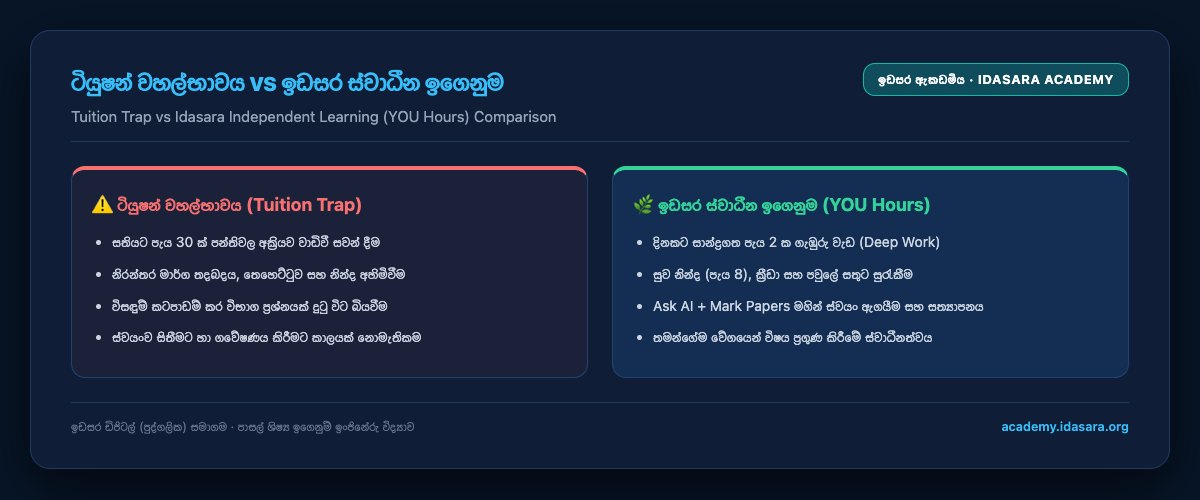
Set that against what Chapter 06 established: two hours of deep, focused work outperform six distracted hours in a hall. The conclusion follows without much argument.
Keep the tuition classes for the one or two subjects where you genuinely need a teacher's guidance — some subjects and some students really do.
Reclaim the remaining hours. These are your YOU hours, and the tools now exist to use them properly: Ask AI as the Socratic tutor, Snap & Score as your personal examiner, the Mastery Heat-Map as the picture of where you actually stand.
The result is learning at your own pace, aimed at your own weaknesses — and hours returned to sleep, sport, family and your own curiosity, which are not luxuries subtracted from study but conditions for it.
Tip
Before dropping any tuition class, run a two-week test: mark two past papers in that subject through Snap & Score. If your $M$ marks exceed 70%, that class is no longer teaching you anything new — what you need now is practice and feedback.
That test is worth following exactly, because it replaces a decision made on feeling with one made on evidence. Method marks above 70% mean you have the concepts; what remains is repetition and correction, and both are available to you at home.
The crossroads after O/L: Kavee's three pathways
On the day O/L results arrive, the same question is asked in every home from Monaragala to Colombo: "So — what now?"
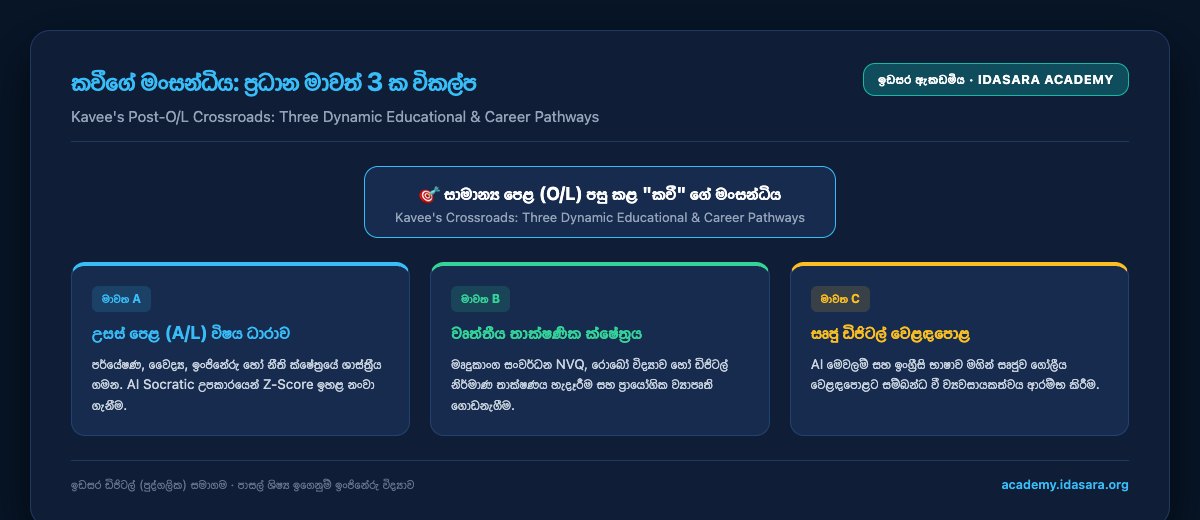
The academic path runs A/L, then university. A worthy road — and passage through the Z-Score cut-off, the statistical ranking that rations Sri Lanka's limited state university places, is granted to only a few. AI is the Socratic companion that improves your odds on this road, but the arithmetic of the cut-off remains what it is.
The professional skills path runs through technical, vocational and diploma training into direct employment. With AI-supported self-study, this route can be compressed by months — and it leads to earning sooner, which for many families is the decisive consideration.
The builder path means building small projects, digital creations and services while still studying. This door stayed shut to previous generations until around age 25, because it required capital, tools and technical staff. AI has opened it at school age, which is genuinely new.
The most important word attached to these three is dynamic. They are not separate, irreversible roads, and the anxiety on results day comes mostly from believing that they are. A student carrying the Learn to Learn skill keeps lifelong freedom to move from any path to any other. Real security lies not in which path you pick but in carrying the learning engine with you — because that engine works on all three.
Passive student, or product engineer?
The whole mental shift this book describes fits into one comparison.
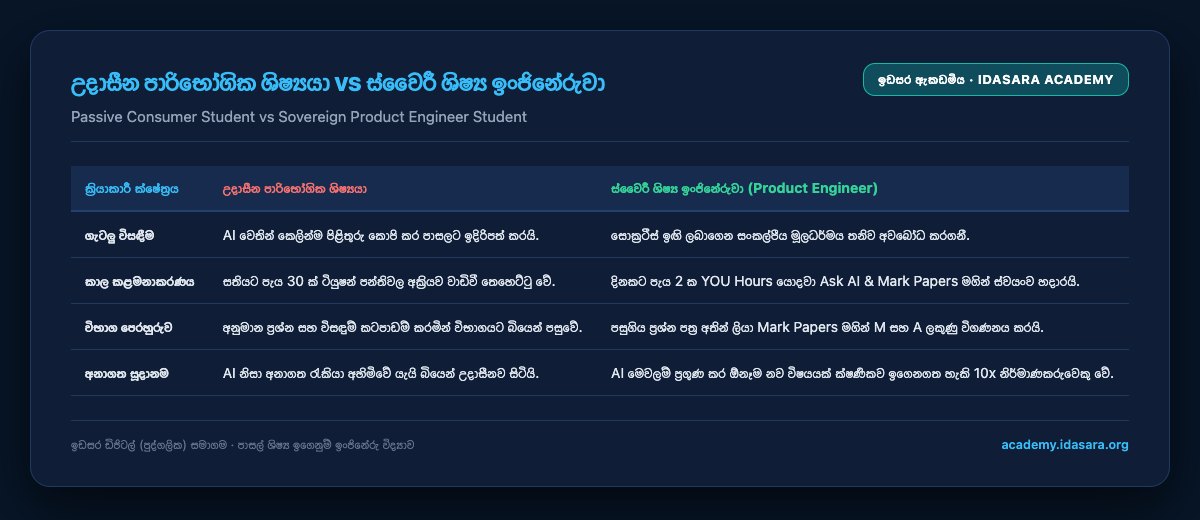
| The Passive Student | The Product Engineer Student (this must be you!) |
|---|---|
| Waits for the lesson to "arrive" — teacher, tuition, notes. | Identifies their own weaknesses themselves (Heat-Map, Mistake Bank). |
| Reads and highlights received notes (Illusion of Competence). | Designs their own weekly learning plan. |
| Copies answers and "finishes" assignments. | Realizes the plan through Active Recall and Snap & Score. |
| Is surprised on results day. | Measures results weekly and continuously improves the method (Operationalize). |
| Read down the right-hand column and notice what it describes: identify, design, realise, improve. That is an engineering cycle, applied to your own learning rather than to a product. |
Just as a product engineer is worth more than a coder who only types syntax, the student who engineered their own learning system will always stand ahead of the one who memorised answers — because the system keeps working after the syllabus changes. Your first engineering product is your own education.
The three things no machine will hold
If AI does everything, what is left for humans? — the question your generation asks most often. The answer is specific rather than reassuring.
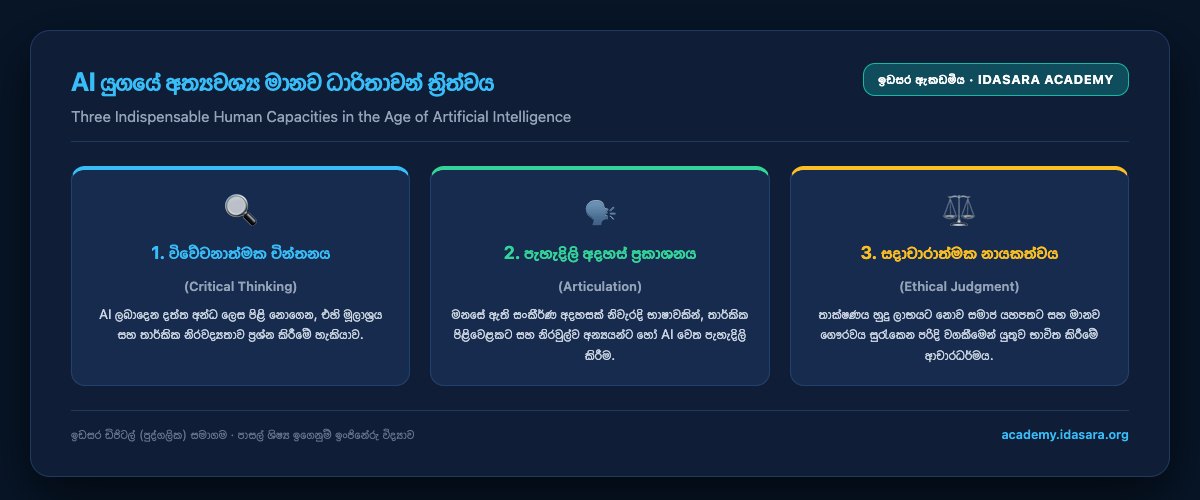
Creative curiosity. AI is unmatched at answering. It is the human who decides which question is worth asking, and every discovery that changed the world began with a question nobody had thought to ask rather than with an answer.
Empathy and collaboration. Understanding a friend's sorrow, encouraging a team, building trust — these happen between human beings, and no amount of fluency substitutes for being present.
Judgment and accountability. AI proposes; the human decides and answers for the consequences. This is the lesson even a firm as large as Deloitte learned expensively, as Core Module 06 recounts: the responsibility of the person who signs can never be transferred to a machine.
Here is the uncomfortable part, and it is worth knowing early. School examinations reward only a narrow slice of the first capacity and essentially none of the other two. The world of work prices all three. So cultivate all three deliberately from your school years, because nothing in your report card will remind you to.
Your onward journey with Idasara Academy
Idasara Academy provides Sri Lankan students a digital learning toolkit, free and at accessible prices, aimed at both school results and the longer-term mindset.
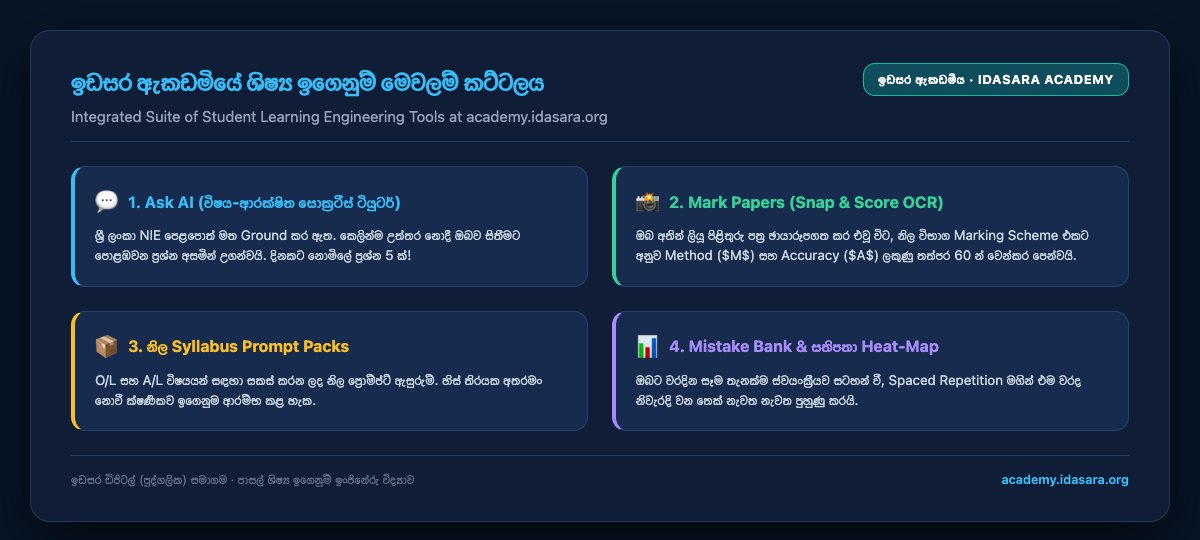
🌐 The official Idasara Academy site — https://academy.idasara.org/ — where Ask AI and Snap & Score can be tried live rather than read about.
🪜 The Idasara English Learn Ladder — https://academy.idasara.org/english-learn-ladder/ — the framework from Chapter 04 that carries children studying in their mother tongue, step by step, to international-grade English.
🧠 The Learn to Learn framework — the methodology for mastering any new subject, technology or skill by self-study, in remarkably little time. Of everything here, this is the one that keeps paying out long after school.
📜 The Final Non-Negotiable Standing Rule: "Whatever frontier AI model or technology the world produces, the official school textbook and the teacher's guidance stand above it all — always!"
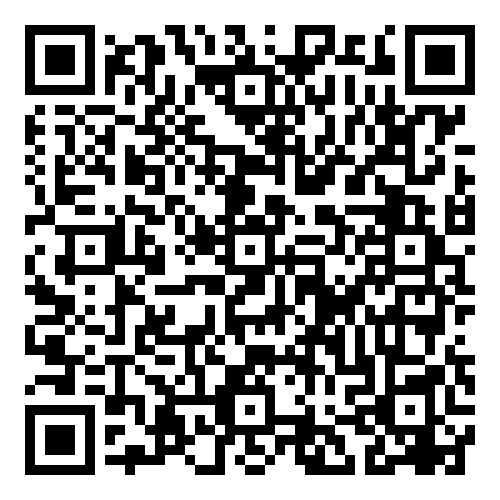 Figure 7.1: QR code for reaching Idasara Academy's free educational resources and digital learning portal (academy.idasara.org)
Closing Note: Tomorrow Is in Your Hands!
"A ship is perfectly safe moored in the harbour. But ships were not built to sit in harbours; they were built to beat the waves and conquer the ocean!"
Dear daughter, dear son,
The school exam is only the beginning of your journey. Make AI not a wall that confines your thinking, but the wind that strengthens your wings.
Do not surrender to the laziness of copied homework. Look at the world with curiosity. Ask questions. Take what you do not know to the AI and learn it deeply. Paste the 5 Golden Rules beside your desk, measure your own progress week by week, and become the Product Engineer of your own education.
You are not a mark on an exam paper. You are the boundless creator of a future that can turn Sri Lanka — and the whole world — toward the good.