04. Humanities, History and the English Learn Ladder
Core Theme: History is not a list of kings' names and dates to be memorized; it is the cause-and-effect analysis of human decisions. And English is not the badge of a social class above you; it is the key that opens the entirety of the world's knowledge. AI can turn both into superpowers you own.
1. History: Cause-and-Effect Chains Beyond Memorization
The reason so many school students dislike History is that our exam culture too often asks only for the memorized names of kings, the years of wars, and the clauses of treaties.
But thinking like a historian is something else entirely. History asks:
- What were the political, economic, and social causes that led to an event?
- What were the effects of that decision?
- What lessons does it hold for our present and future?
The real taste of a cause-and-effect chain: memorization vs. understanding
Take an O/L History question: "Explain the causes of the Kandyan Convention of 1815" — the treaty by which the island's last independent kingdom passed to the British. The memorizing student struggles to hold five bullet points in his head — and forgets them in two weeks. The cause-and-effect thinker works with AI like this:
💡 The Cause-and-Effect Chain Prompt:
"I am an O/L History student. Do not give me a list of facts about the Kandyan Convention of 1815. Instead: build up, step by step, a cause-and-effect chain showing how three factors — (1) the internal political situation of the Kandyan Kingdom at the time, (2) the economic and military aims of the British, and (3) the expectations of the Kandyan chieftains — interlocked to produce the final event. At every step, ask me 'Given this, what do you think happened next?' and open the next link of the chain only after my guess."
A chain of events learned this way is never forgotten in the exam hall — because it is no longer a list; it is a story your own mind built.
Live Conversations with Historical Figures (Simulating Historical Personas):
The most delightful way to learn history so that it never leaves you is to assign the AI the persona of a historical figure and hold a live question-and-answer conversation with that character (the Role-Based Prompting method we covered in Core Module 05):
💡 The Historical Dialogue Prompt:
"Take on the persona of King Parakramabahu the Great, who reigned in the Polonnaruwa era. I am a Grade 10 school student visiting your kingdom.
I want to know: 1. How did the principle 'let not even a single drop of rain that falls from the sky flow to the sea without serving man' come to your mind? 2. What were the greatest engineering challenges your builders faced in constructing the Parakrama Samudra, your great reservoir?
Please answer my questions in the dignified, wise voice of a king of that age. Then ask for my own thoughts."
After a conversation like that, no child ever forgets the irrigation engineering and economic self-sufficiency of the Polonnaruwa era.
2. Literature and Essay Craft: You Are the Author — AI Is the Architect
In term tests and at the O/L examination, a long essay worth 15 or 20 marks appears in Sinhala, Tamil, or English.
The lazy student's move: "Write me a 300-word essay on this topic" — copy, paste, done. This is a serious mistake.
The skilled student uses AI as their Essay Architect:
💡 The Essay Blueprint Prompt:
"For [subject], I am preparing to write a 400-word essay on 'How digital technology and AI can contribute to Sri Lanka's economic revival.' Please do not write the essay for me! Instead, to help me construct a powerful and compelling essay, give me: 1. a strong thematic hook or concept for the introduction, 2. three main arguments with supporting points for three body paragraphs, 3. one counter-argument and how to answer it, 4. an outline for a powerful conclusion.
I will write the essay myself from that blueprint."
This is how you master the real art of essay writing: paragraph discipline, and the craft of building an argument.
3. The Idasara English Learn Ladder
What is the single greatest barrier that holds back hundreds of thousands of Sri Lankan school children — in their exams and in their dreams of future careers? Fear of the English language.
That fear is born in the classroom. When the teacher asks a question in the English period, even the child who knows the answer does not raise a hand — because if one word comes out wrong, the whole class will laugh. This is the secret of how a child can "learn" English for ten years and still be unable to speak one sentence without fear: our society has never given the child the space to make the thousands of mistakes that learning a language requires. And here AI opens a historic door — for the first time in the world, every child owns a language practice partner that never laughs, never tires, and has infinite patience.
The heart of the "English Learn Ladder" framework I introduced through Idasara Academy is this:
Your mother tongue (Sinhala or Tamil) is not your weakness; it is the foundation of your thinking power. All you need is a ladder that translates that thinking, step by step, into English.
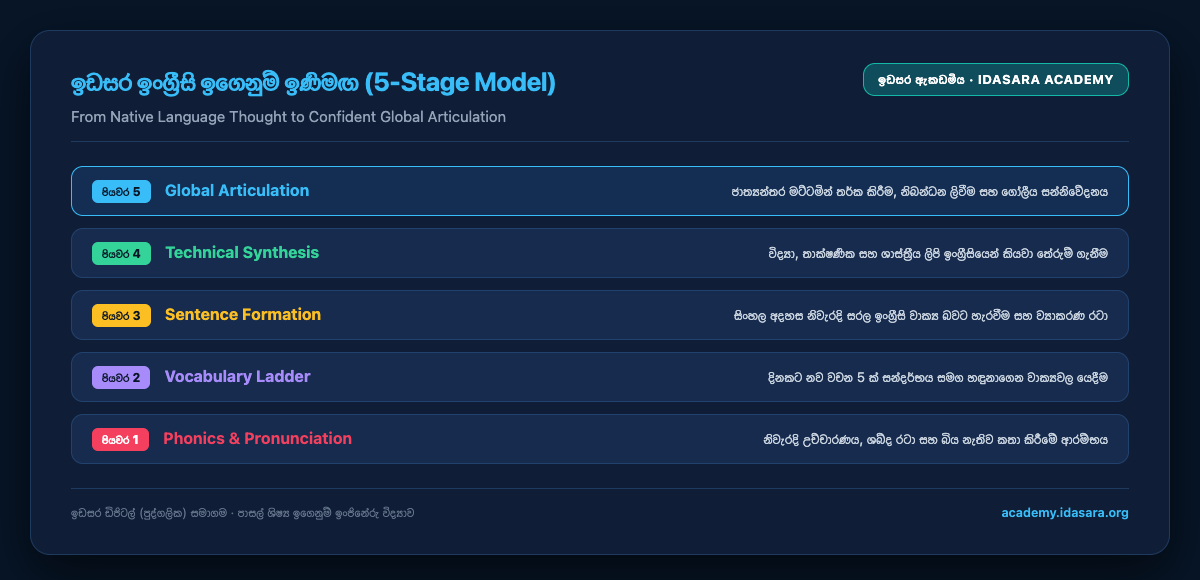
The logic of the ladder's five rungs shown in the figure:
The defining property of a ladder is that nobody leaps from the ground to the roof in one bound. The English Learn Ladder is the same:
- Standing on the mother tongue: your thinking is already strong in Sinhala or Tamil — accepting this dissolves the shame.
- A fear-free practice environment: there is no reason to be embarrassed in front of an AI; every mistake is a correction, never a humiliation.
- Guided correction: the error is shown, and why the correction is right is explained in your mother tongue — that is when the rule stays in memory.
- One idea at several levels: practicing the same thought in simple, standard, and academic forms teaches you to command the language's register.
- The independent summit: reading international textbooks, research, and technical documents on your own — this is what the ladder is for.
The practical method of climbing the ladder with AI:
-
The fear-free conversation: if you are shy to speak or write English, there is nothing to be shy about in front of an AI. Tell the AI this:
"I am a student learning English. I will talk with you in simple English. If my sentences have grammar mistakes or spelling mistakes, please do not scold me. Correct my wrong sentence, explain in Sinhala why the correction is right, and then ask me another question in English."
-
Turning your Sinhala thought into English: Write down the idea as it lives in your mind in Sinhala:
"Show me 3 ways to write this sentence in English — a simple way, a standard way, and an advanced academic way: 'If our country's youth are properly equipped with digital technology, the national economy can grow rapidly.'"
By this method, within months a child can lift their language capacity without fear — not just for the English exam paper, but to the level of reading international textbooks and research.
In the next chapter, we take on exam preparation itself: how to build the world's most successful study methods — Active Recall and flashcards — with AI.