03. AI for STEM: Mathematics, Science and Visualization
Core Theme: Science and mathematics are not a dry stack of equations to be memorized. They are the language that describes how the universe works. What AI can do is turn the lifeless equations on the page into living mental simulations inside your mind.
1. Beyond Dry Formulas: The Art of Seeing with the Mind (Conceptual Visualization)
Why do so many school students find A/L Combined Mathematics, Physics, or Chemistry so hard?
Picture a real tuition-class scene: a hall packed with 300 students, the teacher writes four projectile-motion formulas on the board and says, "Memorize these — they'll come in the exam." The boy in the back row copies them down; but when a ball is thrown into the sky, there is no picture whatsoever in his mind of what actually happens. In the exam, when the question arrives from a slightly different angle, he has no idea which of the four memorized formulas to choose.
The root cause is this: we are trained only to memorize formulas and substitute numbers into them. The real physical or geometric process behind the equation never becomes visible in the mind (no mental model).
But today, through modern multimodal AI tools (Gemini, Claude, ChatGPT), any complex abstract concept can be turned into a living example you can see with your mind's eye.
2. A/L Combined Mathematics: From the Classroom to the AI World
As we discussed in Core Module 02 (Neural Networks and LLMs), the mathematics you learn at school is the precise foundation on which the AI now shaking the entire world runs!
A. Matrices and Vectors:
- The school problem: most students multiply 2 × 2 or 3 × 3 matrices without knowing why — purely to collect exam marks.
- Real understanding with AI: ask the AI this:
"I am an A/L Combined Maths student. Explain to me, with a very simple step-by-step mathematical example, how Matrices and Vectors are used in real-world 3D computer games (e.g., GTA or FIFA) to rotate characters and change the camera view on screen."
- The result: you understand that matrix multiplication is not a numbers game — it is the magic tool that transforms spatial coordinates (3D space transformation) inside a computer.
B. Calculus — Differentiation and Integration:
- The school problem: many students have no clear picture of what dy/dx actually represents.
- Making it visible with AI:
"When a rocket is launched into the sky, how is differentiation used to describe how its velocity and acceleration change? And how is integration used to compute the total fuel the rocket has burned? Explain it graphically, so the picture draws itself in my mind."
3. Physics: Step-by-Step Mental Simulations
When most students see a physics problem, they panic and immediately hunt for a formula ($v = u + at$ or $F = ma$). But what a skilled physicist does first is visualize the scenario in the mind.
The practical physics prompt:
💡 The Physics Visualization Prompt:
"I am studying Projectile Motion in Physics. A ball is thrown from the ground at a velocity inclined to the horizontal. Describe its motion — from launch until it lands back on the ground — in 5 steps, like a film running in slow motion. At every step, show separately what happens to the ball's horizontal velocity, its vertical velocity, and the force of gravity. What I need is not the formulas but the physical logic behind them."
After a prompt like this, the image of a projectile at its highest point — vertical velocity momentarily zero while horizontal velocity glides on unbroken — is etched permanently into the student's mind.
4. Chemistry and Biology: Seeing the Molecular World
A. Chemistry:
- Le Chatelier's Principle: to understand how a chemical equilibrium responds when pressure or temperature changes:
"Explain Le Chatelier's Principle so a school student can grasp it, using the example of a swing rocking back and forth, or a crowded bus."
- Organic Chemistry: instead of memorizing reaction mechanisms, interrogate them live — how electrons strike from a region of high electron density toward a region of low density (electrophilic / nucleophilic attack).
B. Biology:
- Compare the biological synapse and the transmission of nerve impulses — which we discussed in Core Module 02 — against the diagram in your Biology textbook.
- Have the AI describe DNA replication, photosynthesis, and energy production in the mitochondria (ATP synthesis) as the operations of a miniature factory.
💡 The Biology Factory Prompt:
"You are the Idasara tutor teaching A/L Biology to the NIE syllabus. Explain ATP production inside the mitochondrion to me in 5 steps, comparing it to the operation of a power station. Conditions: 1. At each step, give the analogy first (what happens in the power station), then the scientific process, then the official textbook term. 2. After each step, ask me a short question to check that I understood, and move to the next step only after my answer. 3. Do not wander into deep biochemistry beyond the syllabus."
5. The Snap & Score Worked Example: Winning Method ($M$) and Accuracy ($A$) Marks
In school exams, students lose the most marks not because they cannot do the problem, but because of small, careless slips of attention (careless sign errors).
Picture a real case. An A/L Combined Maths student writes all six steps of a matrices problem correctly in the term test — and in the final line copies a $-2$ as a $+2$. Her conclusion is: "I just can't do this topic." But the truth is: she commands the method 100%, and what she lost was only the final accuracy mark. Until those two things are shown to her separately, she will waste her time re-reading topics she already knows — instead of training the real culprit, her attention.
Let us see how Idasara Academy's Snap & Score (Mark Papers) system checks the step marks of a mathematics problem, using a real example:
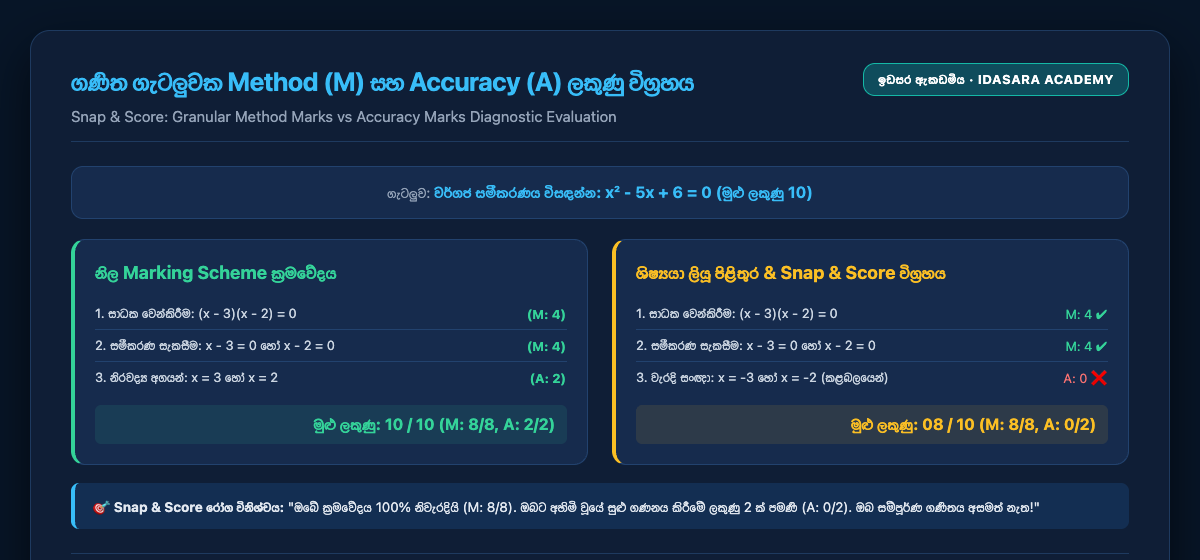
The mark-separation analysis shown in the figure:
- Method Marks ($M$): choosing the correct formula, the substitution, and the order of steps — the majority of marks in the Department of Examinations' marking scheme live here.
- Accuracy Marks ($A$): the final simplification, the sign, and the unit — small marks, but they demand attention.
- The diagnostic line: the system does not say "you are wrong." It says, with surgical precision: "The sign flipped in your line 6; your method is correct."
Because of this immediate diagnostic feedback, the student understands:
- that her method ($M$ marks) is sound — confidence is protected;
- that the one place demanding her attention is the sign-flip — the actual fault gets fixed.
6. Chapter Summary
- STEM subjects are not memorized formulas; they are the language for understanding the real world.
- Use AI to make matrices, vectors, calculus, and projectile motion come alive as pictures in your mind.
- Put your handwritten working through Snap & Score, and learn to tell your Method marks ($M$) apart from your Accuracy marks ($A$).
In the next chapter: how to learn History through reasoning instead of memorization, and how to conquer the English language barrier with Idasara Academy's "English Learn Ladder."