03. Solopreneurship and Freelance Micro-Agencies
Published 2026-09-14
Core Theme: "In the last era, starting a business required an office, a staff, and serious capital. Today, one young person can run a one-person digital agency — with AI agents and copilots as their virtual staff — and earn dollars globally."
Why selling hours is a trap
Traditional freelancing means selling your time at $5 or $10 an hour. The structural problem is not the rate. It is that the day you fall sick or take a holiday, your income is zero — and the better you get, the faster you finish, and the less you earn for the same work.
The AI-powered micro-agency model breaks that link. The work of five employees in a traditional agency — research, content writing, coding, client email, data processing — is executed by one person wielding AI tools at several times the speed. And crucially, you stop selling hours and start selling the value the client receives.
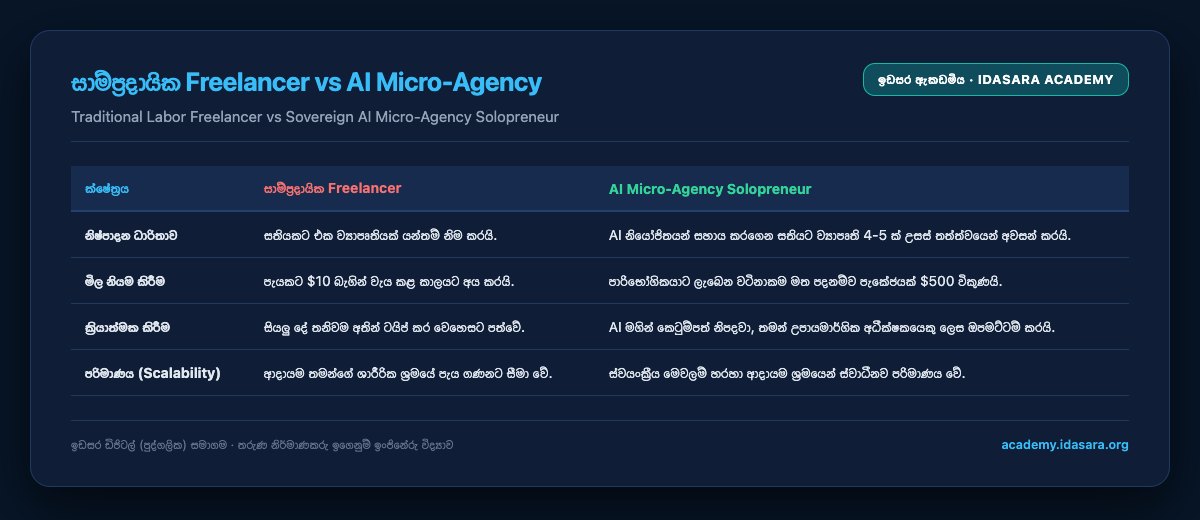 Figure 3.1: Traditional Freelancer vs AI Micro-Agency — the structural transformation from seller-of-hours to builder-of-value.
| Dimension | Traditional Freelancer | AI Micro-Agency |
|---|---|---|
| What is sold | Their time ($5–$10 per hour) | A finished solution / outcome (Rs. 45,000+ per package) |
| The team | Alone — income is 0 on a sick day | You + an AI staff (researcher, writer, coder, designer) |
| Time per project | Weeks | A few days — speed itself is a competitive weapon |
| Income ceiling | Capped by the 24 hours in a day | Multiple projects/clients at once — income decoupled from hours |
| Quality responsibility | A single human check | AI draft + mandatory human final inspection (your name is the guarantee) |
The last row is the one nobody mentions in freelancing advice. AI supplies the draft; your final inspection is what the client is actually buying, because your name is on the delivery. That check is not overhead subtracted from the speed gain. It is the product.
Ravindu's first Rs. 60,000
Ravindu, 21, from Kandy, studied English literature, applied to 40 vacancies and received no replies at all.
Switching to the micro-agency model, he did something specific. He listed ten guesthouses in Kandy's tourist zone with no website or a hopelessly outdated one. Then, for one of them and entirely unrequested, he used an AI coding assistant to build a modern demo landing page in one night.
His message the next day was short: "Here is a demo I built for your business — if you like it, I'll complete it and hand it over." The owner bought it for Rs. 60,000. Within six months, through referrals, he held three monthly retainers worth Rs. 150,000 a month.
Compare the two approaches. Forty applications asked forty employers to evaluate a claim and take a risk. One demo asked one owner to look at something already built for him. The second is not a cleverer pitch; it is a different transaction, and it was only possible because building the demo cost a night instead of a fortnight.
Four services you could start this month
These four command the highest demand on global marketplaces and among local business owners alike.
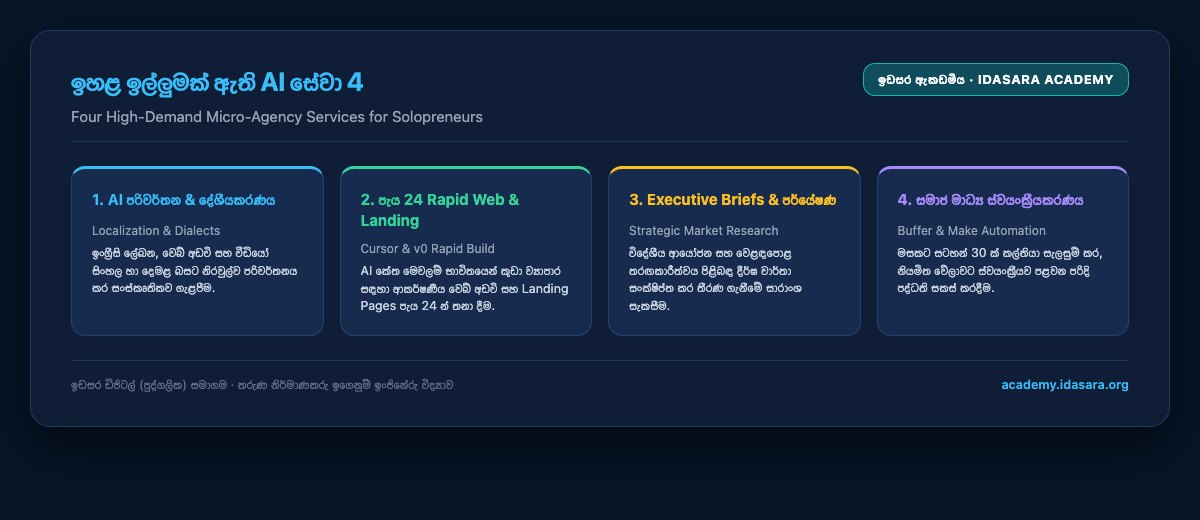
Bilingual translation and localisation. When global companies bring products to Sri Lanka or South Asia, there are cultural nuances raw machine translation cannot carry. AI produces the draft; polishing it until it sounds right to a local ear is the service, and it pays in dollars. Your first language is the qualification here — which reverses the usual assumption that it is a disadvantage.
Landing pages in 24 hours. A website that took three weeks can be built and delivered in a day with modern AI coding assistants. Speed itself is the selling proposition.
Business research and executive briefs. Executives at foreign companies have no time to read hundred-page reports. Distilling a precise brief in two hours earns premium rates, because what is scarce is not the information but the compression.
Social media automation. Producing a business's entire month — thirty posts and ten reels — in one weekend, scheduled to publish automatically. This pairs directly with the reel pipeline from Chapter 02.
How to win your first three clients
Most young freelancers fail by shouting into the void: I'll do any work, I can do anything. That message asks the client to figure out what you are for.
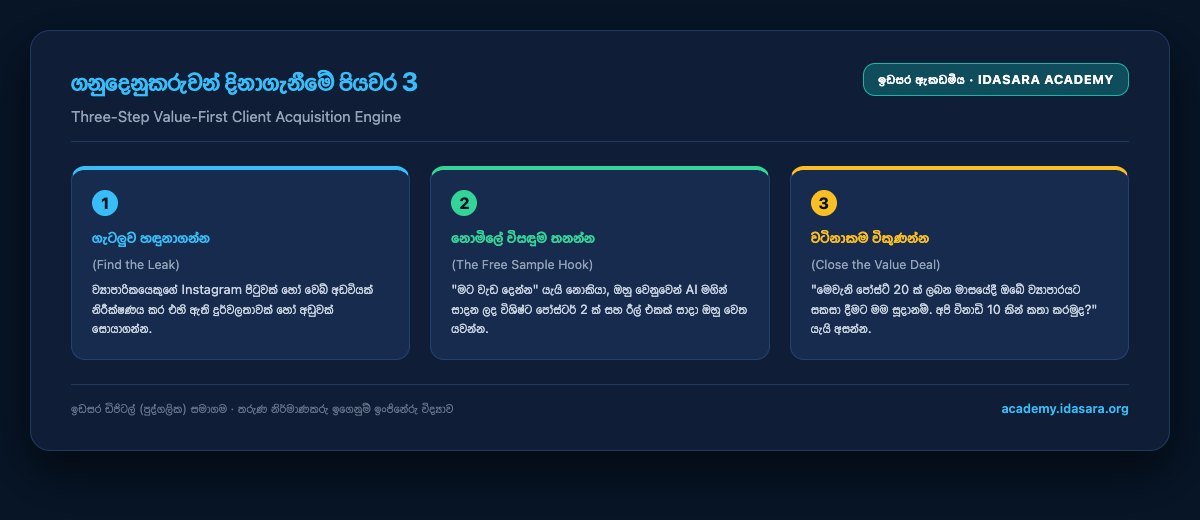 Figure 3.2: The Three-Step Client Acquisition — the 3 steps of the value-first outreach method Ravindu followed.
Step one: target a niche. Instead of anything for anyone, choose one business type — tourist guesthouses, dental clinics, tuition classes — and one service. List ten to twenty such businesses and note their visible gaps. A narrow offer is easier to say yes to, and the research you do for one prospect applies to all twenty.
Step two: build the free sample. For one business on the list, before being asked, build something small but tangible: a demo homepage, a rewritten menu, two reels. Three or four hours of investment.
Step three: lead with the proof. Not "give me work" but "I built this for you." And note the property that makes this strategy safe: even when rejected, the artefact joins your portfolio. No effort is ever wasted, which is not true of forty job applications.
The outreach message
💬 "You are a B2B sales communication expert. I am a young Sri Lankan freelancer. I have built [the artifact — e.g., a demo homepage] for [business name], unrequested. Write a short message the owner can receive on WhatsApp: 1. The first sentence must be an honest, specific compliment about their business (not a generic platitude). 2. Present what I built and the link to view it, simply. 3. Say nothing about price — ask only for 'a 10-minute chat if you like it.' Constraints: under 80 words. Absolutely no begging or submissive tone. No fake urgency ('buy today!')."
Three constraints in that prompt do the work. A specific compliment rather than a platitude, because owners can tell the difference instantly. No mention of price, because raising money before interest kills the conversation. And no begging tone and no fake urgency — a message that reads as desperate or manipulative loses the client you were closest to winning.
When you create and show real value up front, rejection becomes genuinely difficult for the client.
Important
Inspect everything you hand a client with your own eyes. AI is a confident intern — it will, without hesitation, embed a cultural blunder in a translation, a broken link in a web page, or a completely fabricated statistic in an executive brief. The client is not paying AI; the client is paying your name and your responsibility. The trust you lose by delivering an unchecked artifact cannot be rebuilt by any AI tool.
Price the package, not the hour
Never price your work at "Rs. 1,000 per hour" or "$10 per hour", and the reason is arithmetic rather than ambition: when AI lets you finish the job in twenty minutes, hourly pricing means your income falls as your capability rises. You would be penalised for every improvement you make.
Productised packages remove that perverse incentive:
- "Complete social media branding package for local businesses: Rs. 45,000 per month."
- "Multilingual menu and website package for tourist hotels: Rs. 75,000."
The client does not care how long it took. They care about the outcome — and pricing the outcome aligns your interests with theirs, because faster delivery now benefits both of you.
Tip
Be honest about your AI use. "I work with AI tools — that's how I deliver this speed and this price; the final quality check and the responsibility are 100% mine." Saying this openly does not diminish you; it marks you as a professional who commands modern methods and can be trusted. Hiding your AI use — and having it discovered — costs ten times more in shattered trust.
In the next chapter, we tackle the single biggest barrier between young Sri Lankans and the international dollar market: conquering English-language fear, with the Idasara English Learn Ladder.