04. Global Digital Mobility and the Idasara English Learn Ladder
Published 2026-09-14
Core Theme: "The only bridge between a young Sri Lankan's talent and global dollar income is the English language. To work with an international client you do not need a Western accent; you need clear, precise, professional articulation — nothing more. Here we learn to cross that bridge with the Idasara English Learn Ladder and AI."
What is language fear actually costing?
Look honestly at the young people leaving Sri Lanka's schools, rural and urban alike. They carry outstanding technical skill, computer knowledge and creative ability.
And then an invisible wall: the English anxiety barrier. The fear of sending an email to a foreign client, or facing a Zoom call, keeps capable young people in local jobs at Rs. 20,000–30,000 a month — while young people of ordinary skill who happen to speak fluent English earn $1,500–$3,000, which is Rs. 500,000 to a million.
Note what that comparison actually measures. The gap is not a skill gap. It is a confidence gap, priced at twenty times the salary — which makes it the single most expensive fear in the Sri Lankan job market.
Thilini's Zoom call
Thilini, 23, from Galle, is among the most talented young graphic designers in the country. An Australian company saw her work and invited her to a Zoom interview.
She hid from that email for a week without replying. The fear — "if I speak my English, they'll laugh" — let a $1,200-a-month opportunity, about Rs. 400,000, pass by.
Here is the part worth being precise about, because it determines the remedy. Thilini did not lose that opportunity because she lacked English. She lost it because she had never had a fearless, judgment-free space in which to practise. Her English was very likely adequate for the call; what was missing was any evidence to herself that it was.
That space now exists, free, for anyone with a phone.
The English Learn Ladder
The Idasara English Learn Ladder is built to lift a young person educated in their mother tongue, Sinhala or Tamil, step by step, to global professional level. Four principles hold it together.
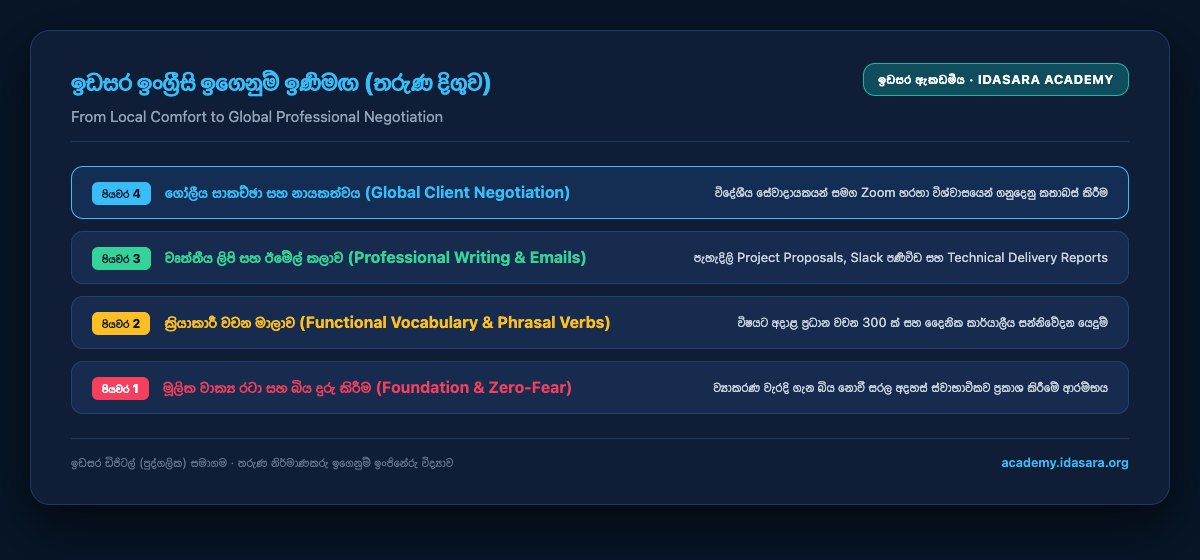 Figure 4.1: The Idasara English Learn Ladder (Youth Edition) — the step-by-step ladder lifting a young person educated in their mother tongue to global professional English.
Start where you stand. "I can't do English" is a myth — everyone is already on some rung. The ladder asks only that you identify today's rung honestly, set the shame aside, and climb one step. The shame is the real obstacle, and it is the first thing the ladder removes.
Communication before perfection. The goal is not passing a grammar examination; it is transmitting your idea clearly to a client. Imperfect but clear English is worth enormously more than silent perfection — and silence is what perfectionism actually produces, as Thilini's week of not replying shows.
Daily micro-practice. Fifteen minutes of conversation practice every day beats one two-hour class a week, because language pathways in the brain are built by frequency rather than duration.
Domain English. You do not need Shakespeare. You need the roughly 300 words of your own field — design, video, web, beauty — and about twenty client-conversation patterns. That is a target you can hit in weeks, which is a very different prospect from "learning English."
🔗 Study the complete ladder on the official site: https://academy.idasara.org/english-learn-ladder/
Using AI as a 24/7 language coach
Most people cannot bring themselves to speak English for one reason: the fear of being shamed in front of others. AI will never laugh at you and never judge you — which removes the only real barrier and leaves practice.
Speaking practice
Open a voice mode on your phone and give it this instruction.
💬 "I'm a young Sri Lankan. I want to practice my spoken English for conversations with foreign clients. Act as an American client and ask me simple questions. When I say something in broken English, understand what I meant, then kindly show me: 'Here's a more natural way to say what you just said.'"
The key phrase is understand what I meant, then show me a more natural way to say it. That is correction without rejection — the model works out your intent first, which is exactly what a patient human listener does and what a frightened speaker has rarely experienced.
Fifteen minutes a day of this builds, within about thirty days, the confidence to face an English conversation. Not perfect English. Confidence — which was the actual missing piece.
Polishing proposals and client emails
If writing in English is hard, write the idea in Sinhala or in broken English and hand it over.
💬 "Here is the note I wrote to send this client: [your note]. Edit it into polite, clear, professional corporate English. Then, pick the 3 most important changes you made, and briefly explain — in simple terms — why you made each one."
Tip
Not "fix it for me" — "fix it and teach me." The second sentence of that prompt is no accident. The young person who only gets AI to fix things remains dependent on AI forever; the one who learns the "why" behind every correction becomes an independent writer within 6 months. This is the standing theme of this whole book — the machine is your practice partner, not your replacement.
Rehearsing the interview
If Thilini's fear is your fear, the remedy is to have the conversation before you have it.
💬 "You are a project manager at an Australian digital agency. You are interviewing me for a freelance [your field — e.g., Graphic Design] position. 1. Ask questions one at a time, exactly like a real interview — never reveal the next question until I've answered. 2. After each answer give me: (a) the strongest part of my answer, (b) a more natural way to phrase it, (c) my score out of 10. 3. At the end, summarize the 2 weaknesses I most need to practice."
Two details make this a real rehearsal rather than a quiz. Questions come one at a time with the next one hidden, so you experience the pressure of answering without preparation. And each answer gets three things back — the strongest part, a more natural phrasing, and a score — which means you leave knowing specifically what to fix rather than feeling generally inadequate.
Run this three times before a real call and the call stops being the first time you have done it.
Where the global work is
Once your skills and your English are ready, four gateways lead to clients anywhere.
Upwork and Fiverr are the beginner's route: collect reviews through small assignments at $50–$200, where the reviews matter more than the money.
Contra and Toptal are commission-free global platforms for top-tier creators and engineers — worth moving to once you have proof of work.
LinkedIn cold outreach means messaging foreign startup founders directly with value, exactly as Chapter 03 describes. This is the highest-leverage channel, because you are not competing on price against a marketplace.
RemoteOK and Wellfound list full-time remote positions at $1,000–$3,000 a month.
Receiving dollars safely in Sri Lanka
Wise and Payoneer are the simplest digital accounts for receiving payments from foreign clients.
Local PFC and RFC accounts let you credit foreign-currency earnings directly to a foreign-exchange account at a recognised Sri Lankan bank — Commercial, Sampath, HNB and others.
And route it legally. Digital earnings arriving as foreign remittances bring dollars into the national economy, and using formal channels is what makes your income visible as income.
Important
Every dollar you earn is national service. A digital services exporter can bring foreign exchange into the country from a home in Galle or Batticaloa — without leaving their family for a Middle East job. Routing it through legal banking channels is a triple investment at once: in your credit record (for the day you need a bank loan or a lease), in your professional standing, and in your country's economy.
That first item is the one young freelancers underestimate. Cash received informally cannot be shown to a bank, which means it cannot support a housing loan or a lease however much of it there was. A documented income history is an asset you are building whether or not you notice.
In the next chapter, we face the financial reality of young people who enter the workforce straight after their O/Levels — Kavi's real working life, and the money management that turns a first job into a career.