05. Financial Literacy, Direct Workforce Entry, and the Career Ladder
Core Theme: "Your growth does not stop just because school did. Even a young person forced by family hardship into a job at 17 can — with sound financial literacy, customer-service skill, and digital learning — become an independent entrepreneur within a few years. Here is Kavi's real-life journey."
1. Sri Lanka's Invisible Majority: Direct Workforce Entry
Our country's traditional education policy speaks only about the top 10% who reach university. But what is the truth?
- Of the 300,000+ students who sit the G.C.E. O/Level exam (the national exam at roughly age 16), 30–40% proceed to no further education at all — for reasons like these:
- The family economy collapses (a father's sudden accident or job loss).
- A mother's income from selling lunch packets or casual work cannot sustain the family.
- The Rs. 30,000 a month demanded by A/Level private tuition is simply unaffordable.
- At 17, they must earn — so younger brothers and sisters can stay in school.
No country can move forward while abandoning these young people. Idasara Academy's vision is to be the one digital education system that stays with a young person even where school stops.
2. Kavi's Tuesday: From the Salon to a Digital Future
Consider the real story of Kavi, a 17-year-old we met in our research:
- Her father's three-wheeler was in an accident; he can no longer drive.
- Her mother's income cannot cover even the family's food.
- Kavi has no money for A/Levels or an NVQ vocational course.
- She joins her aunt's salon as a full-time assistant — Rs. 8,000 a month plus small tips.
Kavi works hard from 6 a.m. to 3 p.m., finishes the housework in the evening, and at 7:30 p.m. picks up her phone. She opens the Idasara app.
There is no textbook syllabus on Kavi's screen. Instead, the Employability Stream runs — matched to her actual life:
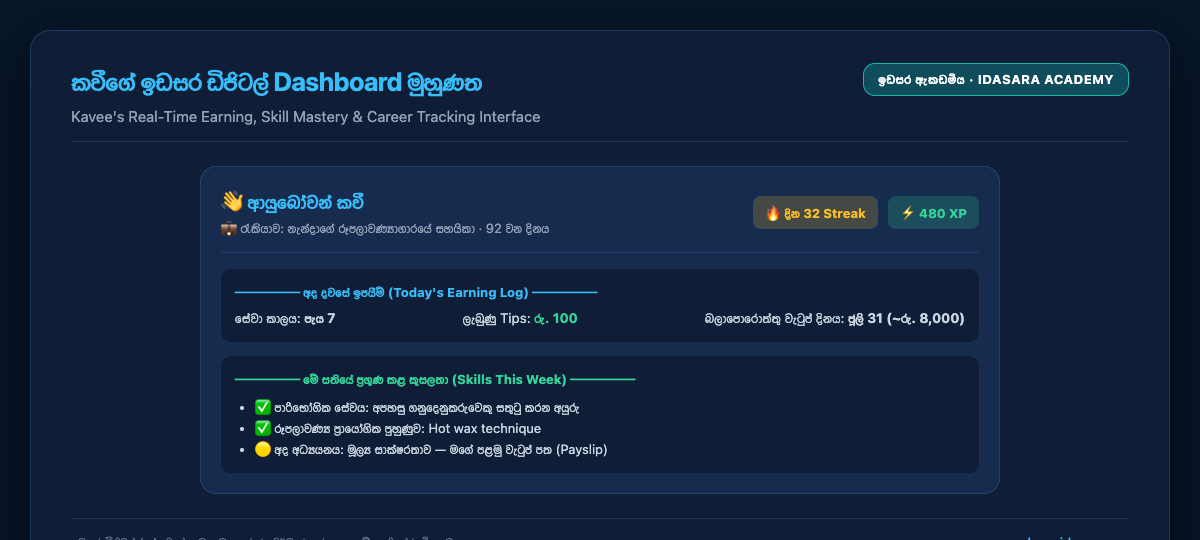 Figure 5.1: Kavi's Idasara Mobile Dashboard — a learning interface built for the real life of a directly employed young woman.
Figure 5.1: The Dashboard Dissected
Kavi's screen is not a digital copy of a school classroom — it is a ladder she climbs from inside her own job:
- Customer Service skills: How to calm an angry customer; how to politely reschedule an appointment — lessons she can use at the salon tomorrow morning.
- Digital Marketing basics: Promoting services through WhatsApp Status and Instagram — not theory, but actions her own hands can take.
- Cash Management discipline: From logging the day's tips to hitting a monthly savings target.
- The progress indicator: Modules completed and the next skill within reach — not tuition-class "marks," but rungs of a life.
3. Financial Literacy: "My First Payslip"
The majority of young Sri Lankans in employment do not correctly understand their own payslip. Many lose EPF rights they are legally owed.
Here is the foundational financial truth Kavi learns through Idasara:
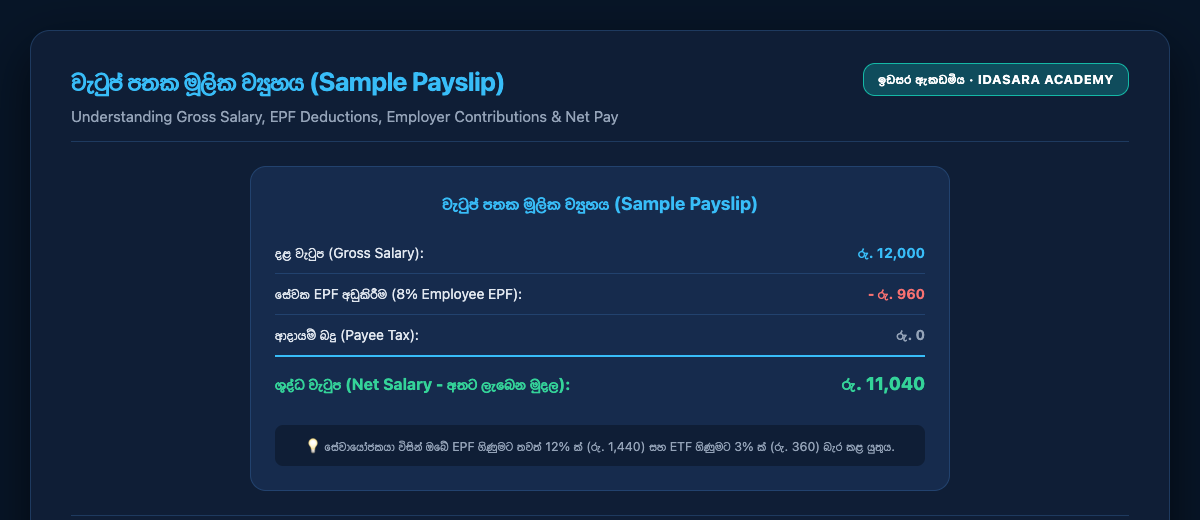 Figure 5.2: Sample Payslip Breakdown — the structure of a Sri Lankan payslip and your legal entitlements.
Figure 5.2: The Payslip Dissected
- Gross Salary: The full amount the employer agreed to pay you.
- Employee Provident Fund (EPF — 8%): 8% of your gross salary is deducted. This is your money, not the company skimming you — it returns to you with interest at retirement. It is your absolute right.
- Employer contributions (EPF 12% + ETF 3%): On top of that, the employer must pay — from their own funds — another 12% into your provident fund and 3% into the Employees' Trust Fund (ETF). (EPF and ETF are Sri Lanka's mandatory retirement and trust funds for private-sector workers.)
- Net Salary: What actually reaches your hand or bank account after deductions.
The Practical Calculation: Kavi's Second-Job Payslip
A year later, when Kavi joins a reputable town salon as a registered employee at a gross salary of Rs. 25,000, her payslip math must look like this:
| Item | Calculation | Amount |
|---|---|---|
| Gross salary | — | Rs. 25,000 |
| Employee EPF deduction | 25,000 × 8% | (Rs. 2,000) |
| Net salary in hand | — | Rs. 23,000 |
| Employer EPF credit | 25,000 × 12% | + Rs. 3,000 (to her EPF account) |
| Employer ETF credit | 25,000 × 3% | + Rs. 750 (to her ETF account) |
So although Rs. 23,000 reaches her hand, Rs. 5,750 a month (2,000 + 3,000 + 750) is being banked in her name for the future — a hidden asset of Rs. 69,000 a year!
Important
"We'll pay cash-in-hand, no EPF" is theft — from you. Under Sri Lankan law, if you are a registered employee — even in a one-employee business — EPF/ETF contributions are the employer's legal obligation. The young person who accepts "a little more salary, without EPF" stands empty-handed at 55. You have the full right to check your EPF balance with the Department of Labour.
With this knowledge, Kavi gains full confidence about her financial rights.
4. Kavi's Career Laddering Model
Must Kavi wash tea cups in her aunt's salon at Rs. 8,000 forever? No!
Through the Idasara Career Explorer, here is the career progression ladder in front of her:
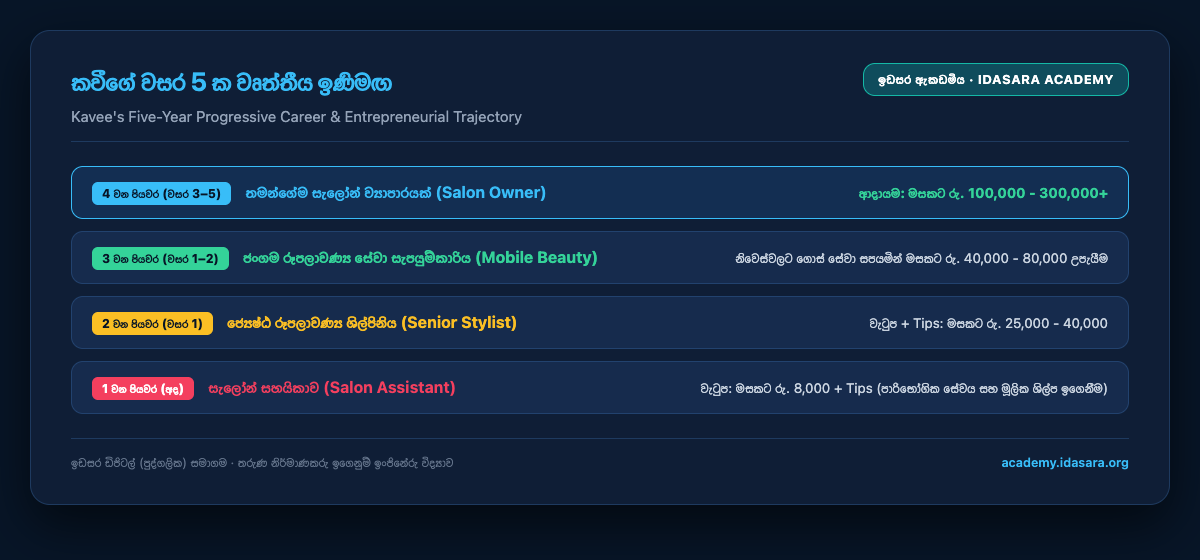 Figure 5.3: Kavi's Five-Year Career Ladder — the staircase from Rs. 8,000 assistant to independent entrepreneur.
Figure 5.3: The Economic Logic of the Ladder
Understand each rung financially: from the assistant's Rs. 8,000, through the skilled worker's Rs. 25,000–35,000, to the day she becomes a Mobile Beauty entrepreneur with her own client list — when her income is no longer set by an employer but by her own service quality and clientele. In a market where one bridal dressing assignment pays Rs. 15,000–50,000, four weddings a month is several multiples of a salon salary. The ladder's secret: on every rung, learn the skill the next rung requires — while standing where you are.
Kavi sets her goal: "launch a Mobile Beauty service within a year." For that she needs:
- The art of talking with customers (Customer Service).
- The basic digital ability to promote her services on WhatsApp and Instagram (Digital Marketing).
- The discipline of collecting and saving money (Cash Management).
Kavi's AI Toolbox: Two Instant Prompts
Even with only O/Level qualifications, Kavi can use these practical prompts today, on a free AI tool on her phone:
💬 Monthly Budget Plan: "I'm a 17-year-old earning a salary of Rs. 8,000 a month plus about Rs. 4,000–6,000 in tips. My daily travel costs Rs. 150. I want to save Rs. 50,000 within 2 years (for A/Level exam fees). 1. Build a simple budget that fits my monthly income (expenses, savings, the share I give my family). 2. Since tip income varies, also give me a 'minimum savings' plan that works even in my worst month. 3. Show everything in simple language, as a table."
💬 WhatsApp Business Promotion: "I'm a young woman who just started a Mobile Beauty service. Write 3 WhatsApp Status messages introducing my at-home service for weddings and parties, aimed at customers across 3 villages. Constraints: each under 40 words. No exaggerated pricing claims. Unprovable claims like 'the best in Sri Lanka' are banned. Use warm, neighborly language a village mother would trust."
5. The Door Back into Education (The Re-Education Savings Goal)
Kavi sets one more beautiful goal:
"Register as a private candidate for the A/Level exam within 2 years." To cover the exam fees and books — Rs. 50,000 — she sets aside Rs. 2,500 a month.
The world does not close on a young person whose schooling stopped. When you invest part of what you earn back into your own knowledge, the door to mainstream education reopens — any day you choose.
In the final chapter, we declare the creed of the young person who builds a country instead of queuing for a job — The Builder's Manifesto — and the Idasara youth vision.