01. The "Learn to Learn" Superpower
Core Theme: "The illiterate of the future are not those who cannot read or write; they are those who cannot learn, unlearn, and relearn. Here is the learning formula for mastering any new digital skill in 4 weeks — using AI, and depending on no institution's certificate."
1. The Collapse of Credentialism
For decades, traditional society told every young person the same story: "Get into a university, spend 4 years on a degree — or buy a paper diploma from an institute — and your life will be secure."
But what is actually happening in the world today?
- The shrinking half-life of skills: Much of the technical content taught in a university today is completely obsolete by the time the student graduates — four years later.
- Real ability beats paper: Google, Apple, Microsoft, OpenAI, and the world's fastest-growing startups have dropped degree requirements for hiring. What they ask for instead is proof that you can do the work.
- The arrival of AI: The coding syntax or graphic-design technique you would spend a year learning at university, AI can now produce in 5 seconds.
Dinuka's Crossroads: The Pain of Two Decimal Points
Consider Dinuka, 19, from a village near Kurunegala. He passed his A/Levels in the maths stream well — but missed the university entrance cutoff by a Z-Score gap of 0.02. (In Sri Lanka, university admission is rationed by a standardized Z-Score; a miss of two-hundredths ends the state university path, full stop.) His family cannot afford a private IT degree, which costs Rs. 400,000–800,000. In the eyes of the village, he is a "failure."
After 8 months adrift at home, Dinuka understood the newest truth of this world: the university gate may close, but the gate of knowledge now never does. He made AI his personal mentor and, at 2 hours a day for 4 weeks, mastered video editing and motion graphics. Today he produces social media videos for 3 local businesses and earns Rs. 90,000 a month — still, technically, "a young man without a degree."
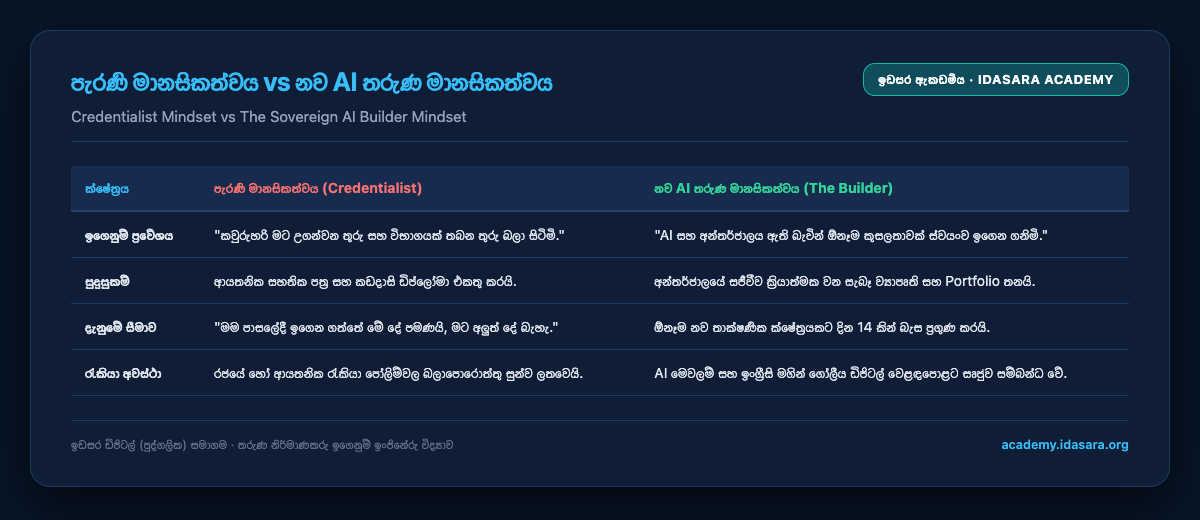 Figure 1.1: Credentialist vs Builder — the old mindset waiting in the certificate queue versus the new creator mindset building skills independently with AI.
Figure 1.1: The Two Mindsets Dissected
| The Credentialist Mindset | The Builder Mindset |
|---|---|
| "I need an institution to teach me." | "I need an AI mentor and 2 hours a day." |
| Measures worth by certificates on the wall. | Measures worth by products built (the portfolio). |
| Waits 4 years, graduates with obsolete knowledge. | Masters the market's most-wanted skill in 4 weeks and earns from it today. |
| Waits to be "given" a job. | Finds a problem and builds the solution to show. |
The greatest superpower you can acquire while young is the ability to learn anything new, by yourself, at speed — Learn to Learn. This is the heart of Idasara Academy's entire educational philosophy.
2. The 4-Week Self-Learning Engineering Framework
Suppose you want to master a modern digital skill from scratch — UI/UX design, Python data analysis, SEO content writing, or video editing.
Here are the 4 scientific steps for mastering it in 4 weeks, with AI as your personal professor:
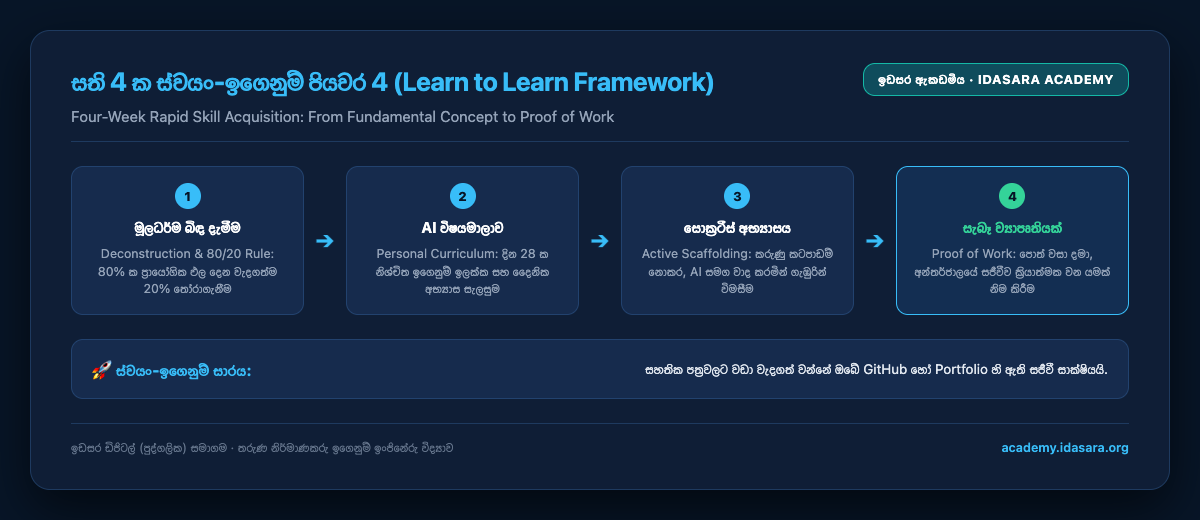 Figure 1.2: The 4-Week Self-Learning Loop — a week-by-week self-learning cycle built on the Pareto principle.
Figure 1.2: The Engineering Behind the 4-Week Cycle
- Week 1 — The 20% Core: By the Pareto principle (the 80/20 rule), roughly 20% of any subject's concepts generate 80% of its results. In week one, you have AI identify those 5 core concepts and you internalize them one by one through simple analogies — not memorizing words, but grasping the why and the how.
- Week 2 — Guided Practice: Turn every concept into a small exercise, do it with your own hands, and resolve every mistake in conversation with AI.
- Week 3 — The Real Project: Leave the tutorials entirely and start your own creation that solves a real problem. Here you will hit a wall of things you "don't understand" — every one of them is a golden moment of genuine learning.
- Week 4 — Ship & Publish: Polish the project and publish it where the world can see it (portfolio, GitHub, social media). An unpublished creation is a creation that does not exist.
Important
What does "learned" actually mean? Watching a video or reading an AI answer teaches you nothing. You have truly learned something only on the day you can do it with your own hands, unassisted — and explain it in plain language to someone else. If you can do neither, you are still inside the Illusion of Competence.
3. How to Build Your Personal AI Curriculum
To avoid getting lost on a blank screen when starting any new subject, use this prompt to get a 4-week learning plan from AI:
💬 Learning Plan Prompt Blueprint: "You are a world-class instructional engineer. I want to practically master [subject to learn — e.g., Generative AI Video Editing and Storytelling] from scratch within 4 weeks. I can commit 2 hours per day. 1. Using the Pareto principle (80/20 rule), name the 5 most important concepts I must master. 2. Build a curriculum with specific weekly milestones and hands-on exercises for all 4 weeks. 3. For the final week, propose a real-world capstone project I can add to my portfolio."
What you gain:
Without paying an institution hundreds of thousands of rupees, you receive — in 30 seconds — a learning plan more practical and more precise than the curriculum of a world-class university.
When You Get Stuck: The Socratic Tutor Prompt
When you hit something you don't understand, demanding "give me the answer" is intellectual laziness. Instead, turn AI into a teacher who questions you:
💬 Socratic Learning Prompt Blueprint: "You are a patient Socratic tutor. I am learning [subject — e.g., JavaScript functions] and here is what I don't understand / where I went wrong: [paste the problem or your failed attempt]. Rules: 1. Never give me the full answer directly. 2. Ask me simple questions, one at a time, so that I discover my own mistake. 3. At each step, confirm whether my answer is correct before moving to the next question. 4. At the end, give me a similar exercise I must solve entirely on my own."
Because the answer emerges from your own mind, it is never forgotten. This is the essence of the Idasara Learn to Learn philosophy — AI is not an answer-dispensing machine; it is a personal tutor worth a fortune, whose job is to sharpen your thinking.
4. Defeating "Tutorial Hell"
What is the single biggest mistake young people make when learning online?
- They passively watch hundreds of YouTube videos for hours.
- They buy online courses (Udemy, Coursera) one after another and just… watch.
- But they never build anything new with their own hands!
Education science calls this Tutorial Hell. While watching a video, the brain believes it has learned everything (the Illusion of Competence). But the moment you try to do it alone, nothing works.
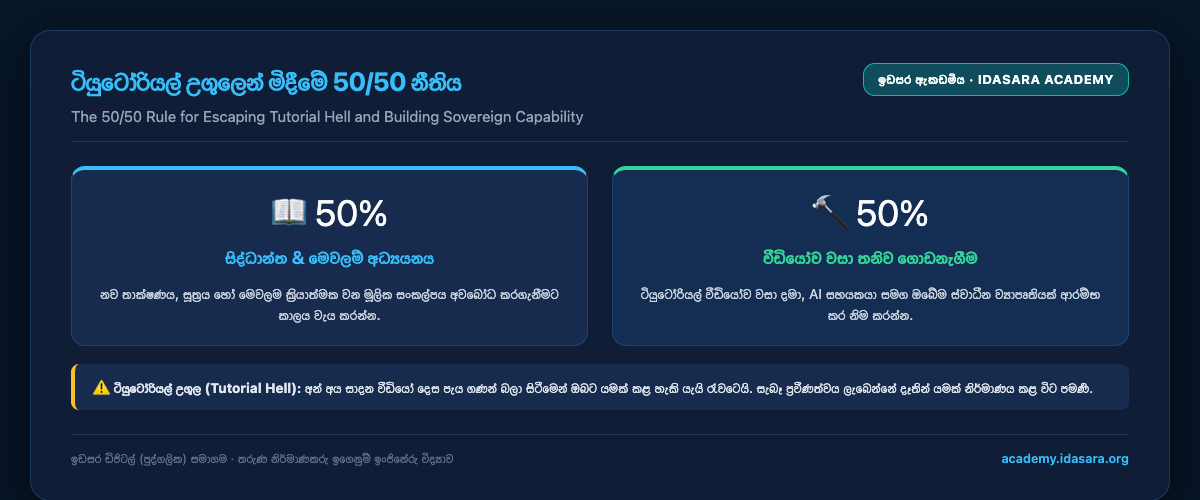 Figure 1.3: The Tutorial Trap & The 50/50 Rule — the passive-watching trap, and the 50/50 discipline that breaks it.
Figure 1.3: How the 50/50 Rule Works
The simplest discipline for escaping tutorial hell: out of every hour you devote to learning, no more than 30 minutes may go to watching or reading. The remaining 30 minutes must go into building something with your own hands.
- 50% — Input: Watching videos, reading articles, asking AI to explain concepts.
- 50% — Output: Writing code, creating, solving exercises, debugging your own mistakes.
You only truly learn when your hands produce mistakes — and you work through those mistakes with AI!
Warning
The Sycophancy Trap: AI tools constantly flatter you — "What a brilliant idea!" Hearing sweet words does not make you skilled. AI is like a confident intern: it delivers wrong information with the same polished confidence as right information. Verify every important thing you learn through action — run the code, publish the creation, observe the result.
5. The Practical Edge: Proof of Work
When you go looking for a job tomorrow, or message a freelance client:
- Sending a 4-page CV achieves nothing.
- Instead, show this: "Here is the website I built with AI tools. Here is the video ad I produced. Here is my code repository (GitHub link)."
What does a young person hold after running the 4-week cycle 3 times? Three months later: a portfolio of 3 working, real-world artifacts. While the graduate faces the universal "no experience" problem even after 4 years, you present direct evidence.
Tip
Start today — for free: All of this requires only a smartphone or an ordinary computer and a free AI account. An expensive course or gadget is no longer an excuse. Tonight, use the Prompt Blueprint above and generate your first 4-week curriculum.
The world does not honor people who talk. The world honors people who build.
In the next chapter, we explore how to earn dollars from images, audio, video, and content inside one of the largest income engines of the modern world — the AI Creator Economy.