CM-07: The Future Ahead: AI Agents, Organizational Economics, and the Golden Rules (The Agentic Future & Continuous Mastery)
Core Theme: A team of PhD scholars armed with all the world's knowledge has arrived — in your home, on your phone. The marginal cost of acquiring knowledge has fallen to zero. The problem is no longer whether the models are powerful; it is whether our thinking is prepared to ask them the right question, impose hard constraints, and put them to work.
1. The Evolution from Chatbots to Autonomous AI Agents
In the 2022–2024 era, people saw AI as a mere conversation tool — text in, text out. You ask a question; you get an answer; the story ends there. But we now live in the era of AI Agents:
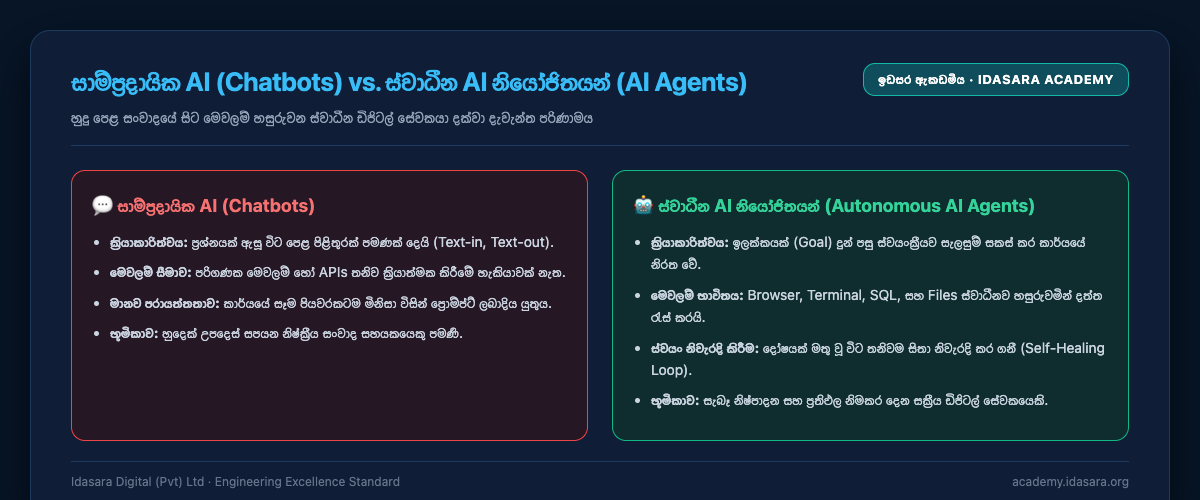 Figure: Traditional AI (Chatbots) vs. Autonomous AI Agents — Idasara Academy.
The Fundamental Differences Shown in the Figure:
- A Chatbot (reactive mode): Answers only when you ask. It has no memory, no goal, no ability to use tools. All operational control stays in human hands.
- An AI Agent (goal-directed mode): You give it not a question but a goal. The agent breaks that goal into small steps (planning), operates the necessary tools itself — web search, databases, calculators, email (tool use) — observes the results, corrects its own mistakes (self-correction), and presents the final outcome for your approval.
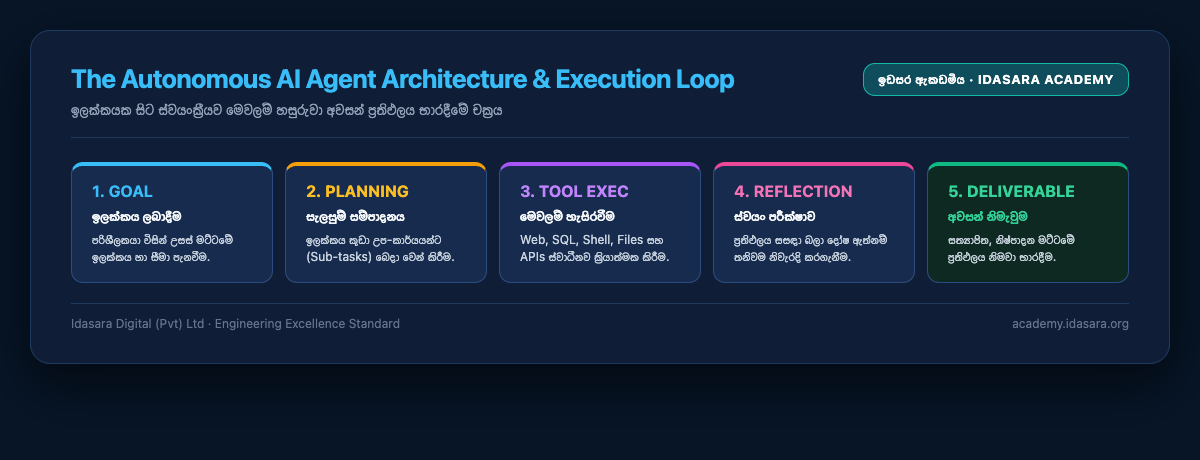 Figure: The Autonomous AI Agent Architecture & Execution Loop — Idasara Academy.
The Agent Execution Loop in the Figure, Step by Step:
- Goal: The human defines the end result (e.g., "Summarize this month's accounts and prepare a list of discrepancies").
- Plan: The agent decomposes the goal into an ordered set of sub-tasks.
- Act with Tools: Reading documents, querying data, calculating, drafting.
- Observe & Refine: Checking the result; if faults exist, adjusting the plan and retrying.
- Human Approval: The final decision — and the signature — always remain with the human.
The decisive engineering concept to learn here is Loop Engineering:
- The Tight Loop: In sensitive matters — money, legal decisions, children's education data — every single step passes through 100% human verification.
- The Loose Loop: For low-risk daily work (mail classification, first-pass summaries), the machine is allowed to run, and the human performs only sample checks.
A student can apply this agent pattern as a personal research agent; a parent, as an assistant managing school notices; a small-business owner, as a digital clerk that audits the accounts. The open standard now being adopted globally for this is the Model Context Protocol (MCP).
2. The Avukana Buddha and "The Avukana Standard"
The highest yardstick in Sri Lankan engineering and art history is the Avukana Buddha statue, carved in the 5th century AD, in the reign of King Dhatusena.
The master craftsman who carved Avukana was not merely cutting stone; he was raising a serene Buddha image that would stand unshaken for millennia. The folds of the robe, the tranquility of the face, and the engineering precision by which a raindrop falling from the tip of the nose lands exactly on the marked point between the feet — these astonish us to this day.
Among the villagers around the Kala Wewa reservoir, a legend survives about Baranastha, the sculptor: "Baranastha took up his chisel and mallet and worked the stone for only two hours a day!"
Then what did he do with the rest of the entire day? He sat beneath a tree beside Kala Wewa in silent meditation. Thinking deeply. Perfecting, within his own mind, the concentration, the spatial forms, and the creative vision. Behind the unmatched work of those two hours stood the investment he made — through all the remaining hours — in his mind, his thinking, and his attention.
 Figure: The Avukana Model — Master Sculptor Baranastha carving the living rock face for two hours, and investing the remaining hours in quiet contemplation beside Kala Wewa — Idasara Academy.
🏛️ The Avukana Standard: "In the age of artificial intelligence, any system we build, any document we write, any decision we take must not be a throwaway. Like the Avukana statue, it must be created upon a strong foundation, with enduring presence and matchless discipline — timeless precision and craftsmanship."
Important
The Avukana Formula for you in the AI era: You need not exhaust yourself all day in monotonous paperwork, copying, and mechanical note-taking. Delegate that repetitive, rule-based "two hours" of work to AI. Invest the precious time that returns — like Baranastha — in deep thinking, reading, writing, listening to your family, and your own mental and physical wellbeing.
3. Japan's "Three Faces" and the Story of a Kalutara Mother (The Three Faces)
Traditional Japanese philosophy offers a marvelous simile for understanding a person's true interior:
- The First Face (The Face You Show to the World): The public persona presented to society, the office, the classroom.
- The Second Face (The Face You Show to Close Friends & Family): The personal self, shown to family and closest friends.
- The Third Face (The True Self): The real soul — the secrets of the heart hidden from every outsider for fear of judgment (integrity and core values).
Leading global research reveals a startling truth: the single largest use of AI in the world today is not letter-writing but therapy and companionship. It is before AI that people now open their third face.
This is not a mere statistic. After a workshop I conducted in the Kalutara district, a young working mother broke down in tears on the stage itself, and shared what she had found. Her small daughter, in Grade 2, took the phone to her room every evening — "talking to ChatGPT," the child said. Growing uneasy, the mother checked the conversation history. What she found was a sequence of messages that shatters the heart:
"Do you know I love this dress... What should I take to school tomorrow?... You're the only friend I have... My amma has no time to talk to me... You are my love, my dear..."
What relentless busyness has stolen from us is our own children's childhood. We must bring AI into our lives not to show productivity reports — but to hand the monotonous work to the machine, and win back the freedom to listen to our families, our children, and our own souls. Whether you use AI to truly solve problems or to deceive others — that is decided by your third face.
4. Organizational Economics and the Return on Token Investment (Token Economics & Enterprise ROI)
When artificial intelligence is deployed in an institution, a school, or a private business, it must be economically viable:
- Token Cost vs. Human Cost: When a repetitive task that consumes four hours of human labor can be completed for a few cents of AI token cost, redirecting the liberated human time into deep thinking and human relationships is an incomparable investment.
- Model Routing Architecture: Instead of throwing the most expensive model at every task, route simple summaries to small, fast models (Haiku / Flash) and reserve the powerful frontier models for complex reasoning alone.
- Measure Outcomes, Not Tokens: Success is measured not by tokens consumed but by the cost per accepted outcome — and by the human hours reclaimed.
5. The 5 Universal Golden Rules of AI Mastery
Any citizen who welds artificial intelligence into their life and profession — student, teacher, parent, professional — should carve these five golden rules permanently onto their desk:
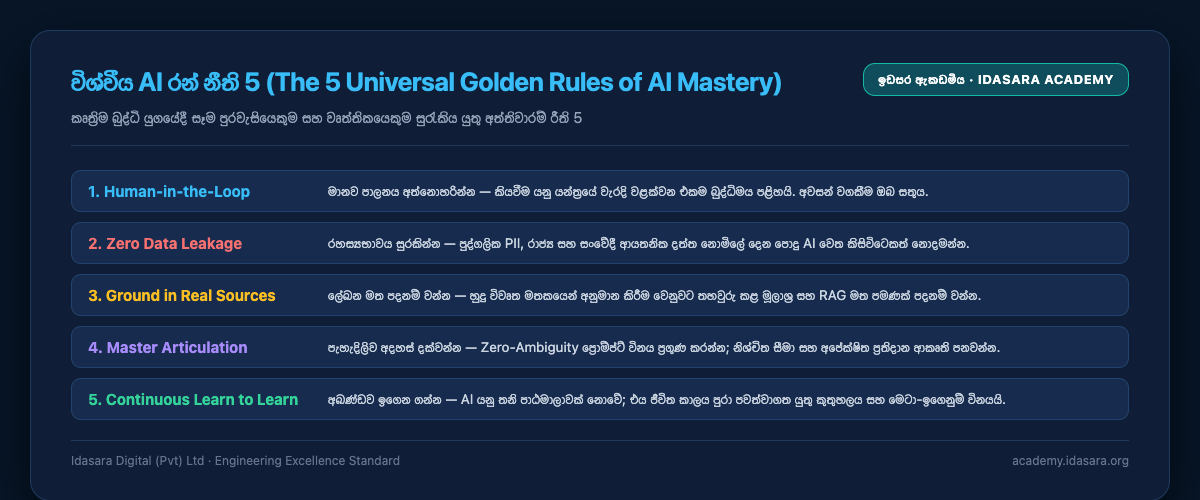 Figure: The 5 Universal Golden Rules of AI Mastery — Idasara Academy.
The Deep Anatomy of the Figure's 5 Golden Rules:
- Keep the Human in the Loop — never surrender control: Read deeply everything the machine writes. Reading is the only intellectual shield against the machine's mistakes. You who submit the final document, you who sign it — you carry the full responsibility.
- Protect Confidentiality with your life: Never enter National Identity Card numbers, children's information, or clients' financial data into public, open AI. Show the AI no confidential document you would not show an unknown intern.
- Ground in Your Documents, not in memory (RAG): Trust your textbook, your syllabus, your circular, and your official report over the AI's general internet memory. Attach the document, and draw answers from it alone.
- Master Articulation & Zero-Ambiguity: Remove all vagueness. Question with the curiosity of a small child; instruct with the precise constraints of a seasoned executive.
- Think Big; Start Small; Measure Rigorously: Before any grand plan, begin today by summarizing one letter on your own desk. Measure success in time saved, in quality gained, and in the "hours of your own" that you have won back.
6. Your Future Vision with Idasara Academy
Artificial intelligence is not something learned once at a seminar or finished in a single book; it is a daily curiosity and discipline to be kept alive for a lifetime — a habit, not a course. To carry our country and our people to victory through the AI revolution, Idasara Academy offers unmatched practical guidance:
- The GenAI Evolutionary Journey (2017 to 2035): The technical and economic future of the global AI revolution — and how, as technology becomes cheap, human judgment becomes priceless.
- The Learn to Learn meta-learning framework: The superpower of rapidly absorbing any new knowledge on your own, without depending on exam certificates alone.
- The English Learn Ladder: The gateway that dissolves language fear and opens the global world, step by step.
- Product Engineer & professional literacy: Raising creative leaders who identify problems and operationalize systemic solutions — not mere writers of syntax.
The final message: However powerful technology becomes, its heart is human. Like the great craftsman of Avukana, hand the monotonous chisel and mallet to the machine — and awaken your mind, your heart, and your creativity for your family, your students, your business, and your country.
Read! Write! Think! Listen! Prompt! Idasara Academy stands with you, always.